Tag Archives: wynne godley

Books In Honour Of Wynne Godley

There are two new books in honour of Wynne Godley and they are out now

The first one – edited by Marc Lavoie and Gennaro Zezza – has selected articles and papers by Wynne Godley, and carefully chosen.

It’s available at amazon.co.uk, but not yet on amazon.com

Here’s the book’s website on Palgrave Macmillan. The book also contains the full bibliography of Godley’s papers, books, working papers, memoranda (such as to the UK expenditure committee), magazine/newspaper articles, letters to the editor etc.

Here’s a picture I took of Marc at Levy Institute in May when he was deciding on the cover.

The is second book written in honour of Wynne Godley contains proceeding of the conference held in May at the Levy Institute (the same place the above photograph was taken)

The publisher’s website for the book is here.

Dimitri says:

The death of Wynne Godley silences a forceful and very often critical voice in macroeconomics. Wynne’s own strong view, that although his work was representative of the non-mainstream Keynesian approach to economics and especially economic policy was important nevertheless, has been confirmed time and time again as evidenced in the fortunes of the UK, US and Eurozone economies. His writings, reflecting the sharpness of his mind and intellectual integrity, have had a considerable impact on macroeconomics and have aroused the interest of scholars, economic journalists and policymakers in both mainstream and alternative thought. In a review of Wynne’s last book with Marc Lavoie (2007), Lance Taylor had this to say: ‘Wynne’s important contributions are foxy – brilliant innovations… that feed into the architecture of his models’

I also like Wynne’s stand on the current account imbalance of the United States:

Bibow finds that Godley’s diagnosis of the looming economic and financial difficulties ahead of their occurrence was prescient with regard to US domestic developments – a theme that came up in the chapters by Wray and Galbraith. But Bibow takes issue with Wynne’s assessment of the US external balance being unsustainable. He notes that the US investment position and income flows are more or less in balance and he attributes this phenomenon to the safety of the US Treasury securities and the dollar functioning as the reserve currency.

Dimitri then says

Even if this is so, it cannot continue indefinitely, Wynne would have replied.

The conference page is here
Macdougall Report

Charles Goodhart and Dirk Schoenmaker just released their article on a game plan for saving the Euro, which is approaching its endgame. According to them,

An EZ Minister of Finance without money is like an emperor without clothes. There are proposals to have tax capacity capable of funding a budget of about 2% of European GDP (Marzinotto et al 2011; Goodhart 2011). This 2% should cover most eventualities, including effective stabilisation policies. Yet there may be exceptional circumstances, for example, relating to banking resolution where more is needed (the deep pockets of government).

Given the severe imbalances in the Euro Area, this looks too low. Really 2%? A recent empirical study done by The Economist for the United States suggests otherwise.

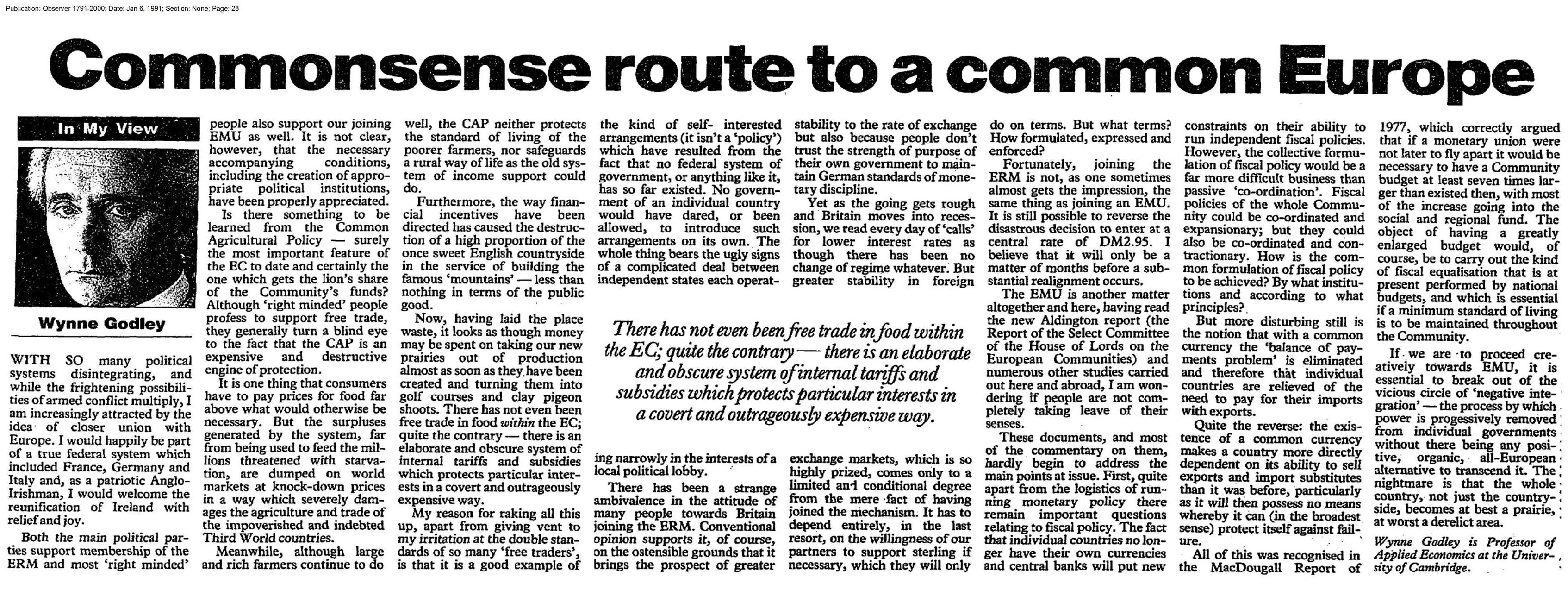
What is wrong with the Euro Area? Wynne Godley said this best in an article (written in 1991) in The Observer titled “Commonsense Route To A Common Europe”. Scan here

But more disturbing still is the notion that with a common currency the ‘balance or payments problem’ is eliminated and therefore that individual countries are relieved of the need to pay for their imports with exports.

Quite the reverse: the existence or a common currency makes a country more directly dependent on its ability to sell exports and import substitutes than it was before, particularly as it will then possess no means whereby it can (in the broadest sense) protect itself against failure.

All of this was recognised in the Macdougall Report of 1977 which correctly argued that if a monetary union were not later to fly apart it would be necessary to have a Community budget at least seven times larger than existed then, with most of the increase going into the social and regional fund. The object of having a greatly enlarged budget would, of course, be to carry out the kind of fiscal equalisation that is at present performed by national budgets, and which is essential if a minimum standard of living is to be maintained throughout the Community.

[emphasis added ;-)]

The Macdougall Report is available from the European Commission website: Part 1 and Part 2. Haven’t read it, so my knowledge is restricted to the above quote, and it adds to my huge list of things to do.

At the time of writing, I believe the situation was much different. The imbalances in the “three sectors” (public, private and external) is now severe in the Euro Area. (Three for each country, so actually 17 x 3)

Sir Donald Macdougall died in 2004 and according to The Guardian‘s obituary:

His career – as an Oxford don, a London “special adviser”, a mover and shaker in Whitehall and Westminster – started before the second world war, and wound down with skilful “letters to the editor” against the euro.

There have been so many proposals on attempts to rescue the Euro Area. Ideas termed “monetary financing” by the European Central Bank carry tremendous risks of exacerbating imbalances within the Euro Area, because nations will keep relying on the Eurosystem’s financing and is a potential political time-bomb. And, there are those simpletons, who argue that nations should just walk away! As if …

To me, it looks as if the European leaders know that the size of the central government and the fiscal transfers would be substantial given Macdougall’s estimations were done when the situation was much different and a redoing may prove this. It is the political unacceptability of this, which will finally lead to Eurocalypse.

Z.1, Q3-2011

The Federal Reserve released the Flow of Funds Accounts of the United States today.

The Flow of Funds Accounts provides one of the best snapshot of an economy. In an article appropriately titled ‘No one saw this coming’ – or did they? (see the full paper here), Dirk Bezemer correctly recognizes that the Economics profession’s ignorance of Flow of Funds had a big role to play in its inability to see a crisis coming. Bezemer says

We economists – and the policymakers who rely on us – ignore balance sheets and the flow of funds at our peril.

Of course, as Bezemer points out, there were exceptions. Post Keynesians were always aware of the flow of funds because monetary economy is a natural starting point in their theory. Wynne Godley and Marc Lavoie wrote a book (my favourite!) Monetary Economics: An Integrated Approach To Credit, Money, Income, Production and Wealth, Palgrave Macmillan, 2007, to unify Post Keynesian theory and the flow of funds approach, perhaps improving the presentation of the latter using something called the “transactions flow matrix”.

In my opinion, nobody even came close to Wynne Godley in not only predicting the crisis but the warning about the difficulties in resolving it.

One notable highlight of today’s Z.1 release was that

Household net worth—the difference between the value of assets and liabilities—was $57.4 trillion at the end of the third quarter, about $2.4 trillion less than at the end of the previous quarter.

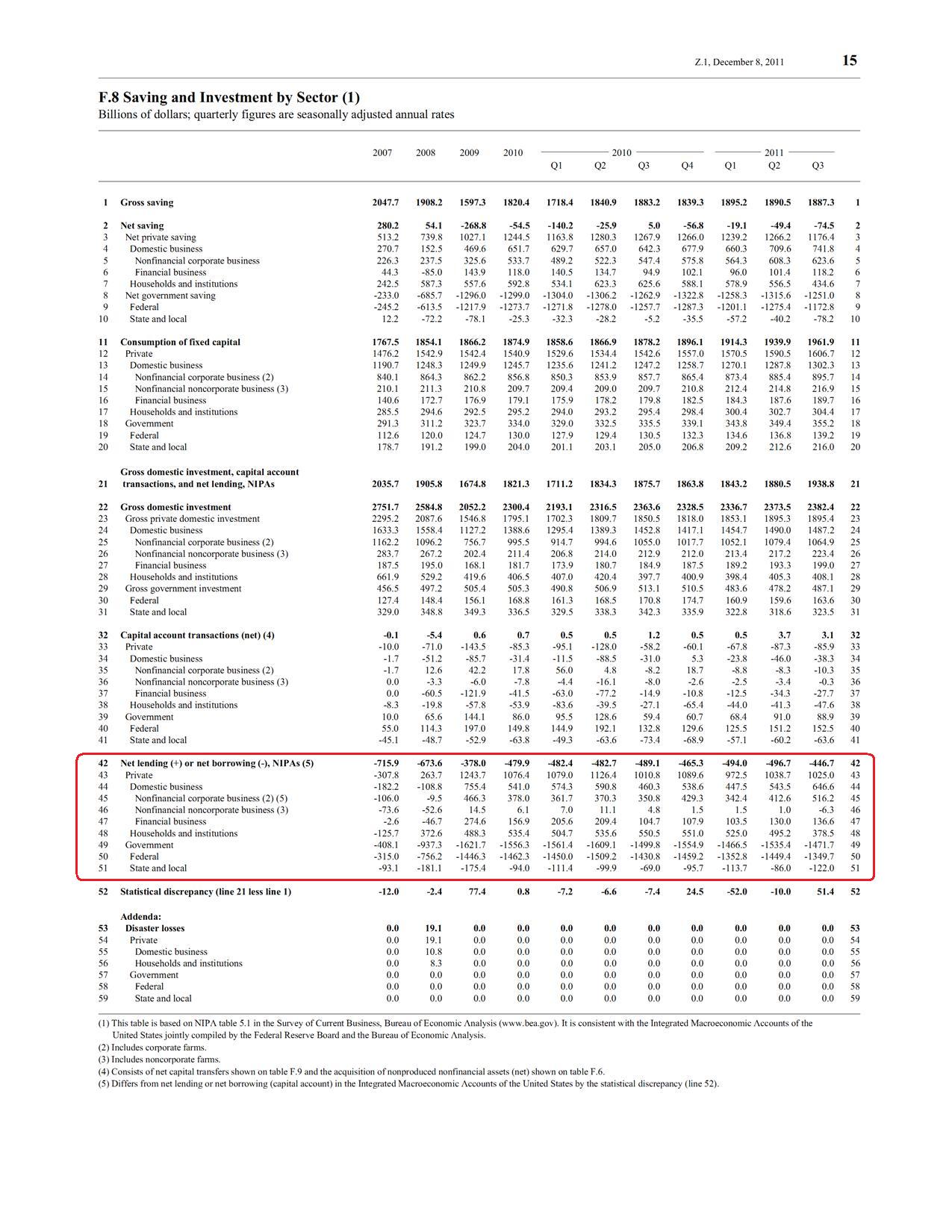
A lot of readers will know about sectoral balances. How do we get that from Z.1? Table F.8 gives “Net Lending” of each sector of the economy. The difference in a sector’s income and expenditure is it’s “Net Lending”.

(click to expand, and click again to expand)

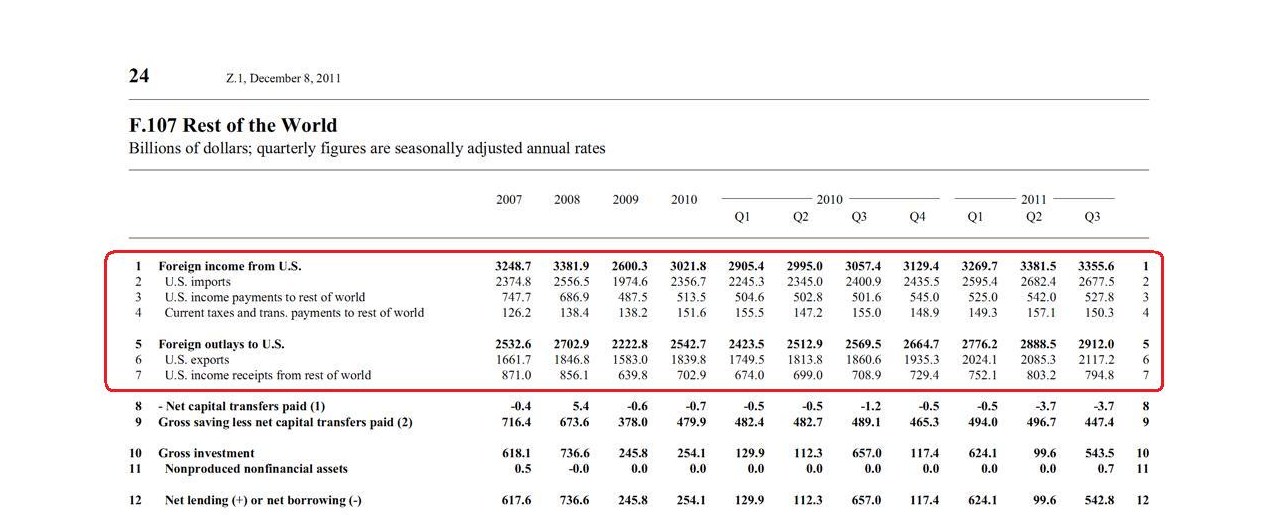
Before the crisis, the private sector had its income lower than expenditure and was financing the difference by borrowing from the other sectors. As the crisis hit, private sector expenditure retrenched – so you can see how the private sector has become a net lender from being a net borrower before the crisis. Because of this, the government’s borrowing increased from (line 49) $408.1bn in 2007 to $1,471.7bn in Q3 2011 (annualized). It was also due to a relaxation of fiscal policy during the crisis, in order to stimulate demand. The expenditure of the United States as a whole is higher than its income, and the difference is the current account deficit. This is financed by net borrowing from foreigners (line 42) – which was $446.7bn in Q3 2011 (annualized). This deficit was $715.9bn in 2007, bleeding demand at a massive scale from the US economy.

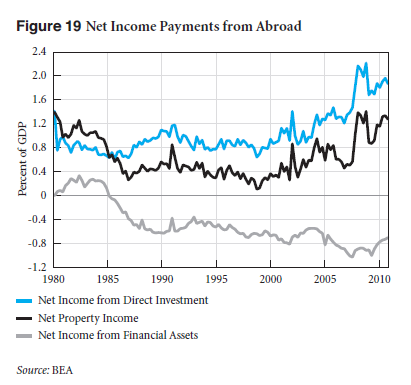
There are two more tables I see closely. The first is the net income payments from the rest of the world, which surprisingly remains positive, leading to a lot of literature about “dark matter”. (More on that some other time). This, according to the Z.1 is the “net receipts from foreigners of interest, corporate profits, and employee compensation”.

 The Levy Institute has been tracking this since 1994. Here’s a latest graph (from their March 2011 analysis)

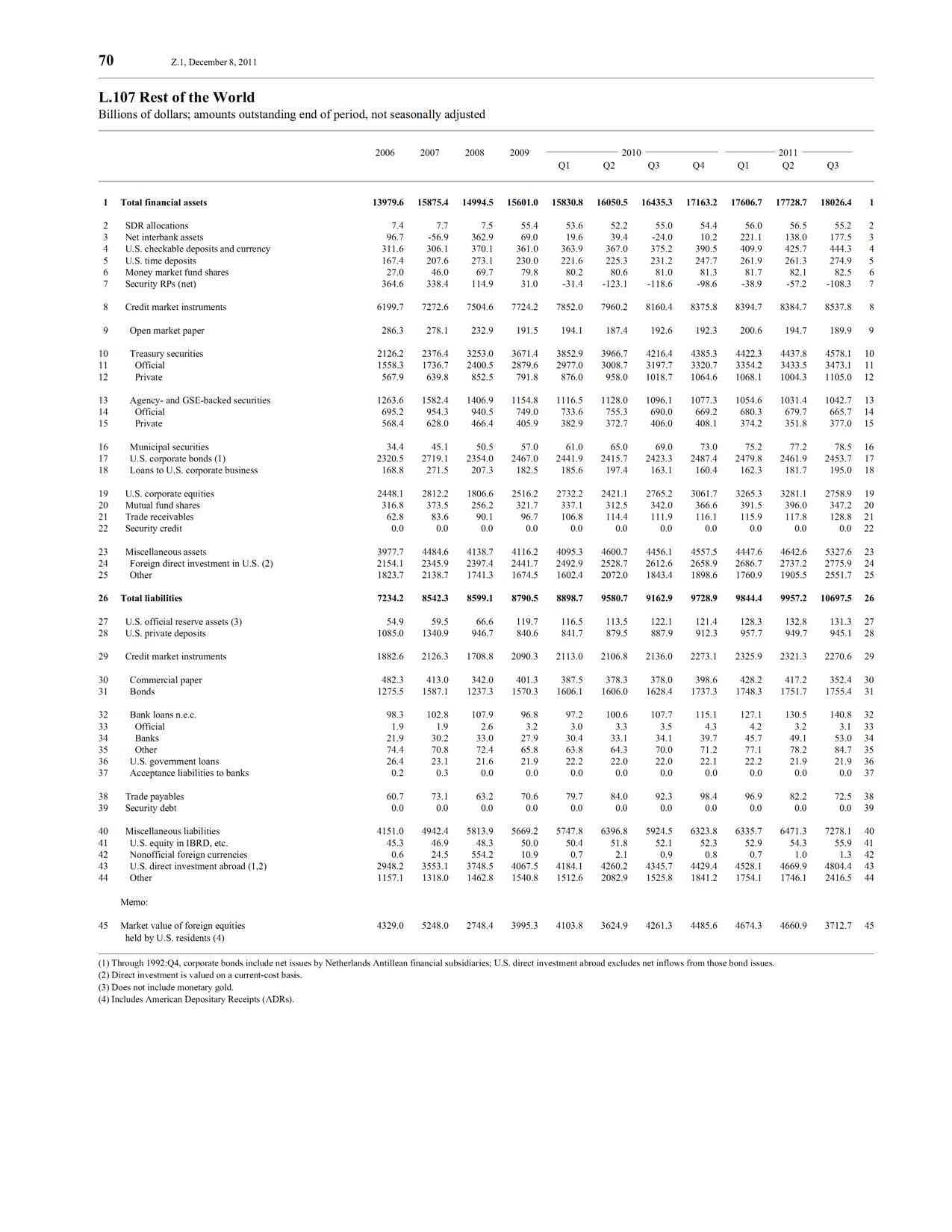
There are discrepancies between BEA and Fed data. The other table which I rush to check, whenever the flow of funds data is released is the United States’ net indebtedness to the rest of the world – L.107:

which at the end of Q3 was $3,616bn, or 24% of GDP.

There’s a new table – L.108, Financial Business – which actually appeared first time in the previous release (Q2). This sector had $64,299bn in assets and $60,457bn of liabilities at the end of Q3!

Of course, I look at all the tables at some time or the other. Highly recommended.

Same Old, Same Old

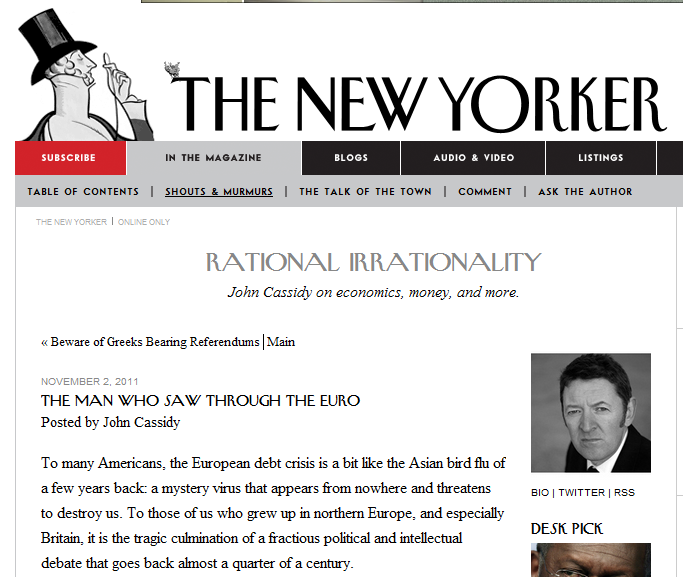
John Cassidy of The New Yorker comments on the failed austerity policies in the UK:

During the past eighteen months, a callow and arrogant Chancellor of the Exchequer, empowered by a hands-off Prime Minister and backed by the bulk of the country’s financial and media establishment, has needlessly brought Britain to the brink of another recession by embracing draconian spending cuts that hark back to the early nineteen-thirties. Rather than changing course and taking measures to boost growth, the Conservative-Liberal coalition is doubling down on austerity. On Tuesday, it announced plans to extend its cuts for two more years, until 2016-2017. “Until now, we had been thinking of four years of cuts as unprecedented in modern times,” Paul Johnson, the director of the non-partisan Institute for Fiscal Studies, said. “Six years looks even more extraordinary.”

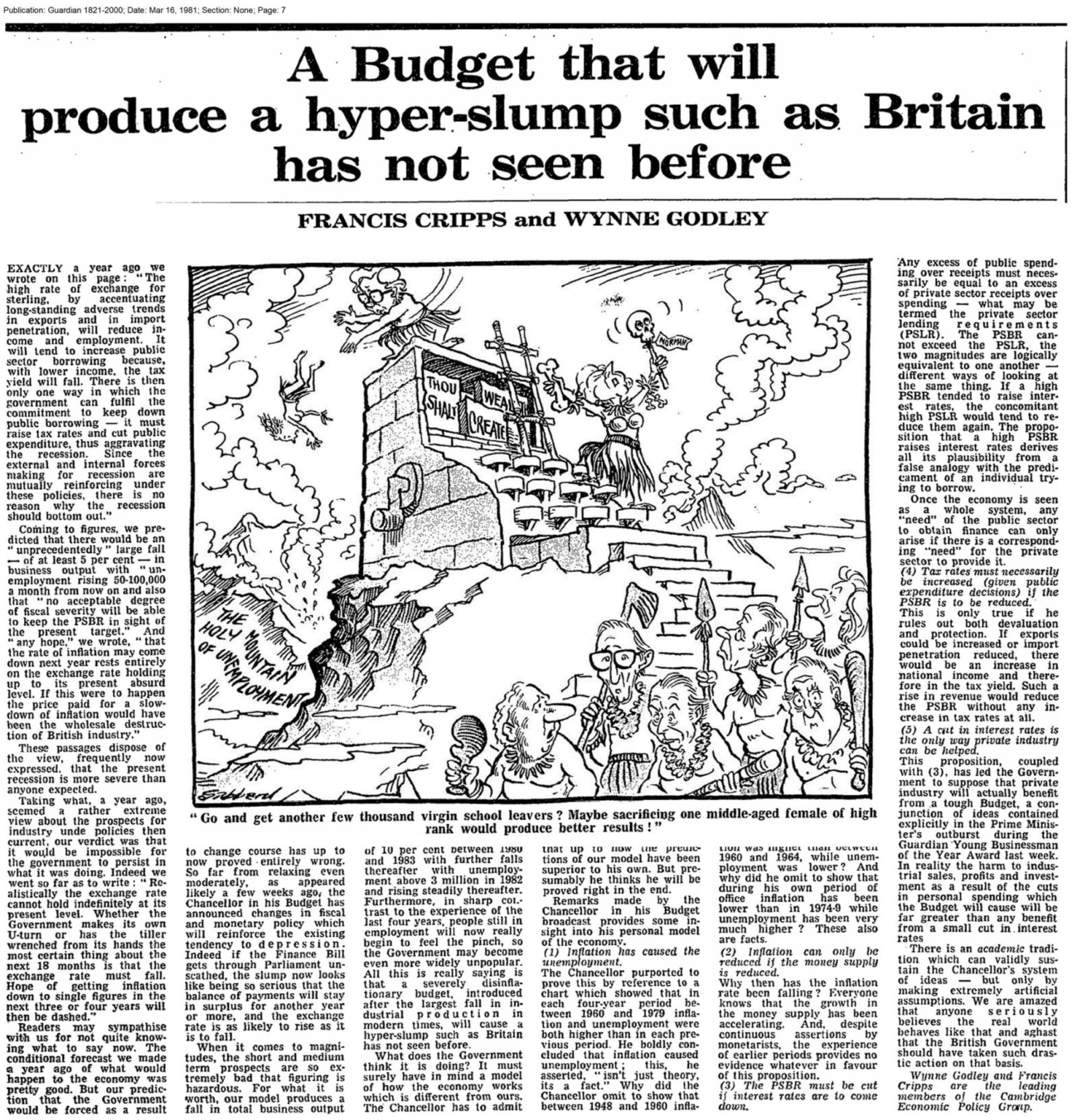
The following was written in The Guardian in early 1981. Click to enlarge. And click again to enlarge.

According to FT,

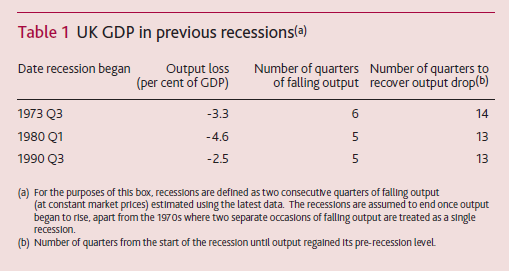
In the early 1980s, when recovery from global recession was slow, the jobless rate more than doubled, soaring from 5.3 per cent in August 1979 to 11.9 per cent in 1984.

13 quarters were required to recover the output drop, according to the BoE Inflation Report, February 2009

Seems nothing has changed in the last 30 years! Although, the Bank of England has dropped the bank rate to 0.5%, the present budget policies of the UK Government is a hangover of Thatcherism.

Charts From OECD’s Economic Outlook

The OECD released its Economic Outlook recently. The preview is available here but download is for subscribers. Else if you are an FT subscriber, you can get it from FT Alphaville’s Long Room.

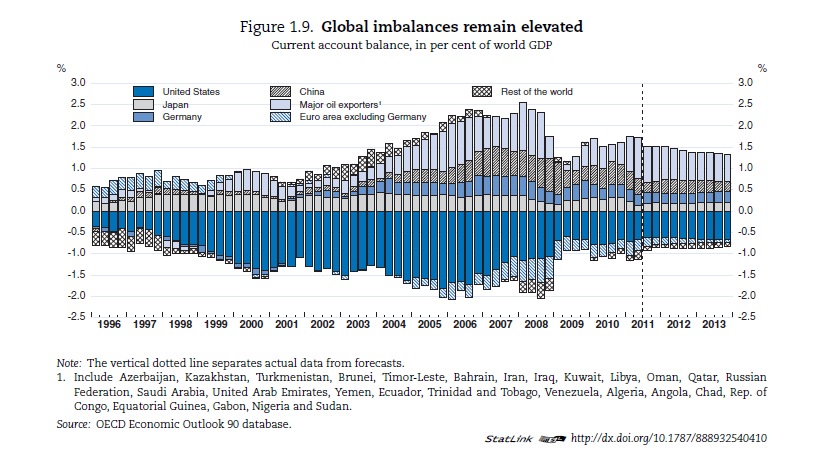
A few interesting charts (at least for me):

(click to enlarge)

Most Economists (except a few good ones), following the work of Mundell, Fleming and Friedman believed that in floating exchange rate regimes, the invisible hand will work to remove imbalances. Unfortunately, this has not happened and it has taken the crisis for them (most of them actually!) to realize that there is no mechanism and it is still unclear if they understand this.

There are some dissenters among Post Keynesians, such as Randall Wray, who do not consider current account deficits as an imbalance. See this blog post. Also see Reserve Bank of Australia’s Guy Dibelle’s speech In Defense of Current Account Deficits from July 2011.

An intuition I see often displayed in blogs is that these numbers are small and hence not problematic! My view is that these imbalances are kept low by keeping demand low. More importantly, these imbalances (deficits) add to the stock of external debt (because a deficit in the current account increases net indebtedness to foreigners) and this gets out of control sometimes leading to deflation of demand and/or seeking help from the IMF. So “low” imbalances accumulate to a huge net indebtedness.

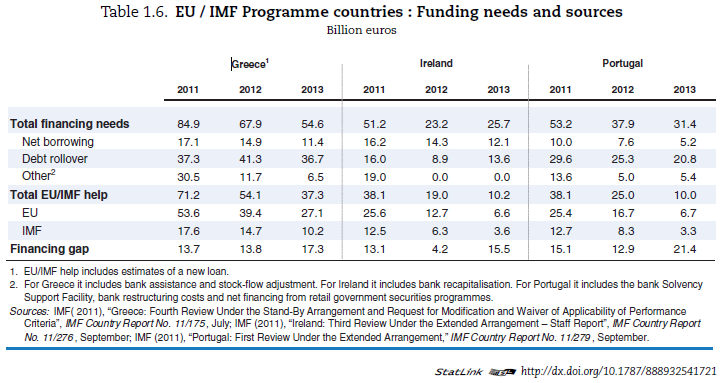
There is an informative graph on the financing needs of Greece, Ireland and Portugal:

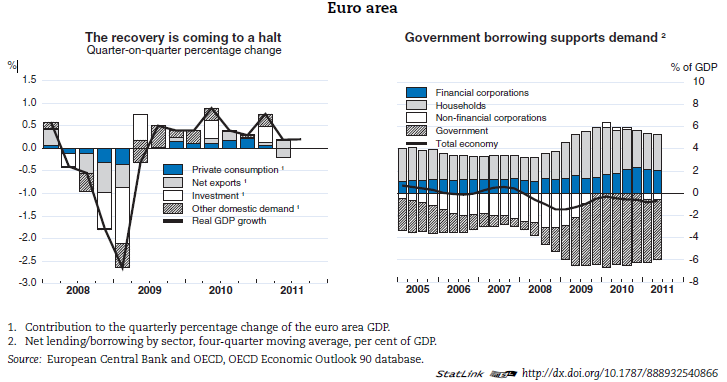
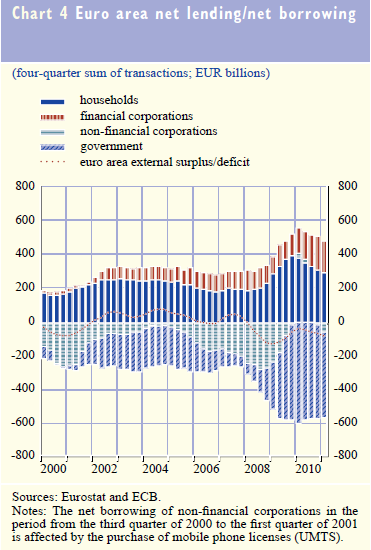
 The report also charts sectoral balances for the Euro Area!

(click to enlarge)

The Euro Area as a whole seems healthy, and it is imbalances within that are causing the troubles.

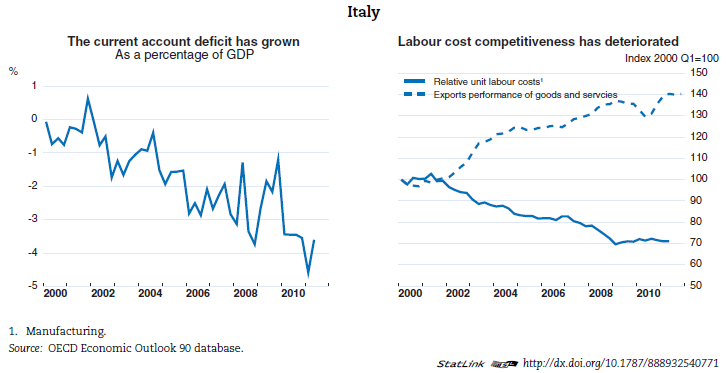
It seems Italy’s current account is worsening:

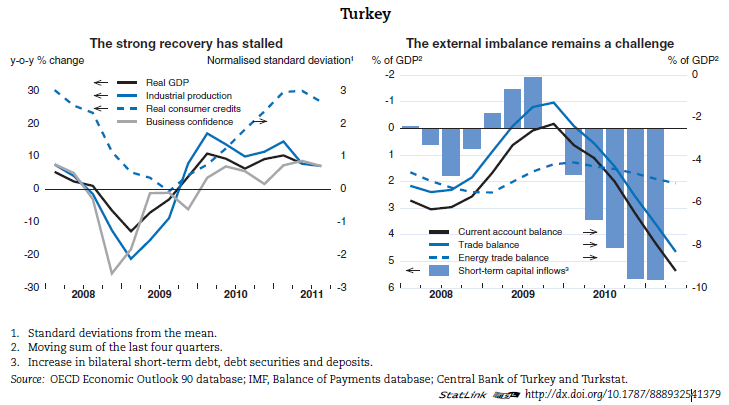
Turkey’s current account attracts a lot of attention and challenges look like this:

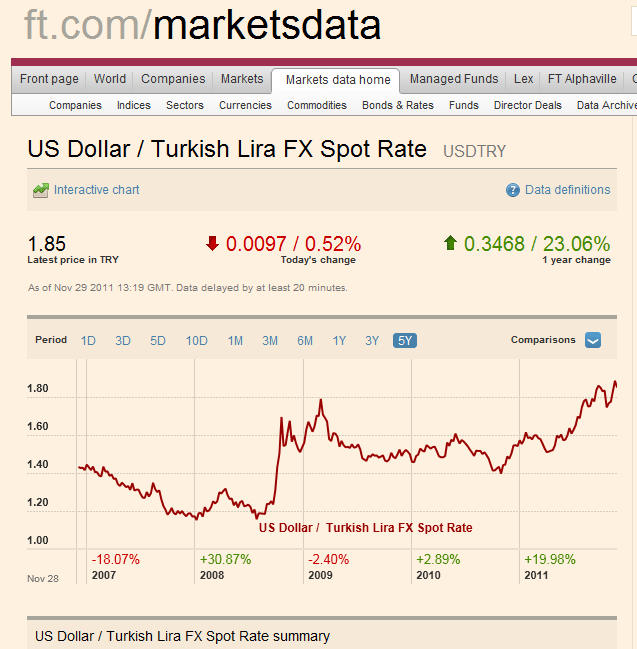
Turkey’s currency Lira has depreciated a lot recently

In Post Keynesian theory, the exchange rate is determined in a beauty contest in addition to demand and supply for financial assets.  Sudden movements can be very painful and hence nations face a balance of payments constraint – success of nations depends on how producers do in international markets. In words of Wynne Godley,

For growth to be sustainable, it is essential that the management of domestic demand be complemented by the management of foreign trade (by whatever policies) in such a way that the net balance of exports less imports contributes in parallel to the expansion of demand for home production.

At the global level, since not everyone can be net exporting, the problem of global imbalances affects everyone, and new changes are required on how the global economy is run.

Krugman, Wolf And Goodhart

Paul Krugman has a blog  post today titled Death By Accounting Identity, commenting on Martin Wolf’s FT Article Why cutting fiscal deficits is an assault on profits, where Wolf talks about the sectoral balances identity made famous by Wynne Godley. I guess the better way to put it is that Martin Wolf is trying to make the accounting identity famous.

A Damascene Moment

In his book with Marc Lavoie, Wynne Godley wrote in his part of Background memories (by W.G.)

… In 1970 I moved to Cambridge, where, with Francis Cripps, I founded the Cambridge Economic Policy Group (CEPG). I remember a damascene moment when, in early 1974 (after playing round with concepts devised in conversation with Nicky Kaldor and Robert Neild), I first apprehended the strategic importance of the accounting identity which says that, measured at current prices, the government’s budget deficit less the current account deficit is equal, by definition, to private saving net of investment. Having always thought of the balance of trade as something which could only be analysed in terms of income and price elasticities together with real output movements at home and abroad, it came as a shock to discover that if only one knows what the budget deficit and private net saving are, it follows from that information alone, without any qualification whatever, exactly what the balance of payments must be. Francis Cripps and I set out the significance of this identity as a logical framework both for modelling the economy and for the formulation of policy in the London and Cambridge Economic Bulletin in January 1974 (Godley and Cripps 1974). We correctly predicted that the Heath Barber boom would go bust later in the year at a time when the National Institute was in full support of government policy and the London Business School (i.e. Jim Ball and Terry Burns) were conditionally recommending further reflation! We also predicted that inflation could exceed 20% if the unfortunate threshold (wage indexation) scheme really got going interactively. This was important because it was later claimed that inflation (which eventually reached 26%) was the consequence of the previous rise in the ‘money supply’, while others put it down to the rising pressure of demand the previous year. …

I believe Wynne Godley discovered this identity while working for the British Treasury in the ’60s – at least the identity relating two sectors – domestic private sector and the government sector, but the damascene moment happened in 1974. The accounting identity is also used heavily in his 1983 book Macroeconomics, with Francis Cripps.

Charles Goodhart

Charles Goodhart also seems to be making use of the accounting identity (and a mental model built around this identity) in his recent Voxeu post Europe: After the Crisis. The difference is that in Charles Goodhart’s writing, fiscal policy is given less importance than monetary policy.

He talks of three implicit and incorrect assumptions:

  • The first, and most important, incorrect assumption was that a private-sector deficit in any country, matched by a capital inflow (current account deficit), should not be potentially destabilising.

The thinking was that the private sector must have worked out how to repay its debts before incurring them.

  • The second misguided assumption was that, in a single monetary system, local current account conditions not only cannot be calculated, but do not matter.
  • The third was that the public sector deficit of a member country is just as damaging when it is matched by a national private sector surplus, as by capital inflows.

I think each of these points is really insightful.

The first assumption is reminiscent of the economic agent in models who has a perfect foresight. The agent must have seen the future very well and would have calculated well in advance that things will go well. Consolidate all agents and we have the first assumption.

The second assumption is extremely well presented. People, especially economists asked – if the states in the United States used the same currency, why not Europe? The pitfall in this assumption is assuming away the U.S. Federal Government which makes fiscal transfers without anyone noticing.

The third assumption has to do with the lack of understanding the various causalities linking the three financial balances.Goodhart also goes into providing ideas for the design of “The fiscal counterpart to a monetary union”. One point I liked was on transfer dependency: 

For a stabilisa­tion instrument to be pure and effective, three principles are key (see Goodhart and Smith 1993 for details):

  • The instrument should be triggered following changes in economic activity but its intervention should be halted as soon as no further changes occur, irrespective of the level at which the economy has again become stable.

Otherwise, the instrument would perform not only a stabilisation function, but also play a redistribu­tive role. Such an ‘impurity’ is typical for traditional fiscal policy measures, but should be avoided in the Community context as it may perpetuate adjustment problems and induce transfer dependency.

….

Goodhart also makes a nice point on Japan – something (a part of it) you can see me writing in the Chartalists’ blogs’ comments section:

This analysis implies that the Eurozone needs a wholesale reorientation of the stability conditions. They must be refocused towards concern with external debt, and deficit, conditions and much less single-minded focus on the public sector finances.

If a member country is in a Japanese condition with a huge public-sector debt, but fully financed domestically, with a current-account surplus and large net external assets, then its debt should entirely be its own concern, and not subject to censure or control by any outside body, whether in a monetary union, or not. Of course, such greater attention to external, especially current-account, conditions needs to be more nuanced, since deficits, and external debts, incurred to finance tradeable goods production subsequently should provide the extra goods to sell to pay off such debts.

Japan’s public debt of 200% of GDP is quoted in rhetoric about public debt, but it is forgotten that Japan is a creditor nation and hence not always great to compare it with other nations.

Another recent article by Goodhart starts off well:

There are two main problems to be faced in any attempt to improve the architecture of international macro‐economic and financial oversight. The first is structural; the second is analytical. The first difficulty resides in the discord between having a system of national sovereignty at the same time as an international market economy, …

Will The Incredible Lacuna Be Rectified?

In 1992, Wynne Godley wrote a terrific London Review of Books article Maastricht And All That pinpointing the exact defect in the Maastricht Treaty. He wrote about an “incredible lacuna”:

… The incredible lacuna in the Maastricht programme is that, while it contains a blueprint for the establishment and modus operandi of an independent central bank, there is no blueprint whatever of the analogue, in Community terms, of a central government …

The New York Times has Wolfgang Schäuble, the German federal minister of finance, for the Saturday Profile this weekend.

According to the article he will push for a treaty change:

MR. SCHÄUBLE said the German government would propose treaty changes at the summit of European leaders in Brussels on Dec. 9 that would move Europe closer to the centralized fiscal government that the currency zone has lacked. The ultimate goal, Mr. Schäuble says, is a political union with a European president directly elected by the people.

and also that

He sees the turmoil as not an obstacle but a necessity. “We can only achieve a political union if we have a crisis,” Mr. Schäuble said.

Schäuble had penned an Opinion piece on the Financial Times, a couple of months ago

where he wrote

Hence my unease when some politicians and economists call on the eurozone to take a sudden leap into fiscal union and joint liability. Not only would such a step fail to durably solve the crisis by addressing only its most superficial symptoms, but it could make it worse in the medium term by removing a key incentive for the weaker members to forge ahead with much-needed reforms. It would also go against the very nature of European integration.

Wolfgang Schäuble, failed to see the crisis coming, but he has a point – it is the other side of the debate to the recent calls to the European Central Bank to act as a lender of the last resort to national euro area governments. Mervyn King made a similar point recently. Schäuble, however wants to manufacture a crisis to force national governments to implement reforms while he gives a blueprint for increasing the powers of the European Parliament. A bit sadist isn’t it?

Seems it is too late! There is a new buzz phrase in financial markets: “redenomination risk”.

Update

Ambrose Evans-Pritchard calls Schäuble the most dangerous man in the world 🙂

German finance minister Wolfgang Schauble – the most dangerous man in the world – is imposing a reactionary policy of synchronized tightening on the whole eurozone through the EU institutions, invoking a doctrine of “expansionary fiscal contractions” that has no record of success without offsetting monetary and exchange stimulus. What is abject is that EU bodies should acquiesce in this primitive dogma.

Financial Crisis And Flow Of Funds

Marc Lavoie forwarded me the European Central Bank’s Monthly Bulletin, October 2011 which has a section on TARGET2 and the European monetary system. I have had good discussions with him on emails to nail the TARGET2 operations so it is good to see the conclusions being verified in publications. I am waiting to write a long blog post on TARGET2 and trying to collect sources I can quote/link and I came across a section on flow of funds in the same article. It appears on page 99 (page 100 of the pdf) and is titled The Financial Crisis In The Light Of Euro Area Accounts: A Flow-Of-Funds Perspective. 

The article has this chart which will be very familiar to readers because it has been in the Levy Institute’s Strategic Prospects since many years.

There are some differences in terminologies. Wynne Godley (and Francis Cripps) started using NAFA (Net Accumulation/Acquisition of Financial Assets) to denote a sector’s surplus in the 1970s and Levy Institute has continued using this. Modern national accountants use Net Lending (by a sector) and split this into Net Acquisition of Financial Assets and Net Incurrence/Acquisition/Increase of/of/in Liabilities and take the difference. Levy’s authors also use Net Lending but as Net Lending to a Sector – e.g., Net Lending to Households.

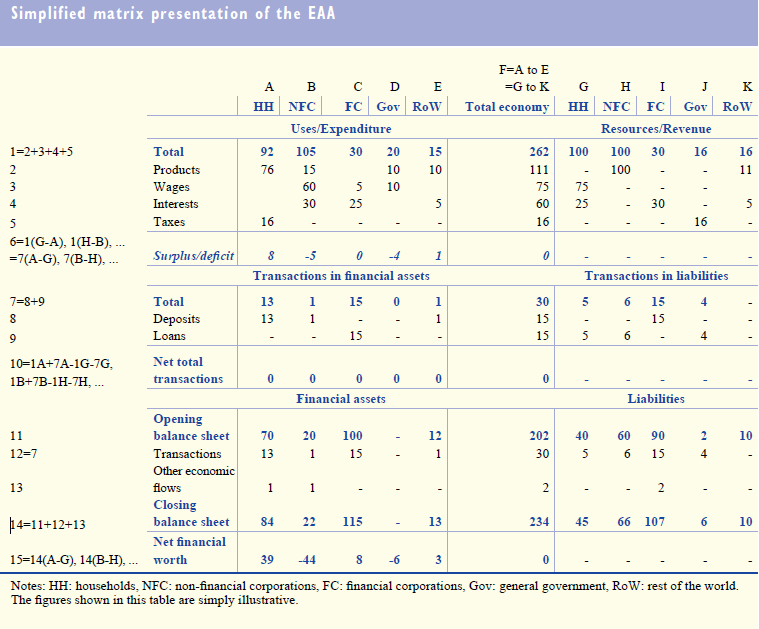
The article also presents this table (termed Transactions Flow Matrix by Wynne Godley – his greatest trick)

(click to enlarge)

and has this description:

The sectoral accounts present the accounts of institutional sectors in a coherent and integrated way, linking – similar to the way in which profit and loss, cash flows and balance sheet statements are linked in business accounting  – uses/expenditure, resources/revenue, financial flows and their accumulation into balance sheets from one period to the next.To this effect, all units in the economy are classified in one of the four institutional sectors (i.e. households, non-financial corporations, financial corporations and general government). Their accounts are presented using identical classifications and accounting rules (those of ESA 95), in a manner such that each transaction/asset reported by one unit will be symmetrically reported by the counterpart unit (at least in principle). Accordingly, the sectoral accounts present the data with three constraints: each sector must be in balance vertically (e.g. the excess of expenditure on revenue must be equal to financing); all sectors must add up horizontally (e.g. all wages paid by sectors must be earned by households); and transactions in assets/liabilities plus holding gains/losses and other changes in the volume of assets/liabilities must be consistent with changes in balance sheets (stock-flow consistency). The sectoral accounts are commonly presented in a matrix form, with sectors in columns and transactions/instruments in rows, with horizontal and vertical totals adding up (see the example in the table).

The first five rows of the table show the expenditure and revenues of each of the sectors (broken down into types of expenditure/revenue). In row 6, the difference between revenue and expenditure (the surplus/deficit) is shown.

The notions of revenue and expenditure are close to, but generally less encompassing than, the more traditional national account concepts of resources and uses. Income can then be defined as revenue (except capital transfers received) minus expenditure other than final consumption and capital expenditure (capital formation and capital transfers paid). For corporations, income corresponds to retained earnings. Savings is the excess of income over final consumption.

Surpluses/deficits are then associated with transactions in financial assets and liabilities in each sector. This is shown in rows 7 to 10. The bottom part of the table shows the stocks of assets and liabilities, which result from the accumulation of transactions and other flows. This table is extremely simplified (e.g. omitting an explicit presentation of the stock of non-financial assets).

The excess of revenue over expenditure is the net lending/net borrowing (i.e. financial surplus/ deficit), a key indicator of the sectoral accounts. Typically, a household’s revenue will exceed its expenditure. Households are thus providers of net lending to the rest of the economy. Non-financial corporations typically do not cover their expenditure by revenue, as they finance at least part of their non-financial investments by funds from other sectors in addition to internal funds. Non-financial corporations are thus typically net borrowers. Governments are also often net borrowers. If the net lending provided by households is not sufficient to cover the net borrowing of the other sectors, the economy as a whole has a net borrowing position vis-à-vis the rest of the world. Deviations from this typical constellation were apparent in several euro area countries before the crisis, in particular, with extremely elevated residential investment that resulted in households becoming net borrowers (as has been the case in the United States).

The adding-up constraints in the accounts require that any (ex ante) increase in the financial balance of one sector is matched by a reduction in the financial balances of other sectors. The accounting framework does not, however, indicate by which mechanism this reduction will be brought about, or which mechanisms are at play. The EAA makes it possible to track changes in net lending in the different sectors of the economy. It also specifies the financial instruments affected and shows how the transactions and valuation changes leave a lasting effect on the balance sheets of the sectors.

The article is worth a read.

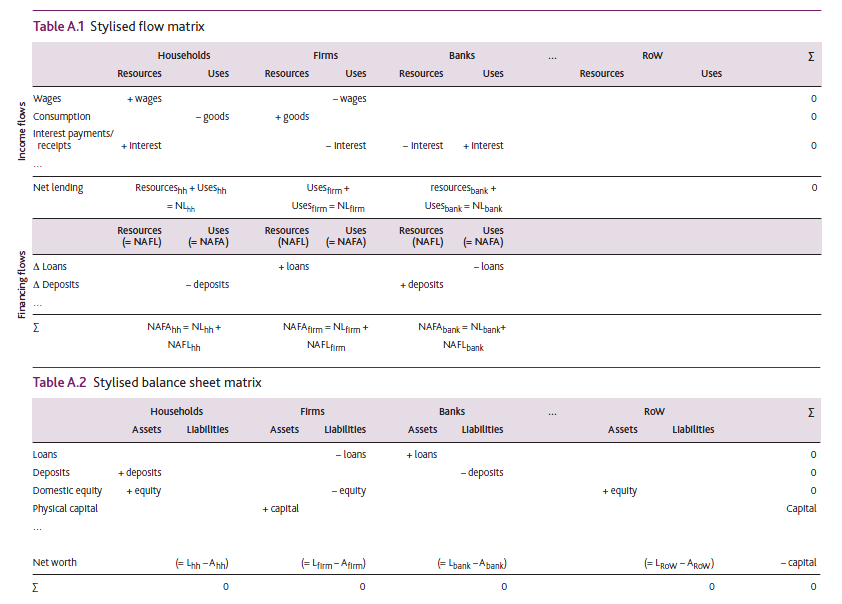
The Bank of England also had a similar article recently but before: Growing Fragilities – Balance Sheets In The Great Moderation by Richard Barwell and Oliver Burrows and quotes the work of G&L (Godley and Lavoie). It also has a similar matrix as the ECB’s article.

(click to enlarge)

Godley and Lavoie build a series of closed accounting frameworks based on the system of National Accounts, which encompass: the standard national income flows, such as wages and consumption; the counterpart financing flows, such as bank loans and deposits; and stocks of physical and financial assets and liabilities. This framework lends itself to representation in a set of matrices. The first matrix captures flow variables (Table A.1). The columns represent the sectors of the economy and the rows represent the markets in which they interact. The matrix has two important properties. Each sector’s resources and uses columns provide their budget constraint — the sums must equal to ensure that all funds they receive are accounted for. And each row must also sum to zero, to ensure that each market clears — that is, the supply of a particular asset must be matched by purchases of that asset, to ensure that no funds go astray.

The table can usefully be split in two, with the top half covering the standard income and expenditure flows and the bottom half covering financing flows. The two halves of the table are linked together by each sector’s ‘net lending balance’, or ‘financial surplus’. The net lending balance can be used to summarise each sector’s income and expenditure flows as the difference between the amount the sector spends on consumption and physical investment and the amount that it receives in income. This difference must be met by financing flows — either borrowing or the sale of financial assets. In national accounts terminology, a sector’s net lending balance (NL) must equal its net acquisition of financial assets (NAFA) less its net acquisition of liabilities (NAFL). Across sectors, the net lending balances have to sum to zero, as all funds borrowed by one sector must ultimately come from another.

While it is useful to split the table for accounting purposes into income and expenditure flows and financing flows, it is important to note that the acquisition of financial assets and liabilities is not necessarily determined purely by imbalances between income and desired expenditure. Sectoral balance sheets can adjust for other reasons. Agents may want to borrow money to purchase assets, simultaneously acquiring financial assets and liabilities. And on occasion agents may want to shrink the size of their balance sheets, selling off financial assets to pay off financial liabilities. Finally, some agents may default on their debt obligations, which will involve a revision in the financial assets and liabilities of both debtor and creditor. At an aggregate level, simultaneous expansion of a sector’s assets and liabilities invariably represents one set of underlying agents taking on assets whilst the other takes on liabilities. The household sector provides an important example. If a young household takes a mortgage to buy a house from an old household, the sector in aggregate simultaneously acquires a liability (the young household’s mortgage) and an asset (the deposit created for the young household to pay to the old household).

All of these activities — leveraging up, deleveraging and default — involve NAFA and NAFL moving in lockstep. The net lending identity still holds: the gap between income and expenditure determines the difference between NAFA and NAFL. But the absolute size of the NAFA and NAFL flows is determined by agents’ actions in financial markets. The second table captures the balance sheet positions of each sector. The balance sheet matrix is updated over time using data on the acquisition of assets and liabilities from the transaction flows matrix, and revaluation effects to asset positions. Proceeding in this manner, balance sheets always balance across sectors, flows of funds are always accounted for over time and the impact of flows of funds on balance sheets is always recorded.

Again, good article!

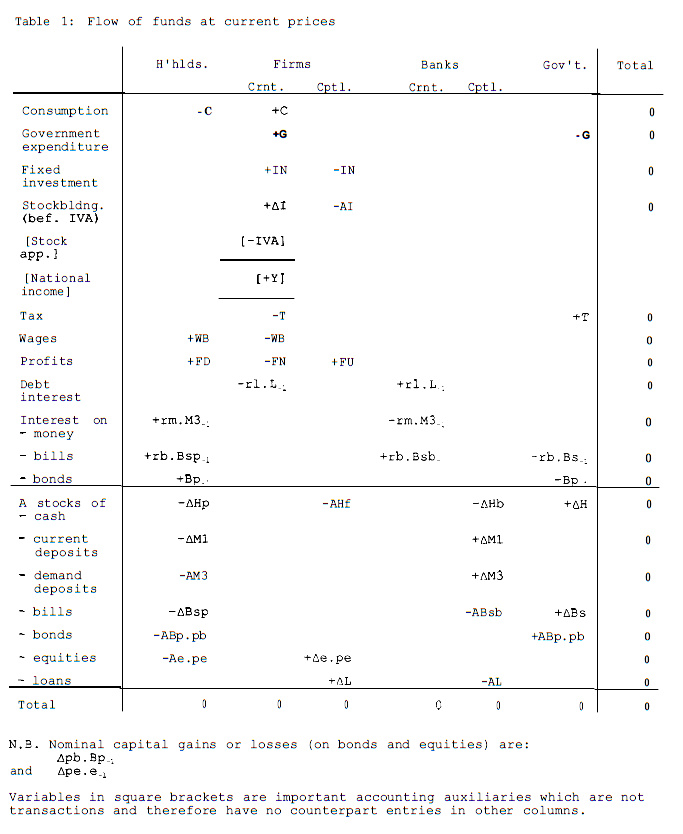
The first time a proper transactions flow matrix appeared was in a 1996 Levy institute paper by Wynne Godley:  Money, Finance And National Income Determination – An Integrated Approach.

(click to enlarge)

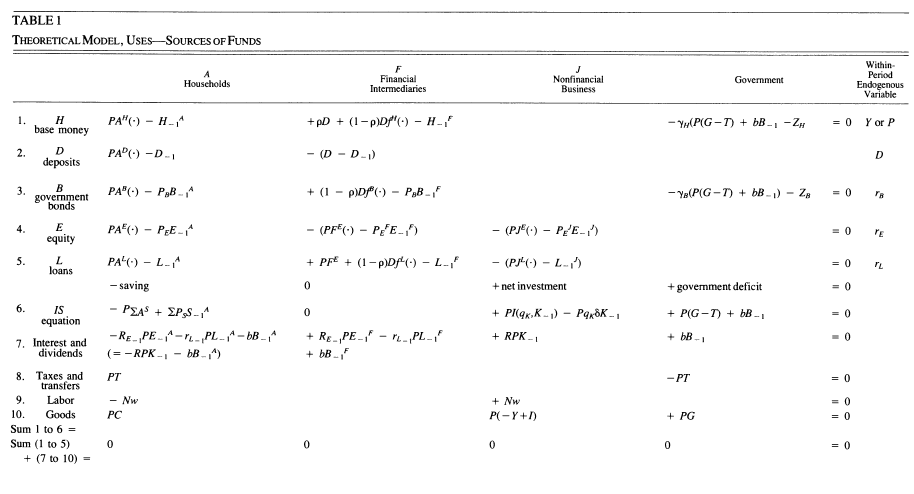
James Tobin et al. had something similar – almost but not quite in A Model Of US Financial And Nonfinancial Economic Behavior :

(click to enlarge)

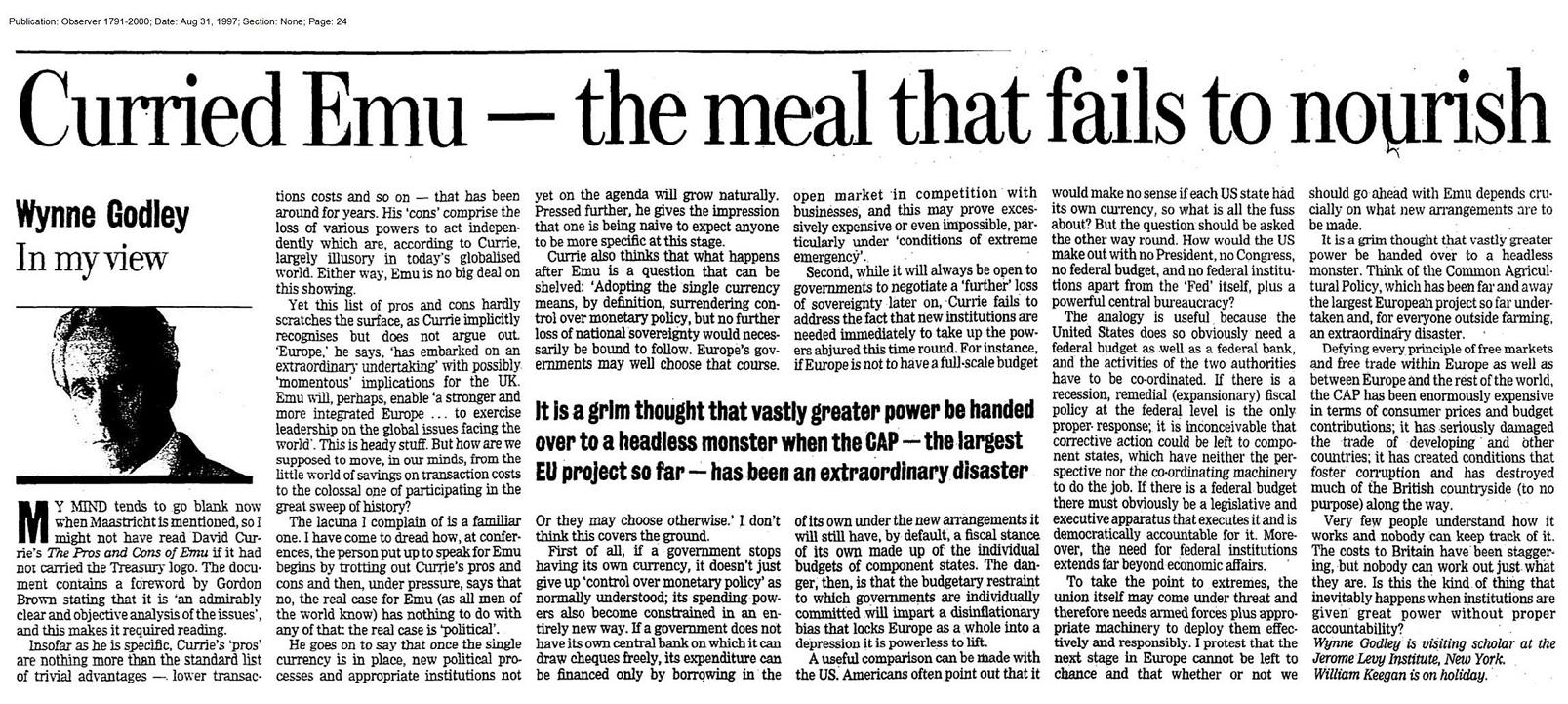
Curried EMU: Wynne Godley From 1997

(Click the newspaper clip to enlarge)

… Currie also thinks what happens after Emu is a question that can be shelved: ‘Adopting the single currency means, by definition, surrendering control over monetary policy, but no further loss of national sovereignty would necessarily be bound to follow. Europe’s governments may well choose that course. Or they may choose otherwise.’ I don’t think this covers the ground.

First of all, if a government stops having its own currency, it doesn’t give up just ‘control over monetary policy’ as normally understood; its spending powers also become constrained in an entirely new way. If a government does not have its own central bank on which it can draw checks freely, its expenditure can be financed only by borrowing in the open market in competition with business firms, and this may prove excessively expensive or even impossible, particularly under ‘conditions of extreme emergency’.