Tag Archives: marc lavoie

Nicholas Kaldor On Rational Expectations

I was recently re-reading an article by Nicholas Kaldor and J. Trevithick [1] and I came across this fine description of rational expectations:

The main plank of the monetarist school has hitherto been that inflation is invariably ‘demand induced’: it can result only from an excessive demand for goods which, however, can manifest itself in the prevalence of excess demand in the labour market [footnote i]. In either case, any consequential increase in output or any fall in unemployment below its natural rate can occur only temporarily.

This latter view, which was shared until recently by the great majority of monetarist economists, is now contradicted by a more radical group of monetarists who developed the notion of ‘rational expectations’ and applied it to the study of inflationary processes. Their position is an extension of the argument that the increase in employment induced by monetary and fiscal policy is the result of some form of ‘cheating’ since workers had expected higher real wages than they actually received, whereas employers had expected to pay a lower real wage than they ultimately had to pay.

It is now claimed by this group of American monetarists that the above theory assumes that expectations are formed on an irrational basis, whereas it is in the interests of all economic agents to form a ‘correct model’ of how the economy functions. The proper cognition of the economy enables rational expectations to be formed which will prevent all but ‘surprise’ departures from an equilibrium path and will, therefore, render nugatory any attempt to reduce unemployment below its ‘natural’ level even in the short run. The centrepiece of this argument is that both workers and employers realise that the quantity theory of money is correct and that wages and prices must rise in the same proportion as the money supply. As a result, it is argued that increased expenditure will cause increases in wages and prices directly without affecting real variables such as output, employment or the real wage rate. They contend that they will base their expectations not on a projection of past trends in the price level or one of its time derivatives (such a procedure would usually be ‘irrational’) but on the ‘correct’ understanding of the economy which takes changing trends into account. Although the mechanism through which prices and wages rise is unclear, this school by-passes the traditional mechanism by which they rise under the pull of excess demand only. The corollary of this hypothesis is that inflation can be reduced far more painlessly than was thought by early monetarists, for, provided that the government can convince the public that it has a firm intention to get the money supply under control, the price level and the level of money wages will respond with only a very short lag: it does not require appreciable restriction of demand in real terms or any abnormal fall in employment even for a temporary period. [footnote ii]

This rational expectations theory goes beyond the untestable basic axioms of the theory of value, such as the utility-maximising rational man whose existence can be confirmed only by individual introspection. The assumption of rational expectations which presupposes the correct understanding of the workings of the economy by all economic agents—the trade unionists, the ordinary employer, or even the ordinary housewife—to a degree which is beyond the grasp of professional economists is not science, nor even moral philosophy, but at best a branch of metaphysics.

[emphasis added]

[footnote i: Harry G. Johnson, ‘What is Right with Monetarism’, Lloyds Bank Review, April 1976]

[footnote ii: It is well known that in the last five years, many Western countries have experienced the phenomenon of rising unemployment coupled with accelerating inflation. This appears to undermine the validity of the traditional natural rate hypothesis and, a fortiori, the rational expectations version. Professor Friedman (‘Inflation and Unemployment’, Institute of Economic Affairs, 1977), has acknowledged this divergence between monetarist theory and empirical observation, but he is hard-pressed to explain it.]

In this recent video, Marc Lavoie (at 28:00) quotes Philip Mirowski saying the same thing:

… orthodox macroeconomists came to conflate ‘being rational’ with thinking like an orthodox economist. What this implied was that agents knew the one and only ‘true model’ of the economy (which conveniently was stipulated as identical with neoclassical microeconomics) …

[1] Kaldor N. and Trevithick J. 1981. A Keynesian Perspective On Money, Lloyd’s Bank Review. (reprinted in Collected Economic Essays, Vol. 9)

Tobinesque Models

Paul Krugman writes today on his blog on James Tobin’s work:

Let me offer an example of how this ended up impoverishing macroeconomic analysis: the strange disappearance of James Tobin. In the 1960s Tobin developed and elaborated a sophisticated view(pdf) [original link corrected] of financial markets that offered insights into things like the role of intermediaries, the effects of endogenous inside money, and more. I’ve found myself using Tobinesque analysis a lot since the financial crisis hit, because it offers a sophisticated way to think about the role of finance in economic fluctuations.

But Tobin, as far as I can tell, disappeared from graduate macro over the course of the 80s, because his models, while loosely grounded in some notion of rational behavior, weren’t explicitly and rigorously derived from microfoundations. And for good reason, by the way: it’s pretty hard to derive portfolio preferences rigorously in that sense. But even so, Tobin-type models conveyed important insights — which were effectively lost.

Compare that to his article in response to another article on Wynne Godley which appeared in the New York Times – completely dismissing Godley’s work.

Three things: first Krugman claimed earlier that we needn’t look at old ideas:

But it is kind of funny to see a revival of old-fashioned macro hailed, at least by some, as the key to a reconstruction of the field

directly contradicting what he says today.

Second – obviously not having read Wynne Godley, he missed the point that Wynne’s analysis has significant improvement of James Tobin’s work.

Third, of course, Krugman’s understanding of monetary economics in general is poor, as can be seen when he gets into debates with heteredox economists and makes the most elementary errors. So it is strange he is lecturing others on this and fails once again to acknowledge heteredox economists.

Here’s Marc Lavoie describing in his article From Macroeconomics to Monetary Economics: Some Persistent Themes in the Theory Work of Wynne Godley in the book Contributions to Stock-Flow Modeling: Essays in Honor of Wynne Godley:

As Godley points out on a number of occasions, he himself owed his formalization of portfolio choice and of the fully consistent transactions-flow matrices to James Tobin. Godley was most particularly influenced and stimulated by his reading of the paper by Backus et al. (1980), as he writes in Godley (1996, p. 5) and as he told me verbally several times. The discovery of the Backus et al. paper, with its large flow-of-funds matrix, was a revelation to Godley and allowed him to move forward. But as pointed out in Godley and Lavoie (2007, p. 493), despite their important similarities, there is a crucial difference in the works of Tobin and Godley devoted to the integration of the real and monetary sides. In Tobin, the focus is on one-period models, or on the adjustments from the initial towards the desired portfolio composition, for a given income level. As Randall Wray (1992, p. 84) points out, in Tobin’s approach ‘flow variables are exogenously determined, so that the models focus solely on portfolio decisions’. By contrast, in Godley and Cripps and in further works, Godley is preoccupied in describing a fully explicit traverse that has all the main stock and flow variables as endogenous variables. As he himself says, ‘the present paper claims to have made … a rigorous synthesis of the theory of credit and money creation with that of income determination in the (Cambridge) Keynesian tradition’ (Godley, 1997, p. 48). Tobin never quite succeeds in doing so, thus not truly introducing (historical) time in his analysis, in contrast to the objective of the Godley and Cripps book, as already mentioned earlier. Indeed, when he heard that Tobin had produced a new book (Tobin and Golub, 1998), Godley was quite anxious for a while as he feared that Tobin would have improved upon his approach, but these fears were alleviated when he read the book and realized that there was no traverse analysis there either.

Draft link here.

Good Reference On Wage-Led Growth

An excellent discussion on wage-led economic growth is a paper by Marc Lavoie and Engelbert Stockhammer titled Wage-led Growth: Concept, Theories And Policies which appears in the recently released book Wage-Led Growth: An Equitable Strategy For Economic Recovery (Palgrave Macmillan book page)

Wage-Led GrowthFrom the article:

… The advocacy of a wage-led economic strategy has a long history. It has been articulated in reformist visions within the labour movement and was discussed under the heading of ‘underconsumption’ in 19th century economics. Famous underconsumptionists in the history of economic thought include Malthus, Sismondi and Hobson.1

Underconsumptionist ideas got a boost from their endorsement by Keynes, when he proposed his theory of effective demand, arguing that excessive saving rates, relative to deficient investment rates, were at the core of depressed economies. Underconsumption theories can also be related to the problems of the realization of profit, as discussed by Marx and subsequently by various Marxist authors such as Baran and Sweezy (1966), while other authors, closely related to Kalecki (1971), such as Steindl (1952) and Bhaduri (1986), have brought together the theory of effective demand and the problem of the realization of profit. On this basis, the benefits of a wage-led growth strategy has been resurrected and formalized by several Kaleckian or post-Keynesian authors, starting with Rowthorn (1981), Taylor (1983) and Dutt (1987). Taylor (1988) showed early on that when emerging countries had enough capacity to adjust, a wage-led growth strategy made sense. More recently, the policy-oriented concept of a wage-led growth strategy was prominently used by UNCTAD (2010, 2011).

A standard objection to the consideration of the underconsumption thesis or the consideration of problems related to the lack of effective demand is that long-run growth – the trend rate of growth, also called the potential growth or the natural rate of growth – is ultimately determined by supply-side factors, such as the growth rate of the labour force and the growth rate of labour productivity. While adepts of the so-called ‘endogenous growth theory’ will recognize that investment in human capital or research and development may end up modifying the potential growth rate, they usually set aside the idea that actual growth rates could have an influence on potential growth rates. Yet, since the advent of the global financial crisis, government agencies and central banks in many industrialized countries have lowered their forecasts of long-run real growth, thus demonstrating clearly that weak aggregate demand does have an impact on potential growth. As Dray and Thirlwall (2011, p. 466) recall, ‘it makes little economic sense to think of growth as supply constrained if, within limits, demand can create its own supply’. This explains why we shall focus on the income distribution determinants of aggregate demand, paying less attention to the supply-side factors…

1See Bleaney (1976) for a historical account of underconsumptionist theories.

Some Nice Words On Wynne Godley And Monetary Economics

I am reading this book The Oxford Handbook of Post-Keynesian Economics, Volume 1: Theory and Origins and it has some nice chapters!

In his chapter Postkeynesian Precepts For Nonlinear, Endogenous, Nonstochastic, Business Cycle Theories, K. Vela Velupillai has some nice words on Wynne Godley and his book Monetary Economics co-authored with Marc Lavoie:

K Vela Velupillai On Wynne Godley(snipping via amazon.com)

Flow Of Funds And Keynesian Macroeconomics

The subject of money, credit and moneyflows is a highly technical one, but it is also one that has a wide popular appeal. For centuries it has attracted quacks as well as serious students, and there has too often been difficulty in distinguishing a widely held popular belief from a completely formulated and tested scientific hypothesis.

I have said that the subject of money and moneyflows lends itself to a social accounting approach. Let me go one step farther. I am convinced that only with such an approach will economists be able to rid this subject of the quackery and misconceptions that have hitherto been prevalent in it.

– Morris Copeland, inventor of the Flow Of Funds Accounts of the United States, in Social Accounting For Moneyflows, in Flow-of-Funds Analysis: A Handbook for Practitioners (1996) [article originally published in 1949]

Alas monetary myths continue to exist. The above referred handbook was published in 1996 starting with Copeland’s 1949 article and the editor of the book John Dawson himself had an explanation of why myths continue to exists despite some brilliant work such as that of Copeland. In page xx, Dawson says:

the acceptance of… flow-of-funds accounting by academic economists has been an uphill battle because its implications run counter to a number of doctrines deeply embedded in the minds of economists.

In a recent blog post blog post Paul Krugman is dismissive of Wynne Godley’s approach to macro modeling and instead appeals to some Friedmanism. Perhaps Dawson’s quote explains why this is so. However it may not be the only reason, given how Krugman has shown some tendency to be heteredox in recent times but his latest post ends all doubts and we can say he is highly orthodox. And that other reason is professional turf-defence.

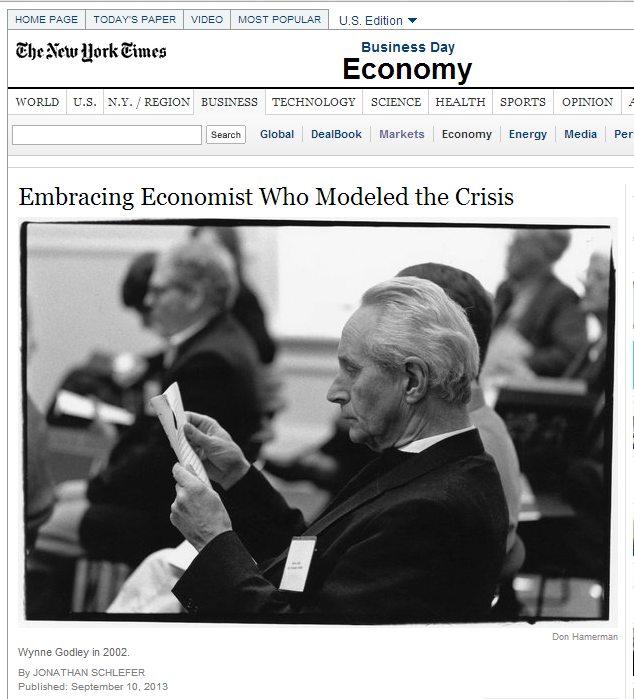
Also, Krugman was writing in response to an NYT article Embracing Wynne Godley, an Economist Who Modeled the Crisis highlighting the importance of Wynne Godley’s work. That article was by a journalist who was perhaps unaware of the history of Post-Keynesianism. But Krugman himself dodged Godley’s work as “old-fashioned” – as if there is something fundamentally wrong about old-fashion and as if economics should proceed by one fashion after another.

A bigger disappointment is that Krugman failed to acknowledge that there has existed a heteredox approach since Keynes’ time. As Wynne Godley and Marc Lavoie begin Chapter 1 in their book Monetary Economics:

During the 60-odd years since the death of Keynes there have existed two, fundamentally different, paradigms for macroeconomic research, each with its own fundamentally different interpretation of Keynes’ work…

And Krugman’s usage of the phrase old-fashioned hides the fact that this is so.

Back to Copeland. In the same article Social Accounting For Moneyflows, Copeland is clear about his intentions and the direction he is looking:

When total purchases of our national product increase, where does the money come from to finance them? When purchases of our national product decline, what becomes of the money that is not spent? What part do cash balances, other liquid holdings, and debts play in the cyclical expansion of moneyflow?

Copeland’s analysis was not simply theoretical. It led to the creation of the flow of funds accounts of the United States and the U.S. Federal Reserve publishes this wonderful data book every quarter. Although, Copeland was simply looking and proceeding in the right direction, it can be said that a more solid theoretical framework to build upon Copeland’s brilliant work was still waiting at the time.

Of course, in the world of academics, there already existed two main schools of thought very hostile to one another. Keynes’ original work contained a lot of errors and for most economists, a bastardised version of Keynes’ work became the popular understanding. It was however the Cambridge Keynesians who founded the school Post-Keynesian Economics who believed they were true to the spirit of Keynes and this led to a parallel body of extremely high-quality intellectual work which continues to this day – and still dismissed by economists such as Paul Krugman. Of course, in this story, it should be mentioned that there was a Monetarist counter-revolution mainly led by Milton Friedman who was trying to bring back the old quantity theory of money doctrines and was “successful” in permanently distorting the minds of generations of economists to date. Greg Mankiw is quite straight on this and according to him, “New Keynesian” in the “New Keynesian Economics” is a misnomer and it should actually be New Monetarism.

Interestingly, one of Morris Copeland’s ideas was to show how the quantity theory of money is wrong. According to Dawson (in the same book referred above):

[Copeland] himself was at pains to show the incompatibility of the quantity theory of money with flow-of-funds accounting.

Meanwhile, in the 1960s and to the end of his life, James Tobin tried to connect Keynesian economics with the flow of funds accounts. While a lot of his work is the work of a supreme genius, he couldn’t manage. Perhaps it was because of his neoclassical background which may have come in the way. According to his own admission, he couldn’t connect the dots:

Monetary and financial data, so far as they are based on institutional balance sheets and prices in organized markets, are abundant. Modern machines have made it possible to improve, refine and expand the compilation of these data, and also to seek empirical regularities in financial behavior in the magnitude of individual observations. On the aggregate level, the Federal Reserve Board has developed a financial accounting framework, the “flow of funds,” for systematic and consistent organization of the data, classified both by sector of the economy (households, nonfinancial business, governments, financial institutions and so on) and by type of asset or debt (currency, deposits, bonds, mortgages, and so on). Although many people hope that this organization of data will prove to be as powerful an aid to economic understanding as the national income accounts, this hope has not yet been fulfilled. Perhaps the deficiency is conceptual and theoretical; as some have said, the Keynes of “flow of funds” has yet to appear.

– James Tobin in Introduction (pp xii-xiii) in Essays In Economics, Volume 1: Macroeconomics, 1987.

After having written a fantastic book Macroeconomics with Francis Cripps in 1983 and which has connections with the flow of funds, Wynne Godley thought he had to try hard to unify (post-)Keynesianism and the flow of funds approach which James Tobin was trying. Wynne Godley had the advantage of being close to Nicholas Kaldor who very well understood the importance of Keynes and was himself an economist of Keynes’ rank. Godley also had the advantage of having worked for the U.K. government and doing analysis using national accounts data and advising policy makers. Wynne Godley is the Keynes of “flow of funds” which Tobin was talking about!

A recent blog post by Matias Vernengo on Wynne Godley is extremely well-written.

In his later years (and his best), Wynne Godley worked with Marc Lavoie, one of the faces of Post-Keynesianism and one who had previously made highly original contributions to Post-Keynesianism and this led to the book Monetary Economics. Marc’s earlier work was also highly insightful and he highlighted – in the spirit of Morris Copeland – how poorly money is understood by economists in general and it was natural he and Wynne would meet and work together.

One of the things about Wynne Godley’s approach is how to combine abtract theoretical work and direct practical economic issues. This actually led him to warn of serious deflationary consequences of economic policy in fashion before the crisis.

Lance Taylor (in A Foxy Hedgehog: Wynne Godley And Macroeconomic Modelling) had a nice way to describe Wynne Godley:

Wynne has long been aware of the stupidity of models when you ask them to say something useful about practical policy problems. He has spent a fruitful career trying to make models more sensible and using them to support his policy analysis even when they are obtuse. As we have seen, this quest has led him to many foxy innovations.

But there is an enduring hedgehog aspect as well. Wynne has focused his energy on combining the models with his acute policy insight based on deep social concern to build up a large and internally coherent body of work. He has disciples and is widely influential. One might wish that he had pursued some lines of analysis more aggressively and perhaps put a bit less effort into others. And maybe not have written down so damn many equations. But these are quibbles. His work is inspiring, and will guide policy-oriented macroeconomic modellers for decades to come.

In this post, I have tried to provide the reader with references to go and verify how flow of funds1 cannot be separated from Keynesian Economics – Keynesian approach in the original spirit of Keynes, not some bastartized versions. It is as if they were made for each other2. While it is true that like other sciences, Macroeconomics is always work in progress, it doesn’t mean one should bring fashions such as inter-temporal utility maximising agents (read: future knowing economic actors) in the approach which Paul Krugman prefers.

1My usage of “flow of funds” is more generic than the usage which distinguishes income accounts and flow of funds accounts and hence my usage is for both.

2The ties between the flow of funds approach and Post-Keynesiansism is argued in Godley and Lavoie’s book Monetary Economics from which I have borrowed a lot.

Correction

I am mistaken about Jonathan Schlefer’s background. He is in academics.
NYT On Wynne Godley

There’s a nice new article on Wynne Godley today in The New York Times.

An interesting thing in the article is the mention of intuition via models while mentioning his book Monetary Economics.

Why does a model matter? It explicitly details an economist’s thinking, Dr. Bezemer says. Other economists can use it. They cannot so easily clone intuition.

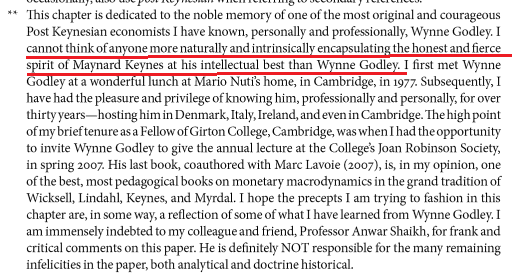
That is so right. The models in the books of Wynne Godley – both Monetary Economics with Marc Lavoie and Macroeconomics with Francis Cripps give a good idea about the authors’ intuitions. Of course, needless to say the man was bigger than his models.

Wynne Godley - NYT

Firestone Backfiring – An Unfriendly Critique ;-)

Firestone's Gun

Joe Firestone’s gun

Joe Firestone has a blog post critiquing Marc Lavoie’s critique of Neochartalism.

Among other things, he seems to have issues with Marc Lavoie’s critique of the Neochartalist claim [which he quotes] that

. . . the creation of high powered money requires government deficits in the long run; . . .

Firestone states:

High-powered money includes cash money and reserves emanating from the Government, including the Federal Reserve. If there’s no deficit spending the Government is destroying as much money through taxation as it is spending/creating.

The trouble with Neochartalism is that Neochartalists and “MMT” fans go to over-overkill levels to show the importance of fiscal policy. In general it is a mix of doublespeak and outright incorrect statements and it is highly unacademic and unscholarly.

Firestone is mixing various things. HPM or “high powered money” is different from the net financial assets created by deficit spending of the government.

To see this point, first imagine an open economy in which there is a current account balance of payments surplus of say around 4% of GDP for over 10 years or so (some proxy for “long run”) and the (domestic) private sector “NAFA” – net accumulation of financial assets is around 2% of GDP. The government budget will be in surplus – as a matter of accounting. This needn’t cause any trouble for the private sector.

Of course this doesn’t take away the role of fiscal policy and in no sense is the above statement meant to propose a policy for the government to be in surplus. In fact since the government’s budget balance is endogenous, it could well be the case in the above situation that the government’s fiscal policy is expansionary.

HPM is a different matter. The central bank can easily provide banks with reserves via open market operations or direct lending. Deficit spending is not really needed.

It may also be the case that while taxes flowing into the account of the government at the central bank is “destroying” more HPM than what expenditures is creating, net redemptions of government bonds (as the government is retiring debt) is creating HPM.

Now consider another case but a closed economy.  Assume that the private sector NAFA is negative for many quarters/years and the government’s budget is in surplus. This by itself is not a problem for HPM but may become unsustainable because the nonfinancial sector can start to have liquidity pressures – i.e., financial assets/income of the private nonfinancial sector may start to deteriorate even though net wealth/gdp is not falling (wealth includes nonfinancial assets such as firms’ fixed capital and households’ houses) and this may lead to more financial fragility.

Again, fiscal policy can be expansionary even with a surplus budget because the government budget balance is endogenous. Cannot be found from the above given data.

But Firestone blurs such matters giving the reader an impression that the private sector is losing assets and sees a reduction in output and income. And to the basic point, this has really little to do with HPM.

Firestone is highly confused and muddled when he says

Lavoie seems to think that net high powered money creation isn’t necessary for an economy, even if it is good to have.

Net HPM creation is not equal to private sector NAFA.

In fact typically the government’s cash flows do not affect the HPM when looked over larger time intervals. Expenditures add to HPM as the government moves its balances from its account at the central bank and taxes do the opposite. Bond issuances reduce HPM and redemptions increase it. Over short intervals, the flows are offset by central bank operations. Also for the wonkish, this needn’t always be the case: when there is a flow out of the government’s account at the central bank, it can simply lead to reduction of banks’ daylight overdrafts instead of increasing HPM. Firestone confuses cash flows with deficits.

Post-Keynesians And Others

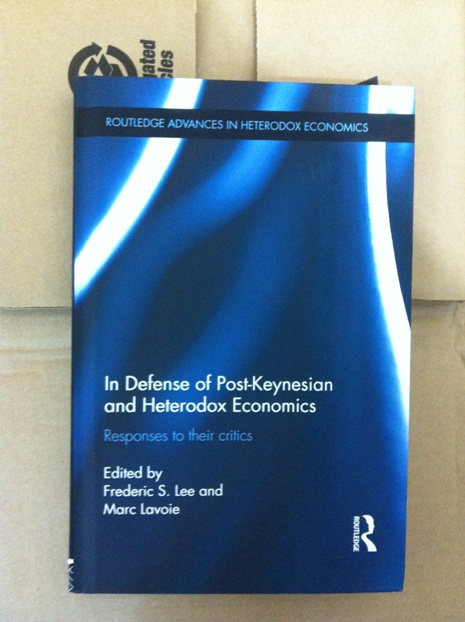
That is the title of Chapter 1 (by John E. King) of this book which has just come out.

The Routledge website is here.

I just got the book and flipped through to come across this at the beginning of Frederic Lee’s article (Chapter 6):

HETERODOX CRITIC: We want to change heterodox economics.

HETERODOX ECONOMIST: What kind of change are you talking about?

HETERODOX CRITIC: The kind that does not mess with the mainstream status quo.

Matias Vernengo had a post a while ago (when the book was finalized) and it has links to articles by Marc Lavoie and Fred Lee (quoted above).

I found this reference to an article by Fischer Black in Marc Lavoie’s article in the book. It was written in 1970:

click to view the pdf file

Philip Pilkington Interviews Marc Lavoie

Philip Pilkington’s interview of Marc Lavoie on his textbook Monetary Economics is available to read at Naked Capitalism. New Directions in Monetary Economics: An Interview with Marc Lavoie – Part I

Part 2 appears here: New Directions in Monetary Economics: An Interview with Marc Lavoie – Part II

Wynne Godley used to think that Keynesians were being defeated by Monetarists because they (the Keynesians) simply could not answer how money (in general assets and liabilities) is created and hence wrote the book Macroeconomics with Francis Cripps. After that he wanted to make it even more solid.

Marc Lavoie says:

… it is clear that Wynne wished to depart from neoclassical economics, and start from scratch, which is what he did to some extent already when Wynne and his colleague Francis Cripps wrote a highly original book that was published in 1983, Macroeconomics. This book was written because Wynne got convinced that the Keynesians of all strands were losing their battle against Milton Friedman and the monetarists, because Keynesians could only provide very convoluted answers to simple questions such as: “Where does money come from? Where does it go? How do the income flows link up with the money stocks? How is new production financed?”

Our book Monetary Economics also tries to provide appropriate answers to these questions. We agonized for a while between trying to engage in a constructive dialogue with our mainstream colleagues and targeting a non-mainstream audience, or perhaps trying to achieve both goals. In the end, we figured that it would be very difficult to please both audiences, and we chose to focus on a heterodox audience. In any case, I have spent most of my academic career trying to develop alternative views and alternative models of economics – what is now called heterodox economics; this is the literature we know best. So we took our book as a formal contribution to this heterodox literature and more specifically as a contribution to post-Keynesian economics.

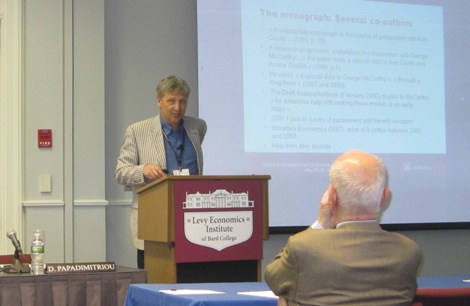
Marc Lavoie at the Levy Institute, May 2011 (Photo Credits: me 😉 )

Toward A Higher European Integration?

In an article today Europe Mulls Major Step Towards “Fiscal Union”, Reuters reports that Angela Merkel is pushing for a “giant leap forward”:

After falling short with her “fiscal compact” on budget discipline, German Chancellor Angela Merkel is pressing for much more ambitious measures, including a central authority to manage euro area finances, and major new powers for the European Commission, European Parliament and European Court of Justice.

She is also seeking a coordinated European approach to reforming labor markets, social security systems and tax policies, German officials say.

Until states agree to these steps and the unprecedented loss of sovereignty they involve, the officials say Berlin will refuse to consider other initiatives like joint euro zone bonds or a “banking union” with cross-border deposit guarantees – steps Berlin says could only come in a second wave.

“Kaldorians” jumped to highlight the serious defects in the European plan for integration when officials were working on the Maastricht Treaty. One of the implicit assumption on which the dogma of “free trade” is pushed is that current account deficits do not matter. The government’s task is to only make markets free in this view. The Euro Area was formed with the highly incorrect notion (among various others) that nations can simply solve their “balance of payments problem” by getting rid of it altogether.

I was reading this article by Ken Coutts and Wynne Godley from 1990 [1] where the authors point to different kinds of arguments put forward by others to defend this position (“current account deficits do not matter” provided markets are made free).

There appear to be six different lines of argument to the effect that the current account deficit can be ignored …

… (v) A different kind of argument makes a comparison between a nation with an external deficit and a relatively poor region within a nation. It is pointed out that there is no balance of payments problem for Scotland or for Northern Ireland and from this it is concluded that as soon as Britain joins a European monetary union its balance of payments ‘problem’ will disappear permanently …

… The argument (v) that a region within a country cannot have a balance of payments ‘problem’ ignores the fact that if a region imports more than it exports its trade deficit is automatically paid for by fiscal transfers.[footnote: Strictly speaking, the fiscal transfers will always exactly compensate for any trade deficit only after allowing for the acquisition of financial assets by the private sector as implied by the ‘New Cambridge’ identity (exports less imports equals net government outlays plus the ‘trade’ deficit). The identity says, of course, nothing whatever about the level of real income and output which trading performance will have generated]. The point may be illustrated by considering an extreme case where a region consumes tradables but cannot produce them at all. In this case there will be a trade deficit exactly equal to imports of tradables, but the flow of government expenditure and net transfers will provide a minimum level of income support and keep life of a kind going without any borrowing at all taking place. If an uncompetitive region were not in receipt of fiscal inflows, its inhabitants would have no alternative but to emigrate or starve. This example illustrates that merely by sharing a common currency with another area, a region or country does not automatically dispose of its balance of payments problems since its prosperity still depends on how successfully it can compete in trade with other areas. The Delors Report itself correctly observes that a monetary union transforms a weakness in the ability to compete successfully from being a balance of payments problem into a regional problem to which there is only likely to be a solution by using the instruments of regional policy.

The movement toward more integration by giving higher powers to the European Parliament was also suggested by Wynne Godley and Marc Lavoie in 2007 [2]:

… Alternatively, the present structure of the European Union would need to be modified, giving far more spending and taxing power to the European Union Parliament, transforming it into a bona fide federal government that would be able to engage into substantial equalisation payments which would automatically transfer fiscal resources from the more successful to the less successful members of the euro zone. In this manner, the eurozone would be provided with a mechanism that would reduce the present bias towards downward fiscal adjustments of the deficit countries.

References

  1. Prosperity and Foreign Trade in the 1990s: Britain’s Strategic Problem, Oxf Rev Econ Policy (1990) 6 (3):82-92. Link
  2. A Simple Model Of Three Economies With Two Currencies, Camb. J. Econ. (2007) 31 (1): 1-23. Link