Triple Crisis has a Spotlight-G20 series and Jayati Ghosh has an article aimed at leaders of G-20 who meet next week in Mexico: Spotlight G-20, If Not Now, Then When
She says:
… the G20 appears to have lost its way. Its original intention – to provide a relatively speedy and workable arrangement for global governance (especially economic governance) at a time when co-ordination of macroeconomic measures is seen as essential – has clearly fallen by the wayside in the past two years. Indeed, if it cannot deliver this time around, it risks sinking into irrelevance, at a time when the global economy badly needs some institutions to respond to what is more and more evident as a crisis of massive proportions
As global imbalances have reached unsustainable levels, the G-20’s role has become more and more important. It is now been forgotten by the economics profession that coordinated reflation of demand is important for growth and that the coordinated action after the crisis hit in 2008 had an important role to play in preventing a deep implosion.
James Tobin realized how shouts used to be ignored. In his article Agenda For International Coordination Of Macroeconomic Policies [1], he said:
Coordinate policies! So economists urge governments. Financiers, journalists, pundits, politicians take up the cry. Central bankers and finance ministers agree, as do presidents and prime ministers. They meet, they talk, they announce progress. It turns out to amount to very little…
With its balance of payments at critical levels, the United States is no longer in a position to reflate demand and in the process continue to drive growth in the rest of the world by acting as the importer of the last resort. Hence it is no longer possible for the rest of the world to grow on the path it had taken before the crisis – i.e., depending on the United States. A recovery for the medium-term is only possible if there is a strong reflation of worldwide demand by governments.
More importantly even this will not be sufficient as it just postpones the reversal of global imbalances. However for now immediate action is required and a strong forum is needed to work out a plan to address the bigger challenge.
References
James Tobin, Agenda For International Coordination Of Macroeconomic Policies, Ch 24, p 633, Essays In Economics, Volume 4: National And International, The MIT Press, 1996
If a government (outside monetary unions) can make a draft at the central bank, why do rating agencies rate governments’ creditworthiness?
In this post, I will attempt to describe the dynamics of defaults and restructurings by going through some monetary economics of open economies.
Carmen Reinhart and Kenneth Rogoff wrote a book in 2009 titled This Time Is Different: Eight Centuries Of Financial Folly or simply This Time Is Different arguing that governments do indeed default – both in debt denominated in the domestic and foreign currencies. They blame the public debt and the government for the public debt – hence giving the innuendo that governments across the planet should attempt to cut public debt by tight fiscal policies. This is an illegitimate conclusion – on which I will say more below.
At another extreme are the Chartalists who argue that the government cannot “run out of money” and hence fiscal policy has no monetary constraints. Sometimes they qualify this statement by saying that the currency they are discussing are “sovereign currencies”. Now, there are various definitions of what a sovereign currency is but it is frequently pointed out by them that nations who have seen restructuring of government debt did not have a “sovereign currency” – because the currency is either pegged or fixed or it is the case that the government had a lot of debt in foreign currency which presumably allows defaults/restructuring of government debt in the domestic currency as well. The motivation behind this is Milton Friedman’s idea that nations should freely float their currencies in international markets and that markets will clear and that the State intervention in the currency markets can only make things worse. Hence Reinhart/Rogoff don’t prove them wrong – according to them – since the situations are supposedly different.
We will see that while there is some truth to it, the notion of a “sovereign currency” is highly misleading. Such intuitions are coincident with the incorrect notion that indebtedness to foreigners (in domestic currency) is just a technical liability and there’s nothing more to that!
Here’s S&P’s article on the methodology it uses to assign ratings on governments: Standard & Poor’s – Sovereign Government Rating And Methodology. One can see the importance it gives to the external sector. However, S&P does not provide a mechanism on how a government will finally end up defaulting. The purpose of this post is to look into this.
Before this let us make a connection between the public debt and the net indebtedness of a nation. Most people in the planet confuse the two. The former is the debt of the government whereas the latter is the (net) indebtedness of the nation as a whole. This is the net international investment position (adjusting for traditional settlement assets such as gold) with the sign reversed. This can be obtained by consolidating all the sectors of an economy and the consolidation involves (for example) netting of the assets of the domestic private sector held abroad and also its gross indebtedness to the rest of the world.
So one can think of two extremes:
Japan – with a high public debt of about 195% of gdp (includes just the central government debt), while being a net creditor of the world. It’s NIIP is about 50% of gdp (data source: MoF, Japan)
Australia – with a low public debt of 18% of gdp and NIIP of minus 59% of gdp.
So in the case of Japan, while the government is a huge debtor, the nation as a whole is a creditor, whereas in the case of Australia, it is the opposite. So the rating agencies get it wrong or opposite!
Let us first assume a closed economy. The greatest starting point in analyzing economies is the sectoral balances approach. For a closed economy it is:
NAFA = DEF
where NAFA is the Net Accumulation of Financial Assets of the private sector and DEF is the government’s budget deficit. If the private sector wants to accumulate a lot of financial assets, and the government wants to run the economy near full employment, the public debt will be higher, the higher the propensity to save, for example. (This is not as straightforward as presented here but can be shown in a simple stock-flow consistent model). So unlike what neoclassical economists think, the level of public debt is somewhat irrelevant. Neither does the government has too much trouble in financing its debt because the public debt is the mirror image of the private sector net financial asset position.
Now let us take the case of an open economy. The sectoral balances identity now is
NAFA = DEF + CAB
A deficit in the current account implies an increase in the net indebtedness to foreigners. Unless the markets miraculously clear with the exchange rate adjusting to bring the CAB in balance, a deficit in the current account implies the nation as a whole has to attract foreigners to finance this deficit i.e., via a lower NAFA or higher DEF. In the long run, the private sector is accumulating financial assets (or has small positive NAFA) and the whole of the current account balance is reflected in the public sector balance.
So the debate fixed vs floating doesn’t help too much. A relaxation of fiscal policy may spill over into higher imports with the public debt and the net indebtedness to foreigners keeps rising forever to gdp. Hence nations typically have to curb growth to bring the current account into balance.
This is theory. So let’s look at an open economy mechanism of an event of default by the government as a story.
In the following, I will use the phrase “pure float” instead of the dubious terminology “sovereign currency”.
Here’s the simplest model:
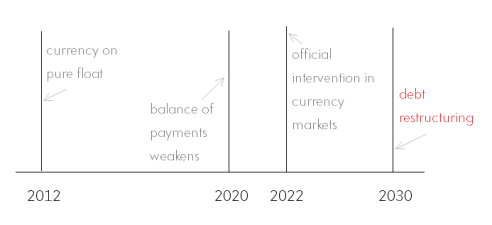
In the above, a nation with its currency on a pure float and with zero official sector liabilities in foreign currencies has a somewhat weak external position in 2012. Now, according to some of the Neochartalist arguments this nation can’t default on its government debt. However this is a wrong conclusion as the scenario above hightlights. In the scenario constructed, the balance of payments position weakens over the years (and I have mentioned that roughly in 2020 it weakens). In 2022, foreigners are no longer willing to finance the debt. This may be due to a capital flight or due to the inability of the banking system to maintain a low net open position in foreign currency. The depreciation of the domestic currency isn’t sufficient to clear the fx markets and the official sector (either the central bank or the government’s treasury) necessarily has to intervene in the foreign exchange markets by issuing debt denominated in foreign currency. The government is then acting as the borrower of the last resort and the objective is to use the proceeds to partially have more foreign exchange reserves and/or to sell the foreign currency proceeds from the debt issuance to clear the fx markets. The government is then left with a net liability position in the foreign currency. Soon the external situation worsens to the point requiring official foreign help – such as from the IMF – which promises to help and requires a restructuring of the debt both in domestic and foreign currencies.
Free marketers have a blind belief in the markets and the theories are built on the assumption that markets always clear. The recent crisis has highlighted that this isn’t the case. Even for the case of Australia – whose currency can be considered closed to being pure float – has had issues in the external sector and the Reserve Bank of Australia had to borrow in US dollars from the Federal Reserve (via swap lines) to help Australian banks meet their foreign currency funding needs during the crisis.
Of course the above is not typical but to prevent the external vulnerability to go out of control, governments keep domestic demand low and a lot of times, they over-do this.
The point of the exercise is to prove that it is not meaningless to think of nations becoming bankrupt in whichever situation one can think of and it doesn’t help to laugh at the rating agencies and make fun of them – possibly with the exception for the case of Japan. Statements such as “government with a sovereign currency cannot become bankrupt” are simply misleading. In the above, the Chartalists would argue that the currency was not sovereign and they were not wrong about the default but the currency was sovereign in their own definition in 2012!
Here are some comments on some nations.
Japan: As mentioned above, Japan is a net creditor of the rest of the world and partially as a consequence of that, most of the Japanese government’s debt is held internally. The rating agencies are aware of this but in spite of this continue to make comments on the creditworthiness of the Japanese government. It is possible that residents may transfer funds abroad for unknown reasons (which the raters for some reason suspect) but it may require just a minor interest rate hike to prevent this from happening. Japan has a relatively strong external situation and hence has no issues in financing its government debt.
Canada: Nick Rowe of WCI mentioned to me on his blog that worrying about the balance of payments constraint is like “beating a dead horse” – citing the example of Canada which has floated its currency and it seems has no trouble with its external sector. But this ignores other things in the formulation of the problem. Canada is an advanced nation and an external situation which is not weak. However, a growth of the nation much faster than the rest of the world will lead to a worsening of the external situation. To some extent the nation’s external situation has been the result of its relatively better competitiveness of exporters compared to its propensity to import and a demand situation which either as a conscious attempt of demand management of the government or by pure fluke has helped its external situation remain non-vulnerable.
United States: The US dollar is the reserve currency of the world and slowly over time, the United States has turned from being a creditor of the rest of the world to becoming the world’s largest debtor nation. (Again not due to its public debt but because of its net indebtedness to foreigners). The US external sector is a great imbalance and any attempt to get out of the recession by fiscal policy alone will worsen its external situation leading to a crash at some point. S&P is right! So to come out of the depressed state, the nation has to complement fiscal expansion with improvement of the external situation such as by (and not restricted to) asking trading partners to not revalue their currencies. Still for some reasons bloggers at the “New Economic Perspectives” think that
… Bernanke also knows that the US has infinite ability to finance these fiscal components, that there is no solvency issue and that the policy rate and both ends of the yield curve are under the direct control of the Fed.
Back to This Time Is Different. While Reinhart and Rogoff’s analysis of government debt may be useful, their conclusions can be destructive for the world as a whole. The domestic private sector of a nation needs continuous injection from outside so that it can run surpluses in general and tightening of fiscal policies will lead to a depression. Global imbalances is crucial in understanding the nature of this crisis (and not public debt alone) and even coordinated attempts to reflate economies may provide only a temporary relief. Since failure in international trade restricts the growth of nations and their attempts to reach full employment, what the world needs is an entirely different way to run the economies under managed trade with fiscal expansion. Ideas of “free trade” such as that outlined here by Alan Blinder simply help some classes of society at the expense of others because it relies on the “market mechanism” which has failed over and over again.
This brings me to “sovereignty”. As argued, the concept “sovereign currency” is almost vacuous (except highlighting the problems of the Euro Area) but sovereignty as argued by Wynne Godley in his great 1992 article Maastricht And All That and by Anthony Thirlwall in the same year on FT (my post on it here Martin Wolf Pays A Generous Tribute To Anthony Thirlwall) definitely have great importance. Some of Thirwall’s concepts of economic sovereignty in the article were: the ability to protect and encourage strategic industries, the possibility of designing systems of managed trade to even out payments imbalances, the ability to protect against certain countries with persistent surpluses, differential taxes which discriminate in favour of the tradeable goods sector.
The Bank of England released the semiannual Financial Stability Report, December 2011 today. Complete book here. These reports have a lot of information, in addition to being well-written, well-formatted and colourful.
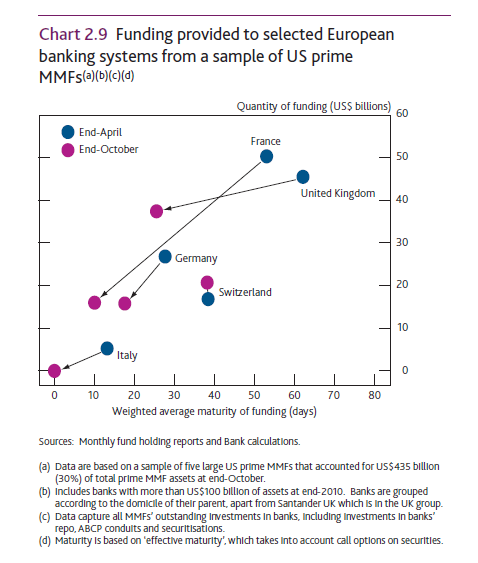
The following graph shows how international banks’ funding from US Money Market Mutual Funds changed during the year.
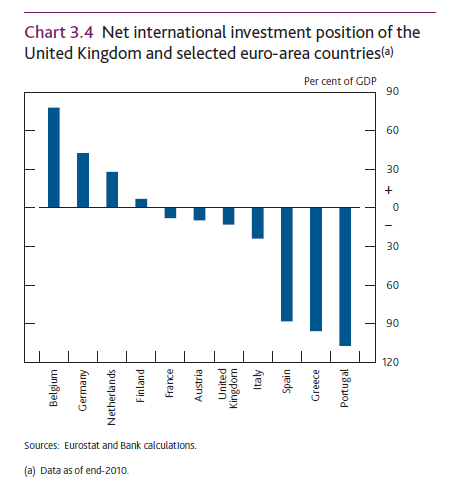
It also plots the Net International Investment Position (the negative of a nation’s debt) – which I have plotted many times in this blog (see here and here for example) and linked to other sources who have plotted it recently and is the reason for my writing this post!
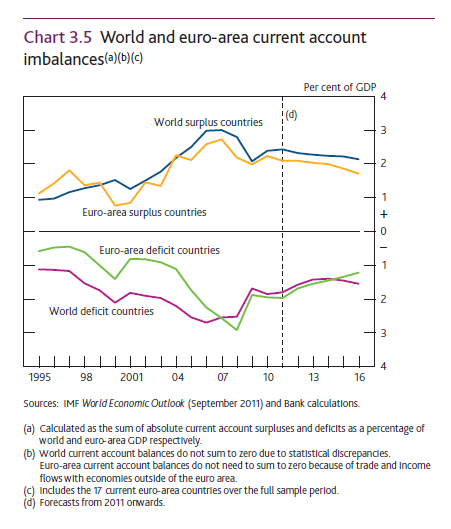
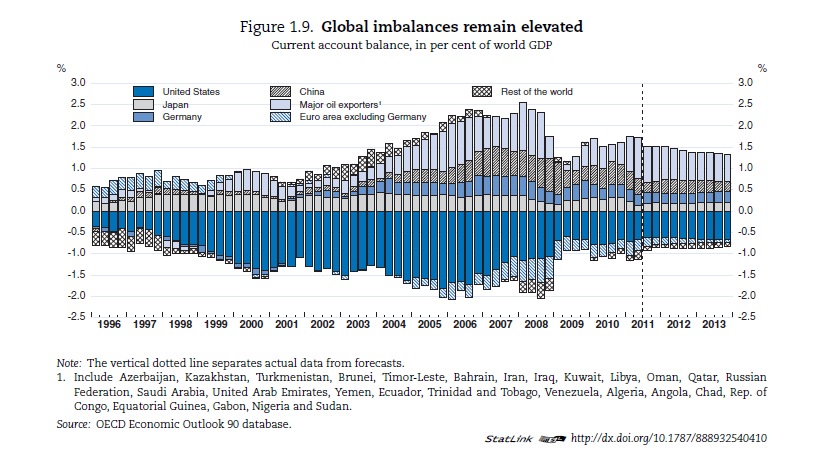
It also has a chart on global imbalances with a focus on EA imbalances
Nice report. Go read.
Update: FT Alphaville’s post BoE charts, UK banks’ gloom also discusses some (different) charts from the report.
The OECD released its Economic Outlook recently. The preview is available here but download is for subscribers. Else if you are an FT subscriber, you can get it from FT Alphaville’s Long Room.
A few interesting charts (at least for me):
(click to enlarge)
Most Economists (except a few good ones), following the work of Mundell, Fleming and Friedman believed that in floating exchange rate regimes, the invisible hand will work to remove imbalances. Unfortunately, this has not happened and it has taken the crisis for them (most of them actually!) to realize that there is no mechanism and it is still unclear if they understand this.
There are some dissenters among Post Keynesians, such as Randall Wray, who do not consider current account deficits as an imbalance. See this blog post. Also see Reserve Bank of Australia’s Guy Dibelle’s speech In Defense of Current Account Deficits from July 2011.
An intuition I see often displayed in blogs is that these numbers are small and hence not problematic! My view is that these imbalances are kept low by keeping demand low. More importantly, these imbalances (deficits) add to the stock of external debt (because a deficit in the current account increases net indebtedness to foreigners) and this gets out of control sometimes leading to deflation of demand and/or seeking help from the IMF. So “low” imbalances accumulate to a huge net indebtedness.
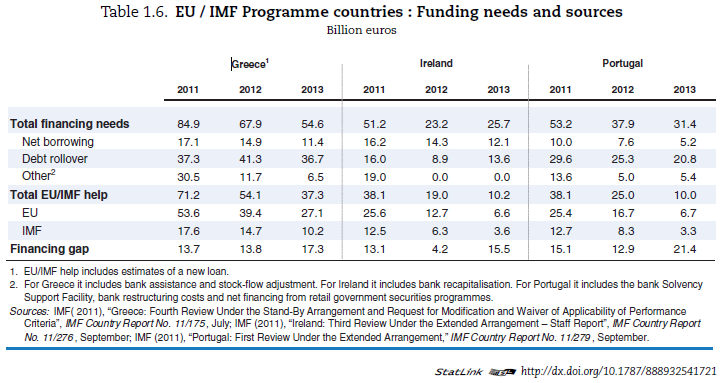
There is an informative graph on the financing needs of Greece, Ireland and Portugal:
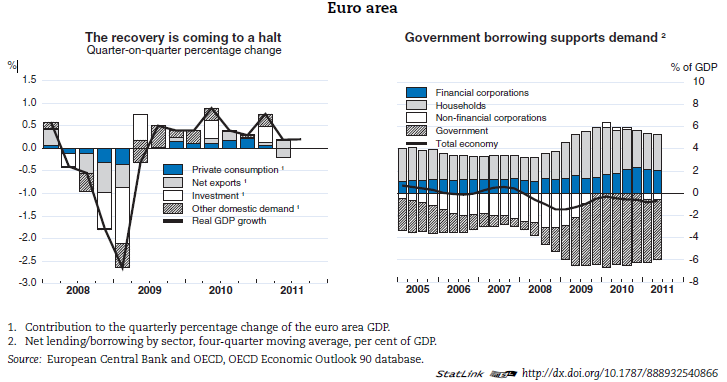
The report also charts sectoral balances for the Euro Area!
(click to enlarge)
The Euro Area as a whole seems healthy, and it is imbalances within that are causing the troubles.
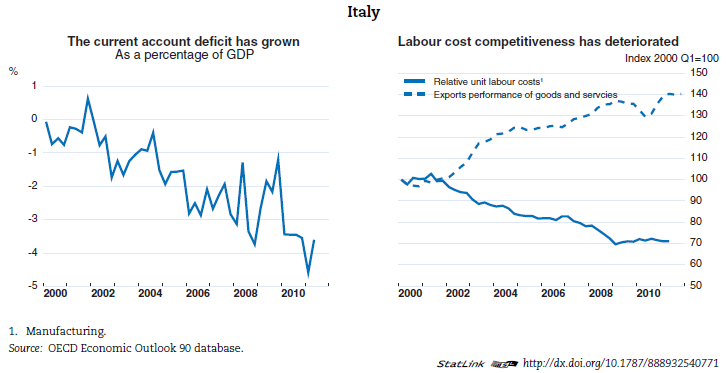
It seems Italy’s current account is worsening:
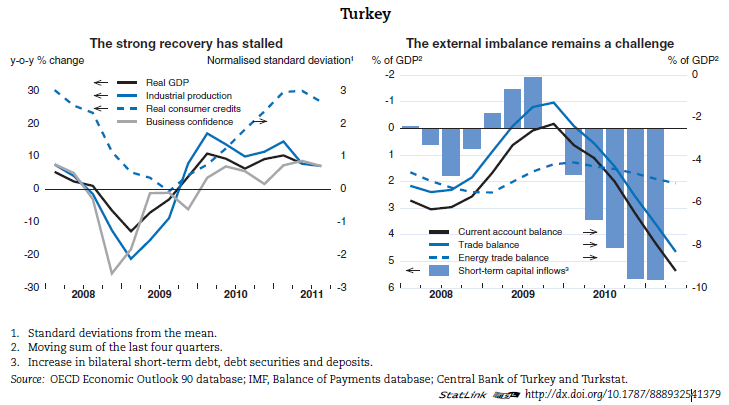
Turkey’s current account attracts a lot of attention and challenges look like this:
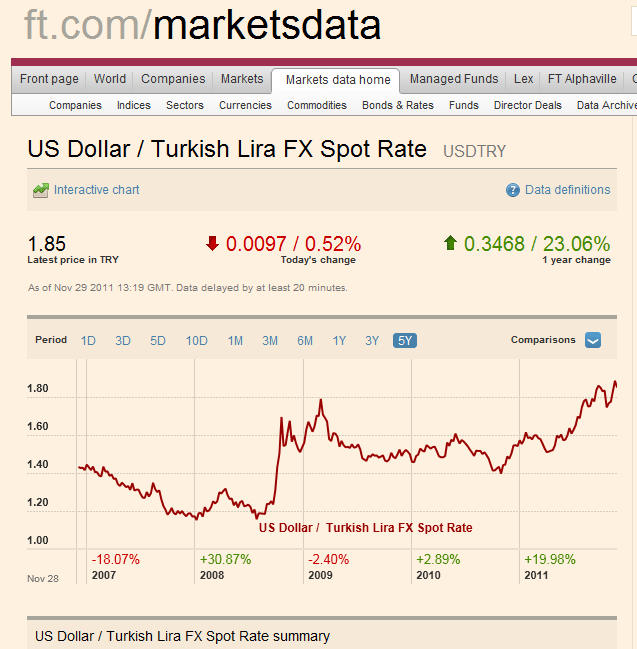
Turkey’s currency Lira has depreciated a lot recently
In Post Keynesian theory, the exchange rate is determined in a beauty contest in addition to demand and supply for financial assets. Sudden movements can be very painful and hence nations face a balance of payments constraint – success of nations depends on how producers do in international markets. In words of Wynne Godley,
For growth to be sustainable, it is essential that the management of domestic demand be complemented by the management of foreign trade (by whatever policies) in such a way that the net balance of exports less imports contributes in parallel to the expansion of demand for home production.
At the global level, since not everyone can be net exporting, the problem of global imbalances affects everyone, and new changes are required on how the global economy is run.
I am curious as to what Barry Eichengreen has to say in his talk at the Federal Reserve’s annual forum at Jackson Hole, Wyoming. He is the author of the book Exorbitant Privilege: The Rise And Fall Of The Dollar And The Future Of The International Monetary System – one of the books I want to read soon. The phrase Exhorbitant Privilege was coined in the 1960s by the then French Finance Minster Valéry Giscard d’Estaing. The term refers to the high ability of the United States (and directly and indirectly, the United States government) to borrow in US$ to finance its balance of payments deficit.
To some extent, the scale and timing of the Federal Reserve’s emergency operations during the credit crisis which started around 2007 has helped maintaining the hegemony of the US$ for a while and Barry Eichengreen knows that. This United States Government Accountability Office (GAO) report Federal Reserve System – Opportunities Exist To Strengthen Policies And Processes For Managing Emergency Assistance is a nice reference for the kind of operations done by the Fed, especially international swap lines. Many central banks made use of the swap lines and lent large quantities of US$ to the banking system because banks were facing funding issues in dollars.
Back to the Jackson Hole Symposium. Everyone is waiting for the ECB Chairman Jean-Claude Trichet’s talk. Meanwhile Christine Lagarde, IMF’s chief touched on some issues about imbalances in her speech. She rightly points out that
… risks have been aggravated further by a deterioration in confidence and a growing sense that policymakers do not have the conviction, or simply are not willing, to take the decisions that are needed.
which is quite right, IMO because this crisis needs coordination at a scale never seen before. She also points out that
As we all know, a major cause of the crisis was too much debt and leverage in key advanced economies. Financial institutions engaged in practices that magnified, disguised and fragmented risk, while households borrowed too much. Experience tells us that these excesses (combining both housing and financial crises) take a long time to work off—and require decisive action. We have made some progress, but not enough to unshackle growth.
I am by no means downplaying what has been done. In 2008, governments took bold action to prevent a calamitous collapse in demand. They offset private contraction with fiscal expansion and used public resources to recapitalize financial institutions. They strengthened financial regulation, and reinforced the capacity and resources of international institutions. And monetary authorities did their part as well.
But today, it is public sector balance sheets themselves that are in the firing line. Today, the headline problems are sovereigns in most advanced economies, banks in Europe, and households in the United States. Adding to this—global growth is also being held back by policies that slow demand in some key emerging market economies while balance sheet risks are increasing in others.
The fundamental problem is that in these advanced economies, weak growth and weak balance sheets—of governments, financial institutions, and households—are feeding negatively on each other. If growth continues to lose momentum, balance sheet problems will worsen, fiscal sustainability will be threatened, and policy instruments will lose their ability to sustain the recovery.
which is quite right. Fiscal expansion has helped nations recover from the private sector imbalance but fiscal policy alone cannot achieve everything. However, somewhere her message won’t work well because she mentions earlier in her speech that
Two years ago, it became clear that resolving the crisis would require two key rebalancing acts—a domestic demand switch from the public to the private sector, and a global demand switch from external deficit to external surplus counties. On the first, the idea was that strengthened private sector finances would allow the engine of growth to switch back from the public to the private sector. On the second, the idea was that higher demand in surplus countries would make up for a lower spending path in deficit countries. But the actual progress on rebalancing has been timid at best, while the downside risks to the global economy are increasing.
implying thereby that coordinated fiscal policy (expansion) has no role in the long run, at least giving the impression to the reader/listener. However, she is right in stressing that surplus nations need to take up the task of rebalancing.
While talking of “urgent recapitalization” banks in Europe require, Lagarde also talks of a common vision for Europe:
Third, Europe needs a common vision for its future. The current economic turmoil has exposed some serious flaws in the architecture of the eurozone, flaws that threaten the sustainability of the entire project. In such an atmosphere, there is no room for ambivalence about its future direction. An unclear or confused message will add to market uncertainty and magnify the eurozone’s economic tensions. So Europe must recommit credibly to a common vision, and it needs to be built on solid foundations—including, for example, fiscal rules that actually work.
but no mention of a fiscal union! Most people – economists at least – would take the above to mean a plan to work toward achieving targets for deficits and public debt – an impossible dream.
Lagarde’s conclusions are right
There is a clear implication: we must act now, act boldly, and act together.
but this comes only by at least and not limited to coordinating fiscal policies not by “fiscal consolidation” – a phrase which literally suggests a fiscal contraction.
Conclusion
The IMF is a part of the problem but Christine Lagarde’s heart is in the right place – she needs to carefully think about how fiscal policy really matters and convey to others some of the ideas she has thought of, since they are slightly different from the IMF’s traditional beliefs. How far she goes will be interesting to see.
The sectoral balances identity
NAFA = PSBR + BP
(where NAFA is the private sector net accumulation of financial assets, PSBR is the public sector borrowing requirement to finance its deficit and BP is the current balance of payments) and the approach which is built around this, implies that if the public sector wants more saving, the government has no choice but to accommodate this demand unless it is prepared to run the economy at less than full employment. However, it doesn’t mean that the government has the ability to fully relax its fiscal stance up to constraints from the supply side, because if domestic demand starts expanding faster than domestic output, the nation’s balance of payments situation will suffer and this can be resolved only by correctly negotiated international policies which is good for all. The IMF should look at it that way instead of recommending fiscal expansion as a temporary measure.
Update
For a different take on Lagarde’s speech check Zero Hedge
On fiscal policy, she continued the IMF’s change of emphasis away from immediate fiscal tightening, and towards fiscal programmes that reduce deficits over the long-term but which allow spending to continue while economies stay weak.