Tag Archives: global imbalances

On Adam Tooze Talking Down Global Imbalances

In his newsletter, Chartbook, in a recent post Chartbook 442: Global imbalances – A new cocktail in old bottles: World Economy April 2026:, Adam Tooze discusses global imbalances but seems dismissive of the problem.

For some, the continuing accumulation of US sovereign liabilities is a worry. It is true that the US Treasury borrows at rates that are higher than for some rich-country sovereigns. But if that is your concern, why start with the balance of payments? If you want to reduce America’s fiscal overhang, issue less debt. In the current moment it is not just American trade policy that is shocking. Never in American history has the country run such a large budget deficit at a time of relatively full employment.

Now that is quite dismissive, especially since the United States is not at full employment. Worse, he comes close to getting it but does not in fact get it: the budget deficit and public debt are large as percent of gdp because of the current account deficits. Having a policy of fiscal contraction would lead to a fall in gdp. Tooze seems to be minimising the causality from the current account balance to budget deficit. Public debt is not itself a problem but reflects the huge negative net international investment position of the United States. Large deficits because the balance of payments situation reduces the expenditure multiplier to bring sufficient taxes in.

From a larger perspective, Tooze offers no solution to all this. Why would he? The purpose of his article is to play down the problem.

Years later, Adam Tooze is going to be writing a mea culpa on how he was wrong on this problem.

The irony is that Adam Tooze is highly influenced by Wynne Godley, who worried about imbalances, and proposed to change the economic order to move toward a system of balanced trade combined with expansionary fiscal policies. In his 2018 book Crashed, Tooze says:

Wynne Godley was a mentor and teacher of a very different kind. Spontaneously warm and generous in spirit, he took me under his cape in my first year at King’s and introduced me, and a group of my contemporaries, to what, at the time, was a highly idiosyncratic brand of economics. In so doing he provided a model of intellectual warmth and vitality. And he confirmed doubts that had been gestating in me about the IS-LM model that was my first great love in economics. Wynne introduced me to the importance of looking “beyond the flows” and insisting on stock-flow consistency in macro models. I don’t think this book, written almost thirty years later, would have been the same without his early influence.


The IMF On Global Imbalances In 2026

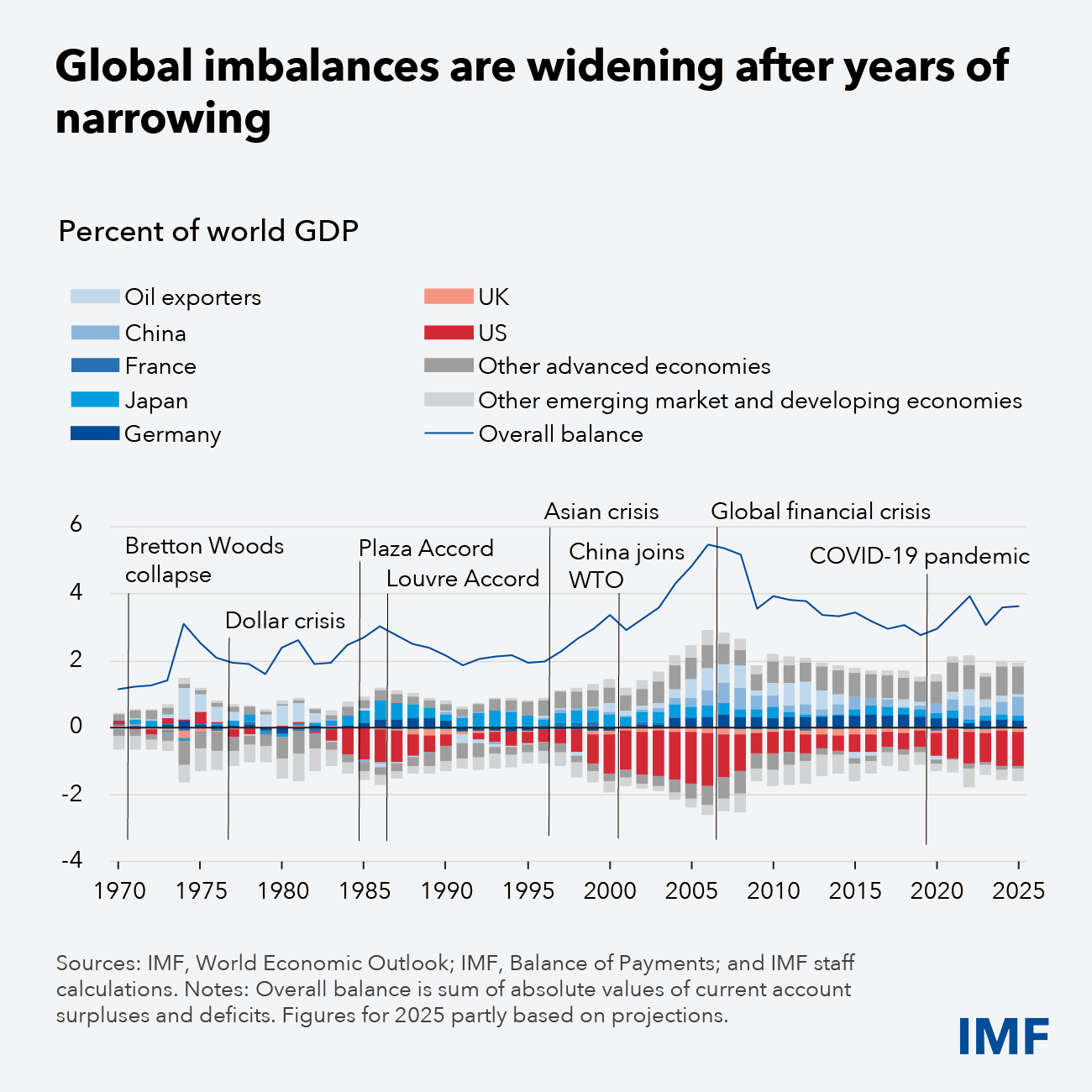
A few days ago, the IMF wrote about global imbalances, with this chart:

Global imbalances in 2026

Source: IMF

The IMF’s analysis uses the identity:

SI = DEF + CAB

where S is private sector saving, I is capital formation (investment), DEF is the government deficit, and CAB is the current account balance.

You can move the government deficit term to the left-hand side, with S and I now denoting the saving and capital formation of the whole country:

S (national) − I (national) = CAB

And just reasoning from the accounting identity, it concludes that, to improve the current account balance, saving has to be raised—and that this should be done via fiscal tightening.

Ugh.

Although it is fascinating that the IMF is at least acknowledging that there is a problem!

However, the IMF’s solution is ridiculous:

This synchronized adjustment would lead to the best outcome for the global economy. The economic drag from US fiscal tightening would be offset by stronger demand from China and Europe. But even if such coordination proves difficult, the best course of action for each country is clear: start addressing domestic imbalances now, regardless of what others do.

The IMF understands that fiscal tightening would slow down the US economy, so it is calling for coordination with China and Europe, which would require them to pursue fiscal expansion. But it is still proposing fiscal tightening even if others do not cooperate, on the assumption that this would pressure them.

There is no guarantee that this would work—it could instead lead to a worldwide recession.

Instead, we should abandon these dogmas and work toward a plan like Keynes’ proposal (without any Bancor), where countries with current account deficits can use import controls and industrial policy, while surplus countries relax import controls and provide assistance to deficit countries. In extreme cases where they fail to rebalance, they should pay penalties to the rest of the world.

Under such a change in the international order, fiscal tightening is not required per se.

Not Bancor, But An International Agreement

While John Maynard Keynes understood that trade/current account deficits can become a problem, not just for a country with it but also for the whole world, he quite underplayed the role of international trade.

(You can read about the downplaying in Nicholas Kaldor’s essay Keynesian Economics After Fifty Years, in the book Keynes And The Modern World : Proceedings Of The Keynes Centenary Conference, King’s College, Cambridge, written in 1983)

To resolve imbalances, Keynes proposed Bancor, a word which is a combination of the words ‘bank’ and ‘or’, which means gold in French, according to a paper The Eurozone: Similarities To And Differences From Keynes’s Plan by Marc Lavoie.

From the paper:

… The plan is based on a fixed exchange rate system, each foreign currency being expressed as a fixed value of the bancor …

A comprehensive explanation can be found in Marc Lavoie’s paper, which I won’t delve into here. But the important point is that there is a supranational central bank—an International Clearing Bank/ICB—like the ECB, in which national central banks hold accounts and which clears international payments.

Now Keynes proposed various rules, based on settlement balances of national central banks at the ICB, to give a sort of responsibility to surplus countries, such as fines but also that they expand their economies, so that they import more and deficit countries able to take measures such as devaluation.

But there is a problem!

The problem is that surplus/deficit etc are defined from settlement balances of national central banks at the ICB, which are not current account deficits, or not necessarily any indication for other things such as the net international investment position!

Imagine a country such as China which has huge trade or current account surpluses and then the counterpart in the financial account of the balance of payments is the Chinese government accumulating US government bonds. The Chinese central bank’s account at the ICB hardly changes, and the balances show no indication that any surpluses are being built up, and no rules need to triggered.

So obviously Bancor cannot be the solution. The solution is diplomacy at the international level, mainly with current account deficit numbers, but other data in the balance of payments and international investment position too. With responsibilities for surplus countries.

Link

FT Letter To The Editor On Current Account Imbalances And War

FT has published a letter to the editor from some post-Keynesian economists arguing for regulating imbalances in the current account balance of payments, and that such imbalances make wars more likely.

One of the signatory of the letter is Dimitri Papadimitriou, who along with Wynne Godley had been warning about imbalances since the turn of the millennium.

From the letter:

A new international economic policy initiative is therefore required to head off the threat of further wars.

A plan is needed to regulate current account imbalances, which draws on John Maynard Keynes’s project for an international clearing union.

The current system of free trade has created a deflationary bias in the world economy. A further bias is introduced because the United States is now a large debtor of the world and till the crisis which started in 2007 it was acting as the driver of the world, a role which it still plays but is not as big as before. With such a deflationary bias, countries try to use beggar-thy-neighbour policies, as world output is limited. That creates tensions between countries and the desperation to raise output exacerbates the tensions. So a new international order: a system of regulated/planned trade.

After The Economist, The IMF Now Emphasizing Surplus Countries’ Responsibility

Recently, The Economist had a cover story saying that surplus nations bear responsibility for global imbalances and weak economic growth. Now, the IMF is also advising surplus nations to expand domestic demand.

The IMF tweeted this, with a link to a new report (2017 External Sector Report) on global imbalances:

click to view the tweet on Twitter

As I have said before, this is the biggest concession to Keynes’ idea that surplus countries bear the responsibility.

In an articleThe General Theory In An Open Economy, published in 1996, Paul Davidson says:

Keynes was well aware that the domestic employment advantage gained by export-led growth ‘is liable to involve an equal disadvantage to some other country’ (p. 338). When countries pursue an ‘immoderate policy’ (p. 338) of export-led growth (e.g., Japan, Germany and the NICs of Asia in the 1980s), this aggravates the unemployment problem for the surplus nations’ trading partners. These trading partners are then forced to engage in a ‘senseless international competition for a favorable balance which injures all alike’ (pp. 338-9). The traditional approach for improving the trade balance is to make one’s domestic industries more competitive by either forcing down nominal wages (including fringe benefits) to reduce labour production costs and/or by a devaluation of the exchange rate. Competitive gains obtained by manipulating these nominal variables can only foster further global stagnation and recession as one’s trading partners attempt to regain a competitive edge by similar policies.

Two Hundred Years Of Ricardian Trade Theory

Ingrid Kvangraven has a nice article200 Years of Ricardian Trade Theory: How Is This Still A Thing? on the blog, Developing Economics. In that, she asks how “the observation of persistent imbalances (and recurring debt crises in the deficit countries) appears to have little impact on the popularity of Ricardo’s theory.”

It’s a nice article going into details about the assumptions of the trade theory, but let me just add another perspective. New Consensus Economics is based on the assumption about the magic of prices and market forces acting to resolve imbalances. Government “intervention” (a loaded word), supposedly spoils this magic and economists are trained to think that this is the reason for crisis. So a New Consensus economist doesn’t find this to be contradictory. “Hey government, why did you interfere with the workings of the market”, an economist is likely to say.

The role of the government in this model is mainly about law and order and is supposed to balance its books. Whenever a crisis arises, economists tend to blame “fiscal profligacy” and recommend contraction of fiscal policy and “economic reforms”.

Of course, since the financial crisis started about ten years back, economists have conceded that they have been wrong about several things. Fiscal policy is one major area where this is so. But the “learned intuition” is so deeply ingrained and ramified into every corner of their minds—borrowing words from Keynes—that it is difficult for them to escape old ideas.

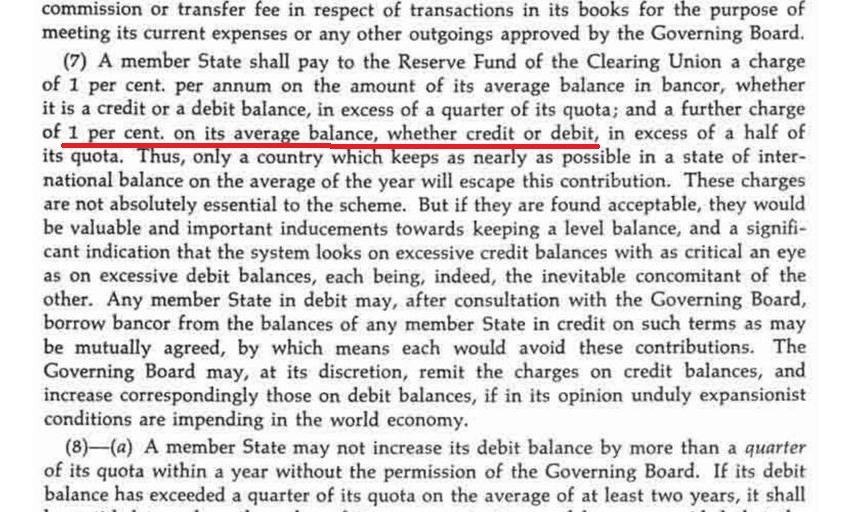
It’s unfortunate that Keynes didn’t stress much about this problem, which is huge. In his GT, he did have a chapter on mercantilism and discussed how the mercantilists behaved the way they behaved because of their distrust in the role of market forces in resolving imbalances. Keynes also had a plan called the Keynes Plan, before the Bretton Woods established. Keynes proposes a fine on creditor nations as well (page 23-24):

from page 23 of IMF’s document on Keynes’ Plan

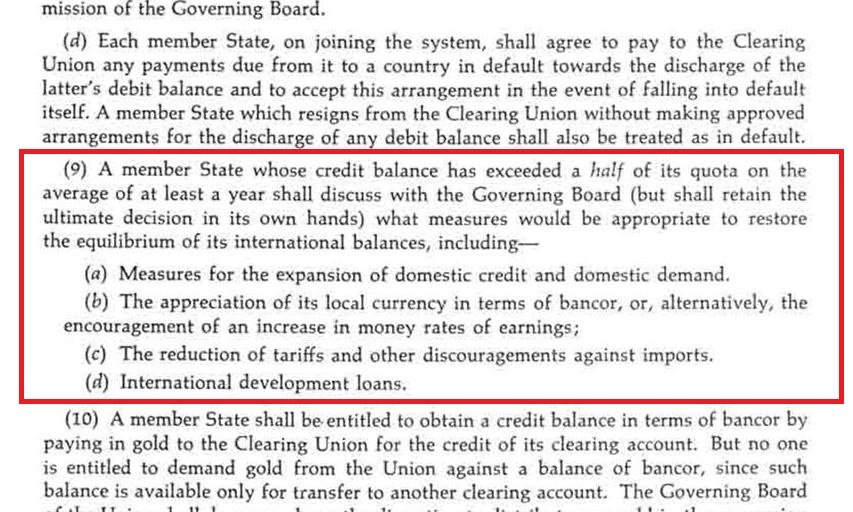
Usually one only hears of this in Post-Keynesian literature but this was not all. He also proposed other responsibilities for creditors:

from page 24 of IMF’s document on Keynes’ Plan

Of course, the idea of a Bancor sounds crazy because of its similarity to the Euro. The trouble with the Euro is that there is no central government with large fiscal powers, such as in a federation like the United States. Bancor would need a world government. Nonetheless, we can still embrace Keynes’ genius that creditors should take responsibility in the rules of the game and reject Bancor. So apart from the principle of effective demand, this is one of Keynes’ biggest contribution to the history of humankind—that creditor nations have a responsibility.

Unfortunately, the world is still stuck with Ricardo’s ideas!

IMF’s World Economic Outlook On Global Imbalances

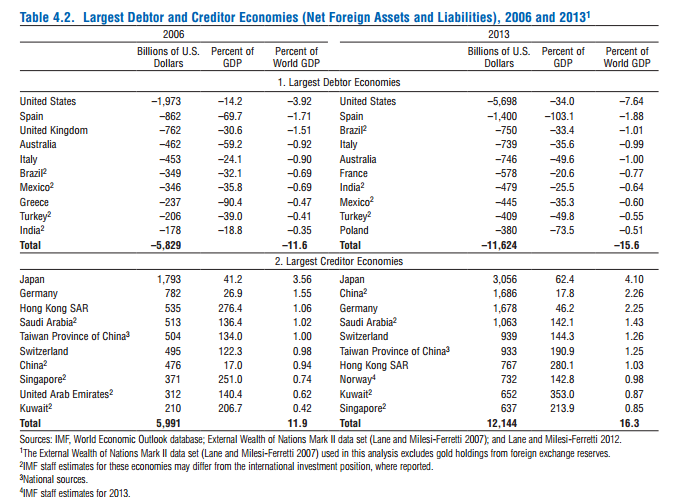
The IMF has released a couple of chapters from its upcoming World Economic Outlook. There is one chapter Are Global Imbalances At A Turning Point, which talks of not just “flow imbalances” (current account deficits/surpluses) but also “stock imbalances” (international investment positions).

There is a nice table with a lot of information (although it is interested in absolute indebtedness and misses out small countries with high indebtedness in the list but still good information).

IMF Largest Creditor And Debtor Economies

The article stresses that flow imbalances are not just enough to analyse the macroeconomics but stock imbalances also need to be studied. Of course, in reality deficits/surpluses are not the true measures of imbalances as Nicholas Kaldor stressed in a footnote in his 1980 article The Foundations Of Free Trade Theory And Their Implications For The Current World Recession (published in Collected Essays Vol. 9):

Morever, the actual surpluses and deficits are not a proper measure of the potential size of such imbalances (and of the deflationary force they exert) since the countries who suffer from an excessive import propensity tend, on that account, to suffer from an insufficiency of domestic demand as well so their aggregate output or income is demand-constrained; they may, in addition be forced to follow a deflationary fiscal and monetary policy, and for both of these reasons, will import less from the surplus countries than they would do under full employment conditions.

The same reasoning is valid for stock imbalances as well. The true solution to reverse the imbalances without hurting aggregate demand is to rein in free trade and expand domestic demand by fiscal policies, especially by creditor nations but with so much orthodoxy around — especially from the IMF, there still is a long way to go. The global imbalances problem itself is the result of neoliberal policies promoted by the IMF.

Cyprus Rescue

Cyprus has recently received the attention of academicians and financial professionals in recent weeks. Need I say that?

So national bankruptcy is to be resolved by winding down a bank, moving guaranteed deposits (i.e., upto €100,000) to another and as per the latest Reuters article on this, big numbers (anywhere ranging from 20 to 40 per cent loss on deposits on amounts over €100,000) are quoted.

Martin Wolf has a good summary:

The current plan is closer to what one would wish to see in an orderly bank resolution. Laiki Bank is to be split into good and bad banks. Deposits of less than €100,000 in the bank and assets worth €9bn – the sum owed to the central bank as part of its liquidity support – will be transferred to Bank of Cyprus. The remainder will be wound down. Those with claims to deposits in excess of €100,000 will obtain whatever the value of the bad bank’s assets turns out to be.

Meanwhile, savers at the Bank of Cyprus with deposits of more than €100,000 will have their accounts frozen and suffer a “haircut” of still unknown size. That reduction in value is likely to be large: perhaps 40 per cent. Finally, temporary exchange controls are to be imposed.

Why are the reasons for such huge numbers?

The reason is that the nation has accumulated huge net indebtedness to foreigners over years and this has been financed by banks raising deposits from foreigners, so that if debt traps are to be avoided, foreigners are to be required to take losses.

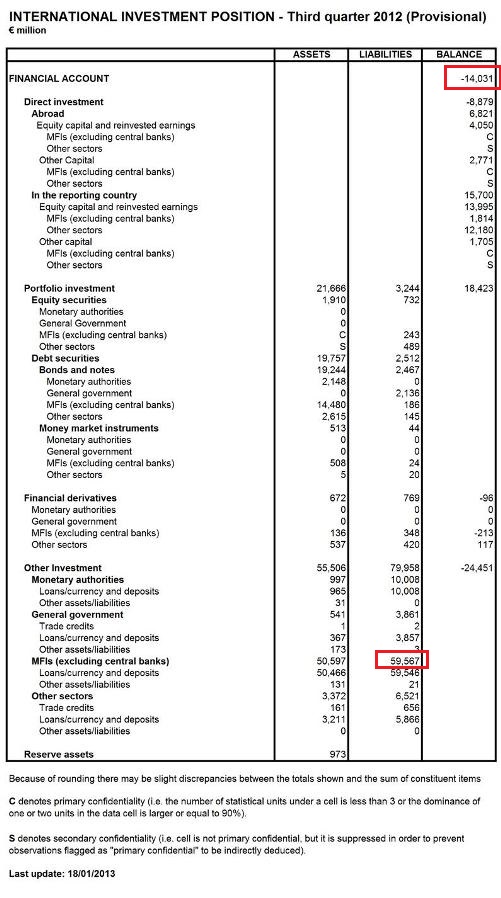
The following is the international investment position of Cyprus at the end of Q3 2012 (source: Central Bank of Cyprus)

Cyprus - International Investment Position Q3 2012In the balance of payments literature, banks’ position is referred as Other Investment. Also, the above refers to a Financial Account but it really means net IIP. Ideally it would have been better if this data had been updated but the above information is useful nonetheless.

As a percent of gdp, the net IIP position (with the opposite convention to standard usage) was 81.1% (Source: Eurostat) which is big in itself but very much lower than the now famous banks’ liabilities to foreigners/Russians! (the second red box above).

If a nation wants to resolve bankruptcy, it is better to do it by imposing losses on foreigners – especially if an international lender of last resort is available! And if this is to done it in the optimal way, best to do it once – rather than keep doing it. The ratio of two red boxes in the table – i.e., net liability as a proportion of gross bank liabilities to foreigners is 24.56%.

So Cyprus needs to wipe out about this amount as a percent of deposits roughly. It is not necessary to reach a position of zero indebtedness but something low such as 10% of gdp is ideal. Some buffer is needed because there will be leakages in spite of capital controls – requiring fire sale of foreign assets (and subsequent losses) by banks or borrowing from the ECB which may want to ensure that banks have good collateral for the ELA. Foreign deposits below €100,000 shouldn’t be hit. So “net-net”, as a percentage, this may be higher than 24.56%. All this depends on the latest situation and the distribution of foreign deposits and also the distribution between residents and foreigners but 24.56% of deposits is a good starting point – it gives a rough estimate of the order of magnitude of the problem.

At any rate, losses imposed on foreigners have to be big for the ECB and Euro Area governments to stand behind.

Gordon Brown Warns G20

Gordon Brown  – who is also known for his slightly silly “Golden Rule” of balancing the budget on current expenditures – has called for a coordination of a “concerted global action plan” in a Reuters Opinion article Decisive Euro Action Is Needed At The G20 Summit.

In my opinion the idea is roughly right – at least someone in talking in this direction.

There needs to be institutions to run the world economy on a fresh set of principles on coordination of fiscal policy, regulation of international capital flows and trade in goods and services instead of having blind faith on market forces.

According to The Telegraph (Gordon Brown: France And Italy May Need A Bail-Out):

Mr Brown’s call is unlikely to come to fruition. Sources have played down speculation of a major international plan, with the summit expected instead to put pressure on Germany to agree to new pan-European bonds.

If anyone has a link to the article of Gene Frieda of Moore Capital on Spain (referred in the Reuters article) please send me.

Jayati Ghosh On G20

Triple Crisis has a Spotlight-G20 series and Jayati Ghosh has an article aimed at leaders of G-20 who meet next week in Mexico: Spotlight G-20, If Not Now, Then When

She says:

… the G20 appears to have lost its way. Its original intention – to provide a relatively speedy and workable arrangement for global governance (especially economic governance) at a time when co-ordination of macroeconomic measures is seen as essential – has clearly fallen by the wayside in the past two years. Indeed, if it cannot deliver this time around, it risks sinking into irrelevance, at a time when the global economy badly needs some institutions to respond to what is more and more evident as a crisis of massive proportions

As global imbalances have reached unsustainable levels, the G-20’s role has become more and more important. It is now been forgotten by the economics profession that coordinated reflation of demand is important for growth and that the coordinated action after the crisis hit in 2008 had an important role to play in preventing a deep implosion.

James Tobin realized how shouts used to be ignored. In his article Agenda For International Coordination Of Macroeconomic Policies [1], he said:

Coordinate policies! So economists urge governments. Financiers, journalists, pundits, politicians take up the cry. Central bankers and finance ministers agree, as do presidents and prime ministers. They meet, they talk, they announce progress. It turns out to amount to very little…

With its balance of payments at critical levels, the United States is no longer in a position to reflate demand and in the process continue to drive growth in the rest of the world by acting as the importer of the last resort. Hence it is no longer possible for the rest of the world to grow on the path it had taken before the crisis – i.e., depending on the United States. A recovery for the medium-term is only possible if there is a strong reflation of worldwide demand by governments.

More importantly even this will not be sufficient as it just postpones the reversal of global imbalances. However for now  immediate action is required and a strong forum is needed to work out a plan to address the bigger challenge.

References

  1. James Tobin, Agenda For International Coordination Of Macroeconomic Policies, Ch 24, p 633, Essays In Economics, Volume 4: National And International, The MIT Press, 1996