Greenspan however confesses that economic models do not have flow of funds in them (just what Bezemer highlighted about mainstream models as opposed to heterodox ones) but claims that the “sophisticated models” of the IMF, the Federal Reserve or JP Morgan explain the real economy well!
This is a note by Eladio Febrero Panos sent to me by Sergio Cesarrato.
by Eladio Febrero Paños
Area de Teoria Economica, Facultad de Economicas, UCLM Pza Universidad no. 1, 02071 Albacete, Spain
Let us assume the following initial situation.
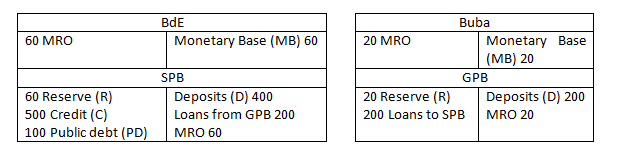
There are two private banks, one in Spain (SPB) and another one in Germany (GPB); we have also two central banks (BdE for Spain and Buba for Germany). For simplicity’s sake, we omit the ECB which connects them through the TARGET2 (T2) system.
Imagine the following balance sheets which (I hope) are self evident:
This figure accounts for the import of a commodity made in Germany by a Spanish agent (amounting to 200 monetary units, m.u. onwards). This import generated a deposit which was then “lent” by GPB to SPB. With this loan, T2 claims and liabilities cancelled out.
Also, we are assuming a compulsory reserve system, with a reserve coefficient of 10% on collected deposits. This is an overdraft system (Lavoie[1] has described this very often), so that each central bank lends to private banks in its jurisdiction the reserves that the former requires the latter to hold.
I think that, up to this point there is nothing controversial.
Next, we shall assume that GPB does not wish to roll over its loan to SPB because whatever reason. Consequently, GPB prefers to bring money at home.
How can this be done, if SPB does not have enough reserves? There are two alternatives.
In the first one, SPB would try to sell its public debt (PD). This option has at least two problems.
Firstly, even if SPB sells all its PD it will not obtain proceeds enough to cancel the loan from GPB.
Secondly, the price of PD would plummet and this is a problem for the implementation of monetary policy:
PD is collateral when borrowing in the interbank market; if its value falls SPB would have it harder to borrow there; and consequently, the credit supply would shrink.
the yield of PD is the reference when calculating the interest rate on loans to solvent borrowers; if the price of PD plummets its yield skyrockets. This would affect negatively to the credit market;
there is a balance sheet effect: if the value of PD falls, SPB’s balance size shrinks because part of its assets has a lower value; if its liabilities remain the same, SPB’s equity would shrink as well and this would lead to less credits.
The central bank aims at preventing this situation (here). Because of this, it will provide SPB with liquidity. And here we have the second alternative.
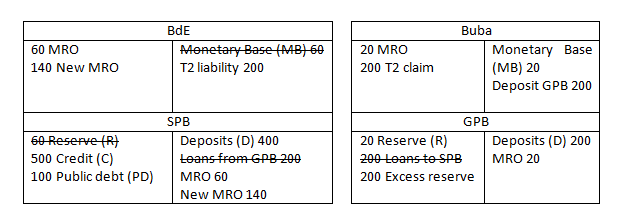
The BdE will lend to SPB, either through the marginal lending facility, providing a loan, or through a MRO / LTRO (for our discussion this does not matter). If it makes a MRO, we shall have:
The ECB, through peripheral NCBs (national central banks) is providing liquidity to make it possible for German investors (and also peripheral ones) to carry their money to a safe harbor (in Germany, but also Luxembourg). T2 imbalances are the consequence of this monetary policy.
It should be noted that this is not a specific policy aiming at financing a current account imbalance in the periphery (here). It is not a fiscal policy, as Sinn has claimed so often.
It is an automatic policy, which makes it possible the payment system to run smoothly, something which is mandatory for the ECB.
Contrary to Sinn who argues as if the EMU is a club of countries with a fixed exchange regime, the EMU is a monetary union. In the EMU, countries are for the union like regions or autonomous communities for a nation-state. If you move your savings from a deposit in Banca San Paolo to Unicredit, and the former has no reserves deposited in the Banca d’Italia, the latter would create money and then credit the reserve account of Unicredit so your money would be there now. In its turn Banca d’Italia would acquire a claim on Banca San Paolo. If the latter has a solvency problem, then Banca d’Italia would force it to disappear (after selling its assets). If it has just a liquidity problem, Banca d’Italia probably would let it continue operating and wait until it can pay back its debt.
It should be noted that if Banca d’Italia in the example just above, or the European System of Central Banks (in this discussion on T2) does not provide with liquidity the banking system, it would collapse: there would be a bank run and the whole economic system would have very serious problems.
It is in this sense that T2 imbalances are the consequence and not the cause of the problems within the EMU.
It should be noted also that if, instead of having a central bank in Spain and another one in Germany, but just one for the whole EMU, T2 claims and liabilities would cancel out.
Also, you will find here statistical information about the relation between MRO and T2 for Spain, drawn from the Banco de España website (here and here in epigraph no. 8.1 if you click on ‘Series temporalesdel cuadro 8.1, you will download an excel file with the numerical information included in the pdf file). There you will see that there is a nice correlation between MRO and T2 imbalances during the last year or so (probably the correlation improves if you add LTRO to MRO).
References
Marc Lavoie, A Primer On Endogenous Credit-Money in Modern Theories Of Money – The Nature And Role Of Money In Capiatlist Economies, Edward Elgar, 2003, ed. Louis-Philippe Rochon and Sergio Rossi. (Google Books Link)
There’s an interesting conversation between JKH and Marshall Auerback here on the constitutionality of TARGET2 balances of the NCBs of the Euro Area.
Rather than intervene in the comments, I thought I will let them exchange comments because I am not sure why Marshall Auerback thinks these are unconstitutional and more generally where he is headed in his series of posts. Links from Robert M Wuner who collects all the articles on TARGET.
Wynne Godley used to think that Keynesians were being defeated by Monetarists because they (the Keynesians) simply could not answer how money (in general assets and liabilities) is created and hence wrote the book Macroeconomics with Francis Cripps. After that he wanted to make it even more solid.
Marc Lavoie says:
… it is clear that Wynne wished to depart from neoclassical economics, and start from scratch, which is what he did to some extent already when Wynne and his colleague Francis Cripps wrote a highly original book that was published in 1983, Macroeconomics. This book was written because Wynne got convinced that the Keynesians of all strands were losing their battle against Milton Friedman and the monetarists, because Keynesians could only provide very convoluted answers to simple questions such as: “Where does money come from? Where does it go? How do the income flows link up with the money stocks? How is new production financed?”
Our book Monetary Economics also tries to provide appropriate answers to these questions. We agonized for a while between trying to engage in a constructive dialogue with our mainstream colleagues and targeting a non-mainstream audience, or perhaps trying to achieve both goals. In the end, we figured that it would be very difficult to please both audiences, and we chose to focus on a heterodox audience. In any case, I have spent most of my academic career trying to develop alternative views and alternative models of economics – what is now called heterodox economics; this is the literature we know best. So we took our book as a formal contribution to this heterodox literature and more specifically as a contribution to post-Keynesian economics.
Marc Lavoie at the Levy Institute, May 2011 (Photo Credits: me 😉 )
I came across this 2009 speech by William Dudley on banking where he rightly says:
… A related concern is the question of whether the Federal Reserve will be able to act quickly enough once it determines that it is time to raise rates. This concern reflects the view that the excess reserves sitting on banks’ balance sheets are essentially “dry tinder” that could quickly fuel excessive credit creation and put the Fed behind the curve in tightening monetary policy.
In terms of imagery, this concern seems compelling—the banks sitting on piles of money that could be used to extend credit on a moment’s notice. However, this reasoning ignores a very important point. Based on how monetary policy has been conducted for several decades, banks have always had the ability to expand credit whenever they like. They don’t need a pile of “dry tinder” in the form of excess reserves to do so. That is because the Federal Reserve has committed itself to supply sufficient reserves to keep the fed funds rate at its target. If banks want to expand credit and that drives up the demand for reserves, the Fed automatically meets that demand in its conduct of monetary policy. In terms of the ability to expand credit rapidly, it makes no difference whether the banks have lots of excess reserves or not.
[emphasis: mine]
🙂
Lots of central bankers have nuanced views on this but mostly end up believing the money multiplier approach at some point and it is rare to see this.
Gordon Brown – who is also known for his slightly silly “Golden Rule” of balancing the budget on current expenditures – has called for a coordination of a “concerted global action plan” in a Reuters Opinion article Decisive Euro Action Is Needed At The G20 Summit.
In my opinion the idea is roughly right – at least someone in talking in this direction.
There needs to be institutions to run the world economy on a fresh set of principles on coordination of fiscal policy, regulation of international capital flows and trade in goods and services instead of having blind faith on market forces.
Mr Brown’s call is unlikely to come to fruition. Sources have played down speculation of a major international plan, with the summit expected instead to put pressure on Germany to agree to new pan-European bonds.
If anyone has a link to the article of Gene Frieda of Moore Capital on Spain (referred in the Reuters article) please send me.
Triple Crisis has a Spotlight-G20 series and Jayati Ghosh has an article aimed at leaders of G-20 who meet next week in Mexico: Spotlight G-20, If Not Now, Then When
She says:
… the G20 appears to have lost its way. Its original intention – to provide a relatively speedy and workable arrangement for global governance (especially economic governance) at a time when co-ordination of macroeconomic measures is seen as essential – has clearly fallen by the wayside in the past two years. Indeed, if it cannot deliver this time around, it risks sinking into irrelevance, at a time when the global economy badly needs some institutions to respond to what is more and more evident as a crisis of massive proportions
As global imbalances have reached unsustainable levels, the G-20’s role has become more and more important. It is now been forgotten by the economics profession that coordinated reflation of demand is important for growth and that the coordinated action after the crisis hit in 2008 had an important role to play in preventing a deep implosion.
James Tobin realized how shouts used to be ignored. In his article Agenda For International Coordination Of Macroeconomic Policies [1], he said:
Coordinate policies! So economists urge governments. Financiers, journalists, pundits, politicians take up the cry. Central bankers and finance ministers agree, as do presidents and prime ministers. They meet, they talk, they announce progress. It turns out to amount to very little…
With its balance of payments at critical levels, the United States is no longer in a position to reflate demand and in the process continue to drive growth in the rest of the world by acting as the importer of the last resort. Hence it is no longer possible for the rest of the world to grow on the path it had taken before the crisis – i.e., depending on the United States. A recovery for the medium-term is only possible if there is a strong reflation of worldwide demand by governments.
More importantly even this will not be sufficient as it just postpones the reversal of global imbalances. However for now immediate action is required and a strong forum is needed to work out a plan to address the bigger challenge.
References
James Tobin, Agenda For International Coordination Of Macroeconomic Policies, Ch 24, p 633, Essays In Economics, Volume 4: National And International, The MIT Press, 1996
Beate Reszat has written a very nice article on TARGET2 Target2 – Q&A which should be read by anyone interested. The article seems to be in response to a speech by George Soros earlier this month in Italy. The link appears in her post and the relevant section of the transcript quoted.
Although it is a very informative article, I think the writer gives a misleading picture by disagreeing with George Soros.
For a background, the whole debate started when a German Professor Hans-Werner Sinn wrote an article The ECB’s Stealth Bailout which led to a series of attacks from academicians to bankers to central banks seriously questioning Sinn. Sinn’s arguments are full of errors but this brought into focus the TARGET2 claims of creditor nations’ NCBs and the risks that this asset may “disappear”.
Critics of Sinn learned the TARGET system and to my surprise, their description had a lot of features on money endogeneity – surprising since most of these writers err on describing one pole (of the two poles) of money endogeneity – that between banks and their central bank.
In the end, the critics claimed victory – although powerful persons such as George Soros and Jen Weidmann of Bundesbank understood and saw the situation slightly differently. Even Martin Wolf who has differences with Weidmann on the German economic strategy – rightly in my view – agrees that it may lead to losses to Germany in case of debtor nations leaving the Euro Area.
(By the way this link by Robert M Wuner has the complete list of articles on the TARGET2 debate).
While it is difficult to summarize the whole debate, the point which comes to mind is that while those who have written about the TARGET2 system in a more technically correct way (central bank articles, banks’ research publications, academicians), they are seriously misleading. Some don’t see it while – in my opinion – the Eurosystem authors see it and downplay the risks.
So here’s from Beate’s article:
If the country in question refrains from staying connected to Target2 and, at the same time, is abandoning the ECB – in my understanding (but we must ask the jurists to find out) its paid-up capital will have to be returned plus its share of profit, or minus its share of loss according to a consolidated closing balance sheet and profit and loss statement.
Now this is serious underplay. She concludes:
The way the issue of Target2 balances is discussed in public is most regrettable. The ever new records of unmanageable bilateral debt allegedly heaping up in the system arouse fears which are wholly unreasonable and stand in the way to finding a viable crisis solution. Two points should be kept in mind: Monetary policy matters such as the creation of central bank money must not be confused with the process of payment and settlement of central bank money, and intra-group payment flows as part of the normal business of the system must not be confused with profits and losses.
At closer inspection, the €2 trillion debt scenario conjured up by some observers in an utterly irresponsible way is evaporating into thin air and the euro crisis – although still a very serious problem and a big challenge – appears as one that probably can be handled.
The error in analysis such as this is that of not thinking of “money” as simultaneously as an asset and a liability.
It is best to think of the creditor nations as a whole so that the complication of “capital key” can be avoided. In my post Who Is Germany I argue that the exit of debtor members of the Euro Area will lead to losses for the creditor nations because the debtor nations will not be able to pay the Euro-denominated TARGET2 liabilities. This appears via a direct loss on the central banks’ balance sheet. And since this is a loss of the balance sheet of a nation (or a group of nations as a whole), it is plainly incorrect to argue that it does not matter or that Soros is wrong. The complication of “capital key” is a bit of a sideshow – if Germany’s losses are less than its TARGET2 claims, other NCBs lose. It is true that the Bundesbank may be capitalized by the German government – in case – but no amount of domestic transaction can change the external assets (of Germany as a whole). The fact that it is a loss to Germany can be seen by looking at the International Investment Position. If the Bundebank loses its TARGET claims, it is a loss for the whole nation. As the chapter 7 of the IMF’s Balance Of Payments And International Investment Position Manual (BPM6) says:
The IIP is a subset of the national balance sheet. The net IIP plus the value of nonfinancial assets equals the net worth of the economy, which is the balancing item of the national balance sheet.
In fact, George Soros’ argument is that since exits of debtor nations from the Euro Area will lead to serious losses to creditor nations, this has the effect of forcing the latter – especially Germany – to do something and in fact in leading them to move toward higher integration! (as a title of his recent article The Accidental Empire from Project Syndicate suggests).
To the point of Beate Reszat’s dislike for the phrase – “evaporating in thin air”, the BPM6 and the 2008 SNA use similar terminology – “appearance and disappearance of assets”!
Michael Sankowski has a post titled Swiss Franc: Trade Of The Year in which – as the title suggests – he points to getting the timing right of the depreciation of the Swiss Franc against the Euro as one trade which can have a huge payoff. His argument is: assuming that the Euro will survive and financial markets gain confidence in the Euro, change in investor portfolio preference into Euro-denominated assets will depreciate the Franc.
Which is fine – as this New York Times article Necessity, Not Inclination, Nudges Europeans Closer Fiscally And Politically argues, it seems Germany is being forced to cede some control to the European Parliament which may act as a central government of the Euro Area (hopefully democratically elected!).
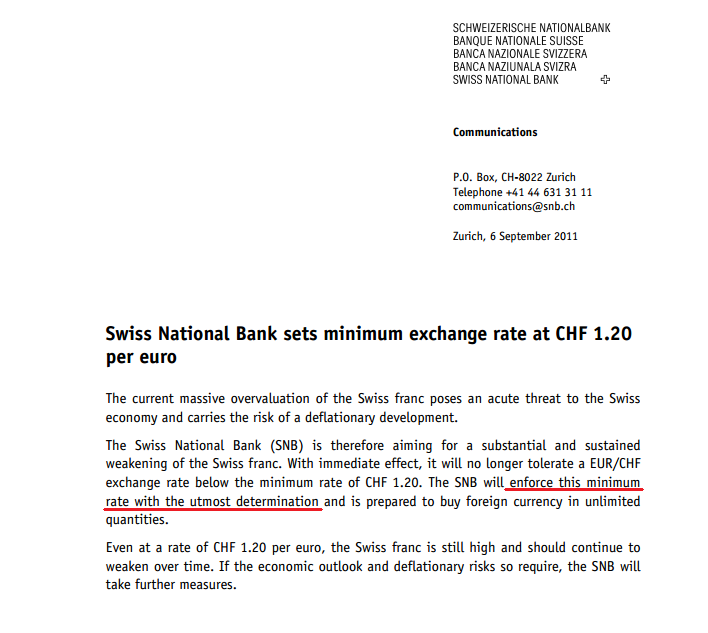
In September 2011, after the SNB found it frustrating that in spite of its intervention in the foreign exchange markets, it could not prevent an appreciation of the Franc. So it decided to say this:
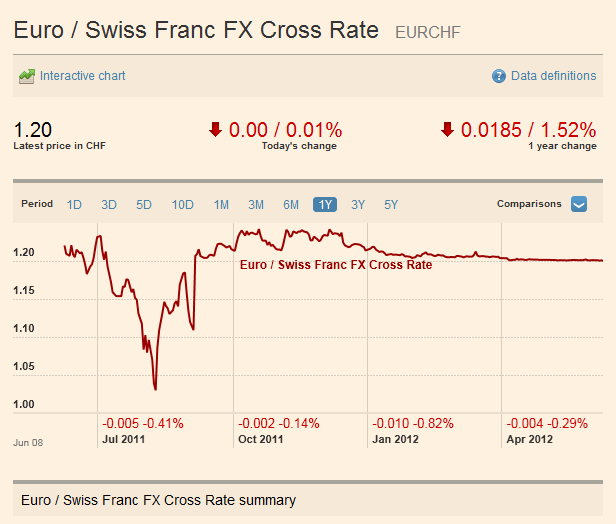
Notice that it is not really a peg but a floor on EURCHF. Here’s a chart of EURCHF (via FT)
Daniel Neilson wrote a post about this on INET but his scenario is slightly different on what may actually happen to the Euro Area.
At any rate, he has an nice study of the effects of the flows on the balance sheets of the SNB and Swiss banks.
… the SNB is facilitating the world’s portfolio reallocation out of EUR and into CHF. Even fixed at 1.20 francs per euro, funds have been fleeing the euro area as the crisis heats up again. The SNB’s policy means that any net flow results not in price adjustment, but in fluctuations in the size of its own balance sheet.
Neilson also makes an interesting observation that there is a similarity of this to TARGET2 in which Bundesbank acquires claims on foreign central banks as funds flow into Germany. He points out however that the SNB has a choice of which asset it can purchase!
Since I am more a balance of payments kind of person, I tend to see this in that language. When a financial institution or a household – either a resident or a nonresident – liquidates Euro denominated assets for its purpose, it will purchase Francs for Euros. The dealer – a bank – which makes this conversion will credit the seller’s bank account and and will try to get rid of the excess Euro denominated deposits at its correspondent bank (which it obtained). If the SNB does not intervene, this sale of EUR by Swiss banks will appreciate the Franc and hence the SNB has to accommodate this and buy EUR. It can then purchase high-quality Euro denominated assets such as German government bills (?). The Swiss bank who made the conversion will have both its assets and liabilities denominated in Franc increase (assets: SNB settlement balances, liabilities: deposits). With the short term Franc interest rate at zero – the SNB needn’t do a “sterilization” operation.
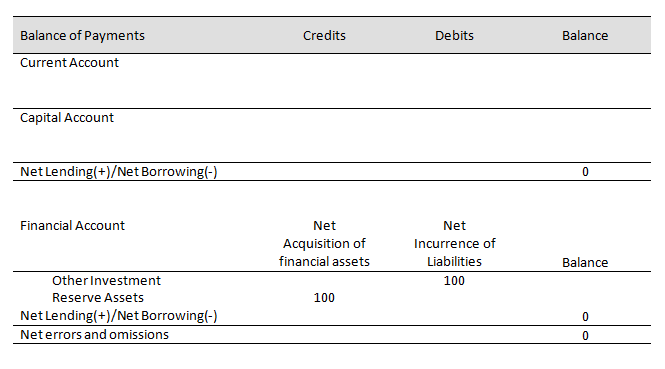
How does this look in the financial account of the balance of payments? If the initial inflow was 100, then:
We can say that the item reserve assets of the SNB is the accommodating item in the balance of payments.
In exchange rate agreements and arrangements such as the ERM I and II, central banks would risk running out of foreign reserves in case of a speculative attack on the currency. They may commit to each other on defending the exchange rate but in extreme cases, the agreements may lose their significance.
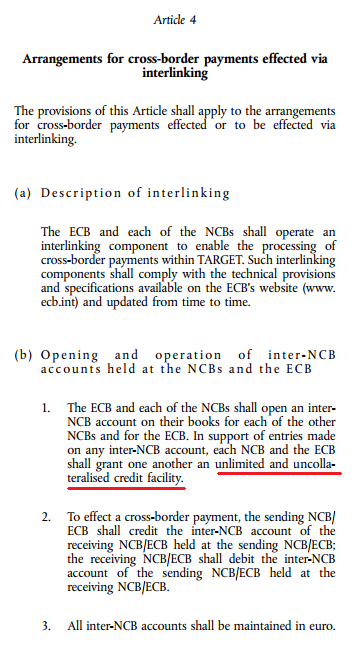
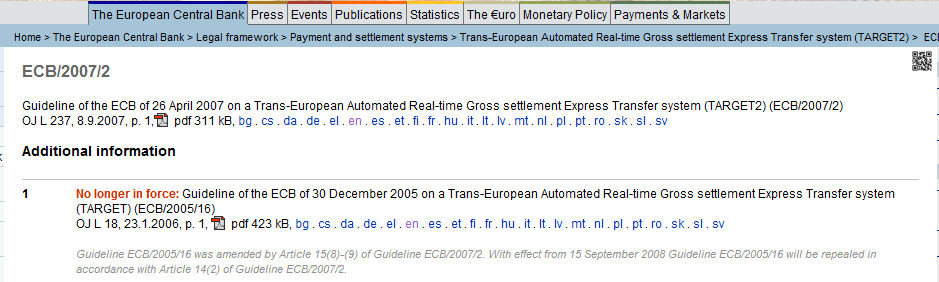
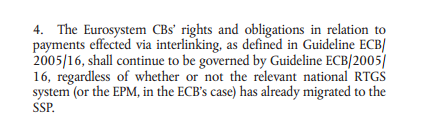
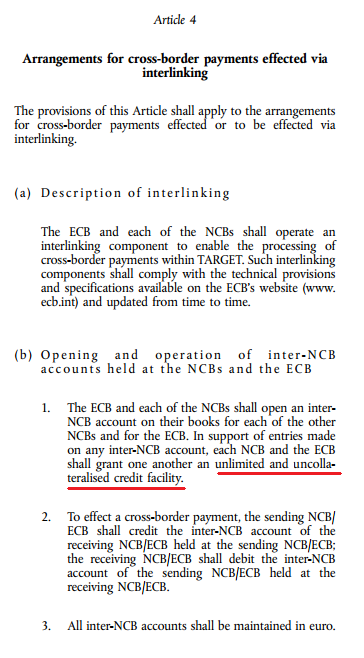
When I saw first this guideline on the ECB Website on TARGET (on NCBs and the ECB providing unlimited and uncollateralized credit facility to each other) – a couple of years back – I was a bit shocked but later seemed to make sense:
According to Garber in the previously existing Very Short Term Financing Facility (VSTFF), central bank of the nation seeing private inflows theoretically has to provide unlimited credit to the central bank of the nation seeing private outflows.
The VSTFF is a facility to be used if serious intervention is necessary to preserve official bilateral bands in the Exchange Rate Mechanism. Under the Basle-Nyborg agreement, the weak currency central bank is to intervene in the exchange markets to prevent the exchange rate from breaching the band. The strong currency central bank is responsible for providing credit to the weak currency central bank through the VSTFF, theoretically in unlimited amounts but in fact limited by the effect on the strong currency central bank’s monetary policy.
More in the paper. Of course, Garber is incorrect in assuming that the central bank providing credit loses control of its monetary policy. (Expect a future post on Sterilization). Anyway interesting paper – especially on how capital flight from the “periphery” before a breakup can lead to huge losses for the creditor Euro Area nations.