Why Paul De Grauwe Is Wrong About TARGET2

The financial and non-financial resources at the disposal of an institutional unit or sector shown in the balance sheet provide an indicator of economic status. These resources are summarized in the balancing item, net worth. Net worth is defined as the value of all the assets owned by an institutional unit or sector less the value of all its outstanding liabilities. For the economy as a whole, the balance sheet shows the sum of non-financial assets and net claims on the rest of the world. This sum is often referred to as national wealth.

– 13.4, System of National Accounts 2008 (pdf)

Recently, Paul De Grauwe joined the long debate on TARGET2 with a paper What Germany Should Fear Most Is Its Own Fear: An Analysis Of Target2 And Current Account Imbalances. He is supposed to be the top economist in both public and academic debates about the Euro Area but unfortunately, there are glaring errors in his paper.

This paper was aimed at Hans-Werner Sinn who started ringing alarm bells on the huge TARGET2 claims of the Deutsche Bundesbank. The claim of this post (and some more in the past in this blog) is that while Prof Sinn may be wrong on many issues in the debate, he is right about a few important issues. Needless to say, his prescriptions are not defended by me. I am a fan of Nicholas Kaldor’s ideas as quoted in my post Nicholas Kaldor On The Common Market.

De Grauwe’s argument is slightly more nuanced that others such as Karl Whelan. While Whelan dismisses any argument that a loss of creditor nations’ TARGET2 claims on the periphery Euro Area nations is a loss, De Grauwe modifies this to say that the repatriation of funds by Germans (individual investors and institutions) does not increase Germany’s risks.

So we have this claim in his paper:

Thus the increase in the Target2 claims of the Bundesbank should not be interpreted as an increase of foreign claims of Germany, and thus as an increase of risk from higher foreign exposure. Using the Target claims as a measure of risk incurred by the German population is therefore erroneous. As we have seen earlier, after 2010, the Target claims of Germany (and other Northern countries) increased dramatically and much more than the current account surpluses during this period. This increase in Target2 claims cannot be interpreted as an increase in the foreign exposure (net foreign claims) of Germany, except to the extent that they were the result of current account surpluses. What changed dramatically is the nature of these claims. Prior to 2010, these claims were mainly claims held by private German agents (mainly financial institutions). Similarly the liabilities of the peripheral countries were held by private agents (financial institutions). The eurozone crisis led to a dramatic shift. As a result of the breakdown of the interbank market, a large part of these private claims and liabilities were transformed into (public) Target claims and liabilities (Buiter et al., 2011), without however changing the total net foreign claims and liabilities of these countries. Thus, the explosion of the Target claims of Germany since 2010 cannot be interpreted as an explosion of the risk of foreign exposure for Germany.

Ignoring the fact that the repatriation of funds by German residents back to Germany puts the risks on the public sector’s books and awards the (ex-) German lender, there is some element of truth to the above claim. The repatriation of funds does not increase Germany’s gross international investment position (assets and liabilities) but just changes the composition. It however ignores the fact that nonresidents also reallocate their portfolios in German assets and this increases Germany’s gross foreign assets and liabilities and in case there is a default by the periphery on the TARGET2 liabilities (in case they leave the Euro Area), Germany suffers a loss. We will see this with an example below. Before that let me highlight one misleading claim in the paper:

The value of the money base is exclusively determined by its purchasing power in terms of goods and services. This value is independent of the value of the assets held by the central bank. In fact in the fiat money system we live in, the central bank could literally destroy the assets without any effect on the value of the money base. In order to stabilize the value of the money base, the central bank should keep the right supply of money base, i.e. a supply that will maintain price stability.

That is Monetarist handwaving. Won’t say anything further!

When the central bank acquires assets, mainly government bonds, it issues new liabilities. The latter take the place of the government bonds in the portfolios of private agents. It is as if the government debt has disappeared. It has been replaced by central bank debt. The central bank could literally put the government bonds in the shredding machine. This would not affect the value of the central bank debt as the central bank has made no promise to redeem its debt (money base) into government bonds. And as long as the central bank maintains price stability, agents will willingly hold the new debt (money base) issued by the central bank.

That is incorrect. The People’s Bank of China cannot shred US Treasuries into a dustbin and claim it does not matter to the Chinese people.

Now to the main point about this post: foreigners shifting funds into assets issued by German residents.

Here is from the Bundebank’s statistical supplement for Germany’s international investment position:
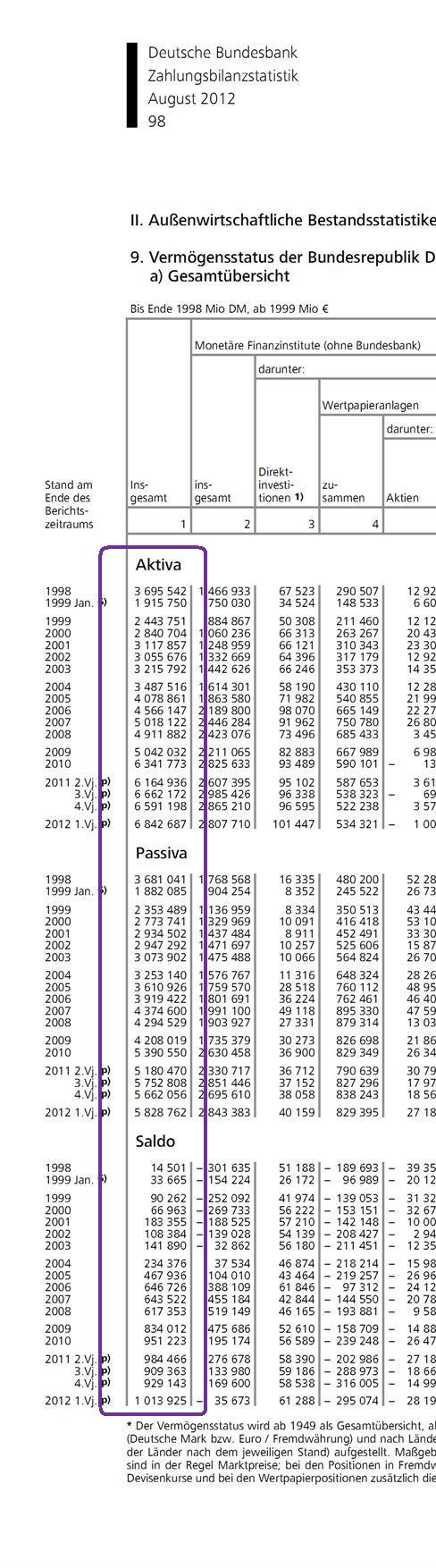
Aktiva is Assets, Passiva is Liabilities and Saldo is Net.

Germany’s assets and liabilities can increase as a result of a nonresident (such as from Spain) buying German Bunds (government bonds). If an institution in Spain liquidates its position in Spanish assets and transfers the funds to purchase  Bunds, Bundebank’s TARGET2 claims will increase (in the current scenario).

Let us use these numbers to see how Germany’s IIP changes if there is a purchase of €100bn of German assets by German nonresidents (but residents in Euro Area for simplicity).

Initially,

Germany’s Assets = €6,843bn

(of which TARGET2 claims = €727bn)

Germany’s Liabilities = €5,829bn

NIIP = €1,014bn

Now assuming a nonresident purchases €100bn of German government bonds from a German resident,

Germany’s Assets = €6,943bn

(of which TARGET2 claims = €827bn)

Germany’s Liabilities = €5,929bn

NIIP = €1,014bn

So while Germany’s gross assets and liabilities have increased by €100bn, its net position is the same.

However this is not the end of the story. When nonresidents purchase €100bn worth of German securities, the TARGET2 claims of the Bundesbank (or more generally creditor nation’s TARGET2 claims) increases by €100bn. If there is breakup of the Euro Area position at this point in time, this will leave the creditor EA nations with an additional liability of €100bn (incurred just before the breakup) while at the same time losing the €100bn of assets (TARGET2) acquired (in addition to other assets) and hence an NIIP worse than the case if the transaction had not occurred.

This number can be much higher because when there are tensions building up in the financial markets, foreigners may shift funds into Germany and if a breakup really is forced upon the Euro Area, it will leave Germany with additional liabilities and a lower NIIP than before and a huge loss of wealth.

At any rate, a non-negligible part of the German international investment position can be due to foreigners already having shifted funds in German assets (as the gross assets and liabilities position indicates).

But De Grauwe claims (thanks to JKH for pointing):

It is surprising that these simple principles are not widely understood.

!

Recently, the ECB announced a plan which substantially reduces the risks of a breakup of the Euro Area. In the absence of a breakup, discussions such as these are purely academic. However, the story has new twists and turns, and one can never be sure what is going to happen. It is however counterproductive to claim there is no risk/loss (in select scenarios) when there is indeed one.

Needless to say this analysis is not a defense of the German position either. Free trade has helped them a lot and it is time they increase domestic demand and help reduce global imbalances.
OMT! Enter The Draghi

As leaked earlier by Bloomberg, Mario Draghi in a press conference today, presented his big plan to save the world.

This will involve OMTs (Outright Monetary Transactions) – in which a Euro Area nation central government requesting aid from the EFSF/ESM will also be provided help by the ECB. Under this plan, when a nation’s government asks for financial aid (and a big if), the ECB/Eurosystem may buy government bonds in the open markets to bring the yields down.

The Eurosystem will buy bonds with maturities between one and three years and will accept credit risk on these bonds and will not ask for a seniority status in case of default. Of course, this will come with strict conditions – the government asking for aid would need to commit to a tighter fiscal policy and promise supply side reforms. There will be no upper limit to the  amount of bonds purchased by the Eurosystem.

The full details are here: Introductory statement to the press conference6 September 2012 – Technical features of Outright Monetary Transactions.

During the press conference (actually a bit before as well – after Bloomberg leaked a part of the plan), government bond yields had huge moves (e.g, Spanish ten year yields decreased 39bp). Now, if the yields do not reverse and deteriorate again soon, governments requiring help may just delay asking for aid. However, sooner or later bond yields may rise again – especially if foreigners holding the bonds start to get nervous.

My own view is that this plan significantly reduces the risk of an exit by a Euro Area member. Unlike previous plans (SMP, EFSF, ESM) this has no limit on the amount of funds needed. There is no need to wait for parliaments and courts to approve any transaction or aid.

Of course this is not a happy set of affairs. Forcing governments into retrenchment will lead to economic conditions deteriorating further. One however needs to realize that an independent fiscal policy for the troubled nations – while it (an expansion) increases national income and output – will have the adverse effect of deteriorating the balance of payments – resulting in the public debt and the nation’s net indebtedness to foreigners (and the latter is already high for troubled nations) rising without limit relative to output. The plan will look good in retrospect if it is supposed to be a bridge toward a political union with a central government.

Post-Keynesians And Others

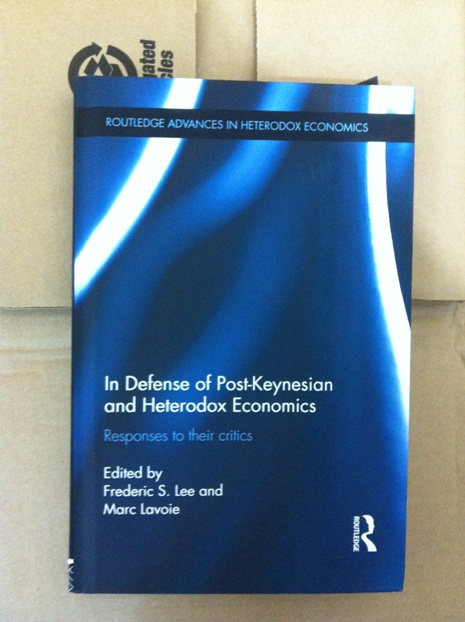
That is the title of Chapter 1 (by John E. King) of this book which has just come out.

The Routledge website is here.

I just got the book and flipped through to come across this at the beginning of Frederic Lee’s article (Chapter 6):

HETERODOX CRITIC: We want to change heterodox economics.

HETERODOX ECONOMIST: What kind of change are you talking about?

HETERODOX CRITIC: The kind that does not mess with the mainstream status quo.

Matias Vernengo had a post a while ago (when the book was finalized) and it has links to articles by Marc Lavoie and Fred Lee (quoted above).

I found this reference to an article by Fischer Black in Marc Lavoie’s article in the book. It was written in 1970:

click to view the pdf file

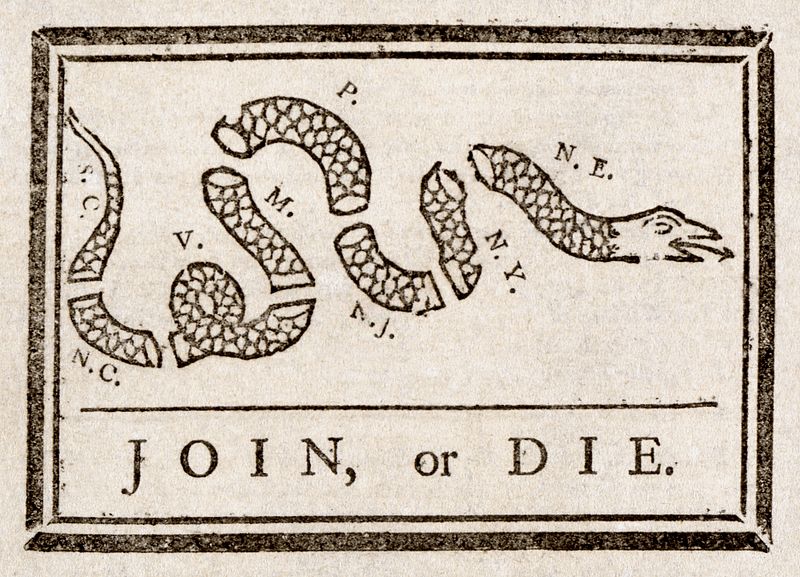
Join, Or Die. aka “I Want Europe”

Join, Or Die by Benjamin Franklin (Source: Wikipedia)

It is possible – in my opinion – that the September Constitutional Court Ruling in Germany may indicate that Germany should move toward a European Integration where European nations surrender powers to the European Union. Angela Merkel has been pushing for this but her critics argue that this is a surrender of sovereignty. They should realize that by giving the power to make a draft at their central bank, European governments have already given up their sovereignty – but without any central government to whom this is entrusted. The integration is a right move in that direction.

However, there is a general lack of trust and this has to be created – else there is no solution to than a breakup with unknown consequences.

Hence Merkel is launching a campaign “I Want Europe”.

Interesting reads on the future of Europe:

The Man At The Heart Of The European Economic Storm (Irish Times article on Wolfgang Schäuble)

Excerpt:

A crucial difference lies in their political styles: while Merkel bases her euro zone strategy on an emotionless, cold-eyed analysis of Europe’s future – unite or die in a globalised world – Schäuble makes the same argument with a passionate eye on the past.

Full Interview

Excerpt:

Q:  At some point it will come to a referendum in Germany on greater European integration. Are you concerned that, by then, German critics of your crisis strategy will have poisoned enough of public opinion here to torpedo the project?

A:  We might need a referendum at some point because it’s in our constitution that, when we transfer considerable parts of our sovereignty to the EU, Germans will at that point have to give themselves a new constitution. When that day comes we will have to lead a big campaign and I am confident we have a good chance it will go well. Germans are in general very pro-European. But it’s not a question of now.

Merkel Joins Lahm, Schmidt In Campaign To Promote Europe (Bloomberg)

Merkel Launches New Pro-EU Campaign (Sky News)

Nicholas Kaldor On The Common Market

… Some day the nations of Europe may be ready to merge their national identities and create a new European Union – the United States of Europe. If and when they do, a European Government will take over all the functions which the Federal government now provides in the U.S., or in Canada or Australia. This will involve the creation of a “full economic and monetary union”. But it is a dangerous error to believe that monetary and economic union can precede a political union or that it will act (in the words of the Werner report) “as a leaven for the evolvement of a political union which in the long run it will in any case be unable to do without”. For if the creation of a monetary union and Community control over national budgets generates pressures which lead to a breakdown of the whole system it will prevent the development of a political union, not promote it.

[italics in original]

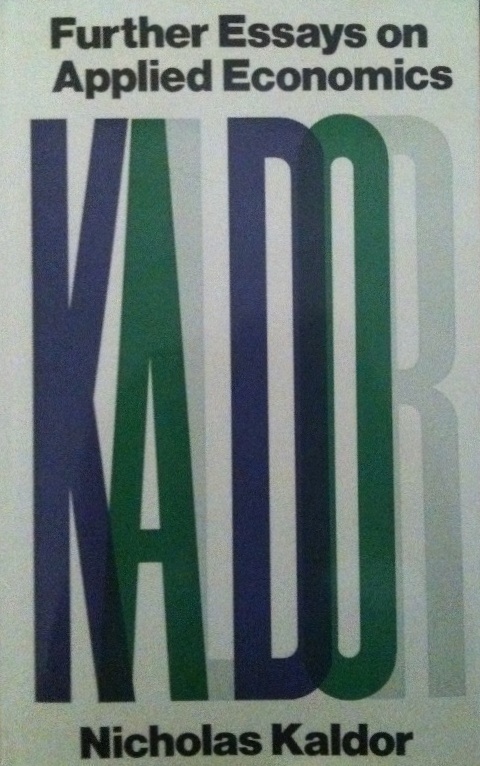
That was written in 1971! In The Dynamic Effects Of The Common Market first published in the New Statesman, 12 March 1971 and also reprinted (as Chapter 12, pp 187-220) in Further Essays On Applied Economics – volume 6 of the Collected Economic Essays series of Nicholas Kaldor.

Further excerpts from the article:

Page 202:

The events of the last few years – necessitating a revaluation of the German mark and a devaluation of the French franc – have demonstrated that the Community is not viable with its present degree of economic integration. The system presupposes full currency convertibility and fixed exchange rates among the members, whilst leaving monetary and fiscal policy to the discretion of the individual member countries. Under this system, as events have shown, some countries will tend to acquire increasing (and unwanted surpluses) in their trade with other members, whist others face increasing deficits. This has two unwelcome effects. It transmits inflationary pressures emanating from some members to other members; and it causes the surplus countries to provide automatic finance on an increasing scale to the deficit countries.

Page 205:

… This is another way of saying that the objective of a full monetary and economic union is unattainable without a political union; and the latter pre-supposes fiscal integration, and not just fiscal harmonisation. It requires the creation of a Community Government and Parliament which takes over the responsibility for at least the major part of the expenditure now provided by national governments and finances it by taxes raised at uniform rates throughout the Community. With an integrated system of this kind, the prosperous areas automatically subside the poorer areas; and the areas whose exports are declining obtain automatic relief by paying in less, and receiving more, from the central Exchequer. The cumulative tendencies to progress and decline are thus held in check by a “built-in” fiscal stabiliser which makes the “surplus” areas provide automatic fiscal aid to the “deficit” areas.

[italics in original]

Page 206:

…What the Report fails to recognize is that the very existence of a central system of taxation and expenditure is a far more powerful instrument for dispensing “regional aid” than anything that special “financial intervention” to development areas is capable of providing.

The Community’s present plan on the other hand is like the house which “divided against itself cannot stand”. Monetary union and Community control over budgets will prevent a member country from pursuing full employment policies on its own- from taking steps to offset any sharp decline in the level of its production and employment, but without the benefit of a strong Community government which would shield its inhabitants from its worst consequences.

page 192:

Myrdal coined the phrase of “circular and cumulative causation” to explain why the pace of economic development of the various areas of the world does not tend to a state of even balance, but on the contrary, tends to crystallise in a limited number of fast-growing areas whose success has an inhibiting effect on the development of others. This tendency could not operate if changes in money wages were always such as to offset difference in the rates of productivity increase. This, however is not the case; for reasons that are not perhaps fully understood, the dispersion in the growth of money wages as between different industrial areas tends always to be considerably smaller than the dispersion in productivity movements. It is for this reason that within a common currency area, or under a system of convertible currencies with fixed exchange rates, relatively fast-growing areas tend to acquire a cumulative competitive advantage over relatively slow growing areas. “Efficiency wages” (money wages divided by productivity) will, in the natural course of events, tend to fall in the former, relatively to the latter – even when they tend to rise in both areas in absolute terms. Just because the differences in productivity increases, the comparative costs of production in fast-growing areas tend to fall in time relatively to those in slow-growing areas and thus enhance their competitive advantage over the latter.

I don’t have the copyrights to reproduce the whole article The Dynamic Effects Of The Common Market, so this is so much I can quote. You can read the rest from the book (Collected Essays 6). Also, there are five chapters on the Common Market.

EU Referendum?

Spiegel Online is reporting that Germany is considering holding a referendum to transfer more powers to Brussels.

Click below to go to the article:

This is definitely a step in the right direction.

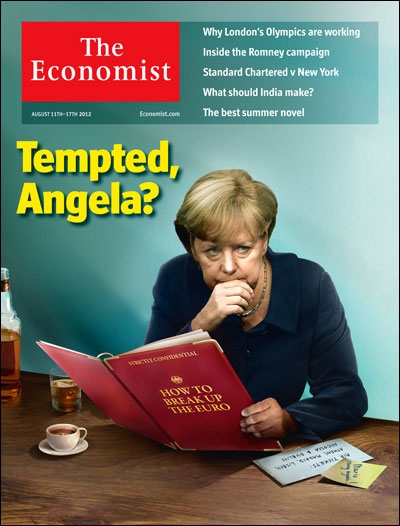
Meanwhile The Economist is reporting of a plan of a Euro Area breakup by Germany! Click to read the article.

Seems fictitious!

Kaldor’s Growth Plan

Dani Rodrik has a Project Syndicate article titled No More Growth Miracles and in my view rightly identifies problems of the world economy, although has less to say how to resolve the crisis.

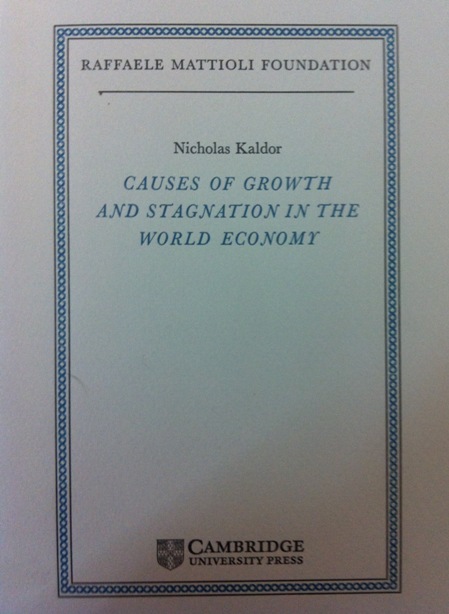
These were most well understood by Nicholas Kaldor (who was touched by genius in Wynne Godley’s words). In the previous post How To Find Nicholas Kaldor’s Works, I recommended his Rafaelle Matiolli Lectures which appeared in a book form titled Causes Of Growth And Stagnation In The World Economy.

The lectures were given in May 1984.

In the fifth and final lecture Kaldor – who understood the shortcomings of Keynesian economics – after having lectured on the causes of growth and stagnation in the world economy, summarizes the situation (page 86):

The fact that OPEC (as a group) is now in deficit on its current balance, and that Britain’s current account surpluses have virtually disappeared while the United States is in a large deficit, makes it a great deal easier for other developed countries to expand their economies than at any time since 1973. But there is still need for coordinated action, at least among the members of the European Community. As the French example has shown, an expansionary budget which is out of line with the fiscal stance of the other main countries of the group, quickly gets a country into serious payments difficulties owing to the resulting imbalance in trade.

But – as is the case now – and even back then policy makers meet and don’t do much ….

The lack of agreement on the fundamental lines of a policy for economic recovery is acutely felt, and the need for it is shown by the increasing frequency of inter-Governmental meetings at various levels: the next world summit meeting in which the heads of the leading western powers all participate is due to take place in London in a few weeks’ time.

If, by some miracle, this summit meeting, unlike all its predecessors, resulted in a constructive programme of recovery, what should its main provisions contain? I should like to end this series of lectures by suggesting the outline of a world-wide agreement on the necessary policies for recovery. The programme could be summed up under four main heads:

In present times, there are very few – in my opinion – who recognizes what needs to be done. Kaldor continues:

1. The first is coordinated fiscal action including a set of consistent balance of payments targets and “full employment” budgets [footnote]. If this does not prove to be politically feasible, it is inevitable that the growth of unemployment will sooner or later force governments to take measures that would make it necessary for them to expand demand without being frustrated by the inevitable balance of payments consequence of expanding their economies relative to their trading partners. This means that there needs to be some form of restriction that would limit the increase in “competitive” imports to some target ratio in relation to exports. Trade liberalisation, which played such an important part in the rapid economic progress during the years of expansion, becomes a serious obstacle to economic recovery in the case of prolonged stagnation due to the inability of countries to achieve a coordinated set of policies. But, given a proper recognition of the problem, that under conditions of unrestricted free trade the actual volume of production and trade may in fact be considerably less than under some system of regulated trade – a system which relates the volume of imports in manufactures from a particular group of countries, such as the members of the EEC, to some mutually agreed ratio to the exports of individual members to the rest of the group – there is no reason why full employment should not be restored through policies of expansion, preferably directed by the expansion of State investment. This coordinated action by all countries, instead of isolated actions by each country, is the first and most important requirement of recovery.

Keynesians and others who have come to understand fiscal policy are however too late. A unilateral fiscal expansion by one country will soon lead to balance of payments problems for it with the result that fiscal policy has to give in and become endogenous sooner or later. (Such is the case with India now, for example). So fiscal expansions need to be coordinated with other countries.

Also there is a footnote suggesting how the endogeneity of the budget deficit is commonly misunderstood:

Footnote: At present all countries have fairly large deficits in the general government budget, but these are largely the consequence of the low level of activity. On a “full employment” basis they would show a highly restrictive picture – they would show surpluses and not deficits. Contrary to appearances, the requirement of stability is for expansionary budgets with lower taxes and higher expenditure, and not further fiscal restriction (as is advocated, for example, by M. de Larosiere of the International Monetary Fund).

Point 2 is about bringing interest rates to as low as possible and this we already have in the present crisis. Point 3 is about stabilization commodity prices and point 4 about the problem of inflation which was more troublesome in the past due to trade unions’ bargaining.

Point 1 is the most important and relevant to the current scenario. Over the years, credit-led growth led to a boom which finally went bust but leaving the world with more “global imbalances”. Economists and politicians wish to resolve the crisis without giving up the doctrine of free trade. At least there is a pressure from the developed world to maintain status quo in spite of resistance from the developing world. As a recent article Protectionism Alert from The Economist recognizes, there is a tendency to move toward more protectionism in practice however which the magazine wishes to alert to the world – so that it is noted and steps taken beforehand to prevent it and free trade is pushed even more.

It should be noted that Kaldor’s plan is more than “coordinated fiscal expansion”. It is also about managing trade instead of relying on market forces. As argued by his “New Cambridge” colleagues, and stated by Kaldor, this will not lead to a decrease in world trade but actually an increase because of higher national output and income!

The first head of the programme is indeed what the world needs at the moment.

One of the listeners of his lectures was Mario Monti! More interestingly, Monti has a question to ask on this plan of Kaldor.

Here’s the Google Books Preview:

click to view on Google Books

How To Find Nicholas Kaldor’s Works

The only truly exogenous factor is whatever exists at a given moment of time, as a heritage of the past.

– Nicholas Kaldor, 1985

That’s my favourite all time quote.

I got myself Kaldor’s lecture series Raffaele Mattioli Lectures in a book titled Causes Of Growth And Stagnation In The World Economy today.

Cover picture taken from my iPhone:

It has Kaldor’s biography by the one and only one Anthony Thirlwall (which is also available separately as a book but reproduced in this book) and a bibliography of Nicholas Kaldor compiled by Ferdinando Targetti.

Another biography is by John E. King, titled Nicholas Kaldor. It also has a lot of articles by Kaldor in the references section and is an excellent book.

Targetti has also written a biography – published in 1992 [which I just ordered on amazon.com!]

Luigi Pasinetti has a small biography of Kaldor in Keynes And The Cambridge Keynesians: A Revolution In Economics To Be Accomplished.

Of course – if you are highly interested in Monetary Economics – you simply shouldn’t miss The Scourge Of Monetarism.

P.S.

My blog turned 1 today!

The α2 Parameter In Stock-Flow Consistent Models

Let us think of a closed economy. Assuming – every year the government runs a budget deficit – a careless analysis would imply the public debt keeps rising relative to gdp.

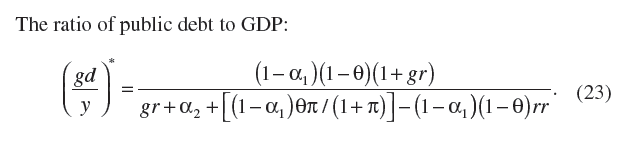
Without going into derivation – which you can find in other sources – it can be shown that if there is a growth rate of g, the public debt converges to

GD/Y = (PDEF/Y)/(gr)

where GD is the government debt, Y – the national income, PDEF – the primary government deficit (government expenditure excluding interest payments less tax revenues) and g and r are the nominal growth rates and the interest rate respectively.

Several things. The above assumes – implicitly – that DEF is a constant percent of GDP (Y). Second, it neglects the fact that interest income is also income to bond holders which leads to more consumption. Third, less importantly, it ignores taxes on interest income. The first one is important. There is an implicit assumption of the exogeneity of the budget deficit and the above expression has nothing to say about the private sector’s propensity to save, consume etc.

The above expression has been derived using the assumption that g > and summing a series. For the opposite case, the series used to derive it diverges. [For example, the equation

1 + x + x2 + x3 + … = 1/(1 – x)

is valid only if x < 1. For x > 1, the left hand side diverges and not negative as the formula implies!]

This has led authors to argue that if the growth rate is higher than the average interest rate paid on government debt, then the public debt doesn’t rise forever.

This intuition is not so right – although there is an element of truth in it but needs to be used extremely carefully.

Wynne Godley and Marc Lavoie [1] (but also [2] – which I haven’t managed to get hold of) show what this “stock-flow norm” converges asymptotically in the case of a very simple model of a closed economy – even when the government is not targeting a primary surplus in the budget.  The following are from their paper and the lower case is used to denote real variables instead of nominal: 

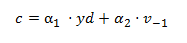
In the above gd is the real government debt, is the real national income, αis the propensity of households to consume out of disposable income, α2 is the propensity to consume out of wealth, gr is the growth rate of output, rr is the real interest rate, π  is the rate of inflation and θ is the tax rate.

The assumed consumption function is:

where c is real consumption,  yd is household real disposable income, and v is real household wealth.

 This expression gives some intuition. The growth rate can be quite less than the interest rate and yet the public debt can be bounded. This is because bond interest payments by the government is income for bond holders. More importantly, the denominator contains α2 which significantly brings the (public debt/gdp) ratio down (compared to the case where α2 is zero).

Looking at the model and how the variables change, one can conclude that the government needn’t pursue a policy of targeting a primary surplus, contrary to the intuition neoclassical economists obtain by doing debt sustainability analysis. The budget may reach a primary surplus automatically as a result of higher taxes due to higher activity.

Also, there is no condition “g > r”. 

One may wonder what value the parameter α2 has for various economies. According to Lance Taylor – a reviewer of Wynne Godley’s work [3] –  the value could be 0.04 or 4% from econometric studies but he does notice the tendency of G&L to choose a higher value in pedagogic examples.

In my opinion it is higher. I think it’s a good challenge to try to show this empirically. This may be true because (abstracting out the effect of the external sector, the public debt ratio is better explained and also that a high α2 implies a quick response to a fiscal expansion – which is true.

One should be highly careful about debt sustainability analysis. For the case of an open economy, while it is true that a debtor nation can be a debtor forever under some assumptions, achieving a faster growth in a world of free trade can lead to stock/flow ratios rising forever instead of converging. Which is to say that nations are balance-of-payments constrained.

References

  1. Wynne Godley and Marc Lavoie, Fiscal Policy In A Stock-Flow Consistent Model, p 79, Journal of Post Keynesian Economics / Fall 2007, Vol. 30, No. 1. Draft version available at http://www.levyinstitute.org/publications/?docid=911
  2. Wynne Godley and Bob Rowthorn, Appendix; The Dynamics Of Public Sector Deficit And Debt, in J. Michie and J. Grieve Smith (eds), Unemployment in Europe (London: Academic Press), pp. 199-206.
  3. Lance Taylor, A Foxy Hedgehog: Wynne Godley And Macroeconomic ModellingCamb. J. Econ. (2008) 32 (4):639-663.