Platinumismatics

I was very happy to have found a small mention in a recent Wired article on the “one trillion coin” – till the idea was killed by the U.S. Treasury and the Federal Reserve.

You may have certainly heard of the proposed $1T platinum coin even if you are not from the United States.

The United States government has hit the debt-ceiling, and will soon run out of other financial resources (asset-sales) to finance its expenditure and this may result in a default on its debt or almost complete freeze on expenditure (except interest payments on debt being financed out of taxes). Of course the simplest solution is to increase the ceiling or to completely do away with this. But it is not so easy.

Here’s Krugman aptly describing the situation in his New York Times Op-Ed piece Coins Against Crazies:

… Republicans go wild at this analogy, but it’s unavoidable. This is exactly like someone walking into a crowded room, announcing that he has a bomb strapped to his chest, and threatening to set that bomb off unless his demands are met.

So there’s an idea originally from Carlos Mucha, a lawyer from Georgia which became viral. The idea is for the U.S. Treasury to mint a $1T platinum coin and deposit it at the Federal Reserve. This sidesteps the debt ceiling because the coin doesn’t count in public debt!

Here is an article from the magazine Wired on him: Meet the Genius Behind the Trillion-Dollar Coin and the Plot to Breach the Debt Ceiling. The article mentions my name as the first to have understood Carlos’ idea and spread it 🙂 🙂

Ezra Klein of the Washington Post first reported two days back that the coin idea was killed by the US Treasury and the Federal Reserve.

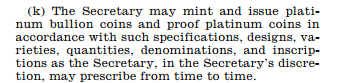
What is it that gives the Treasury Secretary the power to mint a platinum coin of $1T?

According to § 5112 (k) of Chapter 51 of Title 31, Subtitle IV of the U.S. Code:
Platinum Coin Law

Now this alone was strong to make it go viral – thanks to the initiative of Joe Weisenthel of Business Insider who picked up the idea from Cullen Roche of Pragmatic Capitalism and Monetary Realism. Also Neochartalist bloggers were spreading the idea.

The trick was that the coin – although a liability of the government – doesn’t count in what the U.S. government calls the “public debt”.

Now there are several things. Since there are other laws to prevent the Federal Reserve from directly lending to the US Treasury, this raises the question of whether the Federal Reserve can accept the coin. Also, the U.S. Mint which is a part of the U.S. Treasury (as opposed to the Bureau of Engraving and Printing – which prints currency notes for the Federal Reserve) sells “circulating” coins directly to the Federal Reserve – depending on the demand for it from households, businesses and foreigners. There are however some types of coins such as numismatic coins (which coin collectors love) which are directly marketed by the Mint without the Federal Reserve entering the picture. So there are legalities around whether the Fed can directly buy the $1T coin from the U.S. Treasury. To avoid this, some people have proposed that the U.S. Treasury directly sell platinum coins of smaller denominations to the public to get funds in its account in order to make payments.

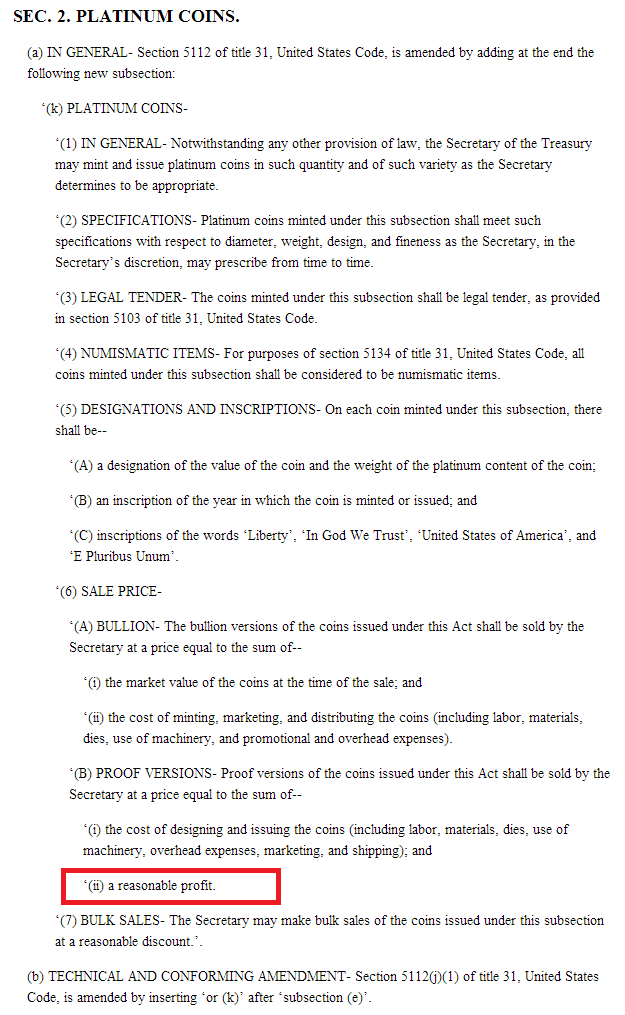
Another obstacle is that the U.S. Code isn’t straightforward on the “price theory” of the coin. For other coins there are some codes in the U.S. Code but apparently not for the platinum coin.

The coin was introduced in a bill H.R. 2018 (104th): United States Platinum and Gold Bullion Coin Act of 1995 which has the price theory (below) for the coin but the whole thing didn’t make it to the final law.
Platinum Coin Price Theory

I think this may have had a role in the Federal Reserve and the U.S. Treasury refusing it.

But it is a genie out of the bottle and won’t go back so easily!

Finally the ultimate authority on the platinum coin:

Carlos Mucha

(click to go to the New York Times’ Room For Debate)
“Free Trade Doctrine, In Practice, Is A More Subtle Form Of Mercantilism”

Dani Rodrik has written a very interesting article The New Mercantilist Challenge for Project Syndicate. 

Perhaps it is the main aim of this blog to argue how the sacred tenet of free trade is devastating to the world as a whole and why a sustainable resolution of a crisis can only be achieved by new international agreements on how to trade with one another combined with coordinated demand management policies with an expansionary bias.

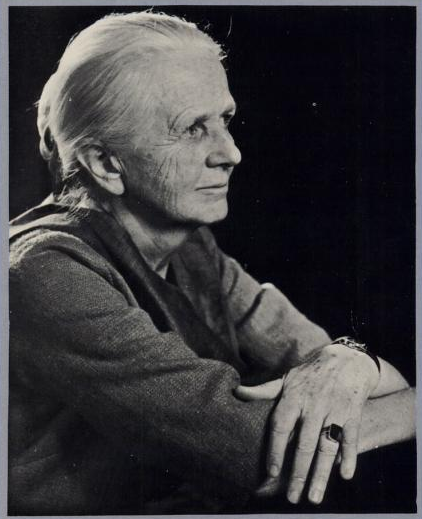
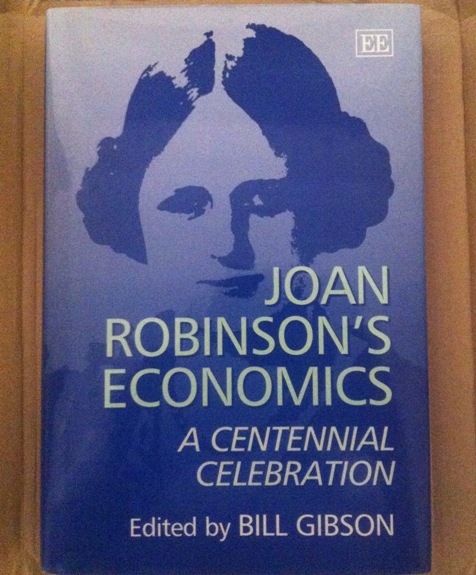
Joan Robinson was one of the fiercest critics of free trade. A good appreciation of her work is by Robert Blecker in the book Joan Robinson’s Economics (2005)

Joan Robinson's Economics

Blecker says:

Robinson’s critique of free trade had several dimensions, including her opposition to the comparative static methodology usually employed to “prove” the existence of gains from trade, as well as her scathing criticism of the actual practice of trade policy by nations proclaiming their fealty to free trade while seeking mercantilist advantages over their neighbors. Robinson also thought that international trade relations were far more conflictive than they were usually portrayed by free traders

[emphasis: mine]

In her 1977 essay What Are The Questions? (which is full of quotable quotes) Robinson says:

A surplus of exports is advantageous, first of all, in connection with the short-period problem of effective demand. A surplus of value of exports over value of imports represents “foreign investment.” An increase in it has an employment and multiplier effect. Any increase in activity at home is liable to increase imports so that a boost to income and employment from an increase in the flow of home investment is partly offset by a reduction in foreign investment. A boost due to increasing exports or production of home substitutes for imports (when there is sufficient slack in the economy) does not reduce home investment, but creates conditions favorable to raising it. Thus, an export surplus is a more powerful stimulus to income than home investment.

In the beggar-my-neighbor scramble for trade during the great slump, every country was desparately trying to export its own unemployment. Every country had to join in, for any one that attempted to maintain employment without protecting its balance of trade (through tariffs, subsidies, depreciation, etc.) would have been beggared by the others.

From a long-run point of view, export-led growth is the basis of success. A country that has a competitive advantage in industrial production can maintain a high level of home investment, without fear of being checked by a balance-of-payments crisis. Capital accumulation and technical improvements then progressively enhance its competitive advantage. Employment is high and real-wage rates rising so that “labor trouble” is kept at bay. Its financial position is strong. If it prefers an extra rise of home consumption to acquiring foreign assets, it can allow its exchange rate to appreciate and turn the terms of trade in its own favor. In all these respects, a country in a weak competitive position suffers the corresponding disadvantages.

When Ricardo set out the case against protection, he was supporting British economic interests. Free trade ruined Portuguese industry. Free trade for others is in the interests of the strongest competitor in world markets, and a sufficiently strong competitor has no need for protection at home. Free trade doctrine, in practice, is a more subtle form of Mercantilism. When Britain was the workshop of the world, universal free trade suited her interests. When (with the aid of protection) rival industries developed in Germany and the United States, she was still able to preserve free trade for her own exports in the Empire. The historical tradition of attachment to free trade doctrine is so strong in England that even now, in her weakness, the idea of protectionism is considered shocking.

[emphasis: mine]

Joan Robinson - What Are The Questions

Joan Robinson (1981)
What Are The Questions? And Other Essays

Wynne Godley And The Dynamics Of Deficits And Debts

In a five-part series in his blog, Functional Finance and the Debt Ratio Scott Fullwiler claims that if the interest rate is held below the growth rate of output, sustainability of the public debt/gdp ratio is guaranteed in the sense that the ratio converges and does not keep increasing forever. This is erroneous and his conclusions are misleading.

Wolfgang Schäuble understands the connection between public finances and international competitiveness, although his solutions are all wrong. Heteredox economists should understand this connection as well!

Rather than write a detailed essay, I thought I should directly get to the point and pinpoint his errors. Of course, several Post Keynesians even before Fullwiler wrote his 2006 paper Interest Rates And Fiscal Sustainability (referred in his posts) have made this claim and this criticism applies to them as well.

While there are future scenarios, where growth improves the public debt/gdp ratio, it does not mean that all scenarios lead to a convergence. Fullwiler has examples in his posts where he shows how the convergence happens. But it doesn’t prove much.

Fullwiler’s error is a simple mathematical one. He sums the series for debt-sustainability equation and shows the the public debt/gdp ratio converges to

– pb/(g – r)

where pb is the primary balance/gdp ratio, g is the growth rate of output and r the interest rate. [notations are changed somewhat without any effect on conclusions]

This is a wrong result because it assumes that the primary balance is constant as a percentage of gdp. The series he sums need not converge if the primary balance in each period is different. One such scenario is when the deficit in each period is bigger than the deficit of the previous period. Fullwiler claims:

… in terms of convergence or unbounded growth of the debt ratio, as Jamie Galbraith put it, “it’s the interest rate, stupid!” since any level of primary deficit can converge if the interest rate is below the growth rate.

[italics and link in original]

This is repeated:

… More importantly, given an interest rate lower than GDP growth, any primary budget deficit will eventually converge …

Now this doesn’t make sense. The claim that “any” level of primary deficit can converge if the interest rate is below the growth rate is incorrect. For example, if we have primary balances pb0, pb1, pb2 and so on and each of them is growing sufficiently faster, the debt/gdp ratio is explosive even if interest rate is less than the growth rate of output. His result is valid if each of the balances pb0, pb1, pb2 … are equal to each other and not in general.

In other words, if g>r, the sequence dn given by the relation

dt – dt-1 = λdt-1 – pbt

where λ is equal to (r-g)/(1+g) need not converge for general values of pband only converges in special circumstances (if suppose the pbn are all equal or more realistic if there is a mechanism to bring the primary deficit into a surplus which may or may not be a discretionary attempt by the government.)

Example

Nothing of the above is purely academic. So in what situation can the public debt explode?

Let us assume an open economy. Let us assume that a country’s exports is X0 and not growing because of its inability to increase its market share or because of limited demand in world markets due to deflationary policies adopted by the rest of the world. Or both.

If one imagines a scenario in which there is growth in output and hence income, imports rise as well in a world of free trade.  This implies the current account deficit explodes. While growth may work to improve the debt/gdp ratio, the current account deficits work to worsen the debt ratio. The net effect is that “growth” instead of improving the debt/ratio worsens it.

This can be seen if one remembers that the sectoral balances identity connects the public sector deficit and the current balance of payments. We have

NAFA = PSBR + BP

where NAFA is the private sector net accumulation of financial assets, PSBR is the public sector borrowing requirement (the deficit) and BP is the current account balance of international payments.

Since the private sector typically wishes to have a positive NAFA (else there is another unsustainable process!), an exploding BP leads to an exploding PSBR if output grows much faster than exports. This implies the public debt/gdp grows forever and growth is not sustainable.

Now Fullwiler can potentially claim that the government can “simply credit bank accounts” and public debt/gdp and external debt/gdp rising forever is no cause for trouble but then why write a post claiming convergence of the ratios!

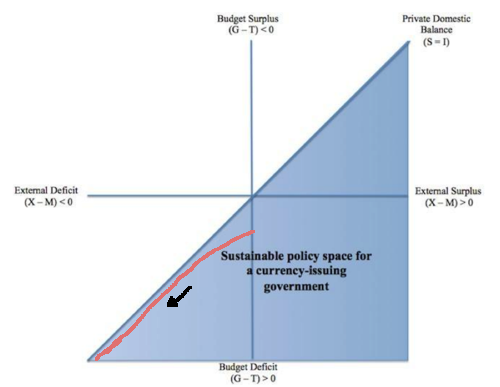
There is a diagram in the post which I modified below with a red line for a path for the sectoral balances. Is the claim that this line extrapolated leads to a stabilizing debt ratio?

[image updated]sf-p4-fig9-modified-corrected

Wynne Godley And Debt Dynamics

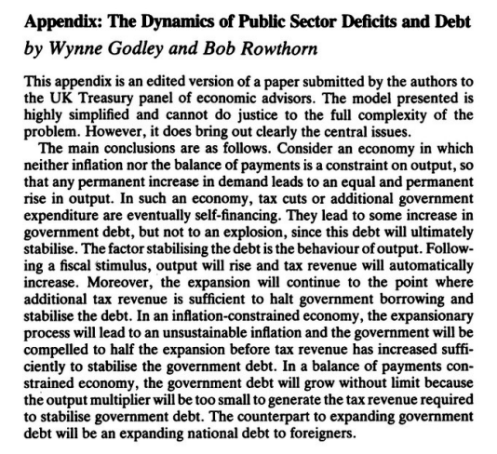
The above was pointed out by Wynne Godley in the 1970s. The following brings it out clearly. It is from an appendix to an article written by his co-author Bob Rowthorn in J. Michie and J. Grieve Smith (eds), Unemployment in Europe (London: Academic Press), 1994 pp. 199-206 and was originally a paper to the UK Treasury around ’92-’93

The main conclusions are as follows. Consider an economy in which neither inflation nor the balance of payments is a constraint on output, so that any permanent increase in demand leads to an equal and permanent rise in output. In such an economy, tax cuts or additional government expenditure are eventually self-financing. They lead to some increase in government debt, but not to an explosion, since this debt will ultimately stabilise. The factor stabilising the debt is the behaviour of output. Following a fiscal stimulus, output will rise and tax revenue will automatically increase. Moreover, the expansion will continue to the point where additional tax revenue is sufficient to halt government borrowing and stabilise the debt. In an inflation-constrained economy, the expansionary process will lead to an unsustainable inflation and the government will be compelled to half the expansion before tax revenue has increased sufficiently to stabilise the government debt. In a balance of payments constrained economy, the government debt will grow without limit because the output multiplier will be too small to generate the tax revenue required to stabilise government debt. The counterpart to expanding government debt will be an expanding national debt to foreigners.

Conclusion

Now this may sound as a pessimistic view for any individual nation or the world as a whole. The real problem is free trade – the most sacred tenet of the economics profession.

Merry Christmas

Merry Christmas to all!

Merry Christmas 2012(card via bluemountain.com)

I have been collecting some quotable quotes from various sources and my bookmarks. Here are some of them:

The purpose of studying economics is not to acquire a set of ready-made answers to economic questions, but to learn how to avoid being deceived by economists.

– Joan Robinson, 1955, “Marx, Marshall And Keynes”Occasional Paper No. 9, The Delhi School of Economics, University Of Delhi, Delhi.

The difficulty lies, not in the new ideas, but in escaping from the old ones, which ramify, for those brought up as most of us have been, into every corner of our minds.

– JMK, GT.

Economics limps along with one foot in untested hypotheses and the other in untestable slogans.

– Joan Robinson, 1962, “Metaphysics, Morals And Science”, Economic Philosophy, Chicago: Aldine

In economics, arguments are largely devoted, as in theology, to supporting doctrines rather than testing hypotheses.

– Joan Robinson, 1977, “What Are The Questions?”, Journal of Economic Literature, Vol. 15, No. 4

One of the main effects … of orthodox traditional economics was … a plan for explaining to the privileged class that their position was morally right and was right for the welfare of society.

– Joan Robinson, 1937, “An Economist’s Sermon”, Essays In The Theory Of Employment, The Macmillan Company

In the natural sciences, controversies are settled in a few months, or at a time of crisis, in a year or two, but in the social so-called sciences, absurd misunderstandings can continue for sixty or a hundred years without being cleared up.

– Joan Robinson, 1981 (1979), What Are The Questions And Other Essays – Further Contributions To Modern Economics, M.E. Sharpe

… I am convinced that this concept of general equilibrium in a monetary economy constitutes the primal scene [endnote: ‘The primal scene’ is a technical term in psychoanalysis; it is the imaginary perception, postulated by Freud, by the infant of its own parents at intercourse.] – the primitive imaginary vision of the world – out of which the whole of mainstream macroeconomics now flows. At one extreme are ‘monetarists’ of various hue who believe that the classical version of this simple model does, or should, or can somehow be made to describe the real world. Almost all other modern macroeconomists, while forming a huge spectrum, have as their essential activity the study of what happens if parts of the machine do not function properly, e.g. are subject to rigidities or time lags. For instance, much work has been concerned with the effects on the solution of this model if the various prices do not clear markets or clear them imperfectly. If wages are not flexible the labour market may not clear; this is what most students now understand as Keynesian economics. If the price of goods is not flexible, the market for goods may not clear, perhaps generating ‘classical’ unemployment.

Now Sylos Labini (like Kaldor and Pasinetti in different ways) makes a devastating case against the empirical relevance or even the meaningfulness of the aggregate production function. What I want to emphasise here is the system role which the production function fulfills and therefore just why the Sylos Labini critique is so important. What the production function does for all equilibrium systems – whether markets clear or not – is to bring labour into instantaneous equivalence with real product in such a way that alternative quantities of each can potentially be traded against one another. The production function is necessary for this equivalence so that labour can instantaneously be translated into the profit-maximising quantity of product which firms are therefore motivated to supply. Without the production function no neoclassical model will start up; the blood supply to its head is cut off …

… I have reached a point when I am prepared to make a declaration. I want to say of neoclassical macroeconomics what I have said sometimes of certain kind of fiction; I know that the world is not like that and I have no need to imagine that it is. In particular, I do not believe that there exists a market in which goods in aggregate and labour in aggregate can be exchanged provided only that the price of each is right in relation to some given stock of ‘money’.

But my objection goes beyond skepticism that the world we live in is being described realistically. My additional concern is that the NCP [neoclassical paradigm] is prejudicial with regard to the understanding of some of the most important processes going on in the world today. Thus in the ‘classical’ version of the NCP real output is determined by supply side alone; fiscal policy is entirely impotent and the government can only affect anything by changing the money supply; even then all it can do is affect the price level. The idea that fiscal policy is impotent, which seems to be based entirely on this model, has been extremely influential in contemporary political discussion; it is not just a provisional result suitable for a week or two in an elementary class.

Then the abolition of time prejudices the perception of inflation as an evolutionary process; the equilibria generate ‘explanations’ of price levels not changes, and theories of inflation cannot be convincingly coaxed forth. As if this were not enough, the whole construction leads by virtue of its axioms to the conclusion that wage and price flexibility, in combination with free trade, will generate full employment and convergence, if not equalisation, of living standards between countries and between regions within countries. In sum, while the absence of processes occuring in historical time means that the NCP does not encourage students to go and look up figures in books, if and when they are forced to do so their vision is likely to have been for ever distorted.

– Wynne Godley, 1993, Time, Increasing Returns And Institutions In Macroeconomics, in S. Biasco, A. Roncaglia and M. Salvati (eds.), Market and Institutions in Economic Development: Essays in Honour of Paolo Sylos Labini, (New York: St. Martins Press), pp. 59-82

Traditional theory, both classical and neoclassical, asserts that free trade in goods between different regions is always to the advantage of each trading country, and is therefore the best arrangement from the point of view of the welfare of the trading world as a whole, as well as of each part of the world taken separately. [footnote: The latter part of this proposition abstracts from the possibility that a particular country possesses some degree of monopoly power and thereby can turn the terms of trade in its favour by means of a tariff even after retaliation by other countries is taken into account.] However, these propositions are only true under specific abstract assumptions which do not correspond to reality. Under more realistic assumptions unrestricted trade is likely to lead to a loss of welfare to particular regions or countries and even to the world as a whole – that is to say that the world will be worse off under free trade than it could be under some system of regulated trade …

… Owing to increasing returns in processing activities (in manufactures) success breeds further success and failure begets more failure. Another Swedish economist, Gunnar Myrdal, called this ‘the principle of circular and cumulative causation’.

– Nicholas Kaldor, 1981, “The Role Of Increasing Returns, Technical Progress And Cumulative Causation In The Theory Of International Trade And Economic Growth”, Further Essays On Economic Theory And Policy, Holmes & Meier

Random Tidbits On National Accounts And Keynesian Models Of Income And Expenditure

I came across this article (via a Tweet from Stephen Kinsella): Accounting As The Master Metaphor Of Economics by Arjo Klamer and Donald McCloskey which discusses how the framework of national accounts has been pushed to the background in economic analysis over the years.

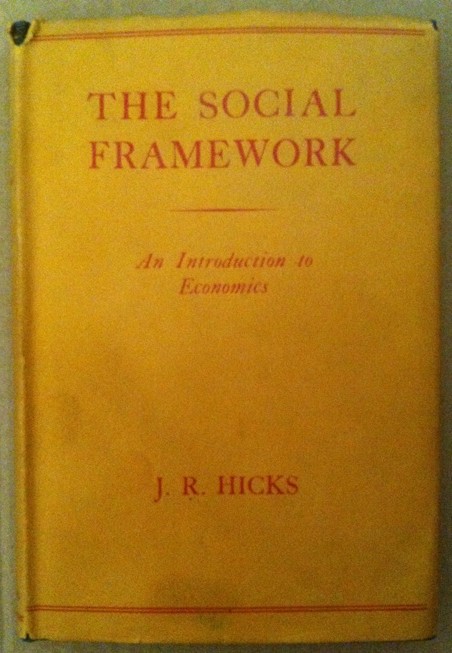
It is a nice read – although boring in a few places. I found this reference to John Hicks’ 1942 book The Social Framework: An Introduction To Economics in the above article and managed to get a copy – although a used one but with almost no usage. As described in the Klamer-McCloskey’s article, Hicks’ textbook really goes into details of national accounts and he seems to have had a great intuition of how it all works.

John Hicks - The Social Framework

Hicks’s book gives a nice introduction to how important national accounts are in understanding and describing the production process and economic cycles.

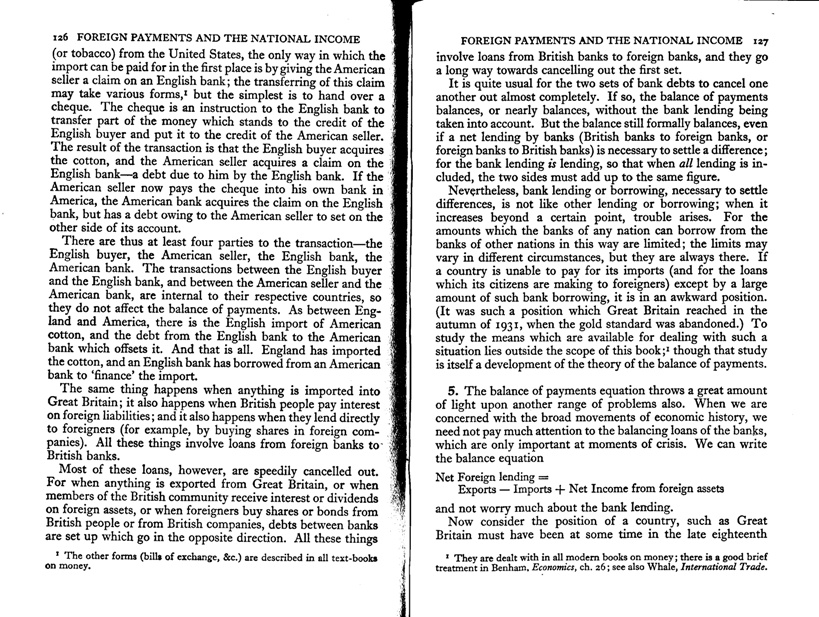
Here is a scan of two pages on the balance of payments – the topic I like the most.

John Hicks Balance Of Payments

(click to enlarge)

Hicks understood how weak balance of payments can cause troubles. Of course, it took the genius of Nicholas Kaldor to realize the supreme importance of balance of payments in the determination of national income and expenditure. Leaving that aside, the text has nice ideas and discussions on how stocks and flows feed into one another.

John Hicks is famous for an entirely different reason – the IS/LM model. Later he accepted it was a huge mistake, but put it mildly: “… as time as gone on, I have myself become dissatisfied with it”. But economists still keep using it and keep erring.

Also, Hicks was to soon abandon/forget his own social accounting approach as per Klamer-McCloskey’s article. Perhaps, not really.

In an extremely important paper, Wynne Godley said:

To come down to it, the present paper claims to have made, so far as I know for the first time, a rigorous synthesis of the theory of credit and money creation with that of income determination in the (Cambridge) Keynesian tradition. My belief is that nothing the paper contains would have been surprising or new to, say, Kaldor, Hicks, Joan Robinson or Kahn.

John Hicks also had another nice book called A Market Theory Of Money written in 1989. Here is a great insight (also the view of Kaldor) from Page 11, Chapter 1 named “Supply And Demand?” on how to create a dynamic Keynesian theory of determination of national income and expenditure:

… The traditional view that market price is, at least in some way, determined by an equation of demand and supply had now to be given up. If demand and supply are interpreted, as had formerly seemed to be sufficient, as flow demands and supplies coming from outsiders, it is no longer true that there is any tendency over any particular period, for them to be equalized: a difference between them, if it were not too large, could be matched by a change in stocks. It is of course true that if no distinction is made between demand from stockholders and demand from outside the market, demand and supply in that inclusive sense  must be equal. But that equation is vacuous. It cannot be used to determine price, in Walras’ or Marshall’s manner. For what matters to the stockholder is the stock that he is holding: the increment in that stock, during a period is the difference between what is held at the end and what was held at the beginning, and the beginning stock is carried over from the past. So the demand-supply equation can only be used in a recursive manner, to determine a sequence (It is a difference or a differential equation); it cannot be used directly to determine price, as Walras and Marshall had used it.

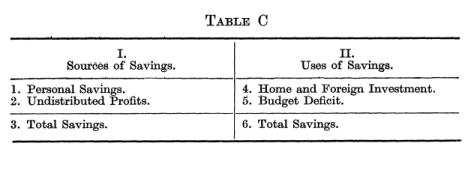
I came across a reference in the book (The Social Framework) to a paper by James Meade and Richard Stone on concepts on national accounts: The Construction Of Tables Of National Income, Expenditure, Savings And Investment written in 1941. It has the following interesting table:

James Meade & Richard Stone - Sectoral Balances

which is the now famous sectoral balances identity! Incidentally, it also includes Kalecki’s profit equation. In the above “Foreign Investment” shouldn’t be confused with Foreign Direct Investment flows in the financial account of the balance of payments. The authors define it as:

… equal to income generated by receipts from abroad less current expenditure abroad.

So can we call the profit equation SMK equation? 🙂

James Meade and Richard Stone were pioneers of national accounts. Incidentally, James Meade wrote a famous textbook on balance of payments.

Of course the way this is presented doesn’t make the connection between the financial account and current accounts. The sectoral balances was usually written by Wynne Godley as:

NAFA = PSBR + BP

where NAFA is the net accumulation of financial assets of the private sector, PSBR is the net public sector borrowing requirement, and BP is the current account balance of international payments. More on this connection below.

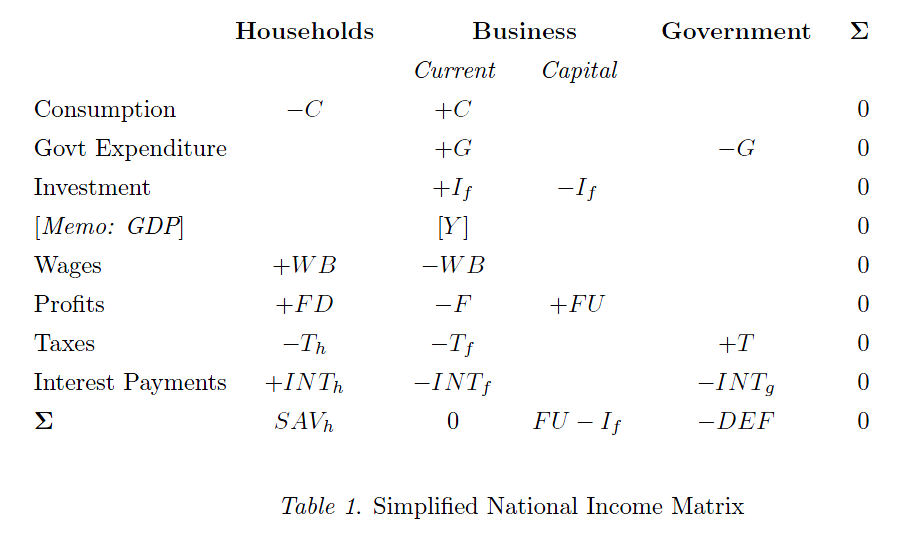
How it is to be derived in a stock-flow consistent framwork of Godley/Lavoie? If you click on this search Transactions Flow Matrix, you will find some blog posts on the background. First, we construct a flow matrix like this:

Simplified National Income Matrix

The last line is essentially Kalecki’s profit equation.

The above construction however raises an important question. Godley and Lavoie’s textbook (Chapter 2) quotes a famous 1949 article of Morris Copeland on this:

When total purchases of our national product increase, where does the money come from to finance them? When purchases of our national product decline, what becomes of the money that is not spent?

Copeland’s work was highly successful and established the flow of funds accounts of the United States in 1952.

Here is a republished version of the article (via Google Books):

click to preview on Google Books’ site

Incidentally, Copeland was motivated to prove the quantity theory of money wrong when he did this work! Also Godley/Lavoie point out that John Dawson (the editor of the above book) says:

the acceptance of…flow-of-funds accounting by academic economists has been an uphill battle because its implications run counter to a number of doctrines deeply embedded in the minds of economists.

in an article from the chapter The Conceptual Relation Of Flow-Of-Funds Accounts To The SNA of the same book.

Over time, the system of national accounts (with its first version in 1947) has used some of the concepts of flow of funds accounting and now the framework is much more wider than usual textbook guides of national accounts. The flow of funds still retains importance because it has information which the system of national accounts such as (2008 SNA) doesn’t handle.

Here’s the UN website for the historical versions of the system of national accounts.

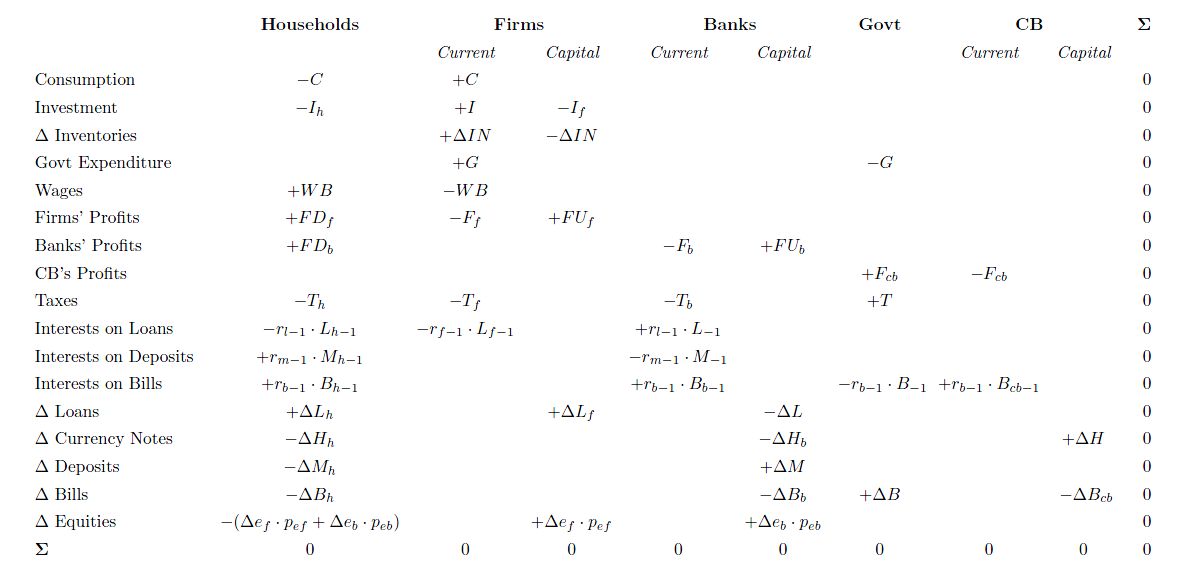
How does one look at this in a stock-flow coherent framework? Simple, we need a full transactions flow matrix – which not only includes income/expenditure flows but also financial flows. The following is how it looks like for a simple model:

Transactions Flow Matrix 3

(Click to zoom)

Of course, identities themselves shouldn’t be looked at as models. One needs a fully coherent accounting model of the economy based on behavioural assumptions and “closures”. See this essay Keynesian theorising during hard times: stock-flow consistent models as an unexplored ‘frontier’ of Keynesian macroeconomics Camb. J. Econ. (July 2006) 30(4): 541-565 by Claudio Dos Santos and also Wynne Godley and Marc Lavoie’s book Monetary Economics. As Dos Santos quotes Lance Taylor in the article:

Formally, prescribing a closure boils down to stating which variables are endogenous or exogenous in an equation system largely based upon macroeconomic accounting identities, and figuring out how they influence one another.

We Are NOT All Keynesians Now!

The Jan Hatzius interview on sectoral balances mentioned in the previous post – although has given it some popularity – has led to great confusions among economic commentators.

Here is a confused Professor from the famous institute INSEAD – Antonio Fatás on his blog.

Fatás implicitly denies that propensities to consume/save and government expenditure and taxing decisions have any impact at all on demand and hence output.

I quote from his blog. The quote includes that of Hatzius’ interview (in italics):

[Hatzius] “That’s the starting point. It’s a truism, basically. Where it goes from being a truism and an accounting identity to an economic relationship is once you recognize that cyclical impulses to the economy depend on desired changes in these sector’s financial balances. If the business sector is basically trying to reduce its financial surplus at a more rapid pace than the government is trying to reduce its deficit then you’re getting a net positive impulse to spending which then translates into stronger, higher, more income, and ultimately feeds back into spending.”

[Fatás] This paragraph is misleading (I will ignore again the fact that in an open economy things are more complex). It states (at least this is the way I read it) that growth depends on the “desired changes in these sector’s financial balance”. This is not correct. I can imagine an economy where those financial balances are not changing at all where output is growing very fast (and I can also imagine another one where output is collapsing). There is no connection between growth and these financial imbalances. As long as demand (private or public) is feeding into production and income, the private or public sector might be spending more than last year but their income is also increasing which can make the financial balance remain at the same level as before.

Jan Hatzius is discussing a model of business cycles and growth in the medium term – such as a year or two. But for Fatás, “this is not correct” and “there is no connection between growth and these financial imbalances”! He claims that demand can be feeding into production and income but doesn’t realize that a change in financial balances caused by say a change in the propensity to save or consume itself leads to changes in the source of demand.

Fatás is thinking of a situation – a type of a long run situation where the parameters in the models are not changing and there is high growth. But that does not mean “there is no connection between growth and these financial balances”. A spontaneous change in one or few parameters (such as the propensity to consume) or an exogenous change in the government expenditure changes financial balances and affects the growth rate.

But these things do not matter for him:

If we believe that we are in a situation where the output gap is large, there are unused resources and, as a result, output is determined by demand, what matters for growth is whether demand increases relative to last year and not so much the change in the desired changes in the financial balances of either the private or public sector.

Again forgetting that desired changes in the financial balances affect the sources of demand.

Somehow basic notions of the Keynesian principle of effective demand are difficult for economists to understand.

Jan Hatzius On Sectoral Balances

Business Insider’s Joe Weisenthal interviewed Goldman Sachs’ Jan Hatzius recently with questions aimed at his usage of the sectoral balances approach:

BI: Back to the balance sheet, multi-sectoral framework of looking at the economy. How did you come to this view? On Wall Street this is still very rare. I don’t see many economist talk about the economy this way, recognizing this identity and making projections based on it. How did you come to see this as the framework by which we should be looking at the economy right now?

HATZIUS: I’ve long been fascinated with looking at private sector financial balances in particular. There was an economics professor at Cambridge University called Wynne Godley who passed away a couple of years ago, who basically used this type of framework to look at business cycles in the UK and also in the US for many many years, so we just started reading some of his material in the late 1990s, and I found it to be a pretty useful way of thinking about the world.

It’s usually not something that gives you the secret sauce at getting it all right, because there are a lot of uncertain inputs that go into this analytical framework, but I do think it’s a reasonable organizing framework for thinking about the short to medium term ups and downs of the business cycle.

Basically, in order to have above trend growth, a cyclically strong economy, you need to have some sector that wants to reduce its financial surplus or run a larger deficit in order to provide that sort of cyclical boost, most of the time.

There are other factors at play in the business cycle – I’m certainly not claiming that ‘this is it!’ – but I have found it to be pretty useful.

The full interview: Goldman’s Top Economist Explains The World’s Most Important Chart, And His Big Call For The US Economy

“Maastricht Is A Half-Baked Half-Way House”

I frequently quote Wynne Godley’s Maastricht And All That written for the London Review Of Books in 1992. Here’s from another article (paywalled) for the same magazine from 1993:

I am in favour of Britain having much closer ties with other European countries, provided that appropriate institutions are created and the whole thing is brought under effective political control …

… The tract made only two points: that a single currency would remove the instability caused by fluctuating exchange rates, thereby enabling business to plan more reliably, and that international traders would no longer incur ‘transaction costs’ in the form of the small margin they now have to pay dealers when they buy and sell foreign exchange. It was as simple as that! The brief contained no reference whatever to the obvious fact that by joining a currency union, member countries would be giving up powers of independent action which at present they possess. It follows a fortiori that the document said nothing about who those powers would be given up to, and how the new authorities would exercise them …

… And if an individual country cannot issue its own money, it has no more power to conduct an independent fiscal policy than has a local authority, say, or an erstwhile colony in an imperial system …

… But to the extent that national governments can no longer be effective, this points to a pressing need for some supranational authority, call it a federal government, to carry out these functions …

… It is a good moment to start again. I think the Maastricht enterprise was built on a premise that has turned out to be completely mistaken: namely, that there can exist some kind of union between countries which is much more than a community of independent nations with special trading arrangements but much less than a full-blown political union. Maastricht is a half-baked half-way house and, with the CAP always at the back of my mind, I cannot agree that it is right to support it on the grounds that it is the only route ahead, the full nature of which will only be revealed in due course. Going forward should now mean that we explicitly hand over the main instruments of independent policy-making to some properly constituted body under appropriate political control. If this is not what Britain wants, is it completely out of the question that we now deliberately go backwards?

[italics in original, boldening mine]

– Wynne Godley in DerailedLondon Review Of Books, 1993

Origins Of The Sectoral Balances Identity

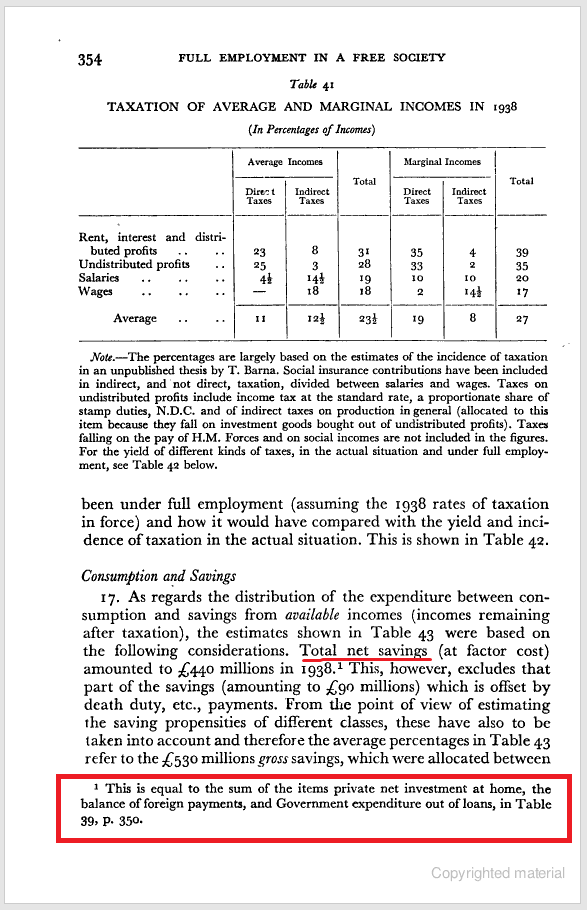
I thought I should share what I found recently about who was to state the sectoral balances identity first – since it comes across as enlightening to say the least. I found the identity in Nicholas Kaldor’s 1944 article Quantitative Aspects Of The Full Employment Problem In Britain. It was published as Appendix C to Full Employment In A Free Society by William Beveridge.

(If you find the mention of this identity anywhere before, please let me know!)

Here’s a Google Books screenshot of the page:

The article also appears in Kaldor’s Collected Essays, Vol 3 (Chapter 2, pp. 23-82).

The ‘net’ is net of consumption of fixed capital. Also ‘balance of payments’ is used for the current balance (footnote 1, page 28). (In The Scourge Of Monetarism, Kaldor used ‘net saving’ as saving net of investment).

Anthony Thirlwall wrote a biography of Kaldor in 1987 and he mentions that Kaldor kept pushing the implications of the identity in the 1960s (page 251). He managed to convinced some of his colleagues such as Wynne Godley and Francis Cripps and pick up public fights with others such as Richard Kahn.

Wynne Godley recalled how he came to appreciate this identity in his book Monetary Economics with Marc Lavoie. In Background Memories (W.G.) he wrote:

… In 1970 I moved to Cambridge, where, with Francis Cripps, I founded the Cambridge Economic Policy Group (CEPG). I remember a damascene moment when, in early 1974 (after playing round with concepts devised in conversation with Nicky Kaldor and Robert Neild), I first apprehended the strategic importance of the accounting identity which says that, measured at current prices, the government’s budget deficit less the current account deficit is equal, by definition, to private saving net of investment. Having always thought of the balance of trade as something which could only be analysed in terms of income and price elasticities together with real output movements at home and abroad, it came as a shock to discover that if only one knows what the budget deficit and private net saving are, it follows from that information alone, without any qualification whatever, exactly what the balance of payments must be. Francis Cripps and I set out the significance of this identity as a logical framework both for modelling the economy and for the formulation of policy in the London and Cambridge Economic Bulletin in January 1974 (Godley and Cripps 1974). We correctly predicted that the Heath Barber boom would go bust later in the year at a time when the National Institute was in full support of government policy and the London Business School (i.e. Jim Ball and Terry Burns) were conditionally recommending further reflation! We also predicted that inflation could exceed 20% if the unfortunate threshold (wage indexation) scheme really got going interactively. This was important because it was later claimed that inflation (which eventually reached 26%) was the consequence of the previous rise in the ‘money supply’, while others put it down to the rising pressure of demand the previous year …

Canada’s Mark Carney To Head The Bank Of England

So the news is that Mark Carney – the Governor of the Bank of Canada will now be the next Governor of the Bank of England.

Wynne Godley would have been happy – had he been alive and known that Carney is perhaps the only central banker to have recognized his foresight. (Carney probably is also the only central bank head to have named some names.)

In a speech From Hindsight To Foresight from 17 Dec 2008, he said:

… Few forecast these events; although, in an outbreak of retrospective foresight, an increasing number now claim they saw it coming. The reality is that among all the banks, investors, academics and policy-makers, only a handful were able to identify ahead of time the causes and potential scale of the crisis. …

with an attached footnote:

Examples include Bill White, formerly of both the Bank of Canada and the Bank for International Settlements; Harvard University’s Ken Rogoff; Nouriel Roubini of New York University; Wynne Godley of Cambridge; and Bernard Connolly of AIG Financial Products.