The Rate Of Saving In Wynne Godley’s Models

In Krugman’s blog post which is dismissive of Wynne Godley’s work (referred in my previous post) he (Krugman) makes the following claim:

First involved consumption spending. Conventional Keynesian consumption functions suggested that the savings rate would rise as incomes rose — and this wasn’t just the Keynesian interpreters, Keynes himself made the same claim.

which shows that Krugman has less clue about what he talks. Funny, the profession is ruled by clowns like him.

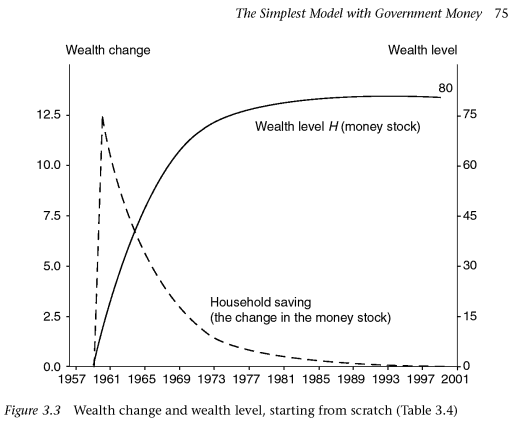
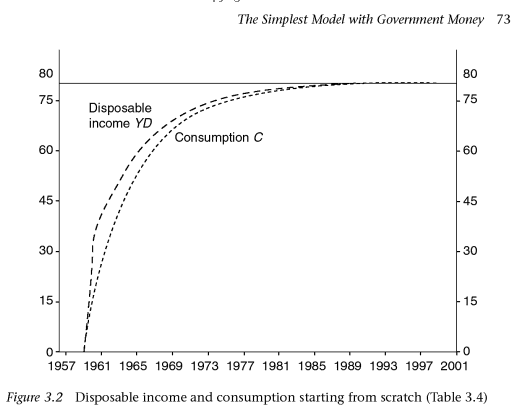
In Wynne Godley’s models, there is a propensity to consume out of income and out of wealth – represented in his models by the parameters αand αand the rate of saving in any period is given by the model. So in the simplest model – for example in Godley’s book with Marc Lavoie Monetary Economics, the rate of saving can has the following dynamic:

Disposable Income - G&L

Rate Of Saving - G&L

(image screenshot via amazon.com “Look Inside”)

(Note: In the above model, money is the only asset). This is starting from scratch but similar behaviour can be seen if one starts with some initial self-consistent configuration.

This is contrary to what Paul Krugman claims of Keynesian models. The above shows how the rate of saving first rises and then starts to fall and this whole adjustment will happen with a time lag given by a “stock-flow norm” and can be fast.

The reason it happens is simple. It is clear Krugman doesn’t realize the underlying stock-flow dynamics. As households’ saving and income rises because of a rise in government expenditure, they are also accumulating wealth. So a scenario where saving rises forever is meaningless because they would start consuming from their wealth as well.

Krugman continues:

This, in turn, led to predictions of rising savings rates after World War II, and hence a persistent shortage of demand — hence the secular stagnation theory briefly prominent. (There was even an early Heinlein novel built in part around the secular stagnation theory. As I recall, it was pretty bad.)

which is quite wrong – as stock-flow consistent dynamics suggests otherwise.

I’ll hold it to make any generic statements but it is clear that Krugman doesn’t know a thing or two about Keynesian Macroeconomics 🙂

*Many times standard textbooks use a Keynesian consumption function of the form

C = α0 + α1·YD

where C is the consumption, and YD is the disposable income.

It is then easy to see that C/YD decreases with YD and this is what Krugman is talking of.

However only slight improved modification where the consumption function depends on wealth as well leads to a different behaviour as highlighted in the main text. So it is strange Krugman dismisses consumption functions and instead talks of “failures that it seemed could have been avoided by thinking more in maximizing terms” !

*I thank Nick Edmonds in pointing this out.

Wynne Godley: The Keynes Of Flow Of Funds

Monetary and financial data, so far as they are based on institutional balance sheets and prices in organized markets, are abundant. Modern machines have made it possible to improve, refine and expand the compilation of these data, and also to seek empirical regularities in financial behavior in the magnitude of individual observations. On the aggregate level, the Federal Reserve Board has developed a financial accounting framework, the “flow of funds,” for systematic and consistent organization of the data, classified both by sector of the economy (households, nonfinancial business, governments, financial institutions and so on) and by type of asset or debt (currency, deposits, bonds, mortgages, and so on). Although many people hope that this organization of data will prove to be as powerful an aid to economic understanding as the national income accounts, this hope has not yet been fulfilled. Perhaps the deficiency is conceptual and theoretical; as some have said, the Keynes of “flow of funds” has yet to appear.

– James Tobin in Introduction (pp xii-xiii) in Essays In Economics, Volume 1: Macroeconomics, 1987.

[bolding: mine]

Paul Krugman writes in his blog responding to a recent Times article on Wynne Godley with a dismissive tone with mischaracterisation on saving etc. He writes:

But it is kind of funny to see a revival of old-fashioned macro hailed, at least by some, as the key to a reconstruction of the field.

Strange. First it is the story of a journalist from NYT who presented it the way it was. The NYT article was fine – what more can we ask from the journalists? But the funny thing is Krugman’s blog post itself which appeals to Friedmanism. Even funnier is the fact that Paul Krugman himself has turned to Keynesianism in recent times and talks about Michal Kalecki but when it suits his purpose, he dismisses Godley’s ideas as old fashioned!

Paul Krugman in his debates with heteredox economists has been exposed with his poor understanding of the nature of money. Wynne Godley’s approach on the other hand goes into a detailed look at the nature of money using the flow of funds among other things in a Keynesian way.

Now Krugman’s post is hardly a critique of any sort to deserve a response. But I thought quoting James Tobin is a good way to advertise Wynne Godley’s work because he has achieved what Tobin dreamed of and could not do it himself.

Also Wynne’s own idea about his work and aims can be seen from his writing in his article Keynes And The Management Of Real National Income And Expenditure, (in Keynes And The Modern World, ed. George David Norman Worswick and James Anthony Trevithick, Cambridge University Press, 1983):

… I have been forced to the conclusion that Keynes was a long way from achieving a coherent theoretical basis for maintaining them [correct ideas], and largely for this reason, his ideas have proved very vulnerable to the attacks from many different directions to which they have been subjected, particularly in the last fifteen years.

Wynne Godley’s work lays the foundation for Keynesian Economics. And Wynne Godley is the Keynes of flow of funds.

Correction: I am mistaken about Jonathan Schlefer’s background. He is in academics.

NYT On Wynne Godley

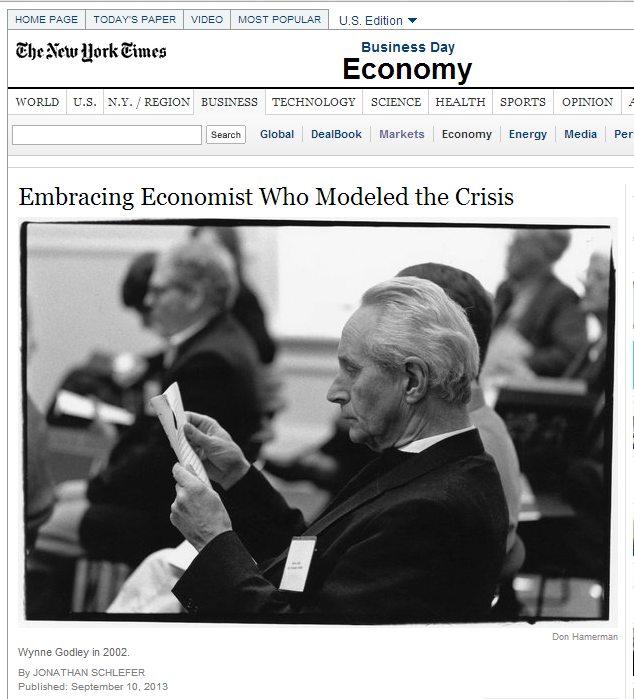
There’s a nice new article on Wynne Godley today in The New York Times.

An interesting thing in the article is the mention of intuition via models while mentioning his book Monetary Economics.

Why does a model matter? It explicitly details an economist’s thinking, Dr. Bezemer says. Other economists can use it. They cannot so easily clone intuition.

That is so right. The models in the books of Wynne Godley – both Monetary Economics with Marc Lavoie and Macroeconomics with Francis Cripps give a good idea about the authors’ intuitions. Of course, needless to say the man was bigger than his models.

Wynne Godley - NYT

James Tobin Turns In His Grave

When I was a boy of 14, my father was so ignorant I could hardly stand to have the old man around. But when I got to be 21, I was astonished at how much the old man had learned in seven years.

– attributed to Mark Twain, Reader’s Digest, September 1939.

Steve Keen has a blog post The Getting Of Wisdom in which he compares Tobin’s view in his 1963 paper Commerical Banks As Creators Of “Money” to his 1982 paper The Commercial Banking Firm: A Simple Model and finds Tobin has so many things (i.e., “loans create deposits” in 1963 to “loans create deposits” in 1982) in those years!

According to Keen:

The difference between the Old and New Tobin is as stark as that between the Old and New Testament. Not only is there an emphasis on the uniqueness of banks in that 1982 paper, Tobin also makes copious use of T-accounts and double-entry bookkeeping to explain why banks do matter. So just as the Testament message moved from “An eye for an eye” to “Turn the other cheek”, Tobin moved from “banks don’t matter and the belief that banks create money is a shibboleth”, to “banks are crucial to macroeconomics and they can and do create money”.

And whereas Tobin the Younger imagined that newly created bank money could be taken out of the system in a form other than bank deposits or cash, Tobin the Elder realizes that those are the only two options at the systemic level. Individuals might get out of bank deposits into (say) gold, but to do so they transfer money from their deposits in one bank into the deposits of the gold dealer in another bank. The only way for money not to be held in a bank is for it to be converted into some other kind of asset that is not a bank liability first. The only candidate here is cash—notes and coins—which you can insist on when you make a withdrawal (you might insist on gold instead, but a bank is under no obligation to deliver it in response to your withdrawal).

(italics in original, boldening mine)

Keen obviously is wrong when he says “the only way for money to be not held … ” because he first he misses the reflux mechanism where money can be extinguished by reducing indebtedness to the banking system. He obviously knows what “reflux” is but nonetheless misses it. Among other things he misses is that the bank can induce the non-banking public to shift in and out of money (or in the opposite case accommodate the non-banking public’s desire to change its portfolio) by changing bid/asks of markets they are dealers in such as government bond prices. So there is a price adjustment in the financial markets as well (leading to changes in deposits)

[Of course Keen attributes it to Tobin but looking at his agreeing tone, looks like it his own claim].

Others examples include but not limited to – a shift of deposits abroad with accommodative transactions which do not bring back the deposits to the original level, a “Treasury Supplementary Financing Operation” type of operation by the government Treasury which reduces the deposits in existence etc.

But more importantly he misses the mechanism which Tobin highlighted in his 1963 paper in which non-bank financials can compete with banks in the loan markets by taking away some borrowers and this leading to a fall in deposits. And this way, it is important not only for a single bank but for the banking system to induce depositors to bank with them.

Another thing which Post-Keynesians (some, not all of course) sometimes do is to think erroneously that bank borrowing (for purchases of goods and services at any rate) adds to demand and that non-bank borrowing/lending is demand-neutral and reading Keen’s post it seems he is close to saying something of the sort. And in his models, borrowing for purchases of financial assets also adds to “aggregate demand”.

I had written the following and am repeating it again about how a non-bank induces a borrower to borrow from it (who then extinguishes his loan from banks to become a borrower from the non-bank financial) and how this reduces the banking system’s balance sheet and hence deposits in the process – something Keen can’t see.

The following example is given in Tobin’s 1963 paper with my own numbers.

Start with a bank with initial balance sheet of 100 units. I will neglect capital and other liabilities to keep things clean so if you are not comfortable you can always change the liabilities side by reducing deposits by say 10 and replacing it with other liabilities. Also I call NBFIs’ liabilities “shares” and this is more like money-market mutual fund shares and shouldn’t be confused with stock-market shares.

t = 0

Banks

Assets: Loans = 100
Liabilities: Deposits = 100

Non-Financial Private Sector

Assets: Deposits = 100
Liabilities: Loans = 100

Non-bank Financial Institutions

Assets: Deposits = 0
Liabilities: Shares = 0

t = 1

At t = 1, let us say NBFIs attract 10 units of deposits from bank depositors. So the balance sheets will look like:

Banks

Assets: Loans = 100
Liabilities: Deposits = 100

Non-Financial Private Sector

Assets: Deposits = 90, Shares = 10
Liabilities: Loans = 100

Non-bank Financial Institutions

Assets: Deposits = 10
Liabilities: Shares = 10

t = 2

At t = 2, someone extinguishes his/her/its loan to the banking system by 10 unit. So,

Banks

Assets: Loans = 90
Liabilities: Deposits = 90

Non-Financial Private Sector

Assets: Deposits = 80, Shares = 10
Liabilities: Loans = 90

Non-bank Financial Institutions

Assets: Deposits = 10
Liabilities: Shares = 10

t = 3

At t = 3, someone borrows 10 units from NBFIs. So,

Banks

Assets: Loans = 90
Liabilities: Deposits = 90

Non-Financial Private Sector

Assets: Deposits = 90, Shares = 10
Liabilities: Loans = 100

Non-bank Financial Institutions

Assets: Loans = 10
Liabilities: Shares = 10

NBFIs who had 10 units of deposits no longer have it because they have lent 10 units which involves transfer of deposits. The net result at the end is that banks have lost a share lending of 10 units out of the initial 100 to non-banks and also deposits worth 10 units.

This of course can go on and it is in the interest of banks to prevent this from happening and induce the public to bank with them. In Tobin’s asset allocation theory, asset demands are dependent on the portfolio preference parameter and also the interest rate paid on the asset (or expected returns in general). So putting up interest rates on deposits would partly prevent this shift to non-bank financial intermediaries.

So in trying to show something, Keen’s effort turns counter-productive because his claim:

The only way for money not to be held in a bank is for it to be converted into some other kind of asset that is not a bank liability first.

turns out to be wrong and misleading.

He misses out Tobin’s insight that banks individually and collectively have to induce the non-banking public to hold deposits with them in his 1963 paper which the simple “loans create deposits” phrase does not highlight and how the banking system’s deposits can reduce due to competition from non-bank financials.

Plus there are more Tobinesque mechanisms (via his asset allocation theory) as I highlight in my previous posts James Tobin, Banking And The Widow’s Cruse and Holier Than Tobin? in which price changes of financial assets leads to a change in the stock of money which Keen is not aware of.

Instead his post has basic errors in monetary economics.
Balance Of Payments Crises

Phil Pilkington takes an issue with Sergio Cesaratto on the usage of the phrase “balance-of-payments crisis” on problems of the Euro Area.

Phil’s argument is that typically nations facing balance of payments problems need foreign currency and it manifests itself as a depreciation of the domestic currency but in the Euro Area this isn’t the case (because the exchange rates are fixed irrevocably between the Euro Area nations by the national central banks and the ECB). So the usage of the phrase “balance-of-payments crisis” is an abuse of language.

Now, to be short my argument that there is nothing wrong with the usage is because of the definition of what “balance-of-payments” actually is. Here is why:

A balance of payments transaction is a transaction between residents and non-residents. It is not relevant in which currency the transaction really is. So if you were a U.S. resident and if I as an Indian pay you $1 in New York in person, it is still a balance of payments transaction from the viewpoint of the United States. (of course if I own a firm in the United States which pays you then it is not a balance of payments transaction because the firm would be a resident).

In this way it becomes clear that some Euro Area nations have a balance of payments financing problem and since it reached a crisis level, the problem can be classified as a balance of payments crisis even though there is no exchange rate which has collapsed.

The nations which were/are in troubled had difficulties because they had huge current account deficits and as a result became indebted to the rest of the Euro Area. This became unsustainable and turned into a crisis. And both borrowers and lenders are to be blamed.

Since these nations had huge indebtedness to the rest of the Euro Area, they had troubles borrowing and refinancing their debts with foreigners and still have.

So I do not know why someone can take an issue with the phrase “balance-of-payments crisis”.

Except for the huge depreciation of the domestic currency, the Euro Area economic dynamics resembles a typical balance-of-payments crisis in all other ways. There is deflation of domestic demand, financial instability, high unemployment, increase in poverty and decrease in happiness and standard of living etc. There is international help in both cases.

Once again. A BoP transaction is between residents and non-residents. (See 2008 SNA, and BPM6 on this). A BoP crisis hence is a crisis in which borrowing and refinancing existing debt from non-residents has become difficult and is at crisis levels.  Whatever a country such as Portugal does at the moment, some units will be left indebted to the rest of the world/Euro Area. This is because liabilities are greater than financial assets and the difference is the net indebtedness to foreigners. Whatever new debts are created are equal in value to newly created financial assets. So the arithmetic dictates foreigners should be relied upon. The one qualification is that Portugal significantly improves its net exports but that is the same as saying its balance of payments is improving.

So anyone saying it is not a “balance-of-payments crisis” is fooling himself/herself.

Here’s Blaming The Rest Of The World For India’s Problems

Recently India is going through a mini-crisis where its currency has plummeted and with hosts of other reasons such as high inflation and a dysfunctional government not just because of the ruling party but also because of the opposition. In all this corruption has risen a lot. During the last few weeks, the Reserve Bank of India – the central bank – has tried to fight the depreciation of the rupee by taking various steps but in spite of this, the currency kept depreciating.

Unsurprisingly, a blame game has begun. To some extent it is good. It shows that the subject Economics isn’t what it has pretended to be – else we would never have had these debates. Simon Johnson recently wrote an article India’s Economic Crisis for NYT’s Economix which once again reminded economists of how dangerous the ideology that financial crisis are a thing of the past can be.

Initially some section of the media made it appear as if the Reserve Bank of India governor is blaming it on the “tapering” of the large scale asset purchases of the U.S. Federal Reserve. In fact an RBI release appeared to say it explicitly. But the RBI governor Duvvuri Subbarao has of course clarified saying that it was just a trigger but put the blame on India’s Finance Minister.

Economists seem to blame the Reserve Bank of India (and the supposed “fiscal indiscipline” of the government). According to them the RBI created a panic of sorts by reacting and this exacerbated the pressure on the Indian Rupee. So according to Swaminthan Aiyar, an economist who wrote an article titled India’s Problem Is Exports, Not the Rupee,

A falling rupee is a political, not an economic disaster

How silly can that get. While the title is okay (India needs more exports), but the above slogan just echoes the thought held among economists that the central bank shouldn’t interfere in the currency markets and that somehow the currency may have stabilized. Criticising the Reserve Bank is like criticising someone under attack for trying to defend (but failing to defend properly). It is important to realize that this “there is always a price” notion is an ideology of economists – a depreciation of a currency says something about it acceptability in international markets. So the fear is that the Rupee may become unacceptable in international markets and go to the IMF for help to refinance its international debts and the pound of flesh demanded in return. If the Rupee continues to depreciate, there will be further outflow of foreign funds and domestic banks will come under tremendous pressure in the foreign exchange markets in which they act as dealers. Perhaps Aiyar needs some lessons from Simon Johnson.

Paul Krugman suggests that India’s net international investment position hasn’t deteriorated and wonders what the issue really is. While it is true that India’s NIIP is not as worse as countries such as Hungary, there is no hard and fast rule that minus 20% is good and minus 100% is bad. India’s currency doesn’t have a brand and acceptability in international markets and 20% can be bad considering the direction in which it is headed given the current account deficits.

The silliest thing I heard (saw actually in a Tweet) is: Japan’s currency is depreciating and that is not a crisis but India’s currency is depreciating and that is a crisis – isn’t that self-contradictory? No it isn’t. Japan is a net creditor to the rest of the world and can talk up its currency as fast as it talked down its Yen. Japan is in a position where it instead can boost domestic demand instead of beggaring its neighbours.

There are other blame games as well. There has been a sharp rise in corruption – or perhaps it is more right to say that such cases have come to the limelight while it has always existing at a large scale. So this has caused India’s troubles. Although there is truth to it, this by itself doesn’t cure India’s external problems. Imagine if these problems hadn’t existed and that there was a rapid rise in output (which anyway is not bad compared to the rest of the world). The rise in output would come about with a rise in domestic demand and this would have also led to a rise in imports deteriorating the balance of payments.

One frequent slogan when such troubles arise in the external sector – and which has been repeated recently – is “increase productivity”. While increase in productivity is welcome (so long as it accompanies a rise in production), this is separate from relative competitiveness with the rest of the world. It is true that a rise in productivity can have some effects on competitiveness but the causality is quite different from what economists generally assume. The major cause of rise in productivity is the rise in production itself and if a nation faces a balance of payments constraint, its production is affected because of deflationary means need to be adopted to keep imports in check.

During the financial and economic crisis which began around 2007, India was the among the first nations to boost domestic demand by fiscal policy. India was already a Keynesian when the phrase “we are all Keynesians” became popular. India has done the opposite of the beggar-my-neighbour policies but has run out of steam and it is time the world boosts domestic demand and ease the constraint on the few “emerging markets” in the news.

It is a deep bias in the economics profession that balance of payments imbalances have a self-adjusting market mechanism. In the years of the Bretton-Wood it was thought that the Mundell-Fleming fixed exchange rate models explained how imbalances would self-correct. But this proved to be wrong. After the fall of the Bretton-Woods, when exchange rates floated, it was thought that there is a market mechanism via prices changes (exchange rate) to keep imbalances in check but – with exceptions of a few – economists again failed to notice their bias with their focus being shifted by Milton Friedman’s Monetarism who also hand-waved the “market mechanism” in order to promote free trade. India’s troubles is another reminder of how their intuitions are wrong. Instead of changing it, they simply blame the government.

It is time for the rest of the world to first boost domestic demand so that India’s exports rise to pay for its imports. This is beneficial to the world itself because it will enjoy more imports. Some criticisms of the Indian government are true but this alone is far from sufficient in solving India’s problems. More importantly, there is no market mechanism to resolve imbalances – a drastic change in coordination of fiscal and monetary policies combined with trade policies which are mutually consistent and beneficial are required.

James Tobin, Banking And The Widow’s Cruse

There is good discussion in the blogosphere on James Tobin’s 1963 paper Commerical Banks As Creators Of “Money” – also mentioned in my previous post Holier Than Tobin?

This blog post is an attempt to present Tobin’s ideas from the paper in a more simplistic way.

One of  Tobin’s points is a critique of the notion that since loans create deposits, it makes banks special as compared to non-bank financial institutions and the over-emphasis on this point by many.

Tobin goes on to show how this is misleading. The fact that a non-banking financial institutions don’t simply credit shares like banks is not too important.

From the viewpoint of a single bank, while loans make deposits, the deposits can “fly out” to another bank and hence the bank is limited by its deposit raising ability. In general, a bank can fund itself by using other things – not just  deposits – so a bank will need to fund itself. It is sometimes said that “banks lend first and look for deposits later” but this is a bit misleading because while it is true in general, it is in the confident knowledge that the funding will be available at a not so costly rate. If the bank fears or the whole banking system fears a funding crisis, then lending will be curtailed.

It is true that the bank can fund itself from the central bank but even this is not available for unlimited amount. It has to provide collateral to the central bank which is limited. Usually these are marketable securities and not loans provided to the private sector and the amount of marketable securities is a small fraction of banks’ balance sheet.

At a macro level however, deposits leaving a bank may move to another bank so one may conclude that the banking sector as a whole collectively possesses a Widow’s Cruse.

Tobin however goes on to show how the presence of non-banking financial institutions (NBFIs) presents problems for such a view – by hook or crook, the banking system has to induce the non-banking private sector to hold deposits with them than depositing it with NBFIs. In general flight of deposits abroad is also important. This comes at a cost – the easiest to think of is the interest rate paid on deposits but one can also think of other things such as advertising costs etc.

In the following I show how this happens and how the banking system’s balance sheet can shrink because of flight of deposits to NBFIs who can take away banks’ market share. The fact that loans create deposits is not so important as is emphasized many times. Even though non-banks cannot simply credit the “share” account  doesn’t mean much. They can keep attracting deposits from banks and lend.

So let us take a simple example: start with a bank with initial balance sheet of 100 units. I will neglect capital and other liabilities to keep things clean so if you are not comfortable you can always change the liabilities side by reducing deposits by say 10 and replacing it with other liabilities. Also I call NBFIs’ liabilities “shares” and this is more like money-market mutual fund shares and shouldn’t be confused with stock-market shares.

t = 0

Banks

Assets: Loans = 100
Liabilities: Deposits = 100

Non-Financial Private Sector

Assets: Deposits = 100
Liabilities: Loans = 100

Non-bank Financial Institutions

Assets: Deposits = 0
Liabilities: Shares = 0

t = 1

At t = 1, let us say NBFIs attract 10 units of deposits from bank depositors. So the balance sheets will look like:

Banks

Assets: Loans = 100
Liabilities: Deposits = 100

Non-Financial Private Sector

Assets: Deposits = 90, Shares = 10
Liabilities: Loans = 100

Non-bank Financial Institutions

Assets: Deposits = 10
Liabilities: Shares = 10

t = 2

At t = 2, someone extinguishes his/her/its loan to the banking system by 10 unit. So,

Banks

Assets: Loans = 90
Liabilities: Deposits = 90

Non-Financial Private Sector

Assets: Deposits = 80, Shares = 10
Liabilities: Loans = 90

Non-bank Financial Institutions

Assets: Deposits = 10
Liabilities: Shares = 10

t = 3

At t = 3, someone borrows 10 units from NBFIs. So,

Banks

Assets: Loans = 90
Liabilities: Deposits = 90

Non-Financial Private Sector

Assets: Deposits = 90, Shares = 10
Liabilities: Loans = 100

Non-bank Financial Institutions

Assets: Loans = 10
Liabilities: Shares = 10

NBFIs who had 10 units of deposits no longer have it because they have lent 10 units which involves transfer of deposits. The net result at the end is that banks have lost a share of 10 units out of the initial 100 to non-banks and also deposits worth 10 units.

This of course can go on and it is in the interest of banks to prevent this from happening and induce the public to bank with them. In Tobin’s asset allocation theory, asset demands are dependent on the portfolio preference parameter and also the interest rate paid on the asset (or expected returns in general). So putting up interest rates on deposits would prevent this shift to non-bank financial intermediaries.

Tobin would say that “at this point the widow’s cruse has run dry”. Perhaps there is an over-emphasis on this but I leave it to the reader to decide.

One thing Tobin didn’t emphasise is the role of effective demand. I would imagine he would explain why lending doesn’t explode by using some neoclassical marginal curves instead of the Post-Keynesian answer.

Holier Than Tobin?

It sometimes happens that important insights of great contributors to an academic field are missed. One of the most important things in Monetary Economics is Tobin’s asset allocation theory which although is well known is sometimes poorly understood.

James TobinJames Tobin (Source: Econometric Theory)

But sometimes a holier-than-thou attitude can lead one to miss an important and insightful aspect of a work.

The blogger Winterspeak – well aware of some of Tobin’s work such as his paper Commercial Banks As Creators Of “Money” from  1963 has written as post A Bank is not a Financial Intermediary and concludes that

… This then is the conceptual fallacy at the heart of academic macro and what it thinks about banks, and it goes at least all the way back to 1963.

Winterspeak is stuck on a quote from Tobin-Brainard paper (1963) which says:

…the essential function of financial intermediaries, including commercial banks, is to satisfy simultaneously the portfolio preferences of two types of individuals or firms. On one side are borrowers, who wish to expand their holdings of real assets… On the other side are lenders who wish to hold part or all of their net worth in assets of stable money value with negligible risk of default.

This is also repeated in Tobin’s Commercial Banks As Creators Of “Money” which obviously states explicitly that loans create deposits and that the money mutliplier view is highly inaccurate:

According to the ‘new view’, the essential function of financial intermediaries, including commercial banks, is to satisfy simultaneously the portfolio preferences of two types of individuals or firms. On one side are borrowers, who wish to expand their holdings of real assets – inventories, residential real estate, productive plant and equipment, etc. – beyond the limits of their own net worth. On the other side are lenders, who wish to hold part or all of their net worth in assets of stable money value with negligible risk of default. The assets of financial intermediaries are obligations of the borrowers – promissory notes, bonds, mortgages. The liability of financial intermediaries are the assets of the lenders – bank deposits, insurance policies, pension rights.

Winterspeak is adamant about the usage of the phrase “intermediary” and that since banks create deposits out of thin air, they shouldn’t really be called intermediary and that Tobin’s views are equivalent to the loanable funds view. For the first part – maybe but Winterspeak seems to crucially miss out the mediating role played by banks in the portfolio allocation decisions of wealth owners such as households. See my comments in that blog.

First it is crystal clear that Tobin knows loans create deposits. Second, he presents a “new view” in which the distinction between “money” and “bonds” is blurred and this led him subsequently to his asset allocation theory. It is true that Tobin’s model was far from complete and this was improved substantially by Wynne Godley, but nevertheless Tobin’s insights were wonderful and the work of a genius.

Perhaps I would have worded what Tobin wrote differently if I were to teach this but this is just a matter of emphasis.

Perhaps “the essential function” is better worded with “an essential function” so that the reader doesn’t take it to mean that the concept I will come to,  isn’t taken to mean “the only function” or “the most essential function”.

The mediation role played by banks is related to the super-version of “loans create deposits” – asset purchases by banks also create deposits.

So when a bank purchases say a government bond from a household (or a mutual fund selling in response to redemptions by a household), banks create more deposits in the process. In the opposite case, there is a destruction of deposits.

Now suppose for some reason – such as improved animal spirits of entrepreneurs, firms borrow more from banks and the expenditures transfers funds to households. Coincidentally – for different reasons – households wish to hold less of their wealth in deposits and more in bonds or other securities. There is now a discrepancy and it is reconciliated by banks standing ready to sell bonds to households. This decreases the stock of money (monetary aggregate) in existence so that there is no discrepancy at all. There is of course another way in which this may happen – i.e., by price changes (of financial secruities and not that of goods and services) bringing supplies equal to demand but this needs a full course on asset allocation theory discovered by nobody else than James Tobin himself!!

Of course there are other ways. There is the reflux mechanism and more complicated mechanisms involving asset allocation theory such as higher issuance of equities by production firms. In the reverse case when households desire to hold more of their wealth in deposits, firms may need to borrow more from banks so that the “supply” of money is equal to the “demand”.

In contrast there is the Monetarist hot potato process which mainly relies on prices changes of goods and services. In ideas such as the asset allocation theory including the mechanism of the mediating role of banks is a blow to the Monetarist hot potato.

Of course there is the notion of convenience lending – one favoured by Basil Moore – in which household volitionally hold bank deposits non-volitionally but it is too artificial.

This mediating role of banks (and not the most important if you like) is also endorsed by some Post-Keynesian authors such as Wynne Godley and Nicholas Kaldor.

In an article In his essay Keynes And The Management Of Real Income And Expenditure, (in Keynes And The Modern World, ed. George David Norman Worswick and James Anthony Trevithick, Cambridge University Press, 1983), Wynne Godley says (p 151):

Even though I am not going in detail into monetary mechanisms it is worth drawing attention to the fact that the commercial banks’ role, apart from creating credit to finance certain kinds of expenditure, is to mediate the non-bank private sector’s portfolio choice, given the income flows and the central authorities’ funding policy.

Nicky Kaldor’s The Scourge Of Monetarism (Oxford University Press, 1982) is more clearer than simply stating:

As it is, a highly developed banking system already provides such facilities on an ample scale, since it is prepared to accommodate the public’s changing demand between different types or financial assets by altering the composition of the banks’ assets or liabilities in a reverse direction. If the non-banking public wishes to switch its holding of gilts for interest-bearing bank deposits, the banks are ready to supply such deposits at the minimum of inconvenience, and at the same time to place their surplus funds into the gilts which were previously held by the public. Similarly the banks provide easy facilities to their customers for switching balances on current accounts into interest-bearing deposit accounts, or vice versa. Hence, while the annual increment in the total holding of financial assets of the private sector (considered as a whole) is nothing more than the mirror-image of the borrowing requirement of the public sector (in a closed economy at any rate), neither the Government nor the banks can determine how much of this increment will be held in the form of cash (meaning notes and current deposits) and how much in the near-equivalents to cash (such as interest-bearing demand deposits) or in various forms of public sector debt. Thus neither the Government nor the central bank can control how much or the total financial assets the public prefers to hold in the form of ‘money’ on one particular definition or another.

Again in 1997 in Money Finance And National Income Determination Wynne Godley repeats himself although criticising Tobin but nevertheless realising the importance of his work – this time writing an explicit model for the whole thing which incorporates Tobin’s ideas:

… I am saying that (within strict limits e.g. concerning credit-worthiness) banks respond passively to the needs of business for loans and to the asset allocation activities of households (as well as providing the means of payment).

Conclusion

It is true that PKE authors and bloggers do have a much better understanding of monetary matters than mainstream economists but in trying to emphasise this point, sometimes they miss out on important matters. There is no need to say (as Winterspeak says “Tobin … sees … [banks as] something which brings efficiency and eases friction between the actual lender and borrower.”) especially when Winterspeak doesn’t seem to understand the mediating role of banks in the portfolio allocation decisions of financial asset owners which really has less to do with any “friction”. Perhaps the word intermediary is not the best but it is a minor point. In fact the ideas of the 1960s and later are missed by younger ones.

Jackson Hole Symposium Starts With The Money Multiplier

The Jackson Hole Symposium organized by the Federal Reserve Bank of Kansas City has been getting a lot of attention these days. The main reason is that Ben Bernanke announced his intention of doing LSAP (QE) in this symposium a few years back.

One would have expected some improvement by economists on monetary matters but here is Robert Hall from Stanford University in the first talk titled The Natural Rate of Interest, Financial Crises and the Zero Lower Bound: 

… Every economic principles book describes how, when banks collectively hold excess reserves, the banks expand the economy by lending them out. The process stops only when the demand for deposits rises to the point that the excess reserves become required reserves and banks are in equilibrium. That process remains at the heart of our explanation of the primary channel of expansionary monetary policy …

When will economists learn? The above shows Hall has no clue whatsoever.

Also, a few economists concede that they have been incorrect about simple basics and causalities but dodge it by saying “you haven’t read the textbook” and so on – so quote the above line!

An Anti-Keynesian Central Bank Governor

So the news is that Raghuram Rajan has been appointed as the Governor of the Reserve Bank of India and his three year term will start in September.

This is a bit surprising given that Indian government officials are not too free market fundamentalists as Raghuram Rajan. What is more disappointing is that Rajan completely denies that Keynesianism works.

For example Rajan wrote the last year in an FT piece (and which was also picked by Paul Krugman)

A general increase in government spending may be too blunt – greater demand in New York is not going to help families eat out in Las Vegas (and hence create more restaurant jobs there).

This is a total denial of Keynesianism. This is exactly what Keynes set out to disprove in the 1930s and unfortunately we have people denying this. A rise in domestic demand in New York will obviously lead to a rise in output in New York and New York employment as well as employment in Las Vegas because New Yorkers will purchase output of people in Las Vegas when their (New Yorkers’) incomes rise.

Also notice he singles out government spending and keeps private spending separate.

Instead Rajan offers supply side reasons for the economic mess. In an article for Foreign Affairs titled The True Lessons of the Recession he offers the following reasons:

In fact, today’s economic troubles are not simply the result of inadequate demand but the result, equally, of a distorted supply side. For decades before the financial crisis in 2008, advanced economies were losing their ability to grow by making useful things.

O.M.G.

Computers, mobile phones don’t count?

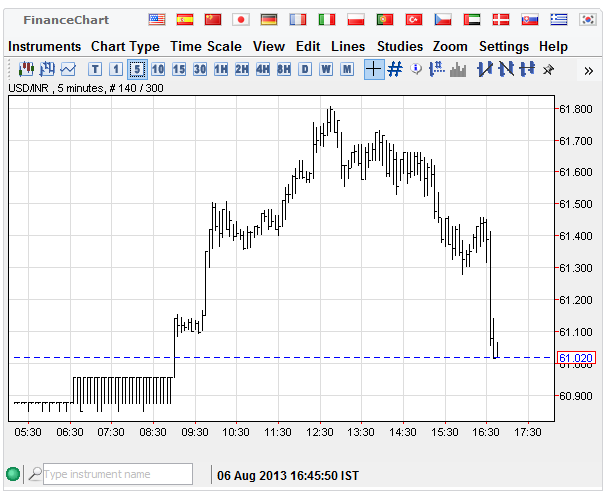
Rajan’s appointment is a bit surprising given that Indian officials are far from free market fundamentalists as Rajan. Perhaps Indian officials were too worried about the depreciation of the Rupee and appointed him? Seems to have helped for today at least – the Rupee hit all time lows during the day and has recovered sufficiently after the announcement.

USDINR - 6 Aug 2013

Chart via NetDania