The ‘Paradox’ Of Protectionism

Paul Krugman says trade wars are a wash. Brad Delong is raising his neoliberal freak flag high.

Who is right? Answer: Neither. Global output will rise under non-selective protectionism (or has an expansionary bias, to be more precise). Protectionism reduces the propensity to import. That doesn’t mean imports will fall. Total imports of an individual nation will rise because of higher income. World trade will rise because of higher world income.

In other words, non-selective protectionism acts by reducing the propensity to import by price elasticity effects but raises volume of imports via income elasticity effects.

The world as a whole is balance-of-payments constrained, not just individual nations. Raising tariffs on imports incentivises producers to produce more as they will face less competition from abroad. Consumers will shift to domestically produced goods because of price elasticity effects.

Moreover, since governments of most nations won’t have a balance-of-payments constraint if there are large tariffs, they will be free to boost domestic demand by fiscal policy, limited only by the economy’s capacity to produce. If it is done, it will be a conscious behaviour by the government.

There is of course another way fiscal policy gets relaxed because of balance of payments. Reduction of current account deficits, relative to gdp, reduces the budget deficit, relative to gdp (as can be shown by a behavioural model and this shouldn’t be surprising as the two are related by an accounting identity). Typically governments follow some rules even if they aren’t explicitly required and their expenditure is endogenous to the government budget deficit: they tighten fiscal policy when the budget deficit goes out of a limit and relax fiscal policy when the budget deficit is within the limit. So improvement in a country’s balance of payments position would lead to a relaxation of fiscal policy, automatically.

To summarize, protectionism if done the right way can raise world trade because of rise in world income. There is no economic case against protectionism. There is opposition because few corporations want to increase their share in world markets. Protectionism reduces share of these mega corporations instead of reducing world trade. So “free trade” (which is managed trade for a few) only benefits a few and imposes a huge cost on the world economy.

All that is for the current world economic outlook. Typically in deep recessions governments take protectionist measures. In such scenarios, since output is falling, there is a tendency to confuse this with causation. It is more accurate to say that protectionism prevented a deeper implosion in such cases.

Non-selective Protectionism In Wynne Godley’s 1999 Article Seven Unsustainable Processes

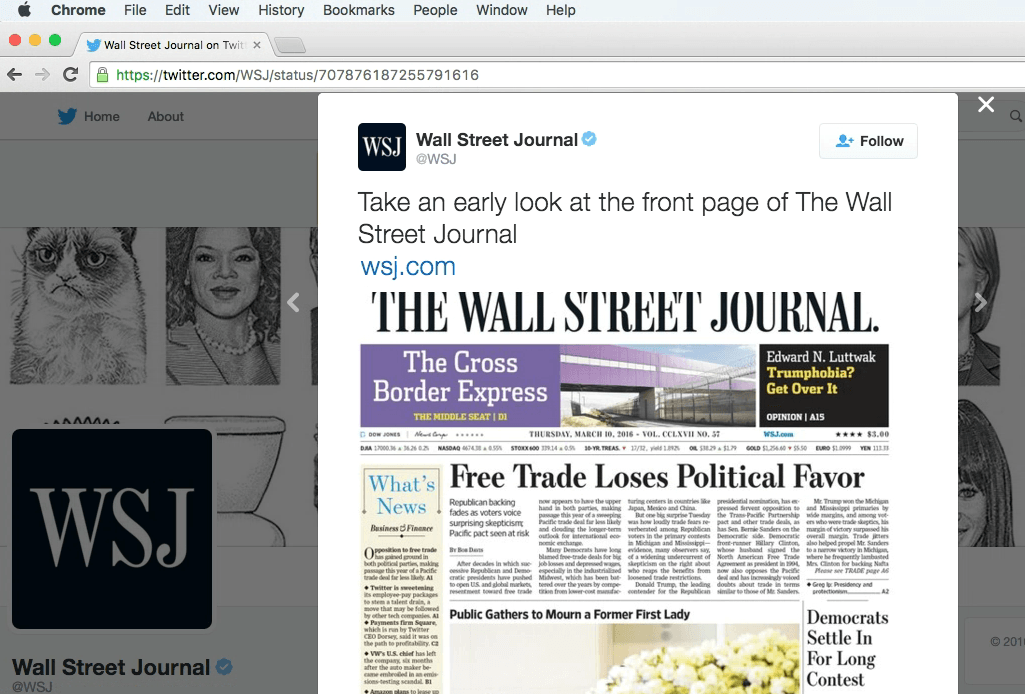
‘Free Trade Loses Political Favour,’ says the front-page of today’s Wall Street Journal.

Free Trade Loses Political Favour

Paul Krugman has two articles conceding that he held wrong views earlier.

Krugman says:

But it’s also true that much of the elite defense of globalization is basically dishonest: false claims of inevitability, scare tactics (protectionism causes depressions!), vastly exaggerated claims for the benefits of trade liberalization and the costs of protection, hand-waving away the large distributional effects that are what standard models actually predict.

Krugman claims that he hasn’t done any of it but a reading of his 1996 article Ricardo’s Difficult Idea says the exact opposite.

The earliest cri de cœur of the U.S. balance of payments situation came from Wynne Godley in his 1999 article Seven Unsustainable Processes. 

In his sub-heading ‘Policy Considerations,’ he says:

Policy Considerations

The main conclusion of this paper is that if, as seems likely, the United States enters an era of stagnation in the first decade of the new millennium, it will become necessary both to relax the fiscal stance and to increase exports relative to imports. According to the models deployed, there is no great technical difficulty about carrying out such a program except that it will be difficult to get the timing right. For instance, it would be quite wrong to relax fiscal policy immediately, just as the credit boom reaches its peak. As stated in the introduction, this paper does not argue in favor of fiscal fine-tuning; its central contention is rather that the whole stance of fiscal policy is wrong in that it is much too restrictive to be consistent with full employment in the long run. A more formidable obstacle to the implementation of a wholesale relaxation of fiscal policy at any stage resides in the fact that this would run slap contrary to the powerfully entrenched, political culture of the present time.

The logic of this analysis is that, over the coming five to ten years, it will be necessary not only to bring about a substantial relaxation in the fiscal stance but also to ensure, by one means or another, that there is a structural improvement in the United States’s balance of payments. It is not legitimate to assume that the external deficit will at some stage automatically correct itself; too many countries in the past have found themselves trapped by exploding overseas indebtedness that had eventually to be corrected by force majeure for this to be tenable.

There are, in principle, four ways in which the net export demand can be increased: (1) by depreciating the currency, (2) by deflating the economy to the point at which imports are reduced to the level of exports, (3) by getting other countries to expand their economies by fiscal or other means, and (4) by adopting “Article 12 control” of imports, so called after Article 12 of the GATT (General Agreement on Tariffs and Trade), which was creatively adjusted when the World Trade Organization came into existence specifically to allow nondiscriminatory import controls to protect a country’s foreign exchange reserves. This list of remedies for the external deficit does not include protection as commonly understood, namely, the selective use of tariffs or other discriminatory measures to assist particular industries and firms that are suffering from relative decline. This kind of protectionism is not included because, apart from other fundamental objections, it would not do the trick. Of the four alternatives, we rule out the second–progressive deflation and resulting high unemployment–on moral grounds. Serious difficulties attend the adoption of any of the remaining three remedies, but none of them can be ruled out categorically.

[italics in original, underlying mine]

Link

Flow Of Funds Sankey Diagrams

The UK ONS (Office of National Statistics) has launched a new set of statistics: the flow of funds for the UK economy.

The recent financial crisis re-emphasised the importance of monitoring the build-up of financial risks in the economy. Since then, there have been renewed calls for identifying balance sheet exposures between different institutional sectors.

Building on recently published flow of funds experimental statistics by Office for National Statistics, in partnership with the Bank of England, this article takes a further step in exploring sectoral interconnectedness within the UK economy and analyses these lender-borrower relationships in the context of risk exposures. Using data visualisation techniques, we illustrate how financial counterparty relationships have changed over time and infer what this tells us about the transmission of financial risks.

In addition, there is an interactive Sankey diagram on the site.

Fun!

(The title of this post is the link).

UK Flow Of Funds Sankey Diagram

Bernie Sanders, U.S. Private Sector Deficits And Balance Of Payments

Over his blog The Beauty Contest – A blog on Spanish and international affairs, macroeconomics and finance, Javier López Bernardo has an analysis of Bernie Sanders’ economic plan (written with his colleague Rafael Wildauer).

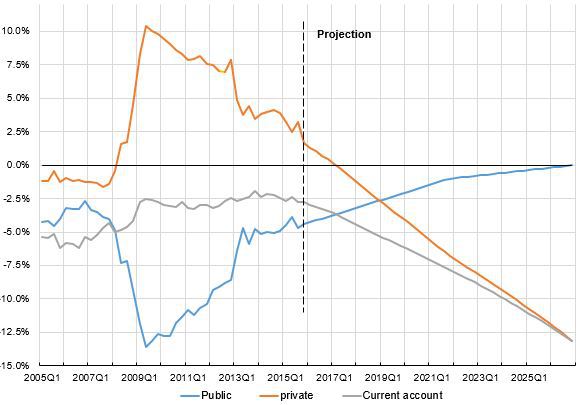
Javier López Bernardo and  Rafael Wildauer stress the importance of the U.S. balance of payments constraint on U.S. growth. He uses a sectoral financial balances model to highlight how sectoral balances would look under Bernie Sanders’ plan: an exploding combination of U.S. private debt and negative net international investment position because of exploding negative financial balance of the private sector and the U.S. economy as a whole.

Also, they say:

We have not intended to bash Mr. Sanders’ economic program (actually, we are quite sympathetic with most of its measures) or Prof. Friedman’s economic exercise (which is useful to frame the economic discussion), but simply to highlight the incompleteness of economic analysis carried out in closed-economy frameworks – as the critics and Prof. Friedman’s exercise have exemplified.

Their projection is this chart:

Sanders-projection-KFBM

Discrete Time Or Continuous Time?

There is always some debate by people on how continuous time is better modelling. A James Tobin quote from his Nobel Lecture comes to mind.

Macroeconomic Modeling Strategy: Continuous or Discrete Time

The issues just discussed are related to the modeling of time. The equations introduced above count time in discrete periods of equal finite length. Within any period, each variable assumes one and only one value. In particular, clearing of asset markets determines one set of asset prices per period. From one period to the next asset stocks jump by finite amounts. Therefore the demands and supplies for these jumps affect asset prices and other variables within the period, the more so the greater the length of the period. They will also, of course, influence the solutions in subsequent periods.

The same modeling strategy can be used with continuous time. The specific saving functions, as well as the total saving function, then tell the rate at which savers want to be increasing their stocks of particular assets and of total wealth. They will reflect both the continuous execution of long run saving and portfolio plans and the speeds of adjustment of stocks to deviations from these plans that arise because of surprises, news, and altered circumstances or preferences.

Either representation of time in economic dynamics is an unrealistic abstraction. We know by common observation that some variables, notably prices in organized markets, move virtually continuously. Others remain fixed for periods of varying length. Some decisions by economic agents are reconsidered daily or hourly, while others are reviewed at intervals of a year or longer except when extraordinary events compel revisions. It would be desirable in principle to allow for differences among variables in frequencies of change and even to make those frequencies endogenous. But at present models of such realism seem beyond the power of our analytic tools. Moreover, many statistical data are available only for arbitrary finite periods.

Representation of economies as systems of simultaneous equations always strains credibility. But it takes extraordinary suspension of disbelief to imagine that the economy solves and re-solves such systems every microsecond. Even with modern computers the task of the Walrasian Auctioneer, and of the market participants who provide demand and supply schedules, would be impossible. Economic interdependence is the feature of economic life and we as professional economists seek to understand and explain. Simultaneous equations systems are a convenient representation of interdependence, but it is more persuasive to think of the economic processes that solve them as taking time than as working instantaneously.

In any event, a model of short-run determination of macroeconomic activity must be regarded as referring to a slice of time, whether thick or paper thin, and as embedded in a dynamic process in which flows alter stocks, which in turn condition subsequent flows.

Subscripting Helps!

The accounting identities equating aggregate expenditures to production and of both to incomes at market prices are inescapable, no matter which variety of Keynesian or classical economics you espouse. I tell students that respect for identities is the first piece of wisdom that distinguishes economists from others who expiate on economics. The second? … Identities say nothing about causation.

– James Tobin, 1997, p. 300, ‘Comment’, in B.D. Bernheim and J.B. Shoven (eds), National Saving and Economic Performance, Chicago: University of Chicago Press.

This is a continuation of my post Stock-Flow Inconsistent? which was a reply to Jason Smith’s blog post More like stock-flow inconsistent on his blog Information Transfer Economics. If you had checked my post before around noon UTC yesterday, you might want to check the updated version.

Jason Smith also has updated his post and proposes a new equation:

ΔH = Γ·(G – T)

(incorrect equation)

Now, that’s quite wrong because it violates rules of accounting.

Morever, Jason Smith insists that it is a behavioral equation.

A lot of clarity can be achieved if one uses subscripts, so that things are clearer.

So we have two equations:

ΔH = GT

dH/dt = GT

Although these two are related, they are not exactly the same: the former is in a difference equation form and the latter in the differential equation form. The in the former has no time dimensions and the in the latter has time dimension equal to –1. The in the former is total expenditure in a period, the in the latter is a rate. 

Since stock-flow consistent models are written typically in difference equations, rather than differential equations, let us avoid subscripts for difference equations for the former and use it for latter.

So it is better to write the equations as:

ΔH = G – T

dHcontinuous/dt = Gcontinuous – Tcontinuous

Each time step in the formalism of difference equations is Δt and hence

G = Gcontinuous ·Δt

T = Tcontinuous ·Δt

Hcontinuous = H

So,

ΔHt = Gcontinuous – Tcontinuous

(approximately)

Or,

ΔH/ Δt = Gt – Tt

Or,

ΔH = G – T

So instead of reaching the correct equation which is:

ΔH= Δt · (Gcontinuous – Tcontinuous)

Jason reaches the equation:

ΔH = Γ·(G – T)

(incorrect equation)

But

ΔH = G – T

as it is an accounting identity in the model!

Stock-Flow Inconsistent?

The first rule of Post-Keynesian Economics is: You do not talk make accounting mistakes. The second rule of Post-Keynesian Economics is: You do not talk make accounting mistakes.

– Anonymous.

Jason Smith—who is a physicist—but writes a blog in Macroeconomics, wonders how equations in the simplest stock-flow consistent model given in the textbook Monetary Economics written by Wynne Godley and Marc Lavoie make any sense from a dimensional analysis viewpoint.

He says he

seem[s] to have found a major flaw.

He sees the equation:

ΔH = GT

and wonders where the time dimensions are. For, H is the stock of money and hence has no time dimension, whereas the right hand side has flows and has time dimensions of inverse of time. For example if the US government spends $4 tn in one year, is $4 tn/year.

In continuous time, the above equation is:

dH/dt = GT

So how are these two equations the same?

Perhaps, Jason is not familiar with difference equations. He instead seems to prefer:

τ·ΔH = GT

Well that’s just wrong if τ is anything different from 1, as a matter of accounting.

Now moving on to time scales, it is true that in difference equations some time scale is implicit. But it doesn’t mean the methodology itself is wrong. Many physicists for example set all constants to 1 and then talk of numbers which are dimensionless.

So if a relativist sets “c=1”, i.e, the speed of light to 1, all velocities are in relation to the speed of light. So if somebody says the speed is 0.004, he/she means the speed is 0.004 times the speed of light.

But Jason Smith says:

Where does this time scale come from over which the adjustment happens? There is some decay constant (half life). It’s never specified (more on scales here and here). If you think this unspecified time scale doesn’t matter, then we can take Δtlp and the adjustment happens instantaneously. Every model would achieve its steady state in the Planck time.

That’s not true. String theorists for example set the parameter α’ = 1. But nobody ever claims that macroscopic adjustments happen at Planckian length scales or time scales.

Coming back to economics, there’s nothing wrong in

ΔH = GT

There’s an implicit time scale yes, such as a day, or a month, or a year, or even an infinitesimal. But parameters change accordingly. So in G&L models we have the consumption function

 C = α1 ·YD + α2 ·W

where is household consumption, YD, the disposable income and W, the household wealth.

Let’s say I start with a time period of 1 year for simplicity. αmight be 0.4. But if I choose a time period of 1 quarter, αwill correspondingly change to 0.1. In English: if households consume of 4/10th  of their wealth in one year, they consume in 1/10th one quarter.

So if we were to model using a time scale of a quarter instead of a year, α2 will change accordingly.

But the equation

ΔH = GT

won’t change because it is an accounting identity!

It’s the difference equation version of the differential equation:

dH/dt = GT

Physicists can pontificate on economic matters. I myself know string theory well. But boy, they shouldn’t make mathematical errors and embarrass themselves!

In other words, accounting identities can be written as accounting identities in difference equations. What changes is values of parameters when one chooses a time scale for difference equations.

Wynne Godley’s model is touched by genius. In fact according to one of the reviewers of Monetary Economics, Lance Taylor says that it is out of choice that Wynne Godley chose a difference equation framework. They can be changed to differential equations and we’ll obtain the same underlying dynamics.

Here’s Lance Taylor in A foxy hedgehog: Wynne Godley and macroeconomic modelling

Godley has always preferred to work in discrete time, responding to the way the data are presented.

Question: is the equation ΔH = Gconsistent with dimensional analysis?

Answer: Yes. H is the stock of money at the end of previous period. Δis the change in stock of money in a period. and are the government expenditure and tax revenues in that period. So H, ΔH, G and T have no times dimensions in difference equations. All are in the unit of account. Such as $10tn, $400bn, $4 tn, $3.6tn. Time dynamics is captured by model parameters.

In G&L’s book Monetary Economics, in Appendix 3 of Chapter 3, there’s a mean-lag theorem, which tells you the mean lag between two equilibrium (defined as a state where stock/flow ratios have stabilized):

it is:

[(1 − α1)/α2 ]· [(1 – θ)/θ]

where θ is the tax rate.

So, in the model, assuming a value of 0.6 for α1, 0.4 for α2, and 0.2 for θ we have the mean-lag equal to 4.

Let’s assume that time period is yearly. This means the mean lag is 4 years.

If instead, we were to use quarterly time periods, α2 would be 0.1 and the mean lag evaluates to 16, i.e., sixteen quarters, which is 4 years, same as before.

So there is really no inconsistency in stock-flow consistent models.

tl;dr summary: In difference equations, there’s nothing wrong with equations such as ΔH = GT. It is an accounting identity. By a choice of a time scale, one implicity chooses a time scale for parameter values. What’s wrong? Jason Smith would obtain the same results as the simplest Godley/Lavoie model if he were to work in continuous time and write equations such as dH/dt = GT. I will leave it to him as an exercise!
Occult Or Investment Banky?

Noah Smith has a blog post calling heteredox economics occult. Rather than write a long post which nobody will read, let me point out that Goldman Sachs’ chief economist Jan Hatzius uses Wynne Godley’s model. He frequently cites Wynne Godley (and only him!) for his model as well.

Noah Smith is a fan of investment banks and Goldman Sachs being the top firm should make him realize the importance of heterodox modelling.

Not only does heterodox economics have a framework, it is used by the top investment banking firm!

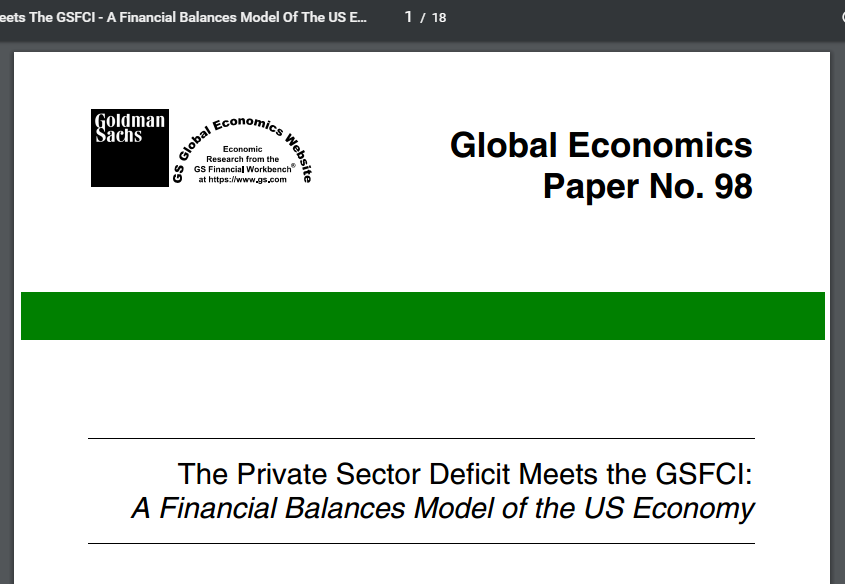
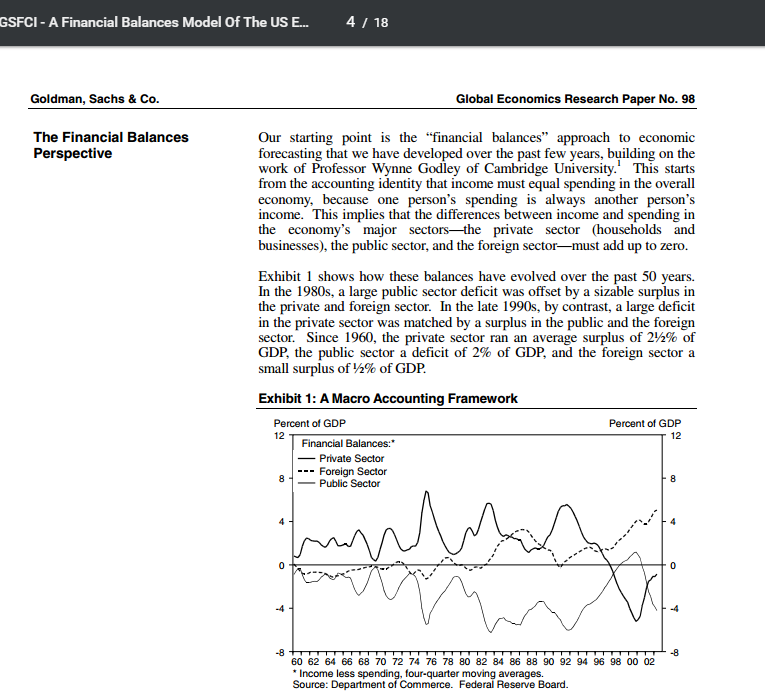
Here’s are two screen snips of GS’ paper written by their chief economist Jan Hatzius and describing their model in detail.

Jan Hatzius Paper Using Wynne Godley's Work

Jan Hatzius’ paper dated September 18, 2003

Jan Hatzius Paper Using Wynne Godley's Work - 2

Jan Hatzius acknowledging Wynne Godley for his model of the US economy 

Heterodox Blogger On Neochartalism

The trouble with Neochartalism (and called “Modern Monetary Theory” by the Neochartalists) is that what is correct is not original and what is original is not correct.

A popular heterodox blogger writing under the pen name “Lord Keynes” and blogging at Social Democracy For The 21st Century has written a post Limits Of MMT

It’s good to see the blogger point that the main trouble with Neochartalism is the balance of payments constraint. He/she has said this in the past in posts while promoting it, so it’s good to see a special post for this. I don’t agree with many things with “Lord Keynes” but given the blog’s popularity, I think it’s a good thing to have happened.

There is one thing I would have liked to see differently. It is sometimes said that Neochartalism works for advanced/rich nations and not for poor nations. But this gives too much importance to Neochartalism. This is because the rise and fall of nations itself depends on competitiveness in international markets. Saying “MMT works for advanced nations” makes it look as if the success and failure of nations is to be explained elsewhere. It’s still true of course that advanced nations can expand domestic demand by fiscal expansion but they also have to look after the being being of firms selling products in international markets, to stay competitive and not lose edge. Similarly as the blogger Lord Keynes says, “What is needed for much of the Third World is heterodox development economics, not MMT.”

More generally a concerted action is needed by world political leaders in which fiscal policies are coordinated with a set of consistent balance of payments targets.

Neochartalism has confused people more than they were confused earlier. It has to be debunked.

The World Balance Of Payments Constraint: Nicholas Kaldor Explaining The Way The World Works

Thirlwall’s Law is counter-intuitive and comes across as shocking. It says that the growth of a nation’s economy is directly proportional to the rate of exports and inversely related to the income elasticity of imports.

The reason it comes as shocking and difficult to believe is that our planet, with all inhabitants and institutions considered resident cannot export (unless there are non-residents such as aliens), but the world still grows.

Now there are several pitfalls in this argument. First, Thirlwall’s law doesn’t fail because the expression for growth rate is indeterminate. Rate of exports is indeterminate and the income elasticity of imports is indeterminate.

So we have

growth = inderminate/indeterminate

Second, the world does not have a central government. So the world as a whole is not comparable to a closed economy with a government.

There is a way in which the world as a whole is balance-of-payments constrained. The argument is by Nicholas Kaldor. In his 1980 article Foundations And Implications Of Free Trade Theory, written in Unemployment In Western Countries – Proceedings Of A Conference Held By The International Economics Association At Bischenberg, France, Kaldor makes the argument for the world balance-of-payments constraint.

Nicholas Kaldor On Free Trade

Nicholas Kaldor on free trade

In a recent article on the ‘Causes of Growth and Recession in World Trade’,1 T. F. Cripps has demonstrated that a country is not ‘balance of payments constrained’ if its full employment imports, M*, are less that its import capacity M̅ (as determined by its earning from exports). Such a country is free to choose the level of domestic demand which it considers optimal for its own circumstances,2 whereas the other countries from whom M* > M̅, must, under conditions of free trade, reduce their output and employment below the full employment level, and import only what they can afford to finance. He then shows that the sum of imports of the ‘unconstrained’ countries determine the attainable level of production and employment of the ‘constrained’ countries, and the remedy for this situation requires measures that increase the level of ‘full-employment’ imports or else reduce the export share of the ‘unconstrained countries’. The ‘rules of the game’ which would be capable of securing growth and stability in international trade, and of restoring the production of the ‘constrained’ countries to full employment levels, may require discriminatory measure of import control, of the type envisaged in the famous ‘scarce currency clause’ of the Bretton Woods agreement.

In the absence of such measures all countries may suffer a slower rate of growth and a lower level of output and employment, and not only the group of countries whose economic activity is ‘balance-of-payments constrained’. This is because the ‘surplus’ countries’ own exports will be lower with the shrinkage of world trade, and they may not offset this (or not adequately) by domestic reflationary measures so that their imports will also be lower. Provided that the import regulations introduced relate to import propensities (i.e. to the relation of imports to domestic output) and not to the absolute level of imports as such, the very fact that such measures will raise the trade, production and employment of the ‘constrained’ countries will mean that the volume of exports and domestic income of the ‘unconstrained’ countries will also be greater, despite the downward change in their share of world exports.3

Footnotes:

1Cambridge Economic Policy Review (March 1978), pp, 37-43.

2Owing to the widespread view according to which a given increase in effective demand is more ‘inflationary’ in its consequences if brought about by budgetary measure than if it is the result of additional investment or exports (irrespective of any limitations of import capacity) the inequality or potential inequality in its payments balance may cause a surplus country to regard a lower level of domestic demand as ‘optimal’ in the first case than in the second case.

3In other words, if countries whose ‘full employment’ balance of payments shows a surplus because M* < α W (where M* is the level of full employment imports, α is the share of a particular country’s exports of in world trade W) after a reduction of α to α̂ (α̂ < α) through the imposition of discriminatory measures, the country will still be better off if α̂ W* > α W where W* is the volume of world trade generated under full employment conditions.

[boldening mine]

What Kaldor is saying that because of balance of payments constraint of economies, the world as a whole has a slower growth because surplus nations do not expand domestic demand to the level needed. He is also saying that import controls raise imports rather than reduce them (this because of higher national income) and the exporters’ exports will also increase (even though their share is reducing.).

So the world as an built-in deflationary bias in the way it works.