Category Archives: Uncategorized

Do The Neochartalists Advocate “Printing Money”?

The question is wrong 🤡

It’s commonly claimed by the opponents of neochartalism or “modern monetary theory” or “MMT”, that the theory advocates the use of “money-financed deficits” or “printing money”—the lowbrow language. This claim is because of a poor understanding of the theory and I say this as a critic. Many Post-Keynesians who don’t identify as chartalists also keep spreading this. Of course this isn’t the complete story as the neochartalists themselves create this confusion indirectly/unknowingly about their own theory.

Imagine a financial system such as in Canada where banks have zero reserve requirements and little bank settlement balances/reserves outside crises. The government can expand fiscal policy by simply raising government expenditure. You could think of the deficit in one period/year as “endogenous”, which will depend on how much taxes come in, which in turn depends on how the private sector responds to the stimulus (with complications of international trade). The difference between the two will be the “net borrowing” in the language of national accounts. If there’s a surplus, the government would be a net lender. But let’s assume it’s in deficit. The government has an account at the Bank of Canada and it will make this shortfall by issuing debt.

The private sector would have additional income and wealth because of the stimulus and the borrowing. Because: the stimulus would raise output and income of the private sector and also because the very act of deficit also adds to the private sector wealth.

Banks would lend more because of the rise in output would lead to more demand for loans, the central bank has a large control of the interest rates and could even set the whole yield curve. There’s no crowding out and the reserve requirement is zero! Banks would also also have more income and their capital-adequacy would improve to allow them to lend more.

Loans make deposits and in the aggregate they won’t be constrained really in lending although individual banks would need to fund themselves as not raising would cause them to have large overdrafts at the Bank of Canada, the central bank and they might run out of collateral to post at the central bank.

The private sector would decide how much of its wealth it wants to allocate in banknotes and how much in government bonds and other financial assets. If the private sector wants more banknotes, they’ll ask their banks which in turn would obtain from the Bank of Canada by going in an overdraft. The Bank of Canada would buy government bonds in the financial markets and bring the reserves back to zero from negative.

In other words, the amount of banknotes and government bonds that the private sector wishes to hold is entirely decided by the private sector. The phrase “money-financed deficits” implies that the Canadian government and the Bank of Canada decide how much this is and is misleading.

Anything here is a typical story in neochartalism. Although neochartalist would like to go more such as proposing “no-bonds” with all deficit spending from the beginning of time to be reflected in banks’ settlement balances at the Bank of Canada, it’s not like a strict requirement that neochartalism would only work with zero-bonds. They’d be comparatively happy with more fiscal expansion than no expansion or contraction or an expansion which is not much.

The main reason for the stimulus and the rise in output would be the act of increased spending of the government itself. Money vs. bonds decided by the private sector needs.

The reason neochartalists’ claim sound like “printing-money” in the lowbrow language is that the above dynamics is poorly understood by their opponents, because monetarism is a prejudice which affects almost everyone.

But to complicate that’s not all. There’s a Stephanie Kelton paper with the title Can Taxes And Bonds Finance Government Spending?

This misleads the reader into thinking that neochartalists are advocating “printing money” but the arguments above show how misleading the phrase itself is. What the “MMTers” are saying is that the government has a virtually large borrowing ability. The phrase “borrowing” makes us thinking that there is some sort of intrinsic constraint. Hence their rejection of the word “borrowing”.

To prove all this, neochartalists try to draw long T-accounts so that the reader is convinced that everything is fine, government deficit is actually mirrored as private sector deficit, the mechanics of central banking in trying to prove in detail how the government can raise as much funds as it wants, so that the reader is convinced there’s no hanky-panky.

But in an effort to prove that they go into overkill. So for example, typically governments can’t have overdrafts at their central bank because neoliberals have made this the law to “discipline” the government. So some positive critics such as Marc Lavoie would try to constructively critique them in a friendly way but others would simply dismiss them using this as an excuse. Neochartalists would respond to former saying that it still doesn’t constrain the government which is true but it’s not a perfect argument.

And in all this they also end up claiming horribly wrong things that taxes needn’t be increased. That is unfortunate as it gives their opponents an even bigger chance to dismiss them. Some like me have criticised them for this too but “MMT” has kind of become this catch-phrase for everything Post-Keynesian so the ones with bad faith exploit it to dismiss the whole of Post-Keynesianism.

More than that, the story falls short because in the case of open economy, the government has constraints, brought because of historic reasons causing large differences in competitiveness between nations. Trade imbalances can cause fiscal policy to be constrained and the international investment position to be unsustainable.

But this part is a digression for this post. The main point is that the claim that “MMT advocates printing money” is a lowbrow claim.
Another Thomas Palley Critique Of Neochartalism

The new issue of Review Of Keynesian Economics (ROKE) is out. Thomas Palley has another critique of Neochartalism or “Modern Modern Theory”, tilted What’s Wrong With Modern Money Theory: Macro And Political Economic Restraints On Deficit-Financed Fiscal Policy. 

I don’t agree with many things but it’s worth a read, as has his other critiques been. From a political economy perspective, the problem of the world is the the liberal international economic order which exists and is totalising. This imperialism needs to be overthrown and new order needs to be established. This is completely missed by the neochartalists because they tend to think that as long as a country’s currency is truly floating, fiscal policy can do the trick. Dismissing the constraints brought from international trade, this way.

Globalists need to be defeated.

Neochartalists also do all sorts of verbal gymnastics in throttling any debate about increase in tax rates. In fact Warren Mosler argues for removal of most taxes. Oh wow! How did us mortals miss such a simple solution to the problem of the world!

Basically neochartalists blur the distinction between two separate issues:

  1. Tax rates needn’t rise to increase domestic demand and output.
  2. Tax rates ought to rise for a fair distribution of the national income.

One can believe both (1) and (2) consistently as typically economies run at less than full employment. Neochartalists however use (1) to throttle the debate on (2).

But if you discuss these issues with them, they concede this but yet the next time seem to argue like before. Another way to see this is that they have no proposals to raise taxes even though they have all sorts of proposals everywhere.

Thomas Palley warns us against this hilarity. He says:

More generally, it is pure semantics whether taxes raise money to finance government spending, or taxes destroy money in order to create the space for reissue of money to finance spending. Taxation and spending occur simultaneously, and taxes are an intrinsic part of the system and cannot be done away with. Even when the economy is far from the full employment/inflation target, taxes are needed to finance the vast bulk of spending. Money-financed budget deficits provide some space at the margin for temporary additional spending, which eventually either has to be cut or be financed by some combination of taxes and borrowing when the economy’s constraints bite.26

  1. If the economy is away from steady state, and the inflation rate and the money–GDP ratio are both rising, then there will be additional temporary financial space along the traverse to the steady state.

Fiscal policy is hugely important and mainstream economists underplay the role of fiscal policy even after so much fiscal policy came to the rescue in this new lockdown crisis. But the problems are much deeper. Imperialism has to be defeated. A new international economic order with planned trade instead of free trade, together with coordination of policies (including fiscal policy) needs to be established. Without the imperial power of either the United States or other international institutions. But something democratic at the international level. Nor is neochartalists’ claims about the importance of fiscal policy original as there’s a tradition of Post-Keynesian economics stressing the importance.

Link

Perry Anderson On Brexit

The new issue of New Left Review is out and Perry Anderson has a 73-page essay on British state and society.

Some good description of Brexit:

In 2015, Cameron was returned to office without need of the Liberal Democrats, who were decimated at the polls, and in the wake of Labour’s renewed defeat, Corbyn was elected its leader in the first one-person-one-vote election in the party’s history. Within a year came the referendum, called and lost by Cameron on Britain’s membership of the EU.32 His decision to call one, product of long-standing divisions among the Tories, was designed to silence the Eurosceptic wing of his party, in a careless display of class insouciance that with united establishment support—extending from the City to the TUC, not to speak of all-party backing—victory was assured. But as in France and the Netherlands, a popular rebellion against the whole governing class led to the opposite outcome. Two thirds of the working class voted for Leave, a higher proportion than any stratum—including even the best-off—voting for Remain, on a larger turn-out than seen in years. London, beneficiary of the financial bubble and closer to Paris than Manchester by rail, voted heavily for Remain; the abandoned industrial North, hardest-hit by austerity, heavily for Leave. On the left, opinions had divided. Those in favour of Remain argued that the xenophobia of Brexiteers of the right made the EU a lesser evil, those in favour of Leave that departure would be a blow to the neo-liberal oligarchies on both sides of the Channel: each voting negatively against, rather than for, anything. But what would Brexit actually mean for the European Union, or for Ukania in parting with it? So far, all that was clear was that ‘Blairized Britain has taken a hit, as has the Hayekianized EU’ and ‘critics of the neoliberal order have no reason to regret these knocks to it’, against which the entire global establishment had inveighed.

More fine-grained analysis made clear the extent to which the Brexit result, though certainly multi-stranded in motivation, was the expression of a regional and social revolt in the North of England: Leave majorities were concentrated in former strongholds of Labour, now reduced to a hinterland of decayed industries and discarded proletarian households.33 There was hostility to immigrants in this part of the country, as elsewhere in Britain. However, that it was not the primary driver of the outcome could be deduced from Labour’s unexpected recovery in the election of 2017, once Corbyn campaigned on a platform amounting to a rejection of the whole neo-liberal order in place since the 1980s. In the face of a high Tory vote, he not only held most of the North, but swept the youth of the country by margins never previously approached by Labour, in what was now a second popular uprising against the entire British establishment. Yet Corbyn’s position remained tenuous in his own party, whose permanent apparatus and parliamentary delegation remained ferociously opposed to him.34 The small team around him lacked any preparation for government in what would be the predictable conditions of an implacable siege by capital and the media. There were no grounds for euphoria.

Britain’s liberal market economy—read: secular eversion—generated the two-fold revolt that produced Brexit. The victory of Brexit led to Conservative capture of a majority of the working class. Working-class expectations require concessions from a suddenly altered Conservative regime that Brexit impedes. The desertion of its proletarian base leaves Labour sociologically adrift in the eddies of a protean middle class. Its share of the middle class is attached to Europe, no part of it more passionately than the liberal intelligentsia. Attracted towards Labour by its stance in the cultural war over Europe, the English intelligentsia is alienated from it by what became of its own principal habitat under it. In Scotland, alienation of all classes of society from Labour has given power to a nationalism looking to Europe. Departure from Europe has both inflamed Scottish nationalism and entrapped it. The price of departure, indexed by the EU to political not economic considerations, has left Britain’s rulers answerless politically and, in all probability, the wells of Brexit further poisoned economically. No part of the current configuration is independent of the others. Their nexus is bound to dissolve, in one way or another. When or how is anyone’s guess.

32 Susan Watkins, ‘Casting Off?’, NLR 100, July–August 2016.

33 Tom Hazeldine, ‘Revolt of the Rustbelt’, NLR 105, May–June 2017.

34 Daniel Finn, ‘Crosscurrents’, NLR 118, July–August 2019.

New Left Review, 125

Link

UNCTAD Trade And Development Report, 2020

UNCTAD has released its annual trade and development report.

It emphasises the importance of Keynesianism and cites Post-Keynesian authors such as Joan Robinosn, Nicholas Kaldor, Wynne Godley, Francis Cripps, Marc Lavoie, Anthony Thirlwall.

From the summary:

From crisis to prosperity for all

Much more ambitious multilateral measures will be required if a global crisis is to be transformed into a global recovery:

  • Expanding the use of Special Drawing Rights (SDRs) to support national development strategies in developing countries through a truly internationally governed reserve system. At the very least, developing countries’ fiscal spaces should be backed by the equivalent of $1 trillion of SDRs to meet current liquidity constraints.
  • Financial support for boosting the health emergency response to COVID-19 in developing countries through a Marshall Plan for Health Recovery funded through increased official development assistance (ODA) commitments, international tax reform and enhanced multilateral financing mechanisms, on a scale to build resilience and boost recovery.
  • An international Public Credit Rating Agency to provide objective expert-based ratings of the creditworthiness of sovereigns and companies, including developing countries, and to promote global public goods. This would, moreover, help to promote competition in a highly concentrated private market.
  • A Global Debt Authority to stop a repeat liquidity crises from turning into serial sovereign defaults. Such an authority would build a repository of institutional memory on sovereign debt restructurings. It would also oversee the establishment of a global publicly accessible registry of loan and debt data pertaining to sovereign debt restructurings. In addition, it would develop a blueprint for a comprehensive and transparent international legal and institutional framework to govern automatic temporary standstills on sovereign debt repayments in times of crises and to manage sovereign debt workouts in a fair, efficient and transparent manner.

The title is the link. You can download find the PDF file in that link.

Glenn Greenwald Twitter Thread On Identity Politics As A Cover For Imperialism And Neoliberalism

Glenn Greenwald has an excellent Twitter thread on how the “centrists” use identity politics as a cover:

He writes:

Contempt for it on the merits aside, one has to acknowledge the propagandistic genius of exploiting harmless-to-power identity politics as the feel-good cover for perpetuating and even strengthening the neoliberal order and further entrenching corporate and imperial power.

See the full Twitter thread and also a recent post, Identity Politics As A Neoliberal Alternative To A Left, where I mentioned him.

Wynne Godley On Sensibility

Wynne Godley in a 1988 article, The Sensibility Of Contemporary Institutions in Theology, (first given as a Sermon before the University in King’s College Chapel, 31 May 1987:

Recourse to the dictionary gives, among the definitions of the word sensibility, ‘the glad or sorrowful recognition of a fact or a condition of things’. Also, ‘readiness to feel compassion for suffering’.

But the major issues at stake have been vastly more important than ones which concern sensibility narrowly defined. They go beyond who becomes rich and who remains poor. They extend to matters such as slavery, mass unemployment and civil war.

… The IMF would do well to reperuse its own Article I, which .lists among its purposes: ‘to facilitate the expansion and balanced growth of international trade, and to contribute thereby to the promotion and maintenance of high levels of employment and real income and to the development of the productive resources of all members as primary objectives of economic policy … ‘ In this passage you hear the authentic note of optimism and mutual concern which informed economic relationships within and between countries in the first twenty-five years after the war.

I have been forced to recognize with sadness and very great disappointment that I have so far failed in my personal endeavour to change the course of events or the attitudes of other people. But I remain steadfast to what I understand to be the meaning of Christianity: the unique value it places on the individual inner life; the ability to tolerate aloneness and the imminence of death; the joyful and sensitive concern for and love of other human beings.

Wynne Godley On Control Of International Trade

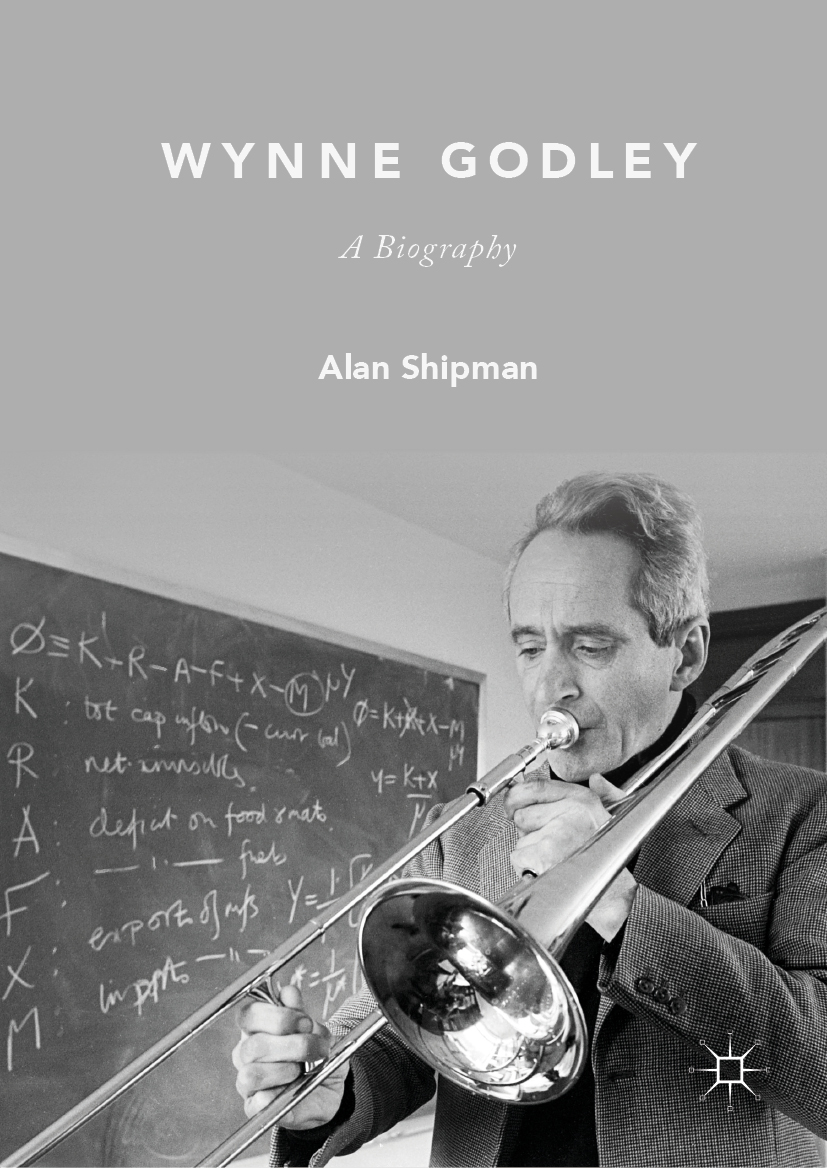
From Alan Shipman’s biography, Wynne Godley, A Biography, Chapter 9: Balance Of Payments, Deindustrialisation And Protection, page 151:

Of all Godley’s policy prescriptions, direct import controls were the one most roundly rejected by other economists, and least likely to be adopted by politicians with any chance of gaining power. The accusation of advocating a policy that was economically illogical, politically infeasible and inadmissible in international law hurt deeply, but never crushed his belief that import quotas should be seriously considered as an additional macroeconomic instrument. The depth of the wound emerged in an unusually personal statement to a 1978 conference on ‘Slow Growth in Britain’, convened by Oxford University’s Wilfred Beckerman in Bath. ‘I am disconcerted and distressed to find myself, together with the group of people with whom I work in Cambridge, in such an isolated position. For we seem to be the only group of professional economists who entertain the possibility that control of international trade may be the only way of recovering and maintaining the prosperity of this country; that free trade may be an enemy for the relatively weak’ (Godley 1979: 226).

References

Godley, W. (1979). Britain’s chronic recession—Can anything be done? In W. Beckerman (Ed.), Slow Growth in Britain. Oxford: Clarendon Press.

Keynes said that:

A study of the history of opinion is a necessary preliminary to the emancipation of the mind.

Although in the poor countries, ones colonised and which suffered because of imposition of laissez-faire, there have been a lot of opposition to free trade—and those voices aren’t heard through silencing internationally—in the advanced countries, it has been almost non-existent except from Cambridge Keynesians and maybe a few others. In recent times, we see some opposition, but not remotely like this even 40 years ago. It is important to know the history of thought to understand how hegemonic the ruling ideology has been.

For Wynne Godley, dissenting against free trade was one of the most important reasons for his dissent against the profession. In his short autobiography written in 2001 for A Biographical Dictionary Of Dissenting Economists, Godley said:

There are two aspects (in particular) of the work of the CEPG [Cambridge Economic Policy Group] which put its members into a category which may he termed ‘dissenting’. The first – a matter mainly of concern to the modelling fraternity and academic econometricians – was the unconventional view we took about how to construct and use an econometric model.

The second, and more egregious, respect in which we became a ‘dissident’ group was that, as a result of trying to think through the possible ways in which Britain’s net export demand might be improved, we entertained the possibility that international trade should be, in some sense, ‘managed’. There might, we argued, be no way in which the adverse trends could be reversed other than some form of control of imports. Our argument (see for instance Cripps, 1978; Cripps and Godley, 1978) was never one in favour of protectionism as normally understood – that is, the selective and unilateral protection of relatively failing industries under conditions of general stagnation. On the contrary, we were most careful to lay down conditions under which the management of trade would benefit not only our own country (without making its industry less efficient) but would also increase the level of trade and output in the rest of the world. The two basic principles were, first, that trade management should reduce import propensities without ever reducing imports themselves (in total) below what they otherwise would have been; and, second, that ‘protection’ should be as minimally selective as possible (for example, through the use of market mechanisms such as auction quotas) so that industrial inefficiency would not be sponsored.

I was surprised by the hostility with which our ideas about trade were received. It seemed to me at the time, and still seems to me, that the arguments actually used against us (at their most coherent by Maurice Scott et al., 1980) did not, in practice, rest on a well-articulated theoretical position but on very special assumptions about behavioural relationships and international political responses. (I have, to the best of my ability, answered these particular points in Christodoulakis and Godley, 1987.)

The ‘dissident’ argument in favour of managed trade is well summarized in Kaldor (1980), where he points out that the modern theory of international trade is based on the assumption that all production takes place according to the conditions described by the neoclassical production function, with constant returns to scale. Kaldor postulated instead, and he was surely right to do so, that the principle of circular and cumulative causation leads (through dynamically increasing returns) to a process, not of convergence, but of polarization between successful and unsuccessful economies in which success in competitive performance feeds on itself and losers become immiserated by trade.

Godley’s Major Writings

(1978), ‘Control of Imports as a Means to Full Employment: The UK’s Case’ (with T.F.
Cripps), Cambridge Journal of Economics, 2, September.

(1987), ‘A Dynamic Model for the Analysis of Trade Policy Options’ (with N. Christodoulakis), Journal of Policy Modelling, 9.

Other References

Cripps, T.F. (1978), ‘Causes of Growth and Recession in World Trade’, Cambridge Economic Policy Review, No. 4.

Kaldor, N. (1980), ‘The Foundations of Free Trade Theory and Recent Experiences’, in E. Malinvaud and Fitoussi, J.P. (eds), Unemployment in Western Countries, London: Macmillan.

Scott, M., Corden, W.M. and Little, I.M.D. (1980), The Case Against Import Controls (Thames Essay No. 24), London: Trade Policy Research Centre.

Nicholas Kaldor On The Importance Of History

Nicholas Kaldor in Limitations Of The General Theory, published in Collected Economic Essays, Volume 9, first published 1982 on the role and importance of history in causation:

My purpose here is to show that many of the difficulties which emerged in the operation of Keynesian policies of demand management were due not to any defect in basic conception but to the failure of Keynes (and of his followers) to work out the full implications of his ‘paradigm’ of the economy as against the ruling ‘paradigm’ of neo-classical economics.

Keynes himself emphasized that the writing of his book was ‘one long struggle to escape from habitual modes of thought and expression … The difficulty lies not in the new ideas, but in escaping from the old ones, which ramify, for those brought up as most of us have been, into every corner of our minds.’3

As far is possible within the confines of a lecture, I hope to demonstrate that the limitations of the General Theory derive more from a failure to escape from traditional modes of thought than from any basic defect in those aspects which were fundamentally new. Apart from his failure to cut himself loose from one of the main tenets of the quantity theory of money, with which I shall deal only briefly as I have discussed it extensively on earlier occasions, the three main aspect in which Keynes remained too much a follower of tradition concern: first, the micro-economic background, in other words, the implications for his theory of the way markets function; second, the regional or territorial aspect, the implications of inter-regional trade for the differing rates of employment-growth of different areas; and finally, the failure to recognize that owing to the importance of increasing returns in manufacturing, the development of an industrial system is largely self-generated, where, owing to a powerful feed-back mechanism, ‘events of the recent past can only be explained in terms of the actual sequence through which the system has progressed; history enters into the causation of events in an essential way’.4

3 General Theory, Preface, p. vii.

4 Cf. Jukka Pekkarinen, On The Generality of Keynesian Economics (Helsinski, 1979), p. 113. He adds that in consequence ‘it is not reasonable to view the economic process as allocating given resources wuth given technologies and preferences’.