Category Archives: Uncategorized

Link

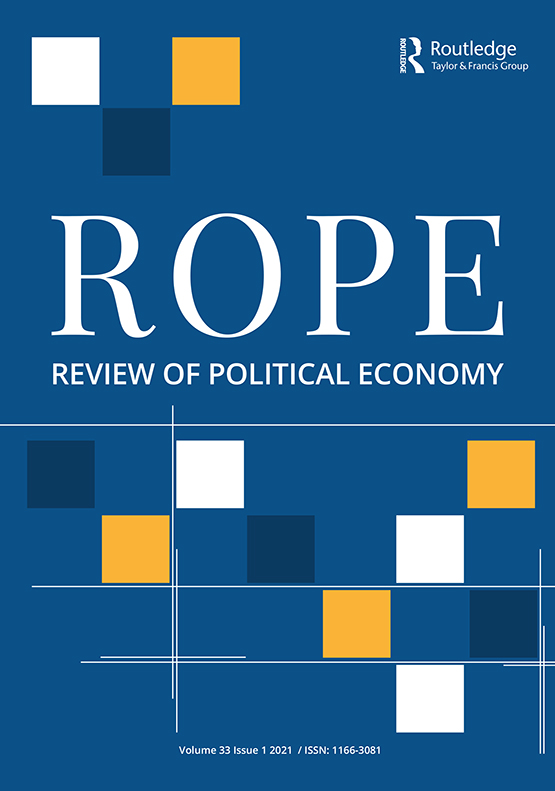
ROPE: Development Economics: Aptly Or Wrongly Named?

Underdevelopment is rooted in a specific connexion, created in a particular historical setting, between an internal process of exploitation and an external process of dependence.

– Celso Furtado, 1973, republished in ROPE, Volume 33, 2021, Issue 1.

The latest issue of Review Of Political Economy is about how the idea of development economics to emulate the west has failed.

How can it work, as the liberal international order works for the “north” at the expense of the “south”.

The issue includes two articles by Celso Furtado from the 70s but unpublished before.

[The title is the link]

Link

Joan Robinson In NYT From 1976

This is an unbelievably good profile (thanks to Carolina Alves on Twitter) of Joan Robinson in The New York Times from 1976.

One of the best things in the article is about bastardisation of Keynes/Keynesian economics. Bastardisation is the process of intentionally misinterpreting a theory or an ideology to suit one’s political purposes. The economics profession largely bastardised Keynes to dilute his message. But the best thing is that Keynes himself allowed this bastardisation. He had it right but then said a lot of wrong things which allowed economists to do that. Like by doing: “what do you mean, Keynes himself said that”.

According to the article:

In essence, she concedes, “this was Keynes himself enunciating the Bastard Keynesian doctrine.” Clearly this side of Keynes frustrates her. “We, the younger chaps working with him, were to his left,” she remarked.

Joan Robinson On Central Banking And Deficits

Jo Michell reminded everyone in a tweet of a quote from Joan Robinson with the comment: “Joan Robinson covered pretty much all of MMT in half a page in 1937.”

😉

It’s a passage from her book Introduction To The Theory Of Employment, pages 72-74 (in the second edition):

CREATION OF MONEY THROUGH A BUDGET DEFICIT

A budget deficit financed by borrowing from the Central Bank has effects similar to those of gold-mining. We have already seen how a budget deficit influences incomes. If there is an increase in government expenditure without any corresponding increase in tax receipts there will be an increase in incomes and activity. This is true equally whether the government borrows from the public or from the Central Bank. If the borrowing is from the public there is no further effect to be considered. But if borrowing is from the Central Bank, then on top of the direct effect of the deficit upon income there is the effect of an increase in the quantity of money. For the Central Bank, in lending to the government, increases the ” cash” of the banks, just as it does by buying securities or by buying gold. The direct effect of the deficit comes to an end as soon as the budget is balanced, but the effect upon the quantity of money remains as a permanent legacy.

The increase in the quantity of money, which takes place cumulatively as long as the deficit is running, will tend to produce a fall in the rate of interest and (unless confidence has been badly shaken) the effects of an increase in investment, induced by lower interest rates, will be superimposed upon the direct effects of the budget deficit in increasing consumption.

At first there will be a drag upon the fall in the rate of interest because the direct effect of the budget deficit in increasing incomes raises the demand for money, since the requirements of the active circulation depend upon the level of income. But the increase in demand for money will be very slight (so long as money wages do not rise) compared to the increase in supply, and it is a once-andfor-all effect, while the increase in the supply of money is cumulative.

The whole difference between a budget deficit financed by creating money and one financed by ordinary borrowing lies in this reaction upon the rate of interest.

Gita Gopinath On Fiscal Policy

Gita Gopinath, the IMF’s chief economist is now arguing for a coordinated fiscal expansion, and that “coordinated spending is better than the sum of the individual parts” (CNN interviewer quoting her) and that “it is time for a global synchronised fiscal push to lift up prospects for all” (FT article referred in the CNN interview.

This is of course welcome! A lot of countries can’t do it alone and a coordinated expansion would allow them to raise output, keeping balance of payments in check.

It’s sad however, that the message was this late (although anything better than never). Also the characterisation of the problem as if we’re in a liquidity trap is dubious as they just want to say that fiscal policy will work only now, not after a recovery. But fiscal policy always works.

Link

Sergio Cesaratto’s New Book

Sergio Cesaratto has a new book which:

  • Introduces readers to the basics of heterodox and orthodox approaches in economics
  • Explains the problematic aspects of the European Monetary Union (EMU) from the standpoint of alternative economic theories
  • Highlights the conservative nature of the EMU and the economic and political difficulties of reforming it

with the further description:

This book discloses the economic foundations of European fiscal and monetary policies by introducing readers to an array of alternative approaches in economics. It presents various heterodox theories put forward by classical economists, Marx, Sraffa and Keynes, as a coherent challenge to neo-classical theory. The book underscores and critically assesses the analytical inconsistencies of European economic policy and the conservative nature of the current European governance. In this light, it examines the political obstacles to proposals to reform the European monetary union, as well as those originating in the neo-mercantilist German model. Given its scope and format, the book offers a valuable asset for researchers and members of the general public alike.

[the title is the book site at Springer]

Link

Glenn Greenwald On The American Press: My Resignation From The Intercept

… The Intercept’s editors, in violation of my contractual right of editorial freedom, censored an article I wrote this week, refusing to publish it unless I remove all sections critical of Democratic presidential candidate Joe Biden …

American media is gripped in a polarized culture war that is forcing journalism to conform to tribal, groupthink narratives that are often divorced from the truth and cater to perspectives that are not reflective of the broader public but instead a minority of hyper-partisan elites. The need to conform to highly restrictive, artificial cultural narratives and partisan identities has created a repressive and illiberal environment in which vast swaths of news and reporting either do not happen or are presented through the most skewed and reality-detached lens.

With nearly all major media institutions captured to some degree by this dynamic, a deep need exists for media that is untethered and free to transgress the boundaries of this polarized culture war and address a demand from a public that is starved for media that doesn’t play for a side but instead pursues lines of reporting, thought, and inquiry wherever they lead, without fear of violating cultural pieties or elite orthodoxies.


The Suspension Of Jeremy Corbyn

So Labour under the new leadership of the rank imperialist Keir Starmer has suspended Jeremy Corbyn from the party with the campaign of smears about antisemitism.

Jeremy Corbyn is far ahead of any politician in the advanced world and one of the nicest human beings. He was strongly anti-imperialist and that explains the hatred of the establishment toward him.

Unfortunately, even people who call themselves leftists—such as Owen Jones of The Guardian—tried their best to stop him from rising to power. In the 2017 elections Corbyn was really close to winning the elections and since the conservatives in the UK didn’t have a majority, Corbyn had to be stopped at all costs. So the charges of antisemitism kept appearing in the media.

There was also an internal struggle led by the now leader Keir Starmer to stop Jeremy Corbyn from taking the side of leaving the EU. Corbyn was always anti-EU, as it’s an imperialist/neoliberal institution built on the idea of free trade. But around 2016, when it was becoming apparent that the leave side was going to win, the establishment started smearing everyone as racists and xenophobic. Labour is heavily neoliberal, so except Jeremy Corbyn and a few they all wanted to remain the EU. Corbyn erred by presenting himself as a remainer before the referendum. This gave the right-wing an opportunity to exploit the situation and present themselves as the party of the working class. They knew that people would vote for them simply because voters would want to protest, not because the working class supported Conservatives‘ policies.

Jeremy Corbyn was a bit cornered and he had to pander to the remain camp and it cost him the election in 2019.

You keep hearing that neoliberalism is dead but that’s all wrong. In recent times—during the lockdown—countries have adopted expansionary fiscal policies but it’s an illusion. The politicians themselves have made it clear that those policies are temporary and would return to restrictive fiscal policy soon. Neoliberalism is stronger than ever. The fall of Jeremy Corbyn is a proof of it. So has to be fought harder than before.
Source: Instagram