Category Archives: Uncategorized

Hungary Again

I had two previous posts on Hungary here and here. Initially I thought of writing more on this, but today Fitch came out with a rating action and I guess explains most stuff on the deterioration of the economy – so enough of Hungary for now. Find below Fitch’s release. I quoted two comments highlighting CHF mortgages (equivalent of 16% of GDP) while my first post was on deteriorating external finance – both highlighted by Fitch.

Full report below

Fitch Revises Hungary’s Outlook to Negative; Affirms at ‘BBB

Fitch Ratings-London-11 November 2011: Fitch Ratings has revised the Outlooks on the Republic of Hungary’s Long-term foreign and local currency Issuer Default Ratings (IDR) to Negative from Stable and affirmed the ratings at ‘BBB-‘ and ‘BBB’, respectively. The agency has also affirmed Hungary’s Short-term IDR at ‘F3’ and Country Ceiling at ‘A-‘.
“The revision in Hungary’s Outlook to Negative reflects a sharp deterioration in the external growth and financing environment facing Hungary’s small, open and relatively heavily indebted economy,” says Matteo Napolitano, Director in Fitch’s Sovereign Group. “Moreover, various fiscal policy measures and the scheme to allow the repayment of household foreign currency mortgages at below market exchange rates have dented foreign investor confidence, on which medium-term growth prospects depend.”

Hungary is particularly exposed to any deterioration in the economic and financial conditions in the eurozone, owing to its open economy, mainly Western European-owned banking sector, relatively high levels of public and external debt and financing ratios, sizeable stock of portfolio investment (including a 40% non-resident share of domestically issued government debt) and Swiss Franc (CHF) mortgages debt.

Heightened risk aversion has increased refinancing risks on external sovereign maturities. Hungary needs to refinance around EUR4.6bn in 2012, and EUR5bn-EUR5.6bn annually in 2013-14, of foreign exchange denominated debt. Any potential selling of HUF-denominated debt by non-resident investors could add to financing pressures. The government’s EUR1.6bn cash deposit at the central bank provides a moderate buffer against refinancing risks.

Growth prospects have weakened sharply both in Hungary and in its main Western European trading partners in recent months. In October, Fitch revised its forecast for 2012 eurozone GDP growth down to 0.8% from 1.8% previously, and to 1.6% from 1.7% previously for 2011. Against this backdrop, with domestic demand weighed down by fiscal tightening and private-sector de-leveraging, Fitch expects Hungary’s economy to grow by only 0.5% in 2012, down sharply from the agency’s projection of 3.2% in June 2011.

The government appears committed to fiscal consolidation and through the course of 2011, has set out an array of measures in the Szell Kalman plan in March, the Convergence Programme in April and the new measures announced in September. Despite some widening in the structural budget deficit in 2011, it will run a general government surplus in 2011 of around 3.5% of GDP, driven by large one-off factors such as the return of private pension assets to the public sector. Fitch forecasts that government debt will decline to around 76% of GDP at end-2011, from 80% at end-2010.

For 2012, the government intends to reduce the structural budget deficit by over 2 percentage points of GDP to bring the headline deficit to 2.5% of GDP, thus taking Hungary out of the EU’s Excessive Deficit Procedure (EDP). However, the weak growth outlook, the uncertain costing and implementation of some measures and potential reform fatigue make this challenging. Fitch forecasts a 2012 budget deficit of 3.3% of GDP.

Over the course of 2011 the Hungarian forint (HUF) has depreciated by 13%-14% against both the euro and the CHF, thus increasing further heavy public- and private-sector debt repayment burdens. The government’s policies to tackle the large stock of CHF-denominated household debt (equivalent to 16% of GDP in mid-2011) may turn out to be fairly ineffective and have negative consequences. Credit constraints and a lack of sufficient savings will likely prevent the share of CHF loans that are repaid early at a preferential exchange rate from rising above 20%-25% of the total (see ‘Hungary: Risks from Swiss Franc Debt Exposure’, dated 5 October 2011 at www.fitchratings.com).

However, this will still place further pressure on the HUF and on the banking sector’s balance sheet, which is already beset by an exceptional levy, rising non-performing loans and several years of sluggish economic activity. Although the system average Tier 1 capital adequacy ratio (CAR), at 10.9% in September 2011, looks reasonable, a number of banks are already making losses and will require re-capitalisation – which is likely to be forthcoming from foreign parents. Nevertheless, foreign parent banks are likely to continue to cut their exposure to Hungary and the supply of credit is likely to continue to contract, weighing on GDP growth.

Some of Hungary’s fundamental rating strengths such as a rich and diverse economy, and underlying political stability remain in place. Moreover, it is running a large current account surplus, which Fitch forecasts at an annual average of 2.4% in 2011-12, helped by resilient export performance and weak domestic demand. It should also attract around USD2bn in non-debt financing in 2012 from EU transfers and other sources.

Foreign direct investment (FDI) registered a net outflow of EUR1bn in H111. Aside from a handful of large investments in the automotive sector, there are few significant FDI projects in the pipeline. Potential investors appear to be either delaying decisions, or investing elsewhere, as government policies have eroded Hungary’s business climate – a traditional rating strength and key part of the growth model.

When Fitch affirmed Hungary’s rating at ‘BBB-‘ and revised the Outlook to Stable on 6 June 2011, it noted that “negative pressure on the rating could also emerge from the anaemic growth, private sector capital outflows, increased problems in the banking sector or a significant shift in investor sentiment that adversely affected Hungary’s public and external financing capacity”.

Hungary is exposed to an intensification of financial instability and recession in the euro area. A significantly worse than currently anticipated slowdown, evidence of private sector capital outflows or problems in the banking sector, a rise in the risk premium or fiscal financing pressure could lead to a downgrade. A material weakening in the government’s commitment to fiscal consolidation could also lead to a downgrade.

Conversely, the government meeting its budget deficit targets and a return to healthy growth, particularly in the context of significant structural reforms and declining external debt ratios, could lead to positive rating action.

Contact:

Primary Analyst
Matteo Napolitano
Director
+44 20 3530 1189
Fitch Ratings Limited
30 North Colonnade
London, E14 5GN

Secondary Analyst
Ed Parker
Managing Director
+44 20 3530 1176

Committee Chairperson
Shelly Shetty
Senior Director
+1 212-908-0324

Media Relations: Peter Fitzpatrick, London, Tel: +44 20 3530 1103, Email: peter.fitzpatrick@fitchratings.com.

Additional information is available at www.fitchratings.com.

The ratings above were solicited by, or on behalf of, the issuer, and therefore, Fitch has been compensated for the provision of the ratings.

Applicable criteria, ‘Sovereign Rating Methodology’, dated 15 August 2011, are available at www.fitchratings.com.

Applicable Criteria and Related Research:
Sovereign Rating Methodology

ALL FITCH CREDIT RATINGS ARE SUBJECT TO CERTAIN LIMITATIONS AND DISCLAIMERS. PLEASE READ THESE LIMITATIONS AND DISCLAIMERS BY FOLLOWING THIS LINK: HTTP://FITCHRATINGS.COM/UNDERSTANDINGCREDITRATINGS. IN ADDITION, RATING DEFINITIONS AND THE TERMS OF USE OF SUCH RATINGS ARE AVAILABLE ON THE AGENCY’S PUBLIC WEBSITE ‘WWW.FITCHRATINGS.COM’. PUBLISHED RATINGS, CRITERIA AND METHODOLOGIES ARE AVAILABLE FROM THIS SITE AT ALL TIMES. FITCH’S CODE OF CONDUCT, CONFIDENTIALITY, CONFLICTS OF INTEREST, AFFILIATE FIREWALL, COMPLIANCE AND OTHER RELEVANT POLICIES AND PROCEDURES ARE ALSO AVAILABLE FROM THE ‘CODE OF CONDUCT’ SECTION OF THIS SITE.

Copyright © 2011 by Fitch, Inc., Fitch Ratings Ltd. and its subsidiaries.
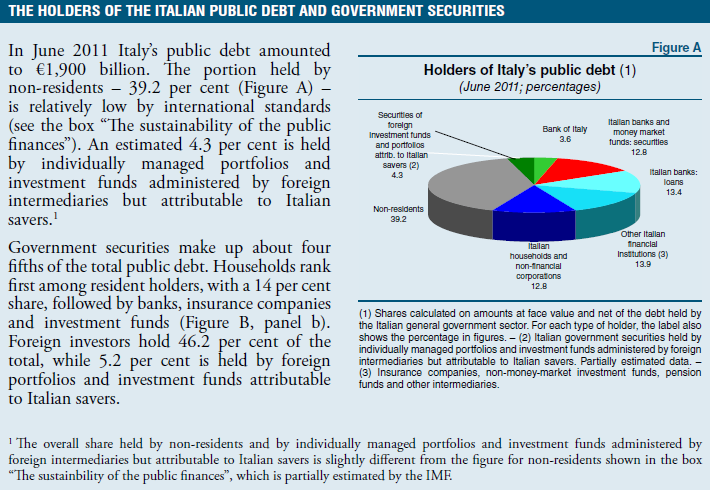
Holders Of Italy’s Public Debt And Government Securities

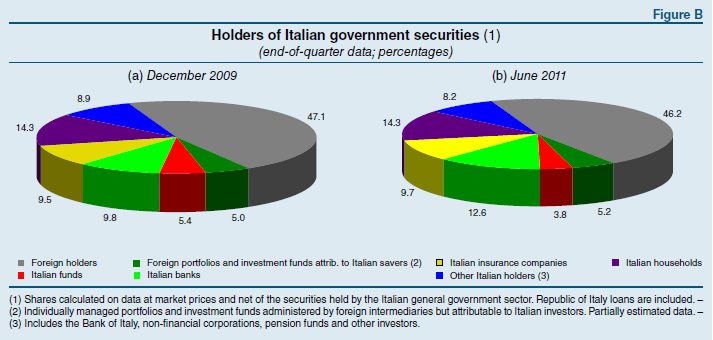
Banca d’Italia – Italy’s National Central Bank – released its Financial Stability Report, Nov 2011 recently. With movements in Italian government bond yields making headlines, the following graphs from the report might be useful.

(Click to enlarge)

Lots of foreigners = lots of trouble!

Comments On Post On Hungary

I received two comments in my previous posts on Hungary. I have a 0-comments policy (as opposed to no-comments policy) because maintaining comments is additional responsibility 🙂 and am posting them here. I received few more comments on other posts so apologies for being partial to some comments in over others.

Sergei said:

It is a very one-side story. I am not even sure it connects any dots. The problem in Hungary is CHF mortgages and with the CHF action it is easy to imagine how many of those are seriously underwater. Even worth, some months ago the government legislated a law which allowed a certain type of mortgage borrowers to prepay their CHF mortgages at, I think, 180 CHFHUF while the current rate is almost north of 250. And these transactions have to be executed by Christmas.

CHF mortgages were typically structured as foreign currency clause, i.e. they are denominated in CHF but all payments are made in HUF at spot. While the mortgage market was booming, Hungarian central bank accumulated huge fx reserves coming from CHF which it was buying from banks which financed from their western parents their local CHF mortgage portfolios. Now, as these flows reverse and as government puts deliberate pressure to reverse them, and as central bank in all its stupidly refuses to sell back its fx-reserves, HUF obviously depreciates.

So the current account story might be a correct introduction but the real reason of depreciation, I believe, is much deeper.

BFG said:

Nice blog Ramanan,

The forint was pegged to the euro until Feb 2008, notice the large turn around in the current account when they abandoned the peg, with the hugh depreciation in their currency. They also have a big mortgage problem in which two-thirds of Hungarian mortgages are denominated in Swiss francs. They receive their income in forints and sell it to pay their mortgages in francs reinforcing the upward spiral against the Swiss franc. Even, if they accept the euro which is very unlikely they will still have the franc problem.

Thanks for the comments.

My post was based on just half an hour of research, but anyhow the point I am making is that Hungary’s balance of payments position makes it very difficult for fiscal policy to do the rescue. (Plus unnecessary pressure from Olli Rehn makes it even harder!)

It doesn’t matter if HUF was pegged to the Euro, going forward. Also, the size of the public debt and the net foreign asset positions makes it clear that the Hungarian private sector is heavily in debt and in fact has a net financial liability position. The fact that the mortgages are indexed (or directly denominated in CHF) makes it even worse as far as debt burden of Hungarian households is concerned. Maybe, this calls for a separate post on this.

However, one should be careful if the interest payments are to be included in the balance of payments or not. If the lender is a domestic bank, it is not included. Given the record of the current account deficit of Hungary over so many years, it is difficult to believe that there will be a huge reversal while keeping domestic demand high.

To clarify, my post was on how the balance of payments situation in Hungary is and what implications it has on fiscal policy going forward, and not on factors that led to the implosion of  demand. The fact that mortgages are in CHF (or indexed) makes it even worse!

Hungary?

WSJ’s Marketbeat reports of troubles Hungary may be headed into. The blog post reports:

Hungary this morning had its own T-bill auction, just like Italy. It did not go so well!

Hungary’s auction had a bid-to-cover ratio of just 1.0, and it had to pay a 6.79% yield to move the debt.

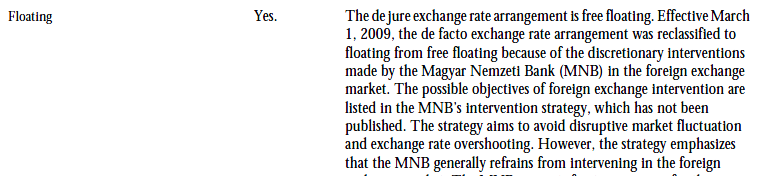
I decided to do some basic analysis of what is going on. The Annual Report On Exchange Arrangements And Exchange Restrictions 2010 reports that

and also that:

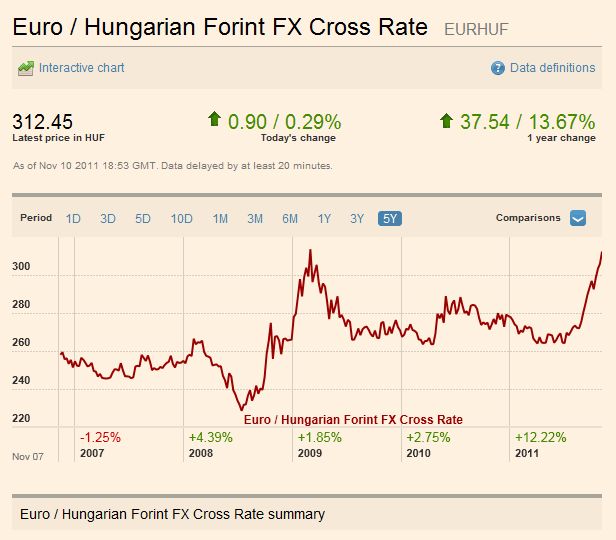
FT provides the chart of EURHUF:

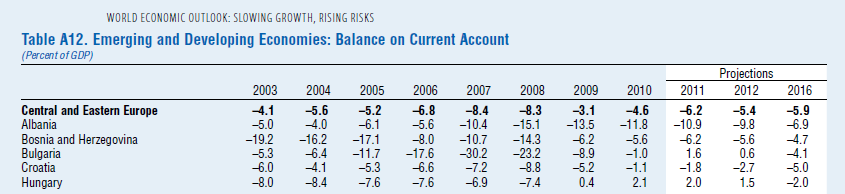
The depreciation got me even more curious. More screenshots from data sources below. The first one is Hungary’s current account balance as a percentage of GDP, courtesy IMF’s World Economic Outlook, Sep 2011.

(Click to enlarge)

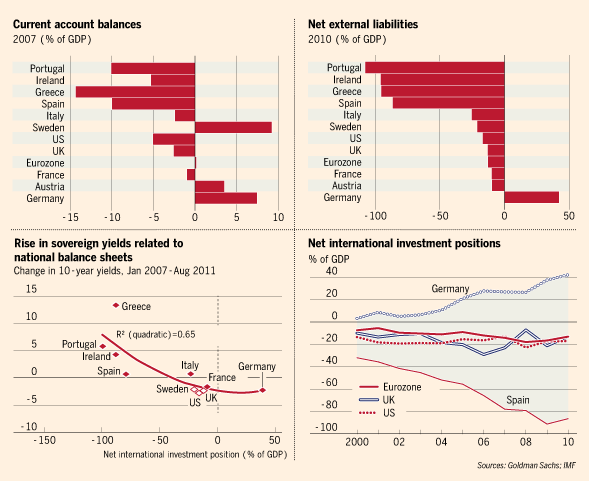
So Hungary has been running a huge current account deficits since many years. A current account deficit means that a nation’s expenditure is higher than income and the difference has to be financed by net borrowing from abroad. During boom times, this may not be problematic but the accumulated debt has to be rolled by attracting foreigners by hook or crook. The route most chosen to prevent getting things out of control is be deflating demand. Only in a Mundell-Fleming fantasy world does the nation’s currency depreciate to bring the current balance of payments to zero and an equilibrium with respect to the external world.

Hungary is a small nation with GDP equivalent of €97b (in 2010, using an approximate average 2010 exchange rate of HUFEUR=0.0036. Note to self: This needs more correction). Due to deficits in the international current balance of payments, the nation has accumulated a debt equivalent of €113.59b (the negative of NIIP) according to the the release Hungary’s balance of payments: 2011 Q2 from Magyar Nemzeti Bank – Hungary’s central bank. With net foreign asset position worse than -100% of GDP, this puts Hungary’s economy in a terrible position. Recent data suggests an improvement in external trade but the international currency markets are not impressed.

According to this Wikipedia Map, Hungary is obliged to join the Eurozone, and has no opt-out option like UK. However, it has not satisfied the Maastricht criteria, and hence the Eurozone won’t let it in yet. Better not! As long as Hungary has its own currency, its government can make a draft at the central bank to finance a portion of its deficit and gives it a tool to protect itself in the short term. So Hungary is protected from being Greece as long as it is not in the Eurozone. But in the long run, Hungary’s growth will be constrained by its balance of payments.

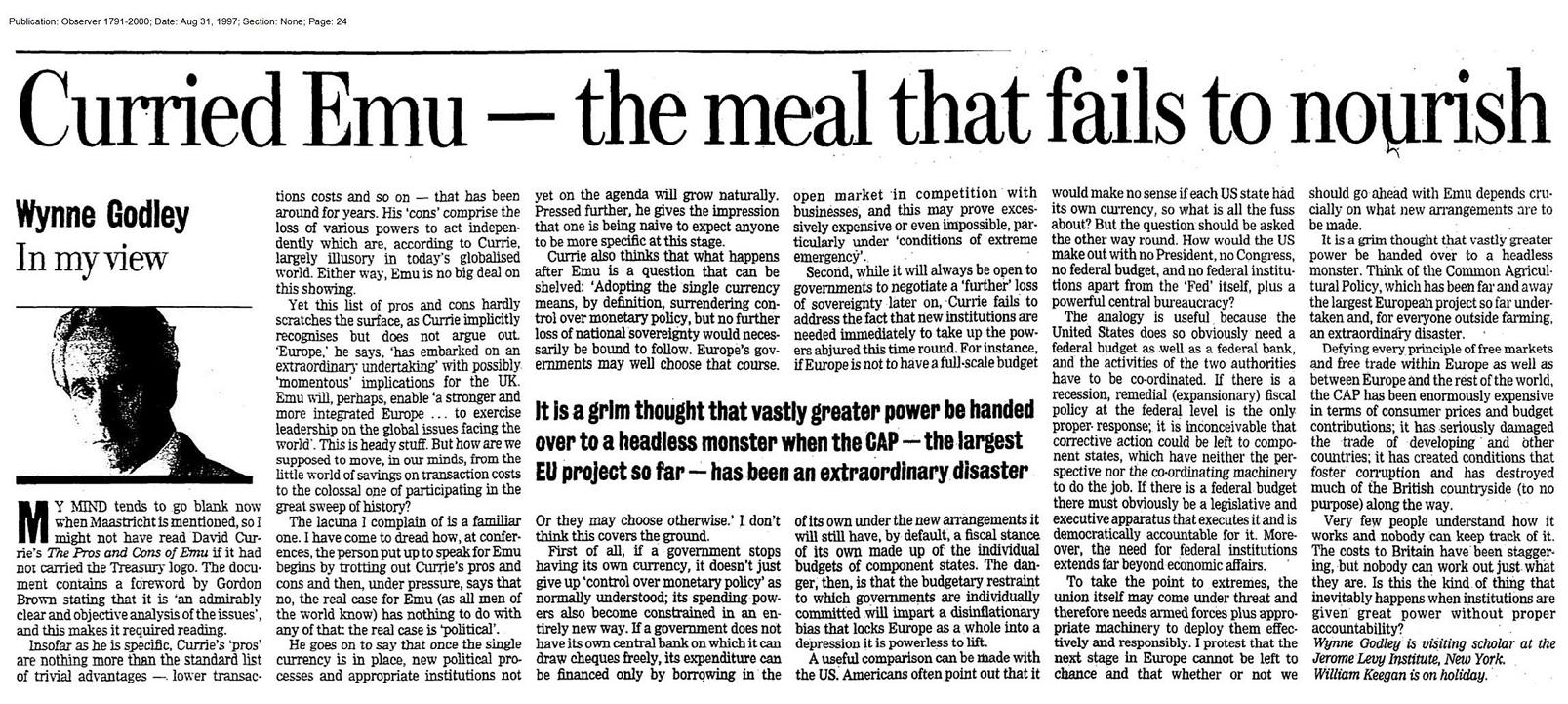
Curried EMU: Wynne Godley From 1997

(Click the newspaper clip to enlarge)

… Currie also thinks what happens after Emu is a question that can be shelved: ‘Adopting the single currency means, by definition, surrendering control over monetary policy, but no further loss of national sovereignty would necessarily be bound to follow. Europe’s governments may well choose that course. Or they may choose otherwise.’ I don’t think this covers the ground.

First of all, if a government stops having its own currency, it doesn’t give up just ‘control over monetary policy’ as normally understood; its spending powers also become constrained in an entirely new way. If a government does not have its own central bank on which it can draw checks freely, its expenditure can be financed only by borrowing in the open market in competition with business firms, and this may prove excessively expensive or even impossible, particularly under ‘conditions of extreme emergency’.

Martin Wolf At His Best!

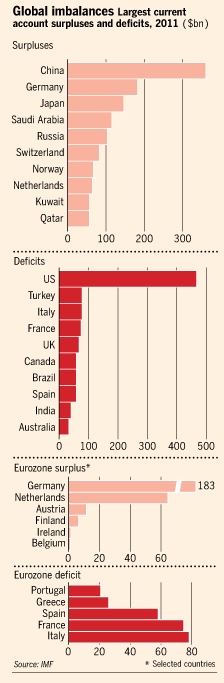
The latest article from Martin Wolf, titled Creditors can huff but they need debtors is probably his best. Martin Wolf correctly identifies the problems with world imbalances:

Blessed are the creditors, for they shall inherit the earth. This is not in the Sermon on the Mount. Yet creditors believe it: if everybody were a creditor, we would have no unpaid debts and financial crises. That, creditors believe, is the way to behave. They are mistaken. Since the world cannot trade with Mars, creditors are joined at the hip to the debtors. The former must accumulate claims on the latter. This puts them in a trap of their own making.

Also, as usual, he has the best charts. You can read the rest here.

Steve Keen Debunking Economics Again

Very nice interview of Steve Keen. I have some issues when he gets technical, but other than that, he is very good at debunking economics, so I like him.

click to watch the video on YouTube

“Tyler Durden” also covers the video at Zero Hedge and quotes a part of the video:

fundamentally neoclassical economists are the priests of Capitalism, but the priests don’t necessarily know there is god. They have this model of god and ditto with neoclassical economics: they have a model of capitalism which is almost but not quite, completely unlike actual capitalism. And they don’t even realize that they have erected a smokescreen behind which if people want to rip the system off, then there is plenty of avenues created by these guys.

Maastricht And All That

Wynne Godley wrote an article in the London Review of Books in 1992 commenting on how and why the idea of a European Monetary Union is doomed to fail. LRB today removed the “paywall” so that the article is accessible to everyone.

click to view the tweet on Twitter

FT Alphaville also wrote on this.