Category Archives: Uncategorized

Central Bank Asset Purchases And Its Connection To Tobin’s Theory Of Asset Allocation

Recently, Martin Feldstein wrote a WSJ article The Federal Reserve’s Policy Dead End with a subheading summary “Quantitative easing hasn’t led to faster growth. A better recovery depends on the White House and Congress”.

This has led to various dubious debunking such as “Feldstein doesn’t understand how QE works”.

In the following (although I am no fan of his) I will try to show that he is about right – at least with his WSJ article.

Feldstein neatly summarizes:

Quantitative easing, or what the Fed prefers to call long-term asset purchases, is supposed to stimulate the economy by increasing share prices, leading to higher household wealth and therefore to increased consumer spending. Fed Chairman Ben Bernanke has described this as the “portfolio-balance” effect of the Fed’s purchase of long-term government securities instead of the traditional open-market operations that were restricted to buying and selling short-term government obligations.

Here’s how it is supposed to work. When the Fed buys long-term government bonds and mortgage-backed securities, private investors are no longer able to buy those long-term assets. Investors who want long-term securities therefore have to buy equities. That drives up the price of equities, leading to more consumer spending.

This has also been the position of Ben Bernanke. Here is from his Jackson Hole speech in 2012:

Imperfect substitutability of assets implies that changes in the supplies of various assets available to private investors may affect the prices and yields of those assets. Thus, Federal Reserve purchases of mortgage-backed securities (MBS), for example, should raise the prices and lower the yields of those securities; moreover, as investors rebalance their portfolios by replacing the MBS sold to the Federal Reserve with other assets, the prices of the assets they buy should rise and their yields decline as well.

and both the views are as per Tobin’s theory of asset allocation.

Now before we proceed let us agree from the start that the naive Monetarist view that central banks creating reserves and this leading to more lending because of the money-multiplier effect is incorrect because – as has been stressed by Post-Keynesians since long, the causality is the opposite. Just because banks hold more reserves doesn’t mean banks’ customers become more creditworthy. Moreover, the naive Monetarist view suffers from confusing fiscal policy and monetary policy.

This however doesn’t mean that LSAPs (Large Scale Asset Purchases) or “QE” doesn’t have any effect. So the question is if it has any effect on asset prices such as equities. This can be seen easily. The non-bank private sector allocates its wealth into various assets and with central bank purchasing government bonds, the non-bank private sector has less stock of government bonds to allocate its wealth into. Of course in the first approximation the supply of equities is independent of central bank asset purchases, so the asset allocation equations lead to a higher clearing price of equities. And this is proportional to the amount of asset purchases by the central bank.

So rise in equity prices because of central bank asset purchases isn’t inconsistent with the theory of endogenous money.

Of course, firms may issue more equities or bonds seeing the rise in asset prices so there is a competition but the net effect will be a rise in prices because firms net issuing more securities depends on many things such as their management’s outlook about demand for their products and services in the medium term and it isn’t the case that they see any significant rise.

Assuming it leads to rise in prices of equity securities, this will lead to higher holding gains. Since this leads to higher household wealth, consumption will rise. However, the effect on output is too less and cannot be noticed in national accounts as pointed out by Feldstein and there is little sign that LSAP had produced this effect.

Tobin’s theory of asset allocation can’t be summarized so easily in a blog post but is roughly as follows: households receive income from various sources such as wages, dividends, interest payments etc. and consume a proportion of it. The remainder is allocated into various assets – financial and nonfinancial. They also have wealth accumulated over time and the theory of asset allocation (improved significantly by Wynne Godley) models this by writing equations for the allocation of wealth into assets. Each asset has a different return and different uncertainty attached to it and there is a different preference for each. So the allocation into one asset class depends both on the return and the portfolio preference. Of course there needs to be a system wide consistency and one has to worry about such technicalities. Some parameters are exogenous (such as the short term interest rate set by the central bank) and some are determined by the model – such as the price of equities, so that demand and supply are brought into equivalence. So the model also determines variables such as amount of money held by households and so on.

Tobin’s theory of asset allocation can also be used with little modifications to consider central bank LSAPs. So central bank purchases of financial assets won’t have direct effects on household consumption but will have an effect on asset allocation and an indirect effect on consumption and output because of capital gains.

Back to the real world from the model world.

To be clear, there are two effects here. The first is the rise in the price of equities and the second a rise in output because of higher consumption due to capital gains . The former may be high but not the latter. Or both may be high (unlikely in the current scenario). But plainly asserting there is no effect is incorrect.

Feldstein seems to understand this except emphasising the the rise in stock prices has been more due to rise in earnings than due to the asset allocation effect of LSAP. So while he seems to understand this, his emphasis is different.

In my opinion, the Federal Reserve LSAP has led to higher asset prices than otherwise but this hasn’t had any measurable effect on consumption.

Worth mentioning is the muddled Krugman IS/LM + liquidity trap view based on the loanable funds theory – although Krugman has been arguing rightly about fiscal policy in recent times. In my opinion, Krugman himself has managed to divert attention away from fiscal policy in all these years.

The unfortunate part of the debate is not the debate itself but the huge waste of time and the Federal Reserve has played a big role in this by implicitly downplaying the role of fiscal policy. Central bank asset purchases is promised land economics.
Gattopardo Economics

Here is a nice new working paper by Thomas Palley titled Gattopardo economics: The Crisis And The Mainstream Response Of Change That Keeps Things The Same.

From the introduction:

Il Gattopardo (The Leopard) is a sweeping movie, based on the novel by Giuseppe Tomasi di Lampedusa, about social tumult and class conflict in Sicily in the 1860s. Directed by Luchino Visconti and starring Burt Lancaster, the film follows the Prince of Salina who is intent on preserving the existing aristocratic class order in the face of a rising bourgeoisie. As the crisis grows, Tancredi, the prince’s wily nephew, speculates that things must change if they are to remain the same. And they do. After the revolution, the old aristocracy remains in charge, allied via marriage with the new urban elite.

The concept of gattopardo is directly relevant for understanding the response of the economics profession since the financial crash of 2008. The response has been gattopardo economics, which is change that keeps things the same.

Endogeneity, Exogenous, Et Cetera

Louis-Philippe Rochon and Sergio Rossi have a very interesting article Endogenous Money: The Evolutionary Versus Revolutionary Views in the Review Of Keynesian Economics. I think it was written many years back and was in an unpublished form and has been published now. It is a nice critique of views of some Post-Keynesians such as Victoria Chick and also others such as Basil Moore. For instance, the paper quotes Moore’s view from 2001:

[w]hen money was a commodity, such as gold, with an inelastic supply, the total quantity of money in existence could realistically be viewed as exogenous.

Click the image to visit the ROKE website.

roke_cover

There are also some nice articles in a recent issue of JPKE on neoliberalism and the financial crisis.

Some gossip: The JPKE was initially supposed to have been called Journal of Keynesian Economics but it didn’t make it because the acronym would have been JOKE.

Also, Jayati Ghosh has written an excellent blog article on Thatcherism – the ‘triumph of private gain over social good’ (borrowing words from her).

Matias Vernengo has a recent blog post on the persistence of poverty in the United States. Which reminds me of an interview clip of Anwar Shaikh titled “The Sin Of Our Era”:

click to watch the video on YouTube

Back to formal matters.

What does it mean when an economist says words such as “endogenous”, “exogenous”? Most of the times, economists – mainstream economists – themselves confuse these terms and hence you see a lot of usage of these words in Post-Keynesian economics.

I was reading an article on econometrics by Fischer Black (of the Black-Scholes fame) titled The Trouble with Econometric Models

An exogenous variable is supposed to be a causal variable, if the structure of a model has economic meaning. In fact, it is usually just a variable that is put on the right-hand side of equations in a model, but not on the left-hand side.

Similarly, an endogenous variable is supposed to be a caused variable. In fact, it is usually just a variable that shows up at least once on the left-hand side of an equation

which is fair but there exists another language.

There is however another usage – that is in the control sense.

In an outstanding paper Federal Reserve “Defensive” Behavior And The Reverse Causation Argument, Raymond E. Lombra and Raymond G. Torto point out the following in the footnote:

Apparently no generally accepted concept of an endogenous money stock (or monetary base) has been defined. In statistical theory a variable is endogenous if it is jointly determined with other variables in the system. However, many monetary theorists have chosen to call a variable endogenous only if its magnitude is not under the control of policymakers. Such semantic problems have undoubtedly prolonged this debate.

For the money stock measure such as M1, M2 etc., there shouldn’t be any confusion. The trouble arises for things such as interest rates. For example, some economists may say that if inflation rises, the central bank may/will raise the short-term interest rate and it is endogenous while others will say it is up to the central bank to decide how much to change the interest rate, if at all. Such things lead to a lot of debate.

I like the latter usage (the control sense) but I think it is difficult to exclusively have the same usage.

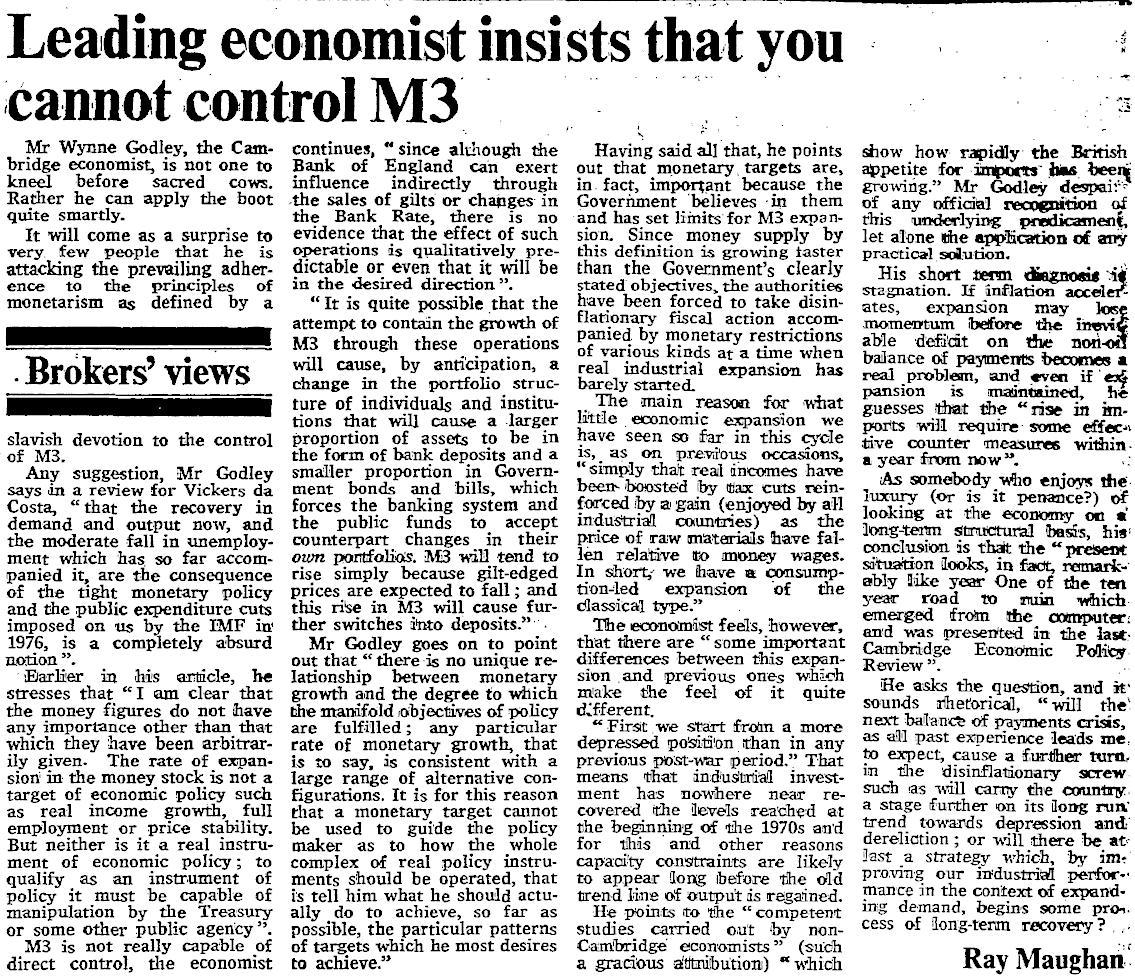
The word “control” is also misunderstood. Here is a fine article on Wynne Godley in The Times from 16 June 1978 where he details on how misunderstood the word is:

Leading Economist Insists That You Cannot Control M3

(click to expand)

Erroneous Use Of The Sectoral Balances Identity

Andrew Lilico of The Telegraph takes issue with the arguments presented using the sectoral balances identity. The website describes him as:

Andrew Lilico is an Economist with Europe Economics, and a member of the Shadow Monetary Policy Committee. He was formerly the Chief Economist of Policy Exchange.

After interpreting the accounting identities in his own way, Lilico goes on to say:

Here’s where the argument goes wrong.  When we talk about “private sector deleveraging” what do we mean?  We mean things like households paying off loans to the bank, or corporates paying off bonds or other loans.  The vast, vast majority of such loans are loans private sector agents make to each other.  So for every pound reduction in borrowing made by one household or company, there is one pound fall in savings by other households and companies.  The net change in the indebtedness of the private sector as a whole, relative to other sectors (i.e. relative to the government or to foreigners) is zero.  Within the private sector, households could pay off all of their debts to each other, and that would (in an accounting sense) make no difference whatever to the net lending of the private sector as a whole to the government.

Unfortunately for him, his argument is erroneous at the most elementary level.

What did the financial crisis lead to? Before the crisis, in many advanced economies, private expenditure was rising relative to income and the difference was increasing. A sudden U-turn in this behaviour led to a fall in output and simultaneously increased the public sector deficit because of lower taxes caused by the fall in output.

Lilico’s argument seems to think of the budget deficit as exogenous – i.e., under the control of the government but a careful study reveals that this ain’t so. His argument is another example where accounting identities are misinterpreted as behaviour.

There are various other errors: Lilico confuses the terms borrowing and saving – as if they are exact opposites. Various intuitions go wrong when one applies it without a proper understanding of national accounts and I showed this in my post from last year for this particular case: Saving And Borrowing.

The most fundamental error of Lilico of course is that he holds output constant in his entire argument. When discussing a scenario with sectoral balances, it is also important to keep in mind the behaviour of output. Most economists who come across the sectoral balances approach err on this. Part of the reason why he errs on this – knowingly or unknowingly – is the chimerical neoclassical production function view of the world where output is determined by supply side factors.

Update:

Seems Lilico has been arguing with people in Twitter. Here is a Tweet from him:

This is confusing the two usages of the phrase investment in macroeconomics – investment as fixed capital formation and investment as allocation in financial assets! If you give your mother £1000, she can consume or have investment expenditures or allocate the remaining in financial assets.

Nicholas Kaldor On Floating Exchange Rates

Martin Wolf has a nice new column on imbalances creating troubles for the UK economy in the Financial Times: What a floating currency gives and what it does not.

Why are current account deficits a haemorrhage in the flow of circular income? Weak external trade performance implies a drain in demand and hence pressure on the path to full employment and also that fiscal policy has to give in: else public debt and net indebtedness to foreigners keep rising relative to output which cannot be sustained for long. This means that if an individual nation or the world as a whole needs reflation, drastic changes need to made on how the world is run – especially using a system of regulated international trade rather than a system of free trade.

Nicholas Kaldor had a lot of change of mind about exchange rates during his lifetime. In the introduction to Volume 6 of his collected essays Further Essays On Applied Economics, he has a lot to say about his views.

Nicky Kaldor also had a paper The Relative Merits Of Fixed Exchange And Floating Rates – a memorandum as an economic adviser to the Chancellor in 1965 in which he was arguing for the merits of floating the exchange rates. In page xiii from introduction to Further Essays On Applied Economics he confesses:

The strategy advocated in my 1965 paper “The Relative Merits of Fixed and Floating Exchange Rates” thus proved in practice futile …

… So the policy which I advocated in the 1960s and developed at greater length in my 1970 Presidential Address to the British Association, of reconciling full employment growth with equilibrium in the balance of payments through adjusting the relationship between import and export propensities by a policy of continuous manipulation of the exchange rate, proved in the event a chimera. The main reason for this was that (along with most economists) I greatly overestimated the effectiveness of the price mechanism in changing the relationship of exports to imports at any given level of income. The doctrine that exports and imports are kept in balance through induced changes in their relative prices is as old and deeply ingrained as almost any proposition in economics.

So there you have it – realising his mistake earlier than anyone else.

He goes on further to drive this point:

… In other words, what the Harrod theory asserts is that trade is kept in balance by variations of production and incomes rather than by price variations: a proposition which implies that the income elasticity of demand of a country’s inhabitants for imports and those of foreigners for its exports are far more important explanatory variables than price elasticities.

which is essentially saying that it is non-price competitiveness which is far more important than price competiveness.

Further …

… If the Harrod theory provides the realistic explanation of the underlying forces which maintain the trade flows of an industrial exporter in balance (subject, of course, to the exceptions to this rule in the shape of long-term surplus and deficit countries, which must be capable of being explained in the same framework) this also carries the implication that the relationship of import propensities to exports will be relatively insensitive to such variations of relative prices as can be accomplished by monetary or exchange rate policies.

This latter implication (though discussed in the 1930s) seems to have got lost when the debate on fixed versus flexible exchange rates flared up again in the 1960s. This explains perhaps the exaggerated hopes placed on variations in exchange rates as an instrument of the “adjustment process” in international trade and payments and, for Britain in particular, on a system of “managed floating” as a means of securing higher and stable growth rates.

Again he later emphasises his learning:

… I was convinced that once exchange rates are freed from the rigidities imposed by Bretton-Woods, the forces of cumulative causation which made some countries grow fast and others slowly will no longer operate, or not in the same manner. That belief was so badly shaken by experience of subsequent years for for reasons explained in my most recent paper on the subject, which is discussed below.

James Tobin said it best once:

I believe that the basic problem today is not the exchange rate regime, whether fixed or floating. Debate on the regime evades and obscures the essential problem.

Of course that doesn’t mean one ties both shoes together and irrevocably fixes exchange rates (and give up the government powers to make drafts at the central bank) but the essential problem referred above – although gets diluted – doesn’t go away outside a monetary union.

Thomas Herndon!

So Comedy Central had a nice show on the Reinhart-Rogoff episode and how their work was used to drive world-wide austerity. The show featured Thomas Herndon – the graduate student from the University of Massachusetts Amherst who found errors in R&R’s work.

Great work Thomas!

Worth a watch:

(Click the two pictures to watch the videos from the original website)

The Colbert Report - 1

This is the video where Thomas Herndon appears:

The Colbert Report - 2

h/t Louis-Philippe Rochon and Mike Norman

United States To Adopt The 2008 SNA

There are two interesting articles in the Financial Times today:

Data shift to lift US economy 3% and US economy gets a Hollywood makeover

According to the first article,

The revision, equivalent to adding a country as big as Belgium to the estimated size of the world economy, will make the US one of the first adopters of a new international standard for GDP accounting.

which links to the 2008 SNA page.

The manual/handbook of the new SNA is available at the Unstats site.

It is also available in print for $150 or $75 (depending on where you live).

It is the book to learn national accounts and is better if read from the start rather than being used as a reference for one particular point.  When you read it patiently, you will realize how much of work and effort has gone into it – especially to make the conceptual framework self-consistent.

Games Economists Play

The purpose of studying economics is not to acquire a set of ready-made answers to economic questions, but to learn how to avoid being deceived by economists.

– Joan Robinson, 1955, “Marx, Marshall And Keynes”Occasional Paper No. 9, The Delhi School of Economics, University Of Delhi, Delhi.

It is fun to watch what economists have to say after the recent Reinhart-Rogoff episode and look at their behaviour.

To be brutally straightforward, I think economists are playing games here to mislead and deceive everyone. Mainstream economists in the past few days have been trying their best to persuade everyone into believing that they are modest people and economics is a hard science* and it’s two outliers who have misled politicians into worldwide austerity etc.

So we hear Mark Thoma saying something like lack of sufficient data prevents economists from choosing the best model. It gives the impression that mainstream economists broadly know how the world works and that they are just unable to give the best solution from a pack of 10 good models. But it hides the fact that at the most elementary level, macroeconomists struggle to even understand basic macroeconomics and that there exists a supreme Post-Keynesian alternative.

In a recent NYT blog post Destructive Creativity Paul Krugman tries his best to mislead everyone about the status of macroeconomics.

According to him:

If you stayed with Econ 101, you got it right, if you went with the trendy stuff you made a fool of yourself.

It is the most inaccurate statement about the state of macroeconomics and reflects poorly on someone who has written articles such as A Dark Age Of Macroeconomics. Econ 101 – as taught in most universities – is deeply misleading and erroneous.

I won’t go into how chimerical macroeconomics is because there are already a few good blogs there. This post is not about attempting to prove how economics taught at universities is chimerical but to point out games economists play.

Krugman tries to play a supergame on top of what other economists are doing. He says:

You can already see quite a few people reacting to this affair by declaring that macro is humbug, we don’t know anything, and we should just ignore economists’ pronouncements. Some of the people saying this are economists themselves!

No, this is misleading. Mainstream economists are not saying this really but are playing games. Those who have been saying that mainstream economics is a chimera have been saying this for a long time. There is hardly any new entrant in this from within the orthodox community. And Krugman tries to defend the subject itself:

What we have experienced since 2007 is a series of huge policy shocks — and basic macroeconomics made some very counterintuitive predictions about the effects of those shocks. Unprecedented budget deficits, the model said, would not drive up interest rates. A tripling of the monetary base would not cause runaway inflation. Sharp government spending cuts wouldn’t free up resources for the private sector, they would depress the economy more than one-for-one, so that private spending as well as public would fall.

There are three things wrong about this. First, basic macroeconomics did not make these predictions. Second, Krugman – as he has done in the past – is saying that in liquidity trap situations exceptions appear and more importantly he knew it beforehand! Third, Krugman says Econ 101 notes the exception.

(Some great tactics to avoid saying that Econ 101 is garbage).

Of course some points should be given to Krugman because he has been saying things which are different from most of his colleagues but it is incorrect and thoroughly misleading and to say that Econ 101 survives the crisis.

*of course true that Macroeconomics is hard but read Luigi Pasinetti’s Keynes And The Cambridge Keynesians: A Revolution In Economics To Be Accomplished.

Margaret Thatcher’s Gigantic Con Trick

There have been too many praises for Mrs Thatcher after her death today.

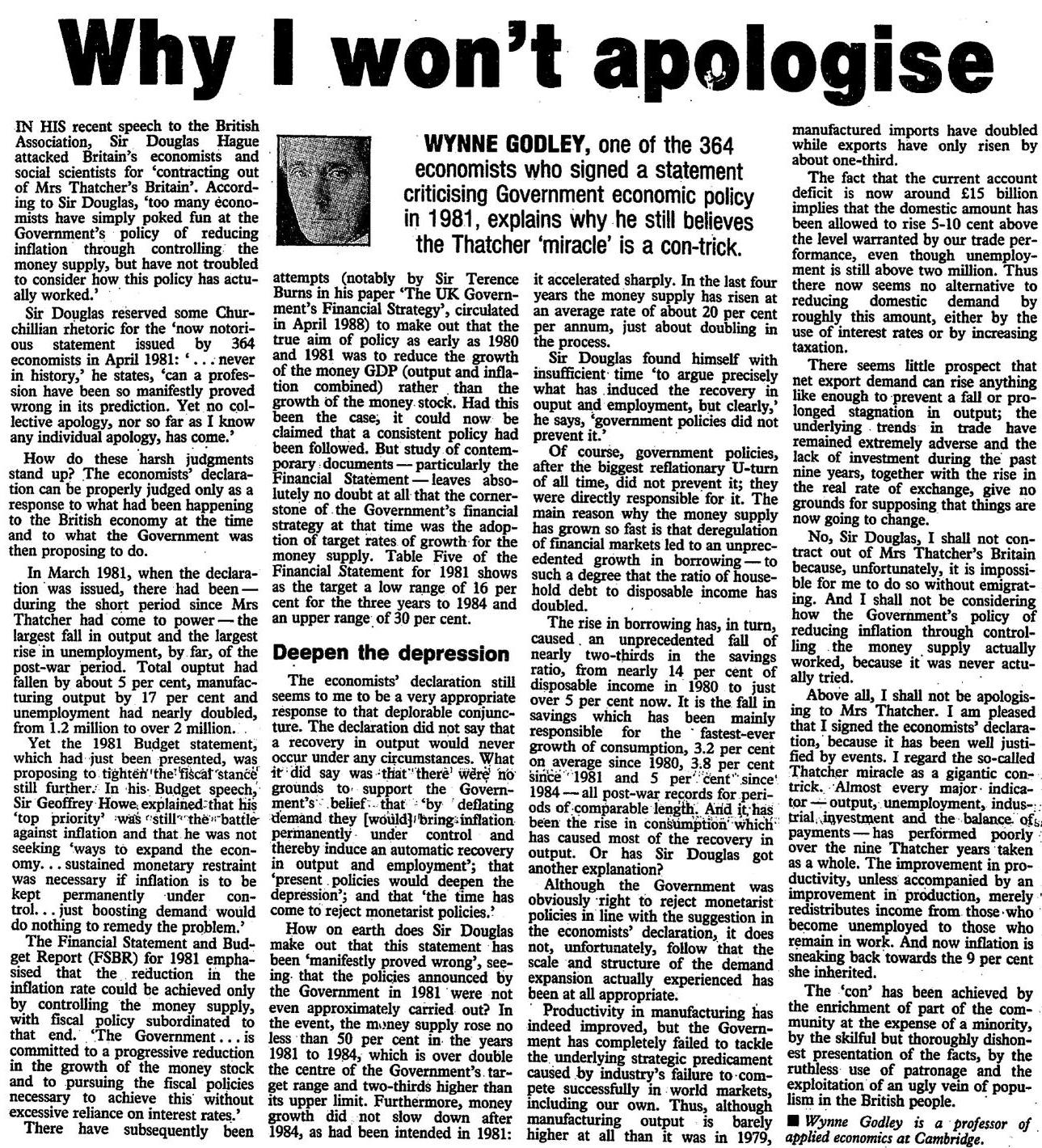
Wynne Godley once described the Thatcher “miracle” as a gigantic con-trick. Here is from a newspaper article:

I regard the Thatcher miracle as a gigantic con-trick. Almost every major indicator – output, unemployment, industrial investment, and the balance of payments has performed poorly over the nine Thatcher years taken as a whole … The ‘con’ trick has been achieved by the enrichment of part of the community at the expense of a minority, by skilful but thorougly dishonest presentation of the facts, by the ruthless use of patronage and the exploitation of an ugly vein of populism in the British people.

– Wynne Godley in Why I Won’t Apologize, September 18, 1988, Observer. 

The article scan is below:

Wynne Godley - Why I Won't Apologize

Wynne Godley, Why I Won’t Apologize
(click to enlarge and click again)

Also see the papers which describes the right facts:

  1. Coutts, K. and Godley, W. (1989), The British Economy Under Mrs Thatcher. The Political Quarterly, 60: 137–151. (Link)
  2. Godley, W. (1990), The British Economy Under Mrs Thatcher: A Rejoinder. The Political Quarterly, 61: 101–102. (Link)

Thatcher’s bluff was caught very early by Godley. The huge rise in unemployment (to 3 million) was predicted first by Wynne Godley himself in 1979.

Reference: Godley W., ‘Britain’s chronic recession-can anything be done?’ in W. Beckerman (ed.) Slow Growth in Britain, Oxford University Press, 1979.

His King’s College Obituary (Annual Report, 2011) had this to say about Thatcherism:

Wynne rather relished his reputation as the ‘Cassandra of the Fens’. He famously made a double prediction: that under current policies of the first Thatcher government unemployment would inevitably rise to three million, but – the second prediction – that this would not in fact happen, on the grounds that, since in post-war Britain three million unemployed had to be an electoral suicide note, the policies would have to be changed. He was right with the first prediction, and – misreading the not-for-turning dispositions of the Iron Lady – wrong with the second. The actual outcomes appalled him. For Wynne the fundamental economic responsibility of a government was to ensure ‘full employment’. In pursuit of that aim he was uninhibited as Keynes himself and perhaps rather close in his motivation. He believed it was essential to use fiscal levers to stimulate demand, and was even prepared – though under very strict conditions – to countenance temporary import controls to protect and strengthen economic activity. His ideas were controversial and, like the man himself, often stood at an odd angle to the contemporary world, but the moral imagination which informed them was large and generous.