Category Archives: Uncategorized

Balance Of Payments Adjustments

Paul Krugman seems to have been thinking on issues related to open economy monetary macroeconomics these days! He has recently warned his readers to not confuse accounting identities with causation but in a recent blog post he seems to be doing it himself.

So Krugman says:

So, here we go. Start from the observation that the balance of payments always balances:

Capital account + Current account = 0

where the capital account is our sales of assets to foreigners minus our purchases of assets from foreigners, and the current account is our sales of goods and services (including the services of factors of production) minus our purchases of goods and services. So in the hypothetical case in which foreigners lose confidence and stop buying our assets, they’re pushing our capital account down; as a matter of accounting, then, our current account balance must rise.

But what’s the mechanism? (Remember the fallacy of immaculate causation.) The answer is, it depends on the currency regime.

Strange. The last statement in the quote warns of potential mistake which is present in the previous statement! ie Krugman wants to have it both ways.

So “… as a matter of accounting …” ?

Let us consider a case (fixed exchange rate or floating) where there is an autonomous capital flow – such as a foreigner liquidating a bond and repatriating funds. This by itself doesn’t affect the current account. In fact it can be compensated by some accommodative flow in the capital account of the balance of payments.

There is a nice 1991 article by the BIS Capital flows in the 1980s: a survey of major trends. The author quotes James Meade who makes this distinction between autonomous flows and accommodative flows:

[accommodative capital flows] take place only because the other items in the balance of payments are such as to leave a gap of this size to be filled … [while] autonomous payments … take place regardless of other items in the balance of payments.

Of course because of flexible exchange rates, the distinction can become blurred but the same is also true in fixed exchange rates. So we have an item called Other Investment in the capital account of balance of payments – like the example in the IMF’s BPM6 (note: “financial account” in the BPM6 terminology, capital account means a different thing):
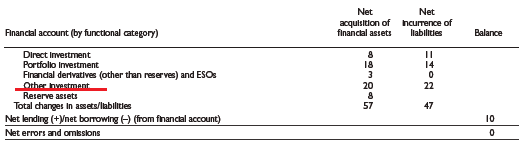
Balance Of Payments Capital Account

In addition Reserve Assets is also one. Again this is somewhat of a simplification and it is possible for other items to accommodate.

“Other Investment” is typically banking sector flows but refer to BPM6 for the full definition. “Reserve Assets” is things such as sale or purchases of foreign currency by the central bank or any other official institution. Sometimes a category Exceptional Financing is used – such as government borrowing in foreign currency in exceptional circumstances or official financing transactions from the IMF.

So changes in some items in the capital account can be balanced by changes in some other account in the capital account and not the current account. Of course this doesn’t mean that there is no causality from the capital account to the current account and I will come to it in a moment but what Krugman says is silly.

Let’s take a few examples starting with the simplest – and you guessed it right – the Euro Area 😉

Suppose there is a capital flow where a German financial firm liquidates Spanish government bonds and transfers funds back home.

As I have explained in posts long back, this will lead to a TARGET2 imbalance in which the Spanish NCB will have a rise in indebtedness to the ECB (which is considered to be a Spanish non-resident). Either it ends here or the Spanish banking system will try to attract funds from abroad. In either case there is an accommodative flow in the balance of payments – balancing the initial outflow and without affecting the current account.

Now take the example of a nation with its currency pegged to another anchor currency. Suppose a nonresident economic unit sells sells securities and transfers funds outside the country. Since banks acts as dealers in the foreign exchange markets, this leaves the banking system with a short position in foreign currency. It may try to close it by borrowing in foreign currency or try to attract funds from outside. In the latter case that is all there is to it (in the short term) and this flow is accommodating and will appear in Other Investment. In the former case, the banking system is left with an open position in foreign currency. As long as the bank’s own risk management or the central bank (with the confident knowledge that it has sufficient foreign exchange in case it has) thinks this it is alright, this is what there is for the short term. Else banks may need to attract funds from abroad. However if there is a depreciation outside the tolerable band (fixed doesn’t mean god has fixed it) in response to a huge amount of capital outflow, the central bank may sell foreign currency. It may also try to hike interest rates to get attract foreigners.

Again no change in the current account. One item in the capital account cancels another to preserve the accounting identity Krugman quotes.

In floating exchange regimes this is more complicated but the story is not too different from the BoP viewpoint. An outflow of funds will be accommodated by banks’ open position (or inventories). Banks will typically try to offload the inventories depending on market conditions and opportunities and it is sometimes said in the fx microstructure theory that the inventory half-life is around 15 minutes. The currency will depreciate to the point where expectations of the market participants reverse in the direction of appreciation bringing in flows in the opposite direction to the initial capital outflow. How this works precisely is a very challenging open question. Of course looked at from a medium term perspective, in general, it is not immediately obvious why the current account balance and capital account sum to zero since the magnitude of “Portfolio Investment” and “Direct Investment” may be quite different from the current account balance. But the sum of balances is zero as a matter of accounting. In such cases, banks may try to attract funds from abroad themselves by marketing bonds offshore – i.e., they may try to find offshore funding. More complications arise from derivative contracts with nonresidents which is not easy to go into in this post.

Of course this not guaranteed to work – pure float is the luxury of a few nations –  and sometimes the central bank may need to intervene in the foreign exchange markets and in the extremis, undertake exceptional financing transactions such as borrowing from the IMF.

In recent times, the Reserve Bank of India had an interesting swap scheme with the banking system who would attract funds from abroad.

Of course, none of this means there is no causality from the capital account to the current account. A nation may face troubles financing its balance of payments and it may try to deflate domestic demand by fiscal and monetary policy to keep its current account imbalance from getting out of hand. It is important to note here this is not a straightforward result of the identity but there is a more complicated story and that output suffers because of this. Krugman makes it sound as if nothing happens to output.
James Tobin Already Knew The Answer

Question: Are flexible exchange rates better than fixed exchange rates?

Answer: Silly oversimplified question.

In a blog post today, Paul Krugman asks Do Currency Regimes Matter? – in the context of the Euro Area. My answer to that would be James Tobin’s wisecrack:

I believe that the basic problem today is not the exchange rate regime, whether fixed or floating. Debate on the regime evades and obscures the essential problem.

Of course that doesn’t mean one ties both shoes together and irrevocably fixes exchange rates (and give up the government powers to make drafts at the central bank) but the essential problem referred above – although gets diluted – doesn’t go away outside a monetary union. Also, a crucial element often missed in the discussion is the existence of the “common market” which acted as (and still acts as) a constraint on Euro Area economies to expand domestic demand.

Sadly by blurring issues such as this and oversimplifying the macroeconomics behind all this, the Euro Area was formed with the incredible lacuna.

One of economists’ fantasy is assuming the existence of a floating exchange rate regime without any need of official intervention. Although it is true for some nations, it doesn’t mean any nation can simply “truly float” and stop worrying.

In the same article A Proposal For International Monetary Reform, Tobin also points out:

Clearly flexible rates have not been the panacea which their more extravagant advocates had hoped …

although also pointing out that:

… I still think that floating rates are an improvement on the Bretton Woods system. I do contend that the major problems we are now experiencing will continue unless something else is done too.

Incidentally, I do not think Tobin tax in the foreign exchange markets is the way to go as has been pointed out by economists working in fx microstructure theory. Nonetheless Tobin’s highly important insights remain.

John Maynard Keynes’ biggest disservice to the economics profession is to not start with an open economy. In a world of free trade and free movement of capital, a nation’s biggest constraint on raising output is the “balance-of-payments constraint”. It is sad that in spite of the crisis the economic profession has not even started debating on the constraints imposed on nations due to free trade (and the whole world as a consequence).

A Clueless Sveriges Riksbank Prize Winner

The subject of money, credit and moneyflows is a highly technical one, but it is also one that has a wide popular appeal. For centuries it has attracted quacks as well as serious students, and there has too often been difficulty in distinguishing a widely held popular belief from a completely formulated and tested scientific hypothesis.

I have said that the subject of money and moneyflows lends itself to a social accounting approach. Let me go one step farther. I am convinced that only with such an approach will economists be able to rid this subject of the quackery and misconceptions that have hitherto been prevalent in it.

– Morris Copeland, inventor of the Flow Of Funds Accounts of the United States, in Social Accounting For Moneyflows, in Flow-of-Funds Analysis: A Handbook for Practitioners (1996) [article originally published in 1949]

So the news is that Eugene Fama shares this year’s Economics Nobel with Robert Shiller and Lars Hansen.

Instead of going into Fama’s main work, I thought I will point out Fama’s quackery on national accounts and flow of funds – which economists are supposed to know but is rarely the case.

In an article from 2009, Bailouts and Stimulus Plans, Fama again puts down fiscal policy in a rather comical way. Fama starts with the sectoral balances identity:

There is an identity in macroeconomics. It says that in any given year private investment must equal the sum of private savings, corporate savings (retained earnings), and government savings (the government surplus, which is more likely negative, that is, a deficit),

PI = PS + CS + GS   (1)

In a global economy the quantities in the equation are global. This means the equation need not hold in a particular country, but it must hold in the world as a whole.

There is so much muddle to start the analysis. The above is incorrect to start with because “private savings” automatically includes corporate savings. Perhaps this error is a typo but going through his analysis doesn’t support the hypothesis that he even knows the equation right. Incidentally government saving is not government surplus in standard terminology. He seems to think these are equal.

Another error in the above equation is that the left hand side should include government investment as well.

Anyway …

Fama continues:

Government bailouts and stimulus plans seem attractive when there are idle resources – unemployment. Unfortunately, bailouts and stimulus plans are not a cure. The problem is simple: bailouts and stimulus plans are funded by issuing more government debt. (The money must come from somewhere!) The added debt absorbs savings that would otherwise go to private investment.

There are so many incorrect things with this. First, there is a reverse causality in the saving/investment identity. Investment creates saving. Second, Fama seems to think that government deficit reduces private saving but the identity itself is suggestive of another interpretation. If I write it as (in the context of a closed economy):

S = I + G – T

where S is the private saving, I is private investment and G and T are government expenditure and tax receipts, respectively. It then becomes clear that government deficit – instead of reducing private saving, creates private saving.

Even more worrisome is his statement “the money must be somewhere” – as if the stock of money is an exogenously fixed quantity. A fiscal expansion (meaning higher governmen expenditure and/or decrease of tax rate) can increase the stock of money in two ways. First is direct – if there is a government deficit with the fiscal expansion and banks purchase a fraction of government debt, the stock of money increases. The second is via a rise in domestic demand which will lead to higher borrowing by the private sector from banks thereby increasing the money stock. Of course there are other effects too via the non-bank private sector asset allocation decisions etc.

Not going in much details for now as I write a lot about it and in any case there is Post-Keynesian monetary economics on this. My aim was to show how an economics Nobel Prize winner is clueless about basic economics! The prize is to be awarded to people who have made great contributions to society but we have an example of someone – Fama – who pushes fiscal contraction with clueless analysis of national accounts.

On Effects Of QE

I am having a discussion on the effects of the Federal Reserve’s Large Scale Asset Purchases (“QE”) especially on the money stock with someone online. Here are some thoughts.

First we have to be crystal clear that there is no direct causality from money to prices of goods and services.

Now, as I highlighted in my post Some Simple LSAP/QE Accounting, QE does increase the money stock if the ultimate sellers of the Treasury securities and mortgage-backed securities are non-banks.

Let me repeat the argument here:

Let us assume the Federal Reserve buys $10bn of Treasuries. We can have two scenarios – Scenario 1: purchase from banks and Scenario 2: purchase from non-banks. (In general a mix).

Scenario 1

Federal Reserve:

Change in Assets = +$10bn
Change in Liabilities = +$10bn
Change in Net Worth = $0

Banks:

Change in Assets = $0
(of which: change in reserves = +$10bn and change in Treasury securities = −$10bn).
Change in Liabilities = $0
Change in Net Worth = $0

Scenario 2

Federal Reserve:

Change in Assets = +$10bn
Change in Liabilities = +$10bn
Change in Net Worth = $0

Banks:

Change in Assets = +$10bn.
Change in Liabilities = +$10bn
Change in Net Worth = $0

Non-banks:

Change in Assets = $0
(of which change in deposits = +$10bn and change in Treasuries = −$10bn)
Change in Liabilities = $0
Change in Net Worth = $0

Summary:

In Scenario 1, the Federal Reserve’s assets and liabilities increase by $10bn since it has $10bn more of Treasury securities as assets and $10bn more of reserves as liabilities. The values of banks’ assets and liabilities do not change as it exchanges one asset for another and its reserves increase.

In Scenario 2, Fed’s balance sheet changes are the same as Scenario 1. Banks see a rise in reserves (assets) and a rise in deposits (liabilities). Nonbanks’ assets and liabilities do not change – just the composition of assets (they have $10bn of more deposits and $10bn less Treasury securities than before).

So in scenario 2, there is a change in deposits and the money stock rises as a result of QE.

On the other hand, it is observed by commentators that the money stock has not increased beyond the trend rise. This however seems contradictory to the previous analysis where it was shown that the money stock rose but these observations are not inconsistent because one has to compare the factual in which there is QE with the counterfactual in which there is no QE.

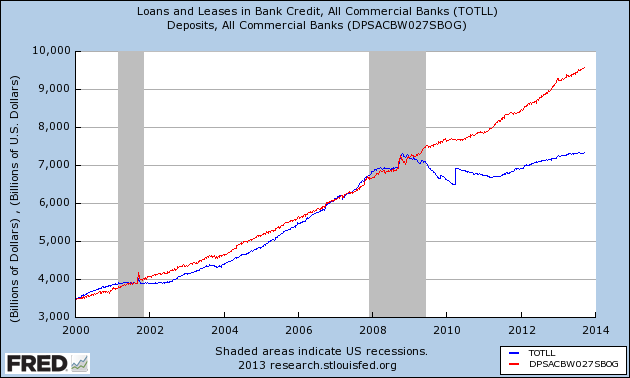
Although we could not have observed the counterfactual because it is another world, the following FRED2 graph gives some hints:

fredgraph

A more detailed analysis would look at all the balance sheet items of banks but at this point since the divergences between loans and deposits which moved hand in hand till the crisis is significant during and post-crisis, we may ignore the rest.

So in the above graph, it can be seen that deposits have not shown any rise above trend in the factual. However since the net creation of loans goes sideways, we may think that the money stock may not have risen by the trend and followed a path similar to loans in the counterfactual.

Because QE creates deposits, it – money stock moving sideways – didn’t actually happen and the money stock rose as per trend.

Of course there is also a lot of talk on the effect of QE on asset prices. I discuss this in my post Central Bank Asset Purchases And Its Connection To Tobin’s Theory Of Asset Allocation.

I also recommend Nick Edmonds’s blog Reflections on Monetary Economics for analysis on this.

Flow Of Funds And Keynesian Macroeconomics

The subject of money, credit and moneyflows is a highly technical one, but it is also one that has a wide popular appeal. For centuries it has attracted quacks as well as serious students, and there has too often been difficulty in distinguishing a widely held popular belief from a completely formulated and tested scientific hypothesis.

I have said that the subject of money and moneyflows lends itself to a social accounting approach. Let me go one step farther. I am convinced that only with such an approach will economists be able to rid this subject of the quackery and misconceptions that have hitherto been prevalent in it.

– Morris Copeland, inventor of the Flow Of Funds Accounts of the United States, in Social Accounting For Moneyflows, in Flow-of-Funds Analysis: A Handbook for Practitioners (1996) [article originally published in 1949]

Alas monetary myths continue to exist. The above referred handbook was published in 1996 starting with Copeland’s 1949 article and the editor of the book John Dawson himself had an explanation of why myths continue to exists despite some brilliant work such as that of Copeland. In page xx, Dawson says:

the acceptance of… flow-of-funds accounting by academic economists has been an uphill battle because its implications run counter to a number of doctrines deeply embedded in the minds of economists.

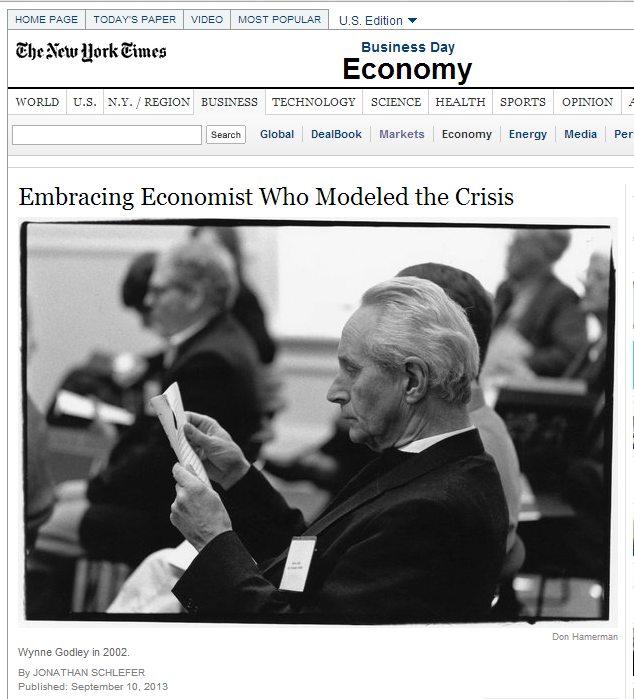
In a recent blog post blog post Paul Krugman is dismissive of Wynne Godley’s approach to macro modeling and instead appeals to some Friedmanism. Perhaps Dawson’s quote explains why this is so. However it may not be the only reason, given how Krugman has shown some tendency to be heteredox in recent times but his latest post ends all doubts and we can say he is highly orthodox. And that other reason is professional turf-defence.

Also, Krugman was writing in response to an NYT article Embracing Wynne Godley, an Economist Who Modeled the Crisis highlighting the importance of Wynne Godley’s work. That article was by a journalist who was perhaps unaware of the history of Post-Keynesianism. But Krugman himself dodged Godley’s work as “old-fashioned” – as if there is something fundamentally wrong about old-fashion and as if economics should proceed by one fashion after another.

A bigger disappointment is that Krugman failed to acknowledge that there has existed a heteredox approach since Keynes’ time. As Wynne Godley and Marc Lavoie begin Chapter 1 in their book Monetary Economics:

During the 60-odd years since the death of Keynes there have existed two, fundamentally different, paradigms for macroeconomic research, each with its own fundamentally different interpretation of Keynes’ work…

And Krugman’s usage of the phrase old-fashioned hides the fact that this is so.

Back to Copeland. In the same article Social Accounting For Moneyflows, Copeland is clear about his intentions and the direction he is looking:

When total purchases of our national product increase, where does the money come from to finance them? When purchases of our national product decline, what becomes of the money that is not spent? What part do cash balances, other liquid holdings, and debts play in the cyclical expansion of moneyflow?

Copeland’s analysis was not simply theoretical. It led to the creation of the flow of funds accounts of the United States and the U.S. Federal Reserve publishes this wonderful data book every quarter. Although, Copeland was simply looking and proceeding in the right direction, it can be said that a more solid theoretical framework to build upon Copeland’s brilliant work was still waiting at the time.

Of course, in the world of academics, there already existed two main schools of thought very hostile to one another. Keynes’ original work contained a lot of errors and for most economists, a bastardised version of Keynes’ work became the popular understanding. It was however the Cambridge Keynesians who founded the school Post-Keynesian Economics who believed they were true to the spirit of Keynes and this led to a parallel body of extremely high-quality intellectual work which continues to this day – and still dismissed by economists such as Paul Krugman. Of course, in this story, it should be mentioned that there was a Monetarist counter-revolution mainly led by Milton Friedman who was trying to bring back the old quantity theory of money doctrines and was “successful” in permanently distorting the minds of generations of economists to date. Greg Mankiw is quite straight on this and according to him, “New Keynesian” in the “New Keynesian Economics” is a misnomer and it should actually be New Monetarism.

Interestingly, one of Morris Copeland’s ideas was to show how the quantity theory of money is wrong. According to Dawson (in the same book referred above):

[Copeland] himself was at pains to show the incompatibility of the quantity theory of money with flow-of-funds accounting.

Meanwhile, in the 1960s and to the end of his life, James Tobin tried to connect Keynesian economics with the flow of funds accounts. While a lot of his work is the work of a supreme genius, he couldn’t manage. Perhaps it was because of his neoclassical background which may have come in the way. According to his own admission, he couldn’t connect the dots:

Monetary and financial data, so far as they are based on institutional balance sheets and prices in organized markets, are abundant. Modern machines have made it possible to improve, refine and expand the compilation of these data, and also to seek empirical regularities in financial behavior in the magnitude of individual observations. On the aggregate level, the Federal Reserve Board has developed a financial accounting framework, the “flow of funds,” for systematic and consistent organization of the data, classified both by sector of the economy (households, nonfinancial business, governments, financial institutions and so on) and by type of asset or debt (currency, deposits, bonds, mortgages, and so on). Although many people hope that this organization of data will prove to be as powerful an aid to economic understanding as the national income accounts, this hope has not yet been fulfilled. Perhaps the deficiency is conceptual and theoretical; as some have said, the Keynes of “flow of funds” has yet to appear.

– James Tobin in Introduction (pp xii-xiii) in Essays In Economics, Volume 1: Macroeconomics, 1987.

After having written a fantastic book Macroeconomics with Francis Cripps in 1983 and which has connections with the flow of funds, Wynne Godley thought he had to try hard to unify (post-)Keynesianism and the flow of funds approach which James Tobin was trying. Wynne Godley had the advantage of being close to Nicholas Kaldor who very well understood the importance of Keynes and was himself an economist of Keynes’ rank. Godley also had the advantage of having worked for the U.K. government and doing analysis using national accounts data and advising policy makers. Wynne Godley is the Keynes of “flow of funds” which Tobin was talking about!

A recent blog post by Matias Vernengo on Wynne Godley is extremely well-written.

In his later years (and his best), Wynne Godley worked with Marc Lavoie, one of the faces of Post-Keynesianism and one who had previously made highly original contributions to Post-Keynesianism and this led to the book Monetary Economics. Marc’s earlier work was also highly insightful and he highlighted – in the spirit of Morris Copeland – how poorly money is understood by economists in general and it was natural he and Wynne would meet and work together.

One of the things about Wynne Godley’s approach is how to combine abtract theoretical work and direct practical economic issues. This actually led him to warn of serious deflationary consequences of economic policy in fashion before the crisis.

Lance Taylor (in A Foxy Hedgehog: Wynne Godley And Macroeconomic Modelling) had a nice way to describe Wynne Godley:

Wynne has long been aware of the stupidity of models when you ask them to say something useful about practical policy problems. He has spent a fruitful career trying to make models more sensible and using them to support his policy analysis even when they are obtuse. As we have seen, this quest has led him to many foxy innovations.

But there is an enduring hedgehog aspect as well. Wynne has focused his energy on combining the models with his acute policy insight based on deep social concern to build up a large and internally coherent body of work. He has disciples and is widely influential. One might wish that he had pursued some lines of analysis more aggressively and perhaps put a bit less effort into others. And maybe not have written down so damn many equations. But these are quibbles. His work is inspiring, and will guide policy-oriented macroeconomic modellers for decades to come.

In this post, I have tried to provide the reader with references to go and verify how flow of funds1 cannot be separated from Keynesian Economics – Keynesian approach in the original spirit of Keynes, not some bastartized versions. It is as if they were made for each other2. While it is true that like other sciences, Macroeconomics is always work in progress, it doesn’t mean one should bring fashions such as inter-temporal utility maximising agents (read: future knowing economic actors) in the approach which Paul Krugman prefers.

1My usage of “flow of funds” is more generic than the usage which distinguishes income accounts and flow of funds accounts and hence my usage is for both.

2The ties between the flow of funds approach and Post-Keynesiansism is argued in Godley and Lavoie’s book Monetary Economics from which I have borrowed a lot.

Correction

I am mistaken about Jonathan Schlefer’s background. He is in academics.

The Rate Of Saving In Wynne Godley’s Models

In Krugman’s blog post which is dismissive of Wynne Godley’s work (referred in my previous post) he (Krugman) makes the following claim:

First involved consumption spending. Conventional Keynesian consumption functions suggested that the savings rate would rise as incomes rose — and this wasn’t just the Keynesian interpreters, Keynes himself made the same claim.

which shows that Krugman has less clue about what he talks. Funny, the profession is ruled by clowns like him.

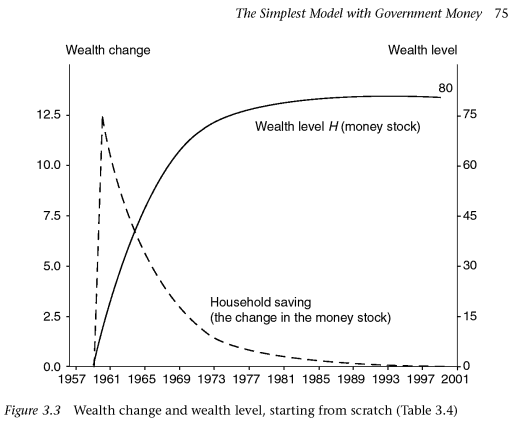
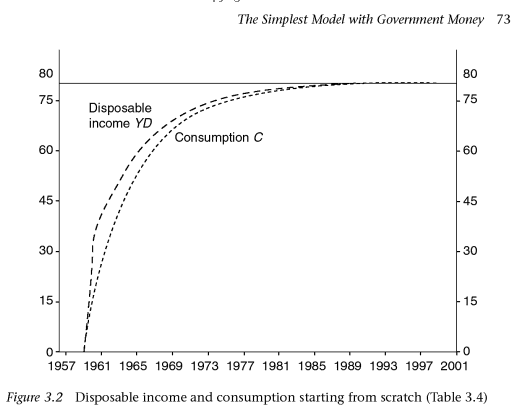
In Wynne Godley’s models, there is a propensity to consume out of income and out of wealth – represented in his models by the parameters αand αand the rate of saving in any period is given by the model. So in the simplest model – for example in Godley’s book with Marc Lavoie Monetary Economics, the rate of saving can has the following dynamic:

Disposable Income - G&L

Rate Of Saving - G&L

(image screenshot via amazon.com “Look Inside”)

(Note: In the above model, money is the only asset). This is starting from scratch but similar behaviour can be seen if one starts with some initial self-consistent configuration.

This is contrary to what Paul Krugman claims of Keynesian models. The above shows how the rate of saving first rises and then starts to fall and this whole adjustment will happen with a time lag given by a “stock-flow norm” and can be fast.

The reason it happens is simple. It is clear Krugman doesn’t realize the underlying stock-flow dynamics. As households’ saving and income rises because of a rise in government expenditure, they are also accumulating wealth. So a scenario where saving rises forever is meaningless because they would start consuming from their wealth as well.

Krugman continues:

This, in turn, led to predictions of rising savings rates after World War II, and hence a persistent shortage of demand — hence the secular stagnation theory briefly prominent. (There was even an early Heinlein novel built in part around the secular stagnation theory. As I recall, it was pretty bad.)

which is quite wrong – as stock-flow consistent dynamics suggests otherwise.

I’ll hold it to make any generic statements but it is clear that Krugman doesn’t know a thing or two about Keynesian Macroeconomics 🙂

*Many times standard textbooks use a Keynesian consumption function of the form

C = α0 + α1·YD

where C is the consumption, and YD is the disposable income.

It is then easy to see that C/YD decreases with YD and this is what Krugman is talking of.

However only slight improved modification where the consumption function depends on wealth as well leads to a different behaviour as highlighted in the main text. So it is strange Krugman dismisses consumption functions and instead talks of “failures that it seemed could have been avoided by thinking more in maximizing terms” !

*I thank Nick Edmonds in pointing this out.

Wynne Godley: The Keynes Of Flow Of Funds

Monetary and financial data, so far as they are based on institutional balance sheets and prices in organized markets, are abundant. Modern machines have made it possible to improve, refine and expand the compilation of these data, and also to seek empirical regularities in financial behavior in the magnitude of individual observations. On the aggregate level, the Federal Reserve Board has developed a financial accounting framework, the “flow of funds,” for systematic and consistent organization of the data, classified both by sector of the economy (households, nonfinancial business, governments, financial institutions and so on) and by type of asset or debt (currency, deposits, bonds, mortgages, and so on). Although many people hope that this organization of data will prove to be as powerful an aid to economic understanding as the national income accounts, this hope has not yet been fulfilled. Perhaps the deficiency is conceptual and theoretical; as some have said, the Keynes of “flow of funds” has yet to appear.

– James Tobin in Introduction (pp xii-xiii) in Essays In Economics, Volume 1: Macroeconomics, 1987.

[bolding: mine]

Paul Krugman writes in his blog responding to a recent Times article on Wynne Godley with a dismissive tone with mischaracterisation on saving etc. He writes:

But it is kind of funny to see a revival of old-fashioned macro hailed, at least by some, as the key to a reconstruction of the field.

Strange. First it is the story of a journalist from NYT who presented it the way it was. The NYT article was fine – what more can we ask from the journalists? But the funny thing is Krugman’s blog post itself which appeals to Friedmanism. Even funnier is the fact that Paul Krugman himself has turned to Keynesianism in recent times and talks about Michal Kalecki but when it suits his purpose, he dismisses Godley’s ideas as old fashioned!

Paul Krugman in his debates with heteredox economists has been exposed with his poor understanding of the nature of money. Wynne Godley’s approach on the other hand goes into a detailed look at the nature of money using the flow of funds among other things in a Keynesian way.

Now Krugman’s post is hardly a critique of any sort to deserve a response. But I thought quoting James Tobin is a good way to advertise Wynne Godley’s work because he has achieved what Tobin dreamed of and could not do it himself.

Also Wynne’s own idea about his work and aims can be seen from his writing in his article Keynes And The Management Of Real National Income And Expenditure, (in Keynes And The Modern World, ed. George David Norman Worswick and James Anthony Trevithick, Cambridge University Press, 1983):

… I have been forced to the conclusion that Keynes was a long way from achieving a coherent theoretical basis for maintaining them [correct ideas], and largely for this reason, his ideas have proved very vulnerable to the attacks from many different directions to which they have been subjected, particularly in the last fifteen years.

Wynne Godley’s work lays the foundation for Keynesian Economics. And Wynne Godley is the Keynes of flow of funds.

Correction: I am mistaken about Jonathan Schlefer’s background. He is in academics.

NYT On Wynne Godley

There’s a nice new article on Wynne Godley today in The New York Times.

An interesting thing in the article is the mention of intuition via models while mentioning his book Monetary Economics.

Why does a model matter? It explicitly details an economist’s thinking, Dr. Bezemer says. Other economists can use it. They cannot so easily clone intuition.

That is so right. The models in the books of Wynne Godley – both Monetary Economics with Marc Lavoie and Macroeconomics with Francis Cripps give a good idea about the authors’ intuitions. Of course, needless to say the man was bigger than his models.

Wynne Godley - NYT

James Tobin Turns In His Grave

When I was a boy of 14, my father was so ignorant I could hardly stand to have the old man around. But when I got to be 21, I was astonished at how much the old man had learned in seven years.

– attributed to Mark Twain, Reader’s Digest, September 1939.

Steve Keen has a blog post The Getting Of Wisdom in which he compares Tobin’s view in his 1963 paper Commerical Banks As Creators Of “Money” to his 1982 paper The Commercial Banking Firm: A Simple Model and finds Tobin has so many things (i.e., “loans create deposits” in 1963 to “loans create deposits” in 1982) in those years!

According to Keen:

The difference between the Old and New Tobin is as stark as that between the Old and New Testament. Not only is there an emphasis on the uniqueness of banks in that 1982 paper, Tobin also makes copious use of T-accounts and double-entry bookkeeping to explain why banks do matter. So just as the Testament message moved from “An eye for an eye” to “Turn the other cheek”, Tobin moved from “banks don’t matter and the belief that banks create money is a shibboleth”, to “banks are crucial to macroeconomics and they can and do create money”.

And whereas Tobin the Younger imagined that newly created bank money could be taken out of the system in a form other than bank deposits or cash, Tobin the Elder realizes that those are the only two options at the systemic level. Individuals might get out of bank deposits into (say) gold, but to do so they transfer money from their deposits in one bank into the deposits of the gold dealer in another bank. The only way for money not to be held in a bank is for it to be converted into some other kind of asset that is not a bank liability first. The only candidate here is cash—notes and coins—which you can insist on when you make a withdrawal (you might insist on gold instead, but a bank is under no obligation to deliver it in response to your withdrawal).

(italics in original, boldening mine)

Keen obviously is wrong when he says “the only way for money to be not held … ” because he first he misses the reflux mechanism where money can be extinguished by reducing indebtedness to the banking system. He obviously knows what “reflux” is but nonetheless misses it. Among other things he misses is that the bank can induce the non-banking public to shift in and out of money (or in the opposite case accommodate the non-banking public’s desire to change its portfolio) by changing bid/asks of markets they are dealers in such as government bond prices. So there is a price adjustment in the financial markets as well (leading to changes in deposits)

[Of course Keen attributes it to Tobin but looking at his agreeing tone, looks like it his own claim].

Others examples include but not limited to – a shift of deposits abroad with accommodative transactions which do not bring back the deposits to the original level, a “Treasury Supplementary Financing Operation” type of operation by the government Treasury which reduces the deposits in existence etc.

But more importantly he misses the mechanism which Tobin highlighted in his 1963 paper in which non-bank financials can compete with banks in the loan markets by taking away some borrowers and this leading to a fall in deposits. And this way, it is important not only for a single bank but for the banking system to induce depositors to bank with them.

Another thing which Post-Keynesians (some, not all of course) sometimes do is to think erroneously that bank borrowing (for purchases of goods and services at any rate) adds to demand and that non-bank borrowing/lending is demand-neutral and reading Keen’s post it seems he is close to saying something of the sort. And in his models, borrowing for purchases of financial assets also adds to “aggregate demand”.

I had written the following and am repeating it again about how a non-bank induces a borrower to borrow from it (who then extinguishes his loan from banks to become a borrower from the non-bank financial) and how this reduces the banking system’s balance sheet and hence deposits in the process – something Keen can’t see.

The following example is given in Tobin’s 1963 paper with my own numbers.

Start with a bank with initial balance sheet of 100 units. I will neglect capital and other liabilities to keep things clean so if you are not comfortable you can always change the liabilities side by reducing deposits by say 10 and replacing it with other liabilities. Also I call NBFIs’ liabilities “shares” and this is more like money-market mutual fund shares and shouldn’t be confused with stock-market shares.

t = 0

Banks

Assets: Loans = 100
Liabilities: Deposits = 100

Non-Financial Private Sector

Assets: Deposits = 100
Liabilities: Loans = 100

Non-bank Financial Institutions

Assets: Deposits = 0
Liabilities: Shares = 0

t = 1

At t = 1, let us say NBFIs attract 10 units of deposits from bank depositors. So the balance sheets will look like:

Banks

Assets: Loans = 100
Liabilities: Deposits = 100

Non-Financial Private Sector

Assets: Deposits = 90, Shares = 10
Liabilities: Loans = 100

Non-bank Financial Institutions

Assets: Deposits = 10
Liabilities: Shares = 10

t = 2

At t = 2, someone extinguishes his/her/its loan to the banking system by 10 unit. So,

Banks

Assets: Loans = 90
Liabilities: Deposits = 90

Non-Financial Private Sector

Assets: Deposits = 80, Shares = 10
Liabilities: Loans = 90

Non-bank Financial Institutions

Assets: Deposits = 10
Liabilities: Shares = 10

t = 3

At t = 3, someone borrows 10 units from NBFIs. So,

Banks

Assets: Loans = 90
Liabilities: Deposits = 90

Non-Financial Private Sector

Assets: Deposits = 90, Shares = 10
Liabilities: Loans = 100

Non-bank Financial Institutions

Assets: Loans = 10
Liabilities: Shares = 10

NBFIs who had 10 units of deposits no longer have it because they have lent 10 units which involves transfer of deposits. The net result at the end is that banks have lost a share lending of 10 units out of the initial 100 to non-banks and also deposits worth 10 units.

This of course can go on and it is in the interest of banks to prevent this from happening and induce the public to bank with them. In Tobin’s asset allocation theory, asset demands are dependent on the portfolio preference parameter and also the interest rate paid on the asset (or expected returns in general). So putting up interest rates on deposits would partly prevent this shift to non-bank financial intermediaries.

So in trying to show something, Keen’s effort turns counter-productive because his claim:

The only way for money not to be held in a bank is for it to be converted into some other kind of asset that is not a bank liability first.

turns out to be wrong and misleading.

He misses out Tobin’s insight that banks individually and collectively have to induce the non-banking public to hold deposits with them in his 1963 paper which the simple “loans create deposits” phrase does not highlight and how the banking system’s deposits can reduce due to competition from non-bank financials.

Plus there are more Tobinesque mechanisms (via his asset allocation theory) as I highlight in my previous posts James Tobin, Banking And The Widow’s Cruse and Holier Than Tobin? in which price changes of financial assets leads to a change in the stock of money which Keen is not aware of.

Instead his post has basic errors in monetary economics.

Balance Of Payments Crises

Phil Pilkington takes an issue with Sergio Cesaratto on the usage of the phrase “balance-of-payments crisis” on problems of the Euro Area.

Phil’s argument is that typically nations facing balance of payments problems need foreign currency and it manifests itself as a depreciation of the domestic currency but in the Euro Area this isn’t the case (because the exchange rates are fixed irrevocably between the Euro Area nations by the national central banks and the ECB). So the usage of the phrase “balance-of-payments crisis” is an abuse of language.

Now, to be short my argument that there is nothing wrong with the usage is because of the definition of what “balance-of-payments” actually is. Here is why:

A balance of payments transaction is a transaction between residents and non-residents. It is not relevant in which currency the transaction really is. So if you were a U.S. resident and if I as an Indian pay you $1 in New York in person, it is still a balance of payments transaction from the viewpoint of the United States. (of course if I own a firm in the United States which pays you then it is not a balance of payments transaction because the firm would be a resident).

In this way it becomes clear that some Euro Area nations have a balance of payments financing problem and since it reached a crisis level, the problem can be classified as a balance of payments crisis even though there is no exchange rate which has collapsed.

The nations which were/are in troubled had difficulties because they had huge current account deficits and as a result became indebted to the rest of the Euro Area. This became unsustainable and turned into a crisis. And both borrowers and lenders are to be blamed.

Since these nations had huge indebtedness to the rest of the Euro Area, they had troubles borrowing and refinancing their debts with foreigners and still have.

So I do not know why someone can take an issue with the phrase “balance-of-payments crisis”.

Except for the huge depreciation of the domestic currency, the Euro Area economic dynamics resembles a typical balance-of-payments crisis in all other ways. There is deflation of domestic demand, financial instability, high unemployment, increase in poverty and decrease in happiness and standard of living etc. There is international help in both cases.

Once again. A BoP transaction is between residents and non-residents. (See 2008 SNA, and BPM6 on this). A BoP crisis hence is a crisis in which borrowing and refinancing existing debt from non-residents has become difficult and is at crisis levels.  Whatever a country such as Portugal does at the moment, some units will be left indebted to the rest of the world/Euro Area. This is because liabilities are greater than financial assets and the difference is the net indebtedness to foreigners. Whatever new debts are created are equal in value to newly created financial assets. So the arithmetic dictates foreigners should be relied upon. The one qualification is that Portugal significantly improves its net exports but that is the same as saying its balance of payments is improving.

So anyone saying it is not a “balance-of-payments crisis” is fooling himself/herself.