Category Archives: Uncategorized

The Soon-To-Be Conventional Wisdom: “Fiscal Policy Is Not So Good”

Donald Trump is the President-elect of the United States. It hardly needs to be mentioned how bad his campaign was. Glenn Greenwald rightly called him an abusive, misogynistic, bigoted, scary, lawless authoritarian.

However on the economic scale, Trump’s plans seem to be to the left of Hillary Clinton. Trump wants to pump the prime, meaning do a fiscal expansion and also put tariffs.

Trump is yet to take his office, but the narrative change about fiscal policy has already started. The important thing to remember is that this is done by economists who might otherwise not object to it – at least the fiscal stimulus.

In other words, just to oppose Trump, economists are on the path to build a conventional wisdom that fiscal policy is neutral or impotent or even destructive if it’s expansionary (as in higher expenditure and/or cuts in tax rates).

Example: Lawrence Summers’ article A Badly Designed US stimulus Will Only Hurt The Working Class for Financial Times. While obviously unable to deny the importance of fiscal expansion (because it works), Summers says:

I am optimistic regarding the efficacy of fiscal expansion. But any responsible economist has to recognise that, past a point, it can lead to some combination of excessive foreign borrowing, inflation and even financial crisis. As Dornbusch showed, in emerging markets this can happen quite quickly. In the US the process would take longer.

Moreover, he also goes on to argue that China is not gaining unfair advantage by keeping its exchange rate at a highly devalued level. Notice the change in tone in Summers’ language. From writing about how the constraints are far, Summers is now saying that fiscal policy is not that good. Surely he’s using a language to hedge himself —as any economist should do—but he’s clearly not saying that, “Fiscal expansion will be good for the US economy. Trump should rather design taxes to be progressive” but instead, giving innuendos that fiscal policy is not that good.

Even a non-progressive system of taxation or even tax cuts for the wealthy can be expansionary. It raises inequality but the size of the pie is still rising. To me it’s still better than a neutral fiscal stance. But Summers’ language is such that it is worse.

Obviously no economist will jump overnight to shifting his/her position to saying, “fiscal policy is impotent or worse expansion destructive”, after the elections, from a position, “fiscal policy should be expansionary” before the elections. So conventional wisdom will be created slowly over the next few months – slowly manufacturing constent, borrowing the phrase from Noam Chomsky.

Is my reading of Summers wrong? Time will tell! But why didn’t Summers ever complain about the non-progressive system of taxation earlier?

Remonetisation

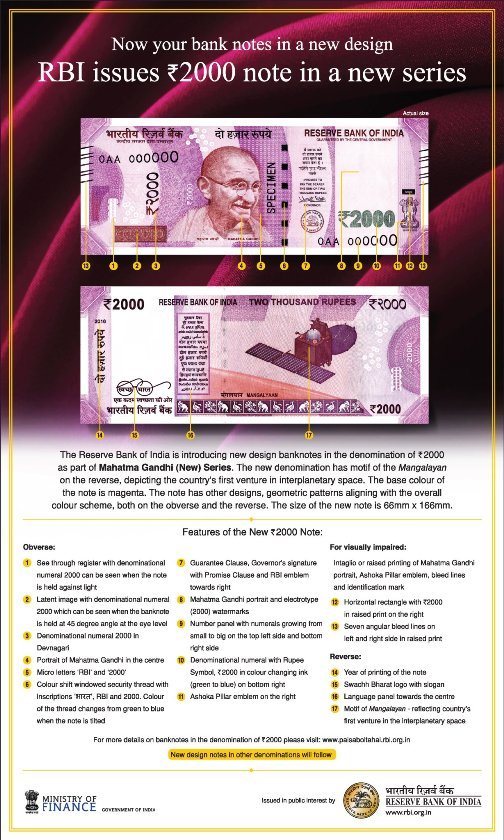
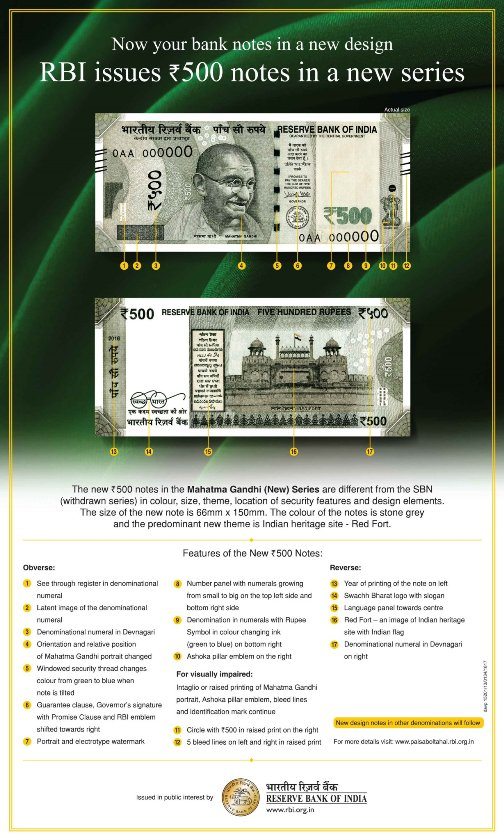
On 8th November 2016, at around 8pm, the Prime Minister of India, in a shock announcement, declared that 86% of currency notes in circulation—notes denominated ₹500 and ₹1,000—are no longer legal tender from midnight. Instead new notes with denominations ₹500 and ₹2,000 will be issued. The press is calling this “demonetisation”, although “remonetisation” seems to be a better word.

rbi-2000-rupee-note

Picture source: RBI on Twitter. Click picture for higher resolution

These notes are worth about $7.37 and $14.75 (at today’s exchange rate USDINR = 67.811). Although this is not much for people resident in the advanced world, it is quite a lot for Indians, especially the poor.

Holders of these currency notes are given time till 30th December to either

  1. exchange these currency notes with banks who will provide the holders with old currency notes denominated ₹100, ₹50, ₹50 or ₹10, or
  2. deposit them in their bank accounts.

The reasons provided were that there is a lot of counterfeiting happening from across the border and there is a lot of “black money” with Indians. Now there is a lot of political rhetoric around “black money” but Indians have this imagery that everyone doing immoral or illegal things with their finances has hidden a lot of currency notes in the water tanks of their homes. Before the Prime Minister’s Bhartiya Janata Party, won the elections, he promised to bring in “black money” worth $40 trillion (no typo!) from abroad and promised that every poor Indian will easily get around $30,000. But having failed in this, he feels pressured to do something about it.

Now, as Pronab Sen points out in Mint, that is hardly the case. The one doing shady things with their financial statements may hold wealth in various forms such as real estate, gold, foreign exchange, foreign accounts, via Panama etc. Moreover, people have been standing in queues in banks and ATMs for the whole day, just to exchange their notes. This is because the Indian government and the central bank didn’t make the new notes immediately available. Since there is a liquidity shortage, and that since a lot of people live in daily wages, there have been delays in payments of wages. People have postponed their expenditures to subsistence levels because it’s not clear how long the shortage will last.

How does the Indian government hope to gain from this operation? Currently, currency notes equivalent of around $222 bn of old notes are no longer legal tender. India’s annual GDP was $1.51 tn in 2015 for comparison with the US (where the currency in circulation is $1.48 tn and annual GDP was $18.44 tn, annualized in Q2 2016 and India’s population is 1.25 bn while US population is 319 mn). When notes are returned and new currency is issued, the Reserve Bank’s liabilities changes because some people won’t return their currency notes in the fear that their finances will be investigated. How much it is is anybody’s guess. But let’s say currency notes equivalent of $210 bn is returned. The RBI will see this as income from this operation and will pay an additional dividend of $12 bn to the government. The government can raise its expenditure because of higher tax revenues.

But since all this was poorly implemented and 11 people have died so for this political propaganda of the government. It’s not like in the Western world here in India. There is a parallel “informal economy” in India and a large population is extremely poor. It is difficult to calculate the loss of output.

I want to distract here to Monetarism and the relevance of this to monetary theory especially the causality from money to prices and output. It’s usually argued by Post-Keynesians that the causality is from price and output to money but as central bank asset purchases (“QE”) have highlighted, there is causality in the reverse direction also via rise in prices of financial assets causing a wealth effect.

Right now in India, there’s a drop of liquidity and from the story above, I hoped to convince you that there is a causality from money to output. People’s wealth hasn’t dropped but liquidity has. So Monetarism can have some truth to it, in selected cases. In standard Post-Keynesian theory, it is assumed that all demand for “money” is accomodated. But right now, this isn’t the case, leading to the reverse-reverse causality.

rbi-500-rupee-note

Picture source: RBI on Twitter. Click picture for higher resolution

Let’s Say, “China”

Trade has always been a subject close to non-orthodox economics. Post-Keynesians emphasize the principle of circular and cumulative causation, which in the words of Nicholas Kaldor means, “success creates further success and failure begets more failure”. The importance of trade for the prospects of the US economy was emphasized the most by Wynne Godley in his series of papers for the Levy Institute from the mid-90s to late 2000s. In his paper Seven Unsustainable Processes, Godley said,

The logic of this analysis is that, over the coming five to ten years, it will be necessary not only to bring about a substantial relaxation in the fiscal stance but also to ensure, by one means or another, that there is a structural improvement in the United States’s balance of payments. It is not legitimate to assume that the external deficit will at some stage automatically correct itself; too many countries in the past have found themselves trapped by exploding overseas indebtedness that had eventually to be corrected by force majeure for this to be tenable.

There are, in principle, four ways in which the net export demand can be increased: (1) by depreciating the currency, (2) by deflating the economy to the point at which imports are reduced to the level of exports, (3) by getting other countries to expand their economies by fiscal or other means, and (4) by adopting “Article 12 control” of imports, so called after Article 12 of the GATT (General Agreement on Tariffs and Trade), which was creatively adjusted when the World Trade Organization came into existence specifically to allow nondiscriminatory import controls to protect a country’s foreign exchange reserves. This list of remedies for the external deficit does not include protection as commonly understood, namely, the selective use of tariffs or other discriminatory measures to assist particular industries and firms that are suffering from relative decline. This kind of protectionism is not included because, apart from other fundamental objections, it would not do the trick. Of the four alternatives, we rule out the second–progressive deflation and resulting high unemployment–on moral grounds. Serious difficulties attend the adoption of any of the remaining three remedies, but none of them can be ruled out categorically.

In his 2008 paperProspects For The United States And The Rest Of The World: A Crisis That Conventional Remedies Cannot Resolve, he said:

At the moment, the recovery plans under consideration by the United States and many other countries seem to be concentrated on the possibility of using expansionary fiscal and monetary policies.

But, however well coordinated, this approach will not be sufficient.

What must come to pass, perhaps obviously, is a worldwide recovery of output, combined with sustainable balances in international trade. Since this series of reports began in 1999, we have emphasized that, in the United States, sustained growth with full employment would eventually require both fiscal expansion and a rapid acceleration in net export demand. Part of the needed fiscal stimulus has already occurred, and much more (it seems) is immediately in prospect. But the U.S. balance of payments languishes, and a substantial and spontaneous recovery is now highly unlikely in view of the developing severe downturn in world trade and output. Nine years ago, it seemed possible that a dollar devaluation of 25 percent would do the trick. But a significantly larger adjustment is needed now. By our reckoning (which is put forward with great diffidence), if the United States were to attempt to restore full employment by fiscal and monetary means alone, the balance of payments deficit would rise over the next, say, three to four years, to 6 percent of GDP or more—that is, to a level that could not possibly be sustained for a long period, let alone indefinitely. Yet, for trade to begin expanding sufficiently would require exports to grow faster than we are at present expecting, implying that in three to four years the level of exports would be 25 percent higher than it would have been with no adjustments.

It is inconceivable that such a large rebalancing could occur without a drastic change in the institutions responsible for running the world economy—a change that would involve placing far less than total reliance on market forces.

So there was a voice for the Post-Keynesian community talking about US trade.

Dean Baker has an article saying the TPP gave us Trump and I agree. Although Donald Trump is a disaster socially, he is less dogmatic about trade and has promised to put tariffs on China (and has even promised fiscal expansion!). Since the Democrats (except Bernie Sanders) didn’t say anything about it and guarded orthodoxies, I believe this was decisive for Trump’s victory.

For the sake of quotes, here’s from The New York Times, July 31, 2016:

Mr. Trump himself said in a telephone interview last week that he believed more borrowing and spending would help lift economic growth, a departure from traditional Republican economics.

“It’s called priming the pump,” Mr. Trump said. “Sometimes you have to do that a little bit to get things going. We have no choice — otherwise, we are going to die on the vine.”

He added: “The economy would be crushed under Hillary. But no matter who it is, the debt is going up.”

Here’s a fun video of Donald Trump saying China in loop

donald-trump-says-china

click the picture to see the video on YouTube.

Since today morning the BBC has been saying how immoral Trump’s policies are: that fiscal expansion invariably burdens future generations and that thinking of the Chinese government using unfair trade policies is orthodoxy.

That’s not all, Paul Krugman even claimed that equity prices aren’t going to ever rise to pre-Trump level, a position which he flipped within hours after financial markets recovered.

So it’s not difficult to conclude that purely for the sake of defending one’s favourite party or ideology, people are going to make the case against fiscal policy and for free trade. We might hear a lot of pre-Keynesian orthodoxies from smart people more and more. I won’t even be surprised if Paul Krugman becomes a fiscal hawk again.

This has already been the case in discussions around wars. George Bush started the Iraq war and faced a lot of opposition from the so-called progressives. But then Barack Obama is the record holder for the most number of days as being in office as the President of the United States while the nation was at war but hardly gets any opposition from those who opposed him. I have also noticed that the same people who opposed Bush are now war apologizers.

So economic orthodoxy lies ahead. What will be sad is that it will come from people to the left of Republicans in the political spectrum.

The Full Julian Assange Interview With John Pilger

Recently, Bloomberg’s Mark Halpern in a short clip managed to get an answer from Julian Assange to the question, “what aspect of the recent leaks by WikiLeaks has the media under-reported” and it was, “Everything”.

Russia Today has released the full video (link at the bottom) of a recent Julian Assange interview with John Pilger. In that, Assange talks about corruptions of the Clinton Foundation and how it has been responsible for terrorist funding. Assange also defends against the charges on him by various others that WikiLeaks is trying to put Donald Trump into the White House.

Hillary Clinton is a leader for neoliberals and neocons. She pretends to look progressive but is far from it. She’s for free trade and balanced budgets and a war hawk. She started sounding progressive and lefty in order to compete against Bernie Sanders.

Julian Assange has exposed Hillary Clinton, although the media tries to pretend otherwise with a “meh”, everytime WikiLeaks releases new emails in the past 30 days. But it’s not the case: Democrats and their supporters are fearful of WikiLeaks as can be seen by a Tweet now deleted tweet by Matthew Yglesias in which he accuses WikiLeaks of trying to side with Donald Trump:

Report on the documents all you like, but the tweets show Wikileaks is a pro-Trump disinformation operation not a transparency group.

As Mark Halpern says in the short clip linked above, you have an Australian guy working for an Icelandic organization, in the Ecuadorian Embassy in the United Kingdom striking fear in the heart of the Democratic presidential candidate in the United States – that’s one hell of a story. I should also add, effectively detained by the Swedish government.

The Julian Assange interview with John Pilger is at Russia Today’s YouTube channel. Transcripts are available at John Pilger’s site.

julian-assange-with-embassy-cat

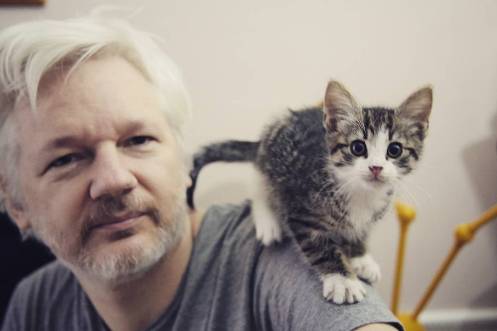
Julian Assange with Embassy Cat. Source: Embassy Cat’s Instagram page.

Noam Chomsky On Free Trade Agreements

Julian Assange is a probably the third most important figure in the current US elections. I came across a video from earlier this year in which Noam Chomsky defends Julian Assange.

“Free trade” puts a tight reign on the rise in output of economies, takes away a sovereignty from nations and is anti-democratic. Not only that, from the very start, free trade agreements are reached in the most undemocratic ways. Around 2/3rd of this nine-minute video, Chomsky explains how this is so. First, the documents are secretive. Then they are handed over to governments for a yes/no vote, which Chomsky says means they should vote “yes”.

It’s also one of the most important speeches on politics and power.

julian-assange-with-noam-chomsky

Julian Assange with Noam Chomsky. Source: WikiLeaks

The New View Of Fiscal Policy?

Jason Furman, Chairman of the Council of Economic Advisers to the President of the United States, has an articleThe New View Of Fiscal Policy And Its Application for Vox. In this, he admits how wrong economists have been about fiscal policy. I’ve quoted his paper on which the article is based before here on this blog.

Furman says:

A decade ago, the prevalent view about fiscal policy among academic economists could be summarised in four admittedly stylised principles:

  • Discretionary fiscal policy is dominated by monetary policy as a stabilisation tool because of lags in the application, impact, and removal of discretionary fiscal stimulus.
  • Even if policymakers get the timing right, discretionary fiscal stimulus would be somewhere between completely ineffective (the Ricardian view) or somewhat ineffective with bad side effects (higher interest rates and crowding-out of private investment).
  • Moreover, fiscal stabilisation needs to be undertaken with trepidation, if at all, because the biggest fiscal policy priority should be the long-run fiscal balance.
  • Policymakers foolish enough to ignore (1) through (3) should at least make sure that any fiscal stimulus is very short-run, including pulling demand forward, to support the economy before monetary policy stimulus fully kicks in while minimising harmful side effects and long-run fiscal harm.

Furman then goes on to highlight how wrong each of the “principles” is.

He also says,

In the immediate postwar decades, economists broadly supported fiscal stimulus (e.g. Blinder and Solow 1973). But much of modern academic macroeconomics has ranged from dismissive of any effect of fiscal policy on the macroeconomy …

While that’s good, the main issue with the article is that it fails to mention that Post-Keynesians have argued about the strong effects of fiscal policy since long. Not only that, Furman advocates fiscal policy coordination across countries:

Finally, there may be larger benefits to undertaking coordinated fiscal action across countries.

Again, this is not “new” in any sense, just non-orthodox. Here is what Nicholas Kaldor said in 1984 in his lectures Causes Of Growth And Stagnation In The World Economy:

I should like to end this series of lectures by suggesting the outline of a world-wide agreement on the necessary policies for recovery. The programme could be summed up under four main heads:

  1. The first is coordinated fiscal action including a set of consistent balance of payments targets and “full employment” budgets.If this does not prove to be politically feasible, it is inevitable that the growth of unemployment will sooner or later force governments to take measures that would make it necessary for them to expand demand without being frustrated by the inevitable balance of payments consequence of expanding their economies relative to their trading partners. This means that there needs to be some form of restriction that would limit the increase in “competitive” imports to some target ratio in relation to exports. Trade liberalisation, which played such an important part in the rapid economic progress during the years of expansion, becomes a serious obstacle to economic recovery in the case of prolonged stagnation due to the inability of countries to achieve a coordinated set of policies. But, given a proper recognition of the problem, that under conditions of unrestricted free trade the actual volume of production and trade may in fact be considerably less than under some system of regulated trade – a system which relates the volume of imports in manufactures from a particular group of countries, such as the members of the EEC, to some mutually agreed ratio to the exports of individual members to the rest of the group – there is no reason why full employment should not be restored through policies of expansion, preferably directed by the expansion of State investment. This coordinated action by all countries, instead of isolated actions by each country, is the first and most important requirement of recovery.

At present all countries have fairly large deficits in the general government budget, but these are largely the consequence of the low level of activity. On a “full employment” basis they would show a highly restrictive picture – they would show surpluses and not deficits. Contrary to appearances, the requirement of stability is for expansionary budgets with lower taxes and higher expenditure, and not further fiscal restriction (as is advocated, for example, by M. de Larosiere of the International Monetary Fund).

But finally some sense prevails in the economics community. Jason Furman’s article should be used to argue against anyone who says: “we always knew” even though his/her position has shifted. So there’s nothing new about the “new view”. Just that economists from the mid-70s till now have been orthodox.

The Treaty Of Rome And Balanced Trade

Policy Research in Macroeconomics (PRIME)’s blog Prime Economics reminds us of the Treaty of Rome, to establish a European Economic Community, first signed in 1957 which has a Chapter on Balance of Payments:

CHAPTER 2

BALANCE OF PAYMENTS

ARTICLE 104

Each Member State shall pursue the economic policy needed to ensure the equilibrium of its overall balance of payments and to maintain confidence in its currency, while taking care to ensure a high level of employment and a stable level of prices.

ARTICLE 105

  1. In order to facilitate attainment of the objectives set out in Article 104, Member States shall co-ordinate their economic policies. They shall for this purpose provide for co-operation between their appropriate administrative departments and between their central banks. The Commission shall submit to the Council recommendations on how to achieve such co-operation.
  2. In order to promote co-ordination of the policies of Member States in the monetary field to the full extent needed for the functioning of the common market, a Monetary Committee with advisory status is hereby set up. It shall have the following tasks:
    – to keep under review the monetary and financial situation of the Member States and of the Community and the general payments system of the Member States and to report regularly thereon to the Council and to the Commission;
    – to deliver opinions at the request of the Council or of the Commission or on its own initiative, for submission to these institutions.

The Member States and the Commission shall each appoint two members of the Monetary Committee.

I have emphasized many times in my blog that Euro Area balance of payments and international investment position imbalances are quite important for the Euro Area. Even before I started writing this blog, I had stressed before anyone else (on other Post-Keynesian blogs) that the imbalances are large and quite important in understanding the crisis.

Of course, imbalances can be corrected by deflating demand and output as has been the case in the Euro Area since the start of the crisis by policy makers. But it’s good to know that the founders of European integration thought of coordinating policies, which implies their policies would have been expansionary. Anyway, had the original ideas not been overthrown, the Euro Area would also have had a central government. Unfortunately neoliberalism became popular in the 1980s and this led to the Maastricht Treaty which forgot the original intentions of the founders.

The Treaty’s opening also has this important line:

RECOGNISING that the removal of existing obstacles calls for concerted action in order to guarantee steady expansion, balanced trade and fair competition

I should mention however that the Euro Area has this thing called the Macroeconomic Imbalance Procedure which tries to address the issue and even thinks of current account surpluses in the balance of payments as an imbalance, but it is still far away from doing anything about it, such as a coordinated fiscal policy expansion.

Julian Assange On TPP, TTIP And TISA

This is nice video of Julian Assange speaking via teleconference on TPP, TISA and TISA with philosopher Slavoj Žižek and former Greek finance minister, Yanis Varoufakis in a conference organized by Southbank Centre on Nov 16, 2015.

julian-assange-on-tpp-ttip-and-tisa

click to see the video on YouTube

The relevant part starts at 1 hour, 15 minutes, 22 seconds.

Excerpts:

[TTP, TTIP and TISA] are a part of a new global economic partition of the world. It is – I think – the most ambitious, concrete plan since the creation of the European Union, since possibly the creation of the WTO, although it goes much further.

That organized plan … and it’s the largest plan and will lock in, permanently will lock in a more radical form of neoliberalism into Europe, into South East Asia, into the United States … and must be intellectually engaged with not just left to the vulgarities of whether and how market prices change and how people move.

Link

Julian Assange On The Mire Of Politically Distorted Language

To radically shift regime behavior we must think clearly and boldly for if we have learned anything, it is that regimes do not want to be changed. We must think beyond those who have gone before us, and discover technological changes that embolden us with ways to act in which our forebears could not. Firstly we must understand what aspect of government or neocorporatist behavior we wish to change or remove. Secondly we must develop a way of thinking about this behavior that is strong enough carry us through the mire of politically distorted language, and into a position of clarity. Finally must use these insights to inspire within us and others a course of ennobling, and effective action

julian-assange-with-embassy-cat

Picture source: “Embassy Cat”‘s Instagram page.

Do US Trade Deficits Result In “Net Profits” For The US?

It’s frequently claimed that the US 🇺🇸 has trade deficits but since the US dollar has not collapsed, the ones saying that the US does not have a balance of payments constraint are all wrong.

Now there are several errors in this line of reasoning but going straight to the point: the balance-of-payments constraint is first a constraint on output. There’s a deflationary bias in the US output because of the imbalance in trade.

This article is written in response to a blog post Cumulative U.S. Trade Deficits Resulting in Net Profits for the U.S. (and Net Losses for China) at the blog macroblog by the Federal Reserve Bank of Atlanta. The article says:

The United States has run trade deficits for decades (1976 is the last year with a recorded surplus). To illustrate this, chart 1 depicts the cumulative U.S. trade deficit since 1980, which now surpasses $10 trillion. As a result, a drastic deterioration in the U.S. net foreign asset position—the difference between the amount of foreign assets owned by U.S. residents and the amount of U.S. assets owned by foreigners—has occurred. That is, as Americans borrow from the rest of the world to finance the recurring trade deficits, the national net worth goes deeply into the red. Not long ago, many commentators predicted that as a result of this increasing U.S. foreign debt, the U.S. dollar was set to collapse, which would trigger a stampede away from U.S. assets. Of course, this has not happened.

The wording of this itself is problematic. First some definitions:

Here’s from the IMF’s Balance of Payments And International Investment Position Manual (BPM6), pg 9:

The balance of payments is a statistical statement that summarizes transactions between residents and nonresidents during a period. It consists of the goods and services account, the primary income account, the secondary income account, the capital account, and the financial account. Under the double-entry accounting system that underlies the balance of payments, each transaction is recorded as consisting of two entries and the sum of the credit entries and the sum of the debit entries is the same.

What the US has is a positive balance in the secondary income account (more credits than debits) despite running large deficits in the primary account and despite having a large negative net international position. But “net loss” or “net profit” is bad wording to start with. Also the net international investment position itself is not “national net worth” because the latter includes non-financial assets owned by resident economic units and hence doesn’t make an appearance in the international investment position.

Now coming back to the point on output – If the US economy were to run under full capacity at all times with the current account deficit widening and the net international investment position deteriorating relative to gdp without limit, it can then be claimed that the US doesn’t have this problem and the economists worrying about US trade got it all wrong. But that is far from the case. Not only is the US economy not running under full capacity, but so much output has been lost since the beginning of the crisis starting in 2007.

Having an imbalance in trade means that output multipliers aren’t as high as it would have been the case otherwise. So the government expenditure multiplier and private expenditure multiplier are inversely related to the propensity to import and would have been higher if the propensity to import were less.

Usually economists talk about either trade or the financial aspect (i.e. either the current account or the financial account of the balance of payments) but not both together in a single unified framework. Most of the conclusions reached are due to lack of analysis which treat both of them simultaneously. Stock flow consistent models are an exception but other models are so messed up even for the closed-economy that it’s difficult in those models to make progress.

The fact that the US secondary income is in the US’ favour has led economists to draw any conclusion they want from their analysis. Let’s touch one aspect – the tipping point.

The tipping point

Let’s say you have assets worth $100 and earning at 6% annually (such as interest or dividend), and liabilities of $110 paying at 5%. So even though your liabilities are higher than assets, your income on assets ($6) is higher than what you pay on your liabilities ($5.5). So far, so good, so what? While this is not a bad situation, this is unlikely to remain the case forever. For example if your assets stay the same whereas liabilities rise to $130, then the net income is against your favour. You are earning $6 per year but paying $6.5.

The point of the above example is that even though the US earns more on assets held abroad than what it pays nonresident economic units on their financial assets, this process cannot continue forever. Sooner or later, the difference between the assets and liabilities (because of continuous trade deficits) will be so high that the secondary income in the current account in the balance of payments will be negative. So estimating the tipping point is estimating when this will happen.

Surely, if the US runs at full capacity and hence higher trade deficits because of higher national income and income effects on imports, the US will hit the tipping point sooner. At that point nobody can obfuscate the debate by saying that the secondary income balance in the current account of the balance of payments is positive. The international investment position will deteriorate at a much faster rate.

Of course reaching the tipping point itself is not apocalypse. Some countries do have a negative balance in the secondary income account of their balance of payments. The situation can continue as long as markets allow it to go on. When the busts, it will create a problem but nobody has a theory yet on when exactly some busts, although we’ve made progress on identifying unsustainable processes.

The point of the above analysis is that none of the arguments trying to claim directly or implicitly that “current account deficits do not matter” are erroneous.

No, the dollar won’t collapse but the US economy will run from full capacity to keep debts in check. Such as so much lost output in the last 9 years or so. To summarize, there are at least two scenarios here which are either confused or conflated or both by economic commentators:

  1. The US economy running closer to full capacity but with international investment position deteriorating fast and a threat to the US economy and the currency.
  2. Status-quo, where there’s deflationary bias to the US economy and hence consequences to output, employment and income for the bottom of the population but no immediate threat to the international investment position (although deteriorating) and in which there’s no dollar collapse.

The empiric of scenario 2 above cannot be used to argue that scenario 1 is benign because these two are different states of the world.

The solution is another scenario, a scenario 3 in which output is raises by fiscal expansion but the US government also works to address its balance of payments problems. For example, China’s strategy of exports is quite damaging to the US economy and it is important that the US establishment addresses this instead of just saying “it does matter” or that market mechanism will do the trick.