Category Archives: Uncategorized

Pankaj Mishra On The Entwined History Of Liberalism And Imperialism

A bit old, from Dec 2015 but still fresh.

Pankaj Mishra in London Review Of Books:

Visiting Africa and Asia in the 1960s, Conor Cruise O’Brien discovered that many people in former colonies were ‘sickened by the word “liberalism”’. They saw it as an ‘ingratiating moral mask which a toughly acquisitive society wears before the world it robs’. O’Brien – ‘incurably liberal’ himself (at least in this early phase of his career) – was dismayed. He couldn’t understand why liberalism had come to be seen as an ‘ideology of the rich, the elevation into universal values of the codes which favoured the emergence, and favour the continuance, of capitalist society’. This seemed to him too harsh a verdict on a set of ideas and dispositions that appeared to promote democratic government, constitutionalism, the rule of law, a minimal state, property rights, self-regulating markets and the empowerment of the autonomous rational individual.

Liberal ideas in the West had emerged in a variety of political and economic settings, in both Europe and North America. They originated in the Reformation’s stress on individual responsibility, and were shaped to fit the mould of the market freedoms that capitalism would need if it was to thrive (the right to private property and free labour, freedom from state regulation and taxation). They did not seem particularly liberal to the peoples subjugated by British, French and American imperialism in the 18th and 19th centuries. Contradictions and elisions haunted the rhetoric of liberalism from the beginning. ‘How is it,’ Samuel Johnson asked about secession-minded American colonists, ‘that we hear the loudest yelps for liberty among the drivers of negroes?’ John Stuart Mill credited India’s free-trading British overlords with benign liberal intentions towards a people self-evidently incapable of self-rule. ‘Despotism,’ he wrote, ‘is a legitimate mode of government in dealing with barbarians, provided the end be their improvement.’ Alexis de Tocqueville, by contrast, felt no need of the ingratiating moral mask; the French colonial project in Algeria was a glorious enterprise, a vital part of French nation-building after decades of political turmoil.

It wasn’t only the entwined history of liberalism and imperialism that in the 1960s made many Asians and Africans suspect American and European liberals of being ‘false friends’ …

Michał Kalecki, 1933 – Stimulating The World Business Upswing

Michał Kalecki in “Stimulating the World Business Upswing,” in Collected Works of Michał Kalecki, vol. 1, Capitalism: Business Cycles and Full Employment, ed. Jerzy Osiatyński, trans. Chester Adam Kisel (Oxford: Clarendon, 1990), 156–64 (possibly ahead of John Maynard Keynes):

We very often encounter the argument against building new factories while the old ones are still unemployed. This simple truism shares the fate of many of its fellows—it is false. In order for existing capital equipment to be fully employed, it must be continually expanded, since then accumulated profits are invested. If they are not invested, profits fall and, along with the fall in profits, there is a decline in the capacity utilization of existing factories.

Let us assume, as often happens in the USA, that two competing railway lines run between two cities. Traffic on both lines is weak. How does one deal with this? Paradoxically, one should build a third railway line, for then materials and people for construction of the third will be transported on the first two. What should be done when the third one is finished? Then one should build a fourth and a fifth one … This example, as we warned, is paradoxical, since unquestionably it would be better to undertake some other investment near the first two railway lines rather than build a third one; nevertheless, it perfectly illustrates the laws of development of the capitalist system as a whole.

Michał Kalecki

Michał Kalecki, picture credit: PWN

quote h/t Jan Toporowski

Brad Setser On The U.S., China And The New “Adjusted Trade Balance”

Since Donald Trump considers the US trade imbalance as the root of all problems and there is—understandably for many reasons—a resistance to Trump, there is a tendency to deny anything he says. This movement is led by Paul Krugman who repeatedly attempts to play down the supreme importance of the critical imbalance of US trade.

One is the trade imbalance with China. In the pre-globalised world, trade deficit would mean what it means. But because of offshoring of production to exploit low wages in Asia, things are more complicated.

Consider the manufacturing of iPhone by Apple Inc., everyone’s favourite example. Although it’s more complicated with involvement of countries such as Taiwan and Ireland (or maybe more), let’s simplify and assume that the whole process is just between the US, China and a third country where the phones are exported to.

This is recorded as a service export to China, goods produced in China, adding to its exports and GDP. The profits of Apple Inc.‘s investment in China adds to the United States’ primary income account of the current account of balance of payments, not the goods and services account.

But if the price was the same had Apple directly exported its phones to the third country (which wouldn’t be the case in reality, since producing in the US is costlier, but let’s ignore), the goods and services account in the current account would have been counted differently.

To put it differently, the goods and services account might give a misleading picture of the trade deficit. But some have exploited this fact to somehow try to convey that somehow, the US trade imbalance with China is nothingburger. 🤦🏻‍♂️

Brad Setser has a great post on his blog Follow The Money addressing the issue. He says:

… rather than providing a better measure of trade, the “augmented” trade balance simply adds to the confusion. It suggests that China doesn’t run a surplus with the U.S. when in reality it does, and it suggests that China isn’t a creditor to the United States when in reality it is.

Brad’s point is that the ones trying to underplay the trade deficit do so by adding gross sales to the US goods and services account in the current account of balance of payments instead of adding profits of US firms’ overseas investment. He gives the true picture.

Link

Pankaj Mishra – The Mask That It Wears

At London Review Of Books, Pankaj Mishra has an excellent review of two books on politics today and the liberal world order and captures its essence:

The most audacious surfers of the bien pensant tide, however, are wealthy and influential stalwarts of the ‘liberal order,’ whose diagnoses and prescriptions dominate the comment pages of the Financial Times, the New York Times and the Economist. They depict the tyro in the White House as an unprecedented calamity, more so evidently than the economic inequality, deadlocked government, subprime debt, offshored jobs, unrestrained corporate power and compromised legislature that made Trump seem a credible candidate to millions of Americans. Hoping to restore their liberal order, journalists, politicians, former civil servants and politically engaged businessmen jostle on both sides of the Atlantic in an air of revivalist zeal.

Moyn’s stern appraisal may not appear new to long-standing critics of Western moral rhetoric in the global South. Anti-colonial leaders and thinkers knew that the global economy forged by Western imperialism had to be radically restructured in order even partially to fulfil the central promise of national self-determination, let alone socialism. Western liberals were widely perceived as ‘false friends’, as Conor Cruise O’Brien reported from Africa in the 1960s, and liberalism itself as an ‘ingratiating moral mask which a toughly acquisitive society wears before the world it robs’.

The Burden Of Adjustment And Keynes’ Solution

Argentina had a balance-of-payments crisis recently and required help. The IMF has agreed for a stand-by arrangement of $50 billion on the condition in the IMF’s own words:

“At the core of the government’s economic plan is a rebalancing of the fiscal position. We fully support this priority and welcome the authorities’ intention to accelerate the pace at which they reduce the federal government’s deficit, restoring the primary balance by 2020. This measure will ultimately lessen the government financing needs, put public debt on a downward trajectory, and as President Macri has stated, relieve a burden from Argentina’s back.

So Argentina has to agree on policies with deflationary bias to its output. John Maynard Keynes made this observation, had a completely different attitude than the IMF and proposed to change it. From The Collected Writings Of John Maynard Keynes, Volume XXV: Shaping The Post-War World: The Clearing Union, Chapter 1, The Origins Of The Clearing Union, 1940-1942, pages 27-30:

III. The Analysis of the Problem

I believe that the main cause of failure (except in special, transient conditions) of the freely convertible international metallic standard (first silver and then gold) can be traced to a single characteristic. I ask close attention to this, because I should argue that this provides the clue to the nature of any alternative which is to be successful.

It is characteristic of a freely convertible international standard that it throws the main burden of adjustment on the country which is in the debtor position on the international balance of payments,—that is on the country which is (in this context) by hypothesis the weaker and above all the smaller in comparison with the other side of the scales which (for this purpose) is the rest of the world.

Take the classical theory that the unlimited free flow of gold automatically brings about adjustments of price-levels and activity between the debtor country and the recipient creditor, which will eventually reverse the pressure. It is usual to-day to object to this theory that it is too dependent on a crude and now abandoned quantity theory of money and that it ignores the lack of elasticity in the social structure of wages and prices. But even to the extent that it holds good in spite of these grave objections, if a country is in economic importance even a fifth of the world as a whole, a given loss of gold will presumably exercise four times as much pressure at home as abroad, with a still greater disparity if it is only a tenth or a twentieth of the world, so that the contribution in terms of the resulting social strains which the debtor country has to make to the restoration of equilibrium by changing its prices and wages is altogether out of proportion to the contribution asked of its creditors. Nor is this all. To begin with, the social strain of an adjustment downwards is much greater than that of an adjustment upwards. And besides this, the process of adjustment is compulsory for the debtor and voluntary for the creditor. If the creditor does not choose to make, or allow, his share of the adjustment, he suffers no inconvenience. For whilst a country’s reserve cannot fall below zero, there is no ceiling which sets an upper limit. The same is true if international loans are to be the means of adjustment. The debtor must borrow; the creditor is under no such compulsion.

… Thus it has been an inherent characteristic of the automatic international metallic currency (apart from special circumstances) to force adjustments in the direction most disruptive of social order, and to throw the burden on the countries least able to support it, making the poor poorer.

I conclude, therefore, that the architects of a successful international system must be guided by these lessons. The object of the new system must be to require the chief initiative from the creditor countries, whilst maintaining enough discipline in the debtor countries to prevent them from exploiting the new ease allowed them in living profligately beyond their means.

So Keynes proposed to change this so that creditors also share the burden. In his plan for Bretton Woods (page 80), he proposed to impose a penalty on creditor nations and also require them to take measures such as:

(a) Measures for the expansion of domestic credit and domestic demand.
(b) The appreciation of its local currency in terms of bancor, or, alternatively, the encouragement of an increase in money rates of earnings;
(c) The reduction of tariffs and other discouragements against imports.
(d) International development loans.

Of course we are past the Bretton Woods system and have a system of a mix of fixed and floating exchange rates but it hasn’t provided the market mechanism required to resolve imbalances. The adjustment is still on output and employment. Hence the need for an official mechanism to resolve imbalances. Bancor isn’t relevant now, but official intervention is.


Sergio Cesaratto — Alternative Interpretations Of A Stateless Currency Crisis

I recently referred to a paper by Sergio Cesaratto on the Euro Area crisis. There is another paper, Alternative Interpretations Of A Stateless Currency Crisis, written for the Cambridge Journal Of Economics, written last year which I somehow missed referring on this site.

CJE link (no paywall at the time of writing), Wayback Machine link.

Abstract:

A number of economists warned that a political union was a prerequisite for a viable currency union. This paper disputes the feasibility of such a political union. A fully fledged federal union, which would likely please peripheral Europe, is impracticable since it implies a degree of fiscal solidarity that does not exist. A Hayekian minimal federal state, which would appeal to core Europe, would be refused by peripheral members, since residual fiscal sovereignty would be surrendered without any clear positive economic and social return. Even an intermediate solution based on coordinated Keynesian policies would be unfeasible, since it would be at odds with German ‘monetary mercantilism’. The euro area is thus trapped between equally unfeasible political perspectives. In this bleak context, austerity policies are mainly explained by the necessity to readdress the euro area balance-of-payments crisis. This crisis presents striking similarities to traditional financial crises in emerging economies associated with fixed exchange regimes. Therefore, the delayed response of the European Central Bank (ECB) to the sovereign debt crisis cannot be seen as the culprit of the euro area crisis. The ECB’s monetary refinancing mechanisms, Target 2 and the ECB’s belated Outright Monetary Transactions intervention impeded a blow-up of the currency union, but could not solve its deep causes. The current combination of austerity policies and moderate ECB intervention aims to rebalance intra-eurozone foreign accounts and to force competitive deflation strategy.

As the abstract says, the ECB alone cannot resolve the crisis.

I agree almost everything in the paper except that in my opinion, a political union—a central government—is the only way to solve the Euro crisis. But Sergio’s arguments about his view are solid.

My Favourite Chart, Updated: Euro Area Imbalances

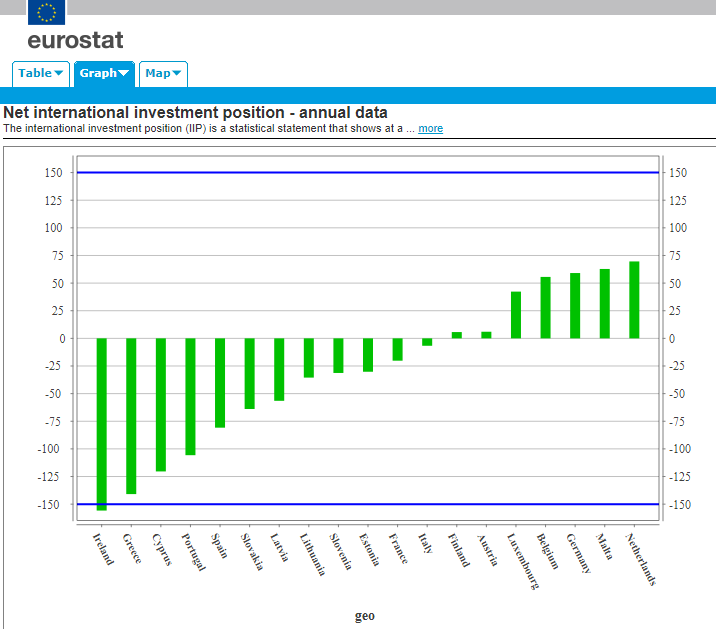
With crisis in Italy, the Euro Area is back in news! But it is not just Italy, the crisis is far from over, as this chart from Eurostat—my favourite—illustrates:

Euro Area Net International Investment Position

EA19, Net International Investment Position

The Euro Area doesn’t have a central government with large fiscal powers and hence there is nothing to keep imbalances in check. So some countries—with no fault of theirs—accumulated large debts. The net international investment position captures the financial position of a country. If it is positive, it is a creditor to the world, if it is negative it is a debtor of the world. If NIIP/GDP is large negative, then there is a problem. It’s difficult to say how large it can go, since it depends on how long markets and official institutions allow it to go. The need to keep it sustainable puts a downward pressure on GDP.

As Nicholas Kaldor wrote in The Dynamic Effects Of The Common Market, in the New Statesman, 12 March 1971:

… the objective of a full monetary and economic union is unattainable without a political union; and the latter pre-supposes fiscal integration, and not just fiscal harmonisation. It requires the creation of a Community Government and Parliament which takes over the responsibility for at least the major part of the expenditure now provided by national governments and finances it by taxes raised at uniform rates throughout the Community. With an integrated system of this kind, the prosperous areas automatically subside the poorer areas; and the areas whose exports are declining obtain automatic relief by paying in less, and receiving more, from the central Exchequer. The cumulative tendencies to progress and decline are thus held in check by a “built-in” fiscal stabiliser which makes the “surplus” areas provide automatic fiscal aid to the “deficit” areas.

Sergio Cesaratto — The Nature Of The Eurocrisis: A Reply To Febrero, Uxó And Bermejo

Recently I commented on a paperThe Financial Crisis In The Eurozone: A Balance-Of-Payments Crisis With A Single Currency? by Eladio Febrero, Jorge Uxó and Fernando Bermejo, published in ROKE, Review Of Keynesian Economics. I hadn’t realised that Sergio Cesaratto has a reply (paywalled) in the same issue.

Sergio Cesaratto

Sergio Cesaratto. Picture credit: La Città Futura, Sergio Cesaratto

Abstract:

Febrero et al. (2018) criticise the balance-of-payments (BoP) view of the European Economic and Monetary Union (EMU) crisis. I have no major objections to most of the single aspects of the crisis pointed out by these authors, except that they appear to underline specific sides of the EMU crisis, while missing a unifying and realistic explanation. Specific semi-automatic mechanisms differentiate a BoP crisis in a currency union from a traditional one. Unfortunately, these mechanisms give Febrero et al. the illusion that a BoP crisis in a currency union is impossible. My conclusion is that an interpretation of the eurozone’s troubles as a BoP crisis provides a more consistent framework. The debate has some relevance for the policy prescriptions to solve the eurocrisis. Given the costs that all sides would incur if the currency union were to break up, austerity policies are still seen by European politicians as a tolerable price to pay to keep foreign imbalances at bay – with the sweetener of some European Central Bank (ECB) support, for as long as Berlin allows the ECB to provide it.

Sergio carefully responds to all views of Febrero et al. and Marc Lavoie, Randall Wray and also Paul De Grauwe, pointing out that he agrees with most of their views except that their dismissal of this being a balance-of-payments crisis with their claims that the problem could have been addressed by the Eurosystem/ECB lending to governments without limits. He points out that, “The austerity measures that accompanied the ECB’s more proactive stance are clearly to police a moral hazard problem”. It is true that the ECB, the European Commission and the IMF overdid the austerity but it doesn’t mean that Sergio’s opponents’ claims are accurate.

Link

M Metin Basbay On Free Trade And All That

In his article, Is A Potential Trade War An Opportunity For Developing Countries?, in TRT World, M Metin Basbay argues how the rules of the international trade, i.e., free trade favours the developed world and that the rising trade war gives developing countries a chance to “better maneuver their political agendas”.

He quotes Ha-Joon Chang to make his point:

In a globalised world, newly emerging (infant) industries have to compete with century-old industrial giants, and more often than not, are crushed before they can even develop the capacity in terms of human capital and know-how for high technology sectors – and reduce the per-item cost associated with large scale initial investments.

Cambridge Economist Ha-Joon Chang argued that the infant industries hypothesis is still relevant in the modern context. In his influential book Kicking Away the Ladder, he argued that developed nations force liberalised trade and globalisation upon less developed nations so that they can enjoy both the cheap labour force and the larger market of developing countries. By doing so, they deprive these nations of political instruments like trade protections which they themselves had the luxury of using while in their own infant-state era.

Contrasting Joan Robinson And Paul Krugman’s Views On The Global Rules Of Trade

Paul Krugman has a new articleWhy A Trade War With China Isn’t ‘Easy To Win’ (Slightly Wonkish), in The New York Times, in which he rightly points out Donald Trump’s switching positions on trade with China. Krugman however has a generic point about international trade as some kind of mercantilism:

Admittedly, the political economy of trade is kind of mercantilist, because it’s driven largely by producer interests. Long ago I wrote about “GATT-think”, the view of trade, enshrined in international negotiations, that sees exports as good, imports as bad, so that letting someone sell us stuff, even if it’s better and cheaper than we could make ourselves, is a “concession.” The genius of the postwar international trading system was that it harnessed this special-interest reality, using the ambitions of exporters to offset the protectionism of those competing with imports, to engineer a kind of enlightened mercantilism that vastly expanded world trade.

[italics: mine]

So Krugman is admitting that it is in the interest of big producers, but claiming that his interests aren’t aligned with them and that the rules of trading were made such that it somehow offset them.

The reality is of course different. More successful countries do not need protection at home. At least we can say that they’re are willing to forgo protectionism as the advantage from selling more easily in markets abroad is immense. As Joan Robinson pointed out in a 1977 article (and even before), What Are The Questions?

From a long-run point of view, export-led growth is the basis of success. A country that has a competitive advantage in industrial production can maintain a high level of home investment, without fear of being checked by a balance-of-payments crisis. Capital accumulation and technical improvements then progressively enhance its competitive advantage. Employment is high and real-wage rates rising so that “labour trouble” is kept at bay. Its financial position is strong. If it prefers an extra rise of home consumption to acquiring foreign assets, it can allow its exchange rate to appreciate and turn the terms of trade in its own favor. In all these respects, a country in a weak competitive position suffers the corresponding disadvantages.

When Ricardo set out the case against protection, he was supporting British economic interests. Free trade ruined Portuguese industry. Free trade for others is in the interests of the strongest competitor in world markets, and a sufficiently strong competitor has no need for protection at home. Free trade doctrine, in practice, is a more subtle form of Mercantilism. When Britain was the workshop of the world, universal free trade suited her interests. When (with the aid of protection) rival industries developed in Germany and the United States, she was still able to preserve free trade for her own exports in the Empire. The historical tradition of attachment to free trade doctrine is so strong in England that even now, in her weakness, the idea of protectionism is considered shocking.

[italics: mine]

The last sentence is also important when discussing Krugman. The United States’ balance of payments has deteriorated and needs some protectionism. But economists are attached to the idea of free trade like it’s some dogma.