Category Archives: Uncategorized

Appreciation Of Wynne Godley’s Work In Adam Tooze’s Crashed And Its Reviews

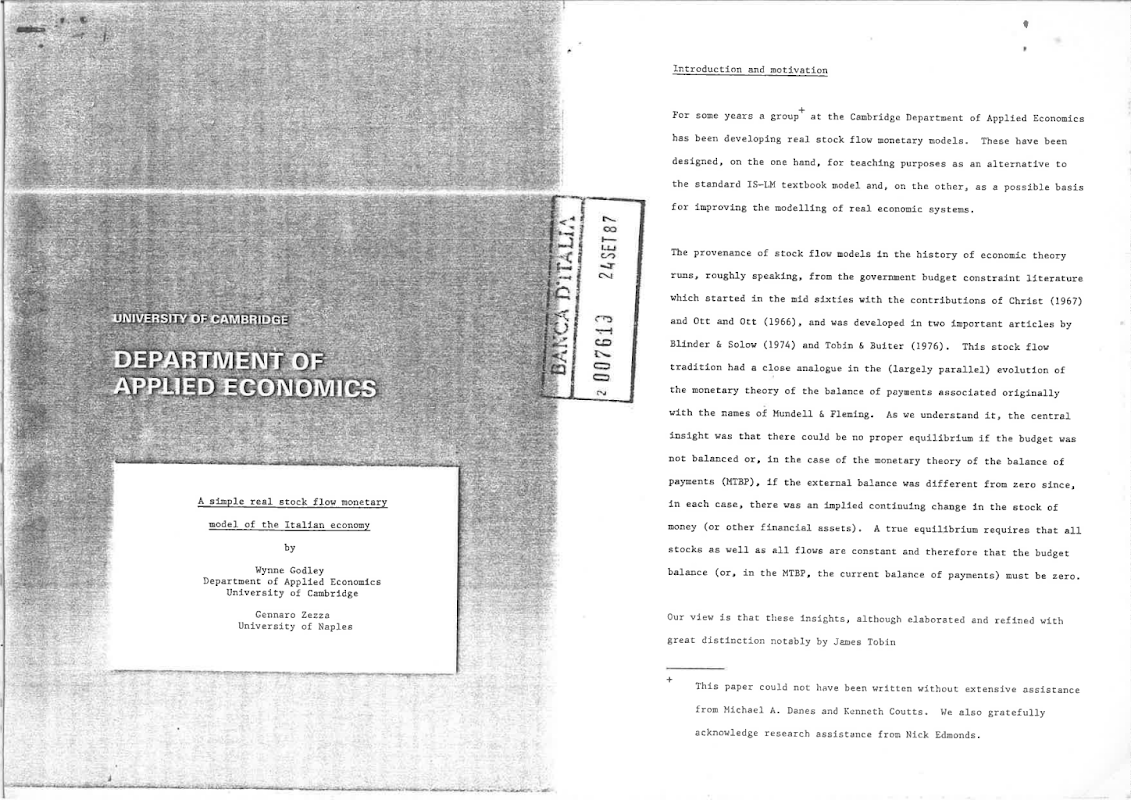
Adam Tooze’s book Crashed seems popular. The book and two reviews have some good appreciation of Wynne Godley’s work used in the book to explain why the crisis happened. The two reviews, both published in New Left Review:

  1. In The Crisis Cockpit, by Cédric Durand,
  2. Situationism À L’envers? by Perry Anderson.

In the acknowledgments section of his book Adam Tooze writes:

Wynne Godley was a mentor and teacher of a very different kind. Spontaneously warm and generous in spirit, he took me under his cape in my first year at King’s and introduced me, and a group of my contemporaries, to what was, at the time, a highly idiosyncratic brand of economics. In so doing he provided a model of intellectual warmth and vitality. He also confirmed doubts that had been gestating in me about the IS-LM model that was my first great love in economics. Wynne introduced me to the importance of looking “beyond the flows” and insisting on stock-flow consistency in macro models. I don’t think this book, written almost thirty years later would have been the same without his early influence.

Cédric Durand says:

What, then, are the conceptual underpinnings of Tooze’s work? In Crashed, none are made explicit. Nevertheless, in his emphasis on balancesheet vulnerabilities he implicitly follows the lead of post-Keynesian research, one of the more creative currents in contemporary economics, deriving from a synthesis of Keynes with a specific form of Marxian macroeconomics pioneered in the 1940s by Michał Kalecki. Tooze appears to draw in part upon the post-Keynesian ‘stock-flow consistency’ model, an approach that seeks to combine the ‘real’ and financial spheres of the economy. The term ‘stockflow’ implies attentiveness to the build-up of vulnerabilities in the ‘stock’ of financial assets and liabilities, beyond the financial ‘flows’ themselves: for example, when a sector’s prolonged deficit results in an unsustainable stock of debt. This approach has become increasingly popular since the crash, and was incorporated in the Bank of England’s policy-making toolkit in 2016. Initially developed by Nicholas Kaldor in the 1940s, the methodology was transformed in the 1960s and 70s by the work of James Tobin and Wynne Godley, Tooze’s teacher at Cambridge. Godley is credited by Tooze here with introducing him to ‘the importance of looking “beyond the flows” and insisting on stock-flow consistency’.

At the heart of this approach is the idea that macroeconomic dynamics hinge on a three-way interaction between the financial balances of public, private and foreign sectors. This ‘three balances’ perspective arguably supplies the unstated backbone of Tooze’s general argument. His achievement is to dress the dryness of this technical skeleton with the dense and complex sensitivity of historical flesh. If this framework were to be made explicit, it would suggest that the adventures of the private-sector balance drove a spectacular upward distribution of wealth that ultimately backfired in the political arena as resurgent nationalism and xenophobia. Public-sector balances were the scene of dramatic deliberations about crisis-containment strategy, with central bankers standing far above the other actors in the hierarchy of policy-making. Finally, the international balance-sheet perspective sheds light on a multipolar world where monetary policy, currency reserves and financial sanctions can be as effective as military force in deciding geopolitical outcomes and national fates.

Tooze’s mentor Wynne Godley observed in 1992 that the establishment of a single currency on the Maastricht model ‘would bring to an end the sovereignty of its component nations’, leaving them with the economic autonomy of ‘a local authority or colony’, while no central government could emerge with sufficient fiscal muscle to take decisive economic action. As a result, in the case of a major macroeconomic shock, the populations of countries deprived of the power to devalue, and not benefiting from a system of fiscal equalization, will see ‘emigration as the only alternative to poverty’. This sounds like an impressive, prescient account of the role of macro-institutional systems—and not just bad policy-making, as Tooze would have it—in the fates the Greek, Portuguese and Spanish people have had to suffer. Political, geopolitical and economic dimensions are structurally intertwined via institutions in the process of crisis making and management. While Tooze perfectly demonstrates the latter, in particular in his magnificent account of the balance-sheet intricacy at the heart of the 2008 crisis, he doesn’t account for the former.

Perry Anderson:

Durand observes, its narrative is no simple—or rather in this case, of course, highly complex and intricate—empirical tracking of the crisis and its outcomes. It possesses definite ‘conceptual underpinnings’, suggested by Tooze himself in acknowledging his debt to Wynne Godley’s use of ‘stock-flow consistency’ modelling of the financial interactions between public, private and foreign sectors. This in Durand’s view supplies ‘the unstated backbone’ of Tooze’s general argument.

Both judgements appear sound. But in Durand’s exposition a paradox attaches to each of them, since by the end of his review, somewhat different notes are struck. For Godley, one of the key advantages of the stock-flow consistency approach was that it integrated the financial with the real economy, as alternative models did not. Durand, however, remarks that Crashed ‘does not discuss the concrete intertwining of the financial and productive sectors in the global economy at all’, and so ‘fails to set the financial crisis in the context of the structural crisis tendencies within contemporary capitalist economies.’ This observation in turn generates another, which might seem to put in question Durand’s overall tribute to the book. For there he writes of ‘Tooze’s unwillingness to investigate the relations between the political and the economic’, a reluctance that ‘ultimately undermines his account of the crisis decade.’ Logically, the question then arises: do these two apparent contradictions lie in Tooze’s work, or in Durand’s review of it? Or can both be coherent in their own terms?

So Adam Tooze is appreciated in using the correct mathematical formulation but not paying much attention to political economy. Of course Wynne Godley’s work is based with a background in Kaldorian/Post-Keynesian economics, so the critique doesn’t apply to him. Tooze has a preface to his response to Anderson which will appear soon.


Fine Heterodox Critiques Of The 2019 Economic Nobel Prize

The economics Nobel Prize was announced on Monday.

There has been a good Twitter debate on the 2019 Nobel prize in economics, led by women in heterodox economics.

In my opinion, the award delegitimises the political economic causes of poverty. I like this tweet by Sara Stevano:

Experiments to alleviate poverty = correct the biases of the poor through narrow interventions and RCTs with huge issues in terms of ethics and research rigour. Seems completely odd at a time when many economists have come to realise we need to rethink the Global economic order!

Then a Twitter thread today by Ingrid Kvangraven linking to her article. She points out:

This movement towards “thinking small” is a part of a broader trend, which has squeezed out questions related to global economic institutions, trade, agricultural, industrial and fiscal policy, and the role of political dynamics, in favor of the best ways to make smaller technical interventions.

Plus another thread by Ingrid from Monday, after the Nobel Prize annoucement which really got everyone’s attention.

A prize to be expected. Banerjee, Duflo & Kremer rely on key tenets of mainstream Econ. While founded on behavioral econ and assumption that tweaks to individual actions can alleviate global poverty, their work is often wrongly presented as purely empirical, objective & radical.

Then an article by Farwa Sial and Carolina Alves (also linked in the thread) which points out:

Poverty alleviation, however, is a hugely complex subject that touches on the strengthening of institutions, the health of governance, the structure and dynamics of markets, the workings of social classes, macroeconomic policies, distribution, international integration and many other issues, none of which can be replicated from one context to another. That means that analyses of poverty have to be based on a critical examination of processes and actors that cannot be ‘controlled’ against—thus violating the principle of RCTs.

Recent developments in economics have failed to account for these fundamental determinants of poverty. Instead, the success of RCTs can be narrowed down to essentially statistical arguments that seek to identify ‘what works’ and ‘which interventions’ should therefore be employed to improve the lives of the poor.

Link

Anthony Thirlwall — Thoughts On Balance-Of-Payments-Constrained Growth After 40 Years

ROKE (Review Of Keynesian Economics) has a special issue, Thirlwall’s Law At 40, celebrating Thirlwall’s law which Anthony Thirlwall discovered in 1979.

Thirlwall himself has an article in the issue.

Interesting, from the conclusion:

Structural change almost certainly requires a country to design an industrial policy embracing a national innovation system to facilitate the flow of technological knowledge across all sectors of the economy. The market mechanism itself is unlikely to bring about the required structural changes needed. I am attracted to the concepts of growth diagnostics (Hausmann et al. 2008) and self-discovery (Hausmann and Rodrik 2003). Growth diagnostics involves locating the binding constraints on a country’s economic performance and to target these directly, giving the most favourable outcome from the resources available compared to the ‘spray gun’ approach to economic policy-making which may not hit hard enough the binding constraints on growth that really matter. In the case of the BoP, it would involve targeting exports with growth potential, and identifying imports where there is import substitution potential. Government expenditure on R&D to enhance export quality could reap high returns. Self-discovery involves seeking out new areas of comparative advantage and then implementing the most appropriate policies to foster them. Hausmann and Rodrik point out that there is much randomness in the process of a country discovering what it is best at producing, and a lack of protection reduces the incentive to invest in discovering what goods and services they are. Governments need to encourage entrepreneurship and invest in new activities, but the first best policy is not by the traditional means of tariffs and quotas, but public sector credit and guarantees which reward the innovator (and not the copy-cats), and can be withdrawn if firms do not perform well after a certain period of time.

Anthony Thirlwall, via Wikipedia

The Cambridge Political Economy Society Digital Archive

I came across the Cambridge Political Economy Society digital archive today. It has scans of papers which aren’t available elsewhere.

There’s an interesting article, Causes Of Growth And Recession In World Trade, there, by Francis Cripps, in which he describes the Cambridge Keynesian idea of achieving balanced trade, because nations face a balance-of-payments constraint:

The main conclusion of the analysis presented below is that demand creation by means of fiscal and monetary action at the national level is very unlikely to be able to procure a recovery from world recession, because it does not offer a solution to the structural problem of imbalances in trade. On the other hand, demand creation at the international level, designed to boost countries’ import capacity in a manner analogous to a national budgetary stimulus of domestic spending, could in principle ensure a steady world reflation. But the political obstacles to an international programme of income creation are immense, partly because this would implicitly or explicitly involve massive transfers of income from surplus countries to deficit countries.

The alternative to a programme of income creation and redistribution would be an effective mechanism for the adjustment of trade shares, making it possible for individual countries to balance their payments at a high level of domestic activity. Exchange rate changes have hitherto been accorded this role, but experience during the past decade of large exchange rate adjustments has shown that they are quite inadequate for this purpose. The exchange rate mechanism therefore needs to be reinforced, or replaced, by some other system of trade discrimination. Import restrictions, already widely used by developing countries to regulate their trade balances, are at present more or less prohibited for Western industrial countries. Many of these could achieve a recovery of their own economies if they were allowed to introduce import controls. But such action on the part of industrialised countries would not help developing countries. Indeed to sustain growth of output and employment in every country, trade controls would have to be operated on a multilateral basis with positive discrimination in favour of the weakest. Given the desperate plight of some very poor countries, the case for positive discrimination in their favour is now becoming urgent.

The analysis developed below treats world trade as a demand-determined system in which the level of demand is governed by balance-of-payments constraints facing individual countries and the way these interact. …

RWER Issue On Neochartalism

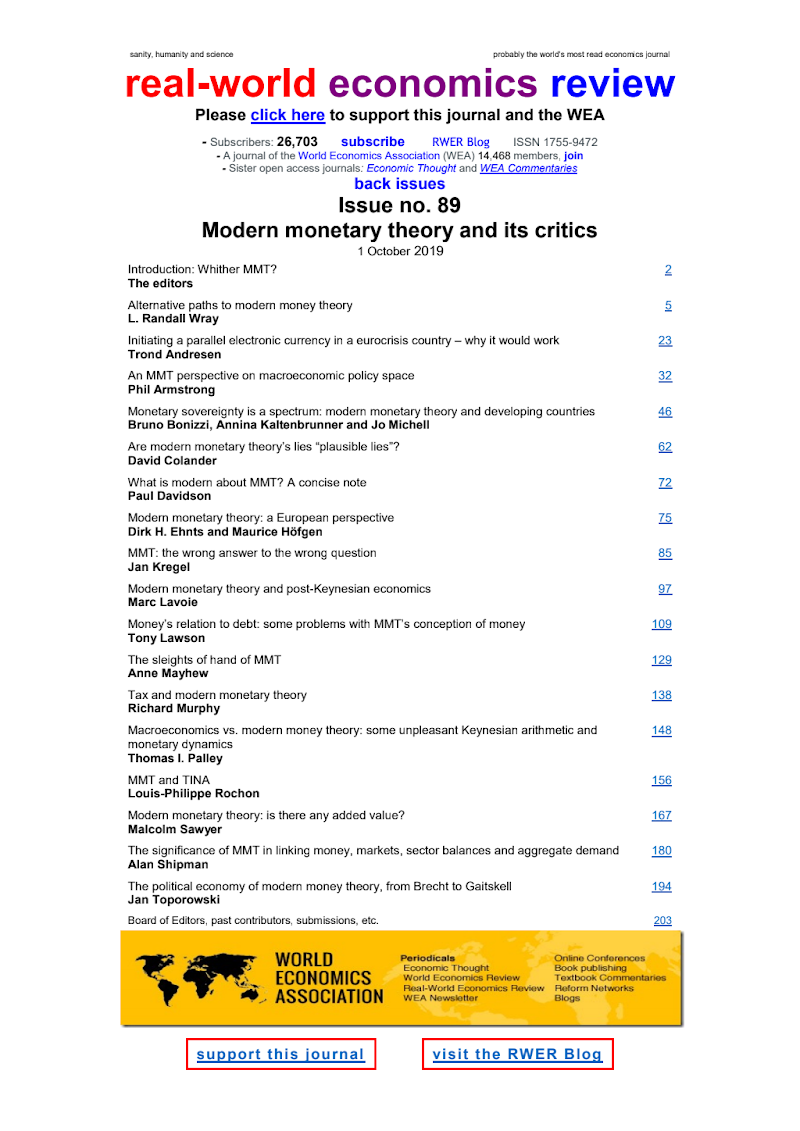
The latest issue of Real World Economic Review is titled Modern Monetary Theory And Its Critics with 204 pages of papers is your weekend reading.


Marc Lavoie talks of how the neochartalists have made it look like all Post-Keynesian monetary theory has been discovered by neochartalists themselves. Lack of credit, basically. Jo Michell challenges them on open economy issues. Thomas Palley points out how their arithmetic doesn’t add up.

Long read. Just my initial impressions.

I have a few comments on Jo Michell’s article with his two co-authors. Jo points out that monetary sovereignty is a spectrum. Some neochartalists such as Fadel Kaboub and Nathan Tankus also say the same without these are contradictory to neochartalists’ claims. The idea of external constraints is an important part of Post-Keynesian work and these authors look like they are erasing the work of Kaldor, Godley, Cripps and Thirlwall and making it look like it’s all part of “M.M.T”.

Link

Marc Lavoie — Advances In The Post-Keynesian Analysis Of Money And Finance

There’s a new article by Marc Lavoie in a newly released book which is an interesting read. Abstract:

This chapter focuses on the various monetary themes that have been emphasized by post-Keynesian economists and that turned out to have been validated by the events that occurred during and after the subprime financial crisis. These include interest rate targeting by the central bank, interest rate spreads, endogenous money, the reversed causality between reserves and money, the defensive role of central banks, the links between the central bank and the government, banks as very special financial institutions, the different role of the shadow banking system, and whether there are limits to the amounts of credit that banks can create. The chapter analyzes unconventional monetary policies, including quantitative easing (QE), QE for the people and 100% reserves. It also discusses the consequences, for the theory of endogenous central bank money, of the adoption of a system where the target interest rate is the interest rate on reserves.

UNCTAD Trade And Development Report 2019

UNCTAD has released its Trade And Development Report 2019. Always, one of the most important voices promoting a concerted action.

Most interesting excerpt, from

Chapter III, A Road Map For Global Growth And Sustainable Development,

Section C, Main considerations in the design of a strategic framework,

Item 7, International coordination for growth, industrialization and crisis response

(pages 54-56 in print/81-83 in the pdf):

Reflationary strategies cannot work as intended without explicit international coordination. Whereas uncoordinated policies ignore global aggregation effects and run into multiple constraints (such as unsustainable external deficits and pressing trade-offs between emission reduction and development priorities) coordination can expand policy space and align the incentives faced by different countries.

By contrast, straightforward export-led growth promises lower-hanging fruits. Cutting unit labour costs is the main instrument, which all countries today are encouraged to use. This may pay off in the medium term, but at the cost of longer-term problems. Cutting unit labour costs means undermining real wage growth and, eventually, aggregate demand. Even if a country initially succeeds in expanding exports and export-oriented employment, wage stagnation means that domestic demand will lag behind, making growth dependent on continuous expansion of foreign markets. Furthermore, this strategy provokes competitive responses from other countries in a global race to the bottom. As labour costs are cut globally, finding expanding markets to sustain growth becomes increasingly hard. Countries may or may not succeed in increasing export shares, but they surely incur steep costs in the form of redistribution from wages to profits, slower growth, higher instability and diminished prospects for industrialization.

Medium-term gains are not an automatic prospect either, as competitive export-led growth is not a fair game in the neo-liberal era. Short-term gains from exploiting static comparative advantages are within reach only for countries whose productive systems do not need the inputs that the current international legal framework for trade and investment restricts, such as technology transfer and public investment in infrastructure. In addition, volatile cross-border capital movements can lead to undesired exchange rate movements that work against medium-term goals of export promotion. In the current framework of international rules, it is rare for deficit countries to switch to surpluses without going through recession. As a result, current account imbalances tend to last and accumulate into unsustainable external debts, posing a recurring global challenge. This makes international policy coordination inevitable, but in the perverse form of bailout programmes with strict policy conditions. In such a context, it makes sense for all countries, but especially for developing countries, to invest politically in establishing forms of coordination that preserve their policy sovereignty while supporting global aggregate demand and financial stability (Helleiner, 2014, 2019).

Therefore, international coordination has at least three constructive functions. First, it helps to counteract the pressure that international capital mobility puts on domestic policies. Agreed standards for capital controls, if widely adopted, are instrumental in reducing capital flight in the face of economic and financial tensions, as well as the related pressures on exchange rates. Coordination mechanisms can also provide buffers to withstand pressure on exchange rates when the latter does occur. Second, and more fundamentally, international coordination can shield against protracted current account imbalances while preserving global demand, such as through mechanisms requiring that all countries expand domestic spending, while surplus countries increase their spending faster (Keynes, 1929; UNCTAD, 2014). In clearing unions, mechanisms to “recycle” external surpluses can be implemented through rules that stabilize thresholds, notional currencies to measure the imbalances, and lending mechanisms to clear them. Clearing unions are particularly useful for developing countries, as they offer an effective solution to the problem of financing likely external deficits. Third, as noted in chapter V, coordination on tax policies can be hugely effective in increasing fiscal revenues for all countries.

National growth strategies have a greater chance of success if they are globally consistent. Crisis response is also more effective and efficient when it is coordinated. On the one hand, crises (economic, financial, environmental) often hit different countries at different times, making it more efficient, overall, for the countries that have been spared to take on some of the burden of crisis response. For example, foreign exchange reserves are a “leakage” from global demand but they are also a critical buffer during a currency or balance-of-payments crisis. If a credible commitment to mutual foreign exchange assistance can be made, for example through formal currency swap agreements or through institutions that pool and lend reserves, currency crises can be contained with less accumulation of reserves and a smaller burden for developing countries (chapter V) and for the global economy. This was the idea that inspired the Bretton Woods system. Likewise, developed countries can support the expansion of policy space in developing countries to support their ability to invest in climate stabilization.

As a supporting mechanism for a long-term growth strategy and as a crisis-response instrument, international coordination is more efficient the larger the number of countries that participate. But in some cases, smaller coordination arrangements are also beneficial – as shown, for example, by the many regional funds, regional payment systems and exchange-rate agreements established to contain the risks of exchange-rate fluctuations (chapter IV).

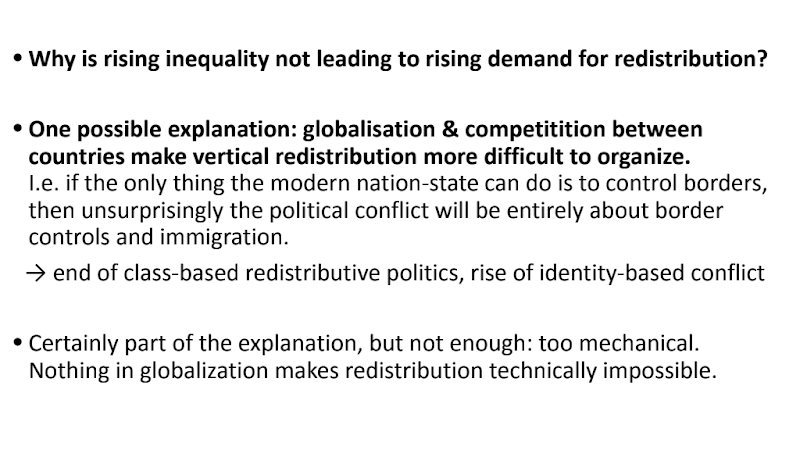
Thomas Piketty On Globalisation And Borders

Thomas Piketty has an interesting observation on globalisation and migration/borders.

From slide 11 from a lecture from July (and in earlier talks too):

Globalisation—under the current rules of the game—puts a constraint on the expansion of economies. So Piketty thinks that this can explain the debate around migration since the last few years. Although he doesn’t say that, I’d imagine that he is saying that the distribution of income favouring lower classes is difficult because of the race to the bottom caused by globalisation.

Roy Harrod by Esteban Pérez Caldentey

If you’ve worked with Post-Keynesian models of the open economy, you’ll see the expression X/μ often. This, or the “foreign trade multiplier” was first discovered by Roy Harrod in the early ’30s.

Esteban Pérez Caldentey has a new biography of Roy Harrod.

Description:

This landmark book describes and analyzes the original contributions Sir Roy Harrod made to fields including microeconomics, macroeconomics, international trade and finance, growth theory, trade cycle analysis and economic methodology. Harrod’s prolific writings reflect an astounding and unique intellectual capacity, and a wide range of interests. He became Keynes’ biographer and wrote a volume on inductive logic. At the policy level, Harrod played a central role in the formulation of the Keynes´ Clearing Union plan for international monetary reform. He also actively participated in British politics and government and gained recognition as an expert in the field of international economics. Yet, until now, Harrod has remained an underrated economist, commonly misunderstood and misrepresented. This is the first major intellectual biography of Harrod to be published.

I found an interesting bit from the book. From page 259:

He [Harrod] also introduced the asymmetry of adjustment between creditor and debtor which was pivotal to Keynes’s Clearing Union proposal.

The asymmetry of adjustment is in my view one of the most important concepts to understand in economics. From The Collected Writings Of John Maynard Keynes, Volume XXV: Shaping The Post-War World: The Clearing Union, Chapter 1, The Origins Of The Clearing Union, 1940-1942, pages 27-30:

III. The Analysis of the Problem

I believe that the main cause of failure (except in special, transient conditions) of the freely convertible international metallic standard (first silver and then gold) can be traced to a single characteristic. I ask close attention to this, because I should argue that this provides the clue to the nature of any alternative which is to be successful.

It is characteristic of a freely convertible international standard that it throws the main burden of adjustment on the country which is in the debtor position on the international balance of payments,—that is on the country which is (in this context) by hypothesis the weaker and above all the smaller in comparison with the other side of the scales which (for this purpose) is the rest of the world.

Take the classical theory that the unlimited free flow of gold automatically brings about adjustments of price-levels and activity between the debtor country and the recipient creditor, which will eventually reverse the pressure. It is usual to-day to object to this theory that it is too dependent on a crude and now abandoned quantity theory of money and that it ignores the lack of elasticity in the social structure of wages and prices. But even to the extent that it holds good in spite of these grave objections, if a country is in economic importance even a fifth of the world as a whole, a given loss of gold will presumably exercise four times as much pressure at home as abroad, with a still greater disparity if it is only a tenth or a twentieth of the world, so that the contribution in terms of the resulting social strains which the debtor country has to make to the restoration of equilibrium by changing its prices and wages is altogether out of proportion to the contribution asked of its creditors. Nor is this all. To begin with, the social strain of an adjustment downwards is much greater than that of an adjustment upwards. And besides this, the process of adjustment is compulsory for the debtor and voluntary for the creditor. If the creditor does not choose to make, or allow, his share of the adjustment, he suffers no inconvenience. For whilst a country’s reserve cannot fall below zero, there is no ceiling which sets an upper limit. The same is true if international loans are to be the means of adjustment. The debtor must borrow; the creditor is under no such compulsion.

… Thus it has been an inherent characteristic of the automatic international metallic currency (apart from special circumstances) to force adjustments in the direction most disruptive of social order, and to throw the burden on the countries least able to support it, making the poor poorer.

I conclude, therefore, that the architects of a successful international system must be guided by these lessons. The object of the new system must be to require the chief initiative from the creditor countries, whilst maintaining enough discipline in the debtor countries to prevent them from exploiting the new ease allowed them in living profligately beyond their means.

The book also says that Roy Harrod was a life long believer of free trade. It’s a bit shocking!