Author Archives: V. Ramanan

Comments On Post On Hungary

I received two comments in my previous posts on Hungary. I have a 0-comments policy (as opposed to no-comments policy) because maintaining comments is additional responsibility 🙂 and am posting them here. I received few more comments on other posts so apologies for being partial to some comments in over others.

Sergei said:

It is a very one-side story. I am not even sure it connects any dots. The problem in Hungary is CHF mortgages and with the CHF action it is easy to imagine how many of those are seriously underwater. Even worth, some months ago the government legislated a law which allowed a certain type of mortgage borrowers to prepay their CHF mortgages at, I think, 180 CHFHUF while the current rate is almost north of 250. And these transactions have to be executed by Christmas.

CHF mortgages were typically structured as foreign currency clause, i.e. they are denominated in CHF but all payments are made in HUF at spot. While the mortgage market was booming, Hungarian central bank accumulated huge fx reserves coming from CHF which it was buying from banks which financed from their western parents their local CHF mortgage portfolios. Now, as these flows reverse and as government puts deliberate pressure to reverse them, and as central bank in all its stupidly refuses to sell back its fx-reserves, HUF obviously depreciates.

So the current account story might be a correct introduction but the real reason of depreciation, I believe, is much deeper.

BFG said:

Nice blog Ramanan,

The forint was pegged to the euro until Feb 2008, notice the large turn around in the current account when they abandoned the peg, with the hugh depreciation in their currency. They also have a big mortgage problem in which two-thirds of Hungarian mortgages are denominated in Swiss francs. They receive their income in forints and sell it to pay their mortgages in francs reinforcing the upward spiral against the Swiss franc. Even, if they accept the euro which is very unlikely they will still have the franc problem.

Thanks for the comments.

My post was based on just half an hour of research, but anyhow the point I am making is that Hungary’s balance of payments position makes it very difficult for fiscal policy to do the rescue. (Plus unnecessary pressure from Olli Rehn makes it even harder!)

It doesn’t matter if HUF was pegged to the Euro, going forward. Also, the size of the public debt and the net foreign asset positions makes it clear that the Hungarian private sector is heavily in debt and in fact has a net financial liability position. The fact that the mortgages are indexed (or directly denominated in CHF) makes it even worse as far as debt burden of Hungarian households is concerned. Maybe, this calls for a separate post on this.

However, one should be careful if the interest payments are to be included in the balance of payments or not. If the lender is a domestic bank, it is not included. Given the record of the current account deficit of Hungary over so many years, it is difficult to believe that there will be a huge reversal while keeping domestic demand high.

To clarify, my post was on how the balance of payments situation in Hungary is and what implications it has on fiscal policy going forward, and not on factors that led to the implosion of  demand. The fact that mortgages are in CHF (or indexed) makes it even worse!
Hungary?

WSJ’s Marketbeat reports of troubles Hungary may be headed into. The blog post reports:

Hungary this morning had its own T-bill auction, just like Italy. It did not go so well!

Hungary’s auction had a bid-to-cover ratio of just 1.0, and it had to pay a 6.79% yield to move the debt.

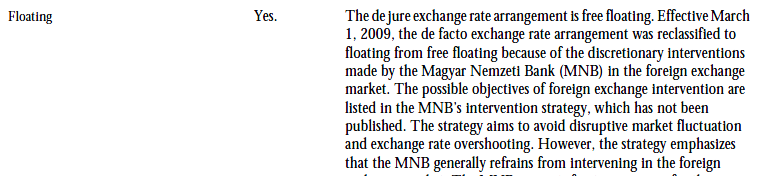
I decided to do some basic analysis of what is going on. The Annual Report On Exchange Arrangements And Exchange Restrictions 2010 reports that

and also that:

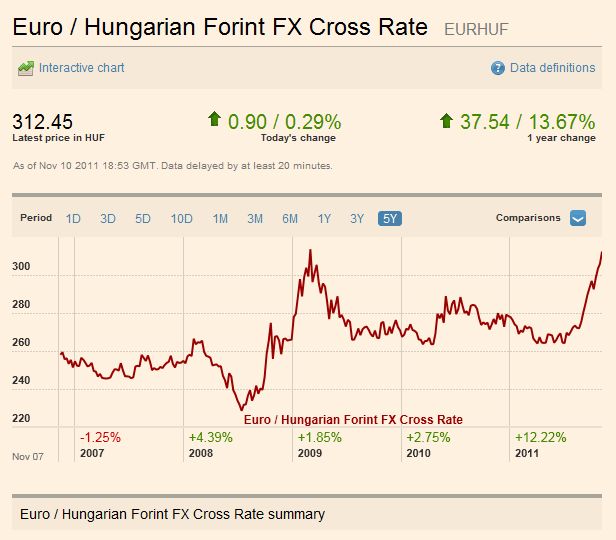
FT provides the chart of EURHUF:

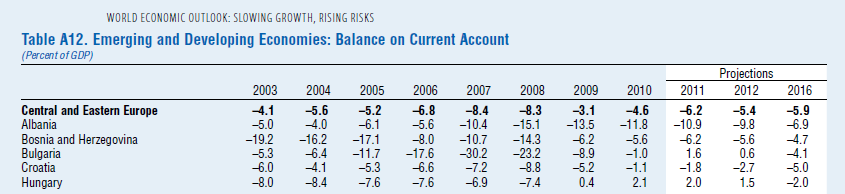
The depreciation got me even more curious. More screenshots from data sources below. The first one is Hungary’s current account balance as a percentage of GDP, courtesy IMF’s World Economic Outlook, Sep 2011.

(Click to enlarge)

So Hungary has been running a huge current account deficits since many years. A current account deficit means that a nation’s expenditure is higher than income and the difference has to be financed by net borrowing from abroad. During boom times, this may not be problematic but the accumulated debt has to be rolled by attracting foreigners by hook or crook. The route most chosen to prevent getting things out of control is be deflating demand. Only in a Mundell-Fleming fantasy world does the nation’s currency depreciate to bring the current balance of payments to zero and an equilibrium with respect to the external world.

Hungary is a small nation with GDP equivalent of €97b (in 2010, using an approximate average 2010 exchange rate of HUFEUR=0.0036. Note to self: This needs more correction). Due to deficits in the international current balance of payments, the nation has accumulated a debt equivalent of €113.59b (the negative of NIIP) according to the the release Hungary’s balance of payments: 2011 Q2 from Magyar Nemzeti Bank – Hungary’s central bank. With net foreign asset position worse than -100% of GDP, this puts Hungary’s economy in a terrible position. Recent data suggests an improvement in external trade but the international currency markets are not impressed.

According to this Wikipedia Map, Hungary is obliged to join the Eurozone, and has no opt-out option like UK. However, it has not satisfied the Maastricht criteria, and hence the Eurozone won’t let it in yet. Better not! As long as Hungary has its own currency, its government can make a draft at the central bank to finance a portion of its deficit and gives it a tool to protect itself in the short term. So Hungary is protected from being Greece as long as it is not in the Eurozone. But in the long run, Hungary’s growth will be constrained by its balance of payments.

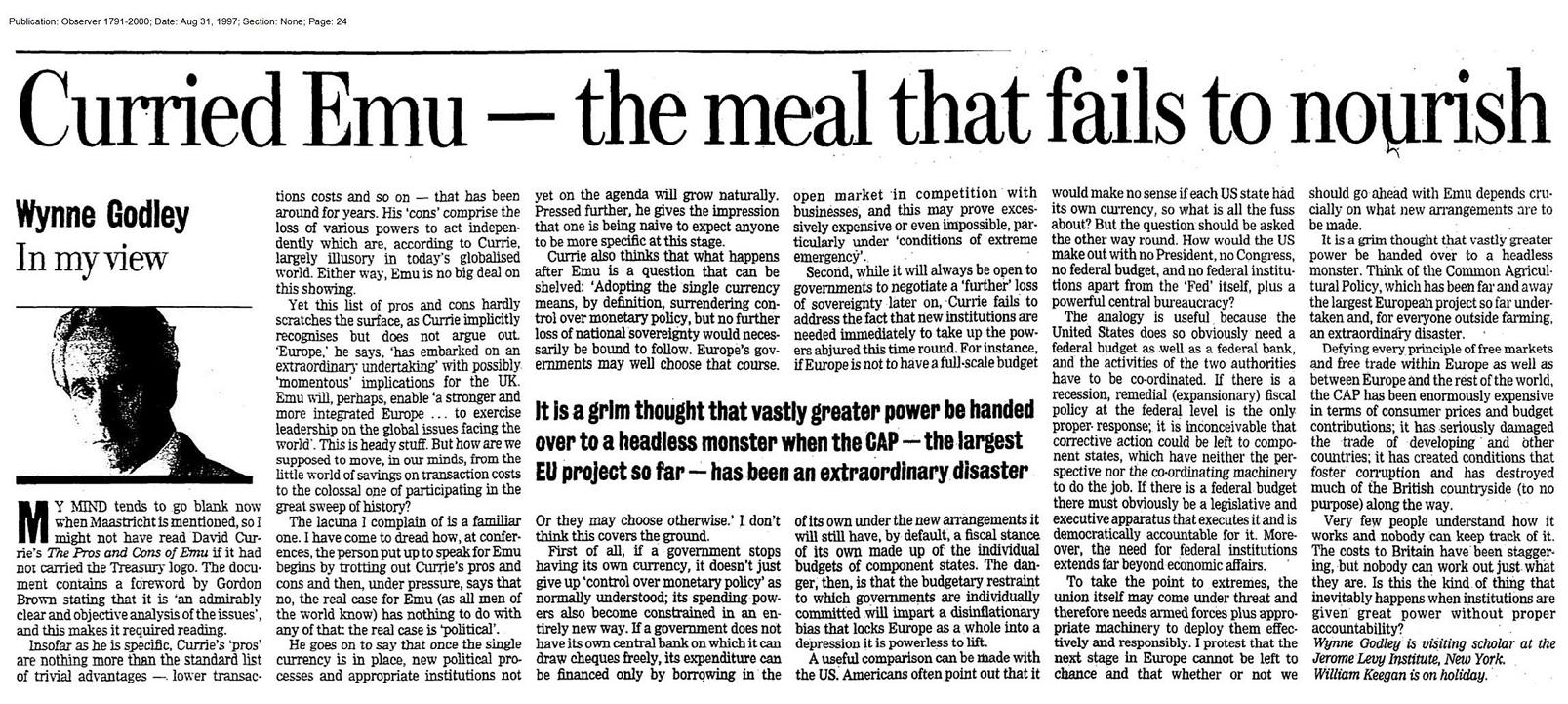
Curried EMU: Wynne Godley From 1997

(Click the newspaper clip to enlarge)

… Currie also thinks what happens after Emu is a question that can be shelved: ‘Adopting the single currency means, by definition, surrendering control over monetary policy, but no further loss of national sovereignty would necessarily be bound to follow. Europe’s governments may well choose that course. Or they may choose otherwise.’ I don’t think this covers the ground.

First of all, if a government stops having its own currency, it doesn’t give up just ‘control over monetary policy’ as normally understood; its spending powers also become constrained in an entirely new way. If a government does not have its own central bank on which it can draw checks freely, its expenditure can be financed only by borrowing in the open market in competition with business firms, and this may prove excessively expensive or even impossible, particularly under ‘conditions of extreme emergency’.

Martin Wolf At His Best!

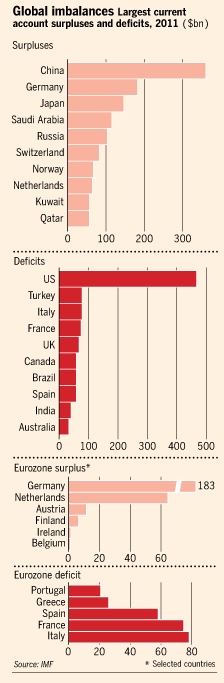
The latest article from Martin Wolf, titled Creditors can huff but they need debtors is probably his best. Martin Wolf correctly identifies the problems with world imbalances:

Blessed are the creditors, for they shall inherit the earth. This is not in the Sermon on the Mount. Yet creditors believe it: if everybody were a creditor, we would have no unpaid debts and financial crises. That, creditors believe, is the way to behave. They are mistaken. Since the world cannot trade with Mars, creditors are joined at the hip to the debtors. The former must accumulate claims on the latter. This puts them in a trap of their own making.

Also, as usual, he has the best charts. You can read the rest here.

Steve Keen Debunking Economics Again

Very nice interview of Steve Keen. I have some issues when he gets technical, but other than that, he is very good at debunking economics, so I like him.

click to watch the video on YouTube

“Tyler Durden” also covers the video at Zero Hedge and quotes a part of the video:

fundamentally neoclassical economists are the priests of Capitalism, but the priests don’t necessarily know there is god. They have this model of god and ditto with neoclassical economics: they have a model of capitalism which is almost but not quite, completely unlike actual capitalism. And they don’t even realize that they have erected a smokescreen behind which if people want to rip the system off, then there is plenty of avenues created by these guys.

Maastricht And All That

Wynne Godley wrote an article in the London Review of Books in 1992 commenting on how and why the idea of a European Monetary Union is doomed to fail. LRB today removed the “paywall” so that the article is accessible to everyone.

click to view the tweet on Twitter

FT Alphaville also wrote on this.

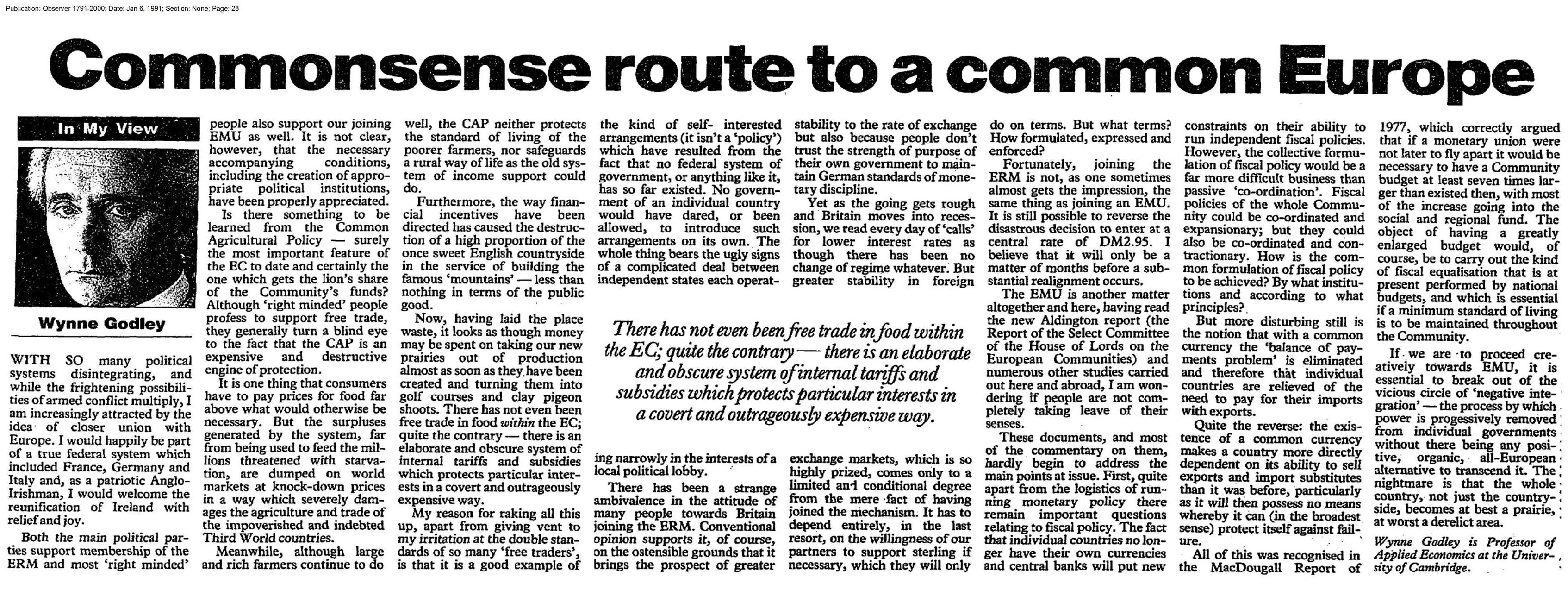
Commonsense Route To A Common Europe

If you read my posts or look at the “Tag Cloud” on the right, you will recognize what a big fan of Wynne Godley I am :-).

Above is an Observer article from 1991. Click the newspaper clip to enlarge.

Quoting from the end of the article:

If we are to proceed creatively towards EMU, it is essential to break out of the vicious circle of ‘negative integration’— the process by which power is progressively removed from individual governments without there being any positive, organic, all-European alternative to transcend it. The nightmare is that the whole country, not just the countryside becomes at best a prairie, at worst a derelict area.

Severe Imbalances Within EA17

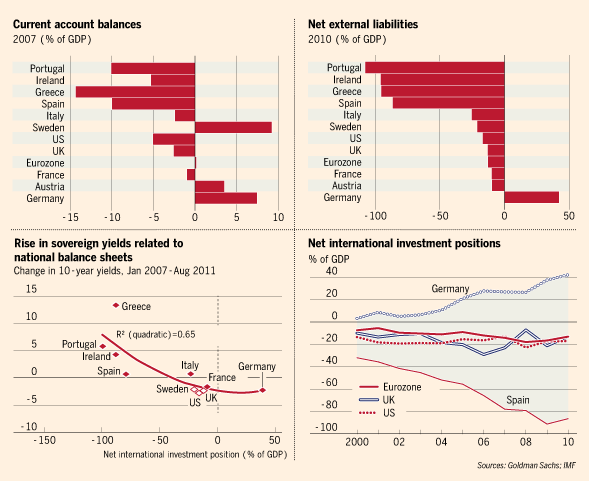
In a recent post Chart: Euro Zone Indebtedness, I graphed the Net International Investment Position (the negative of “external debt”) for EA17 nations to highlight the severity of internal imbalances within the Euro Area. I found a source of data for the current account balance as a percentage of GDP in the IMF’s latest World Economic Outlook and am posting a screenshot below of the table I am talking about.

(It’s a bit of hard work to get this otherwise). Click the image to enlarge. You can see that around 2007, the imbalances grew out of control but continued to grow in 2008.