Author Archives: V. Ramanan

Yesterday’s Auction Fail

I had some discussions with someone on yesterday’s post Today’s Auction Fail, which led me to find out how the German Finance Agency acting for the account of the German Government, through the Deutsche Bundesbank acted with confidence in rejecting a good proportion of bids in yesterday’s auction.

It seems, the German government holds a lot of financial assets, which could meet its financing needs for a good amount of time.

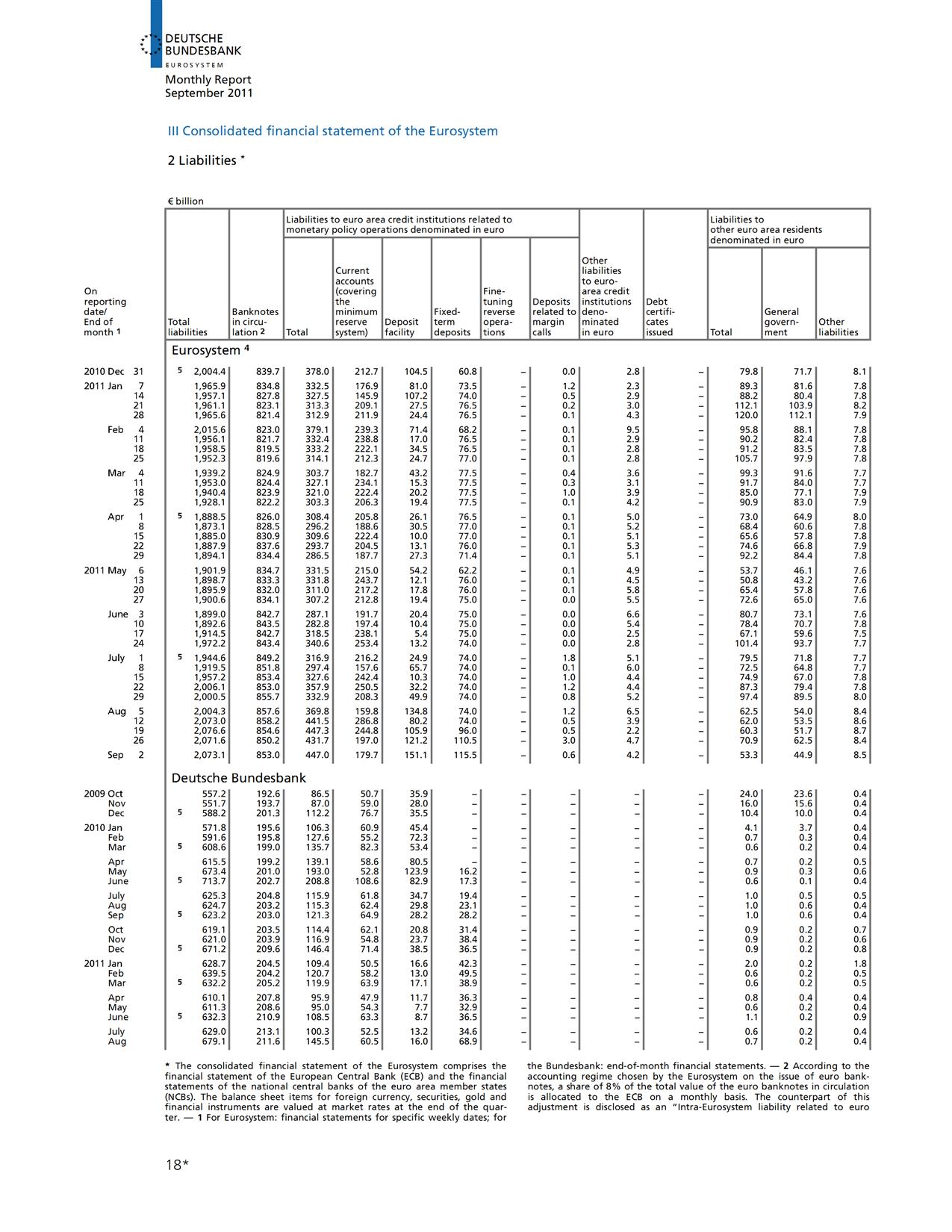
The Bundesbank Monthly Report, September 2011, Statistical Section, III, Consolidated financial statement of the Eurosystem, Liabilities shows that the German government has only €0.2 billion of deposits.

(click to enlarge)

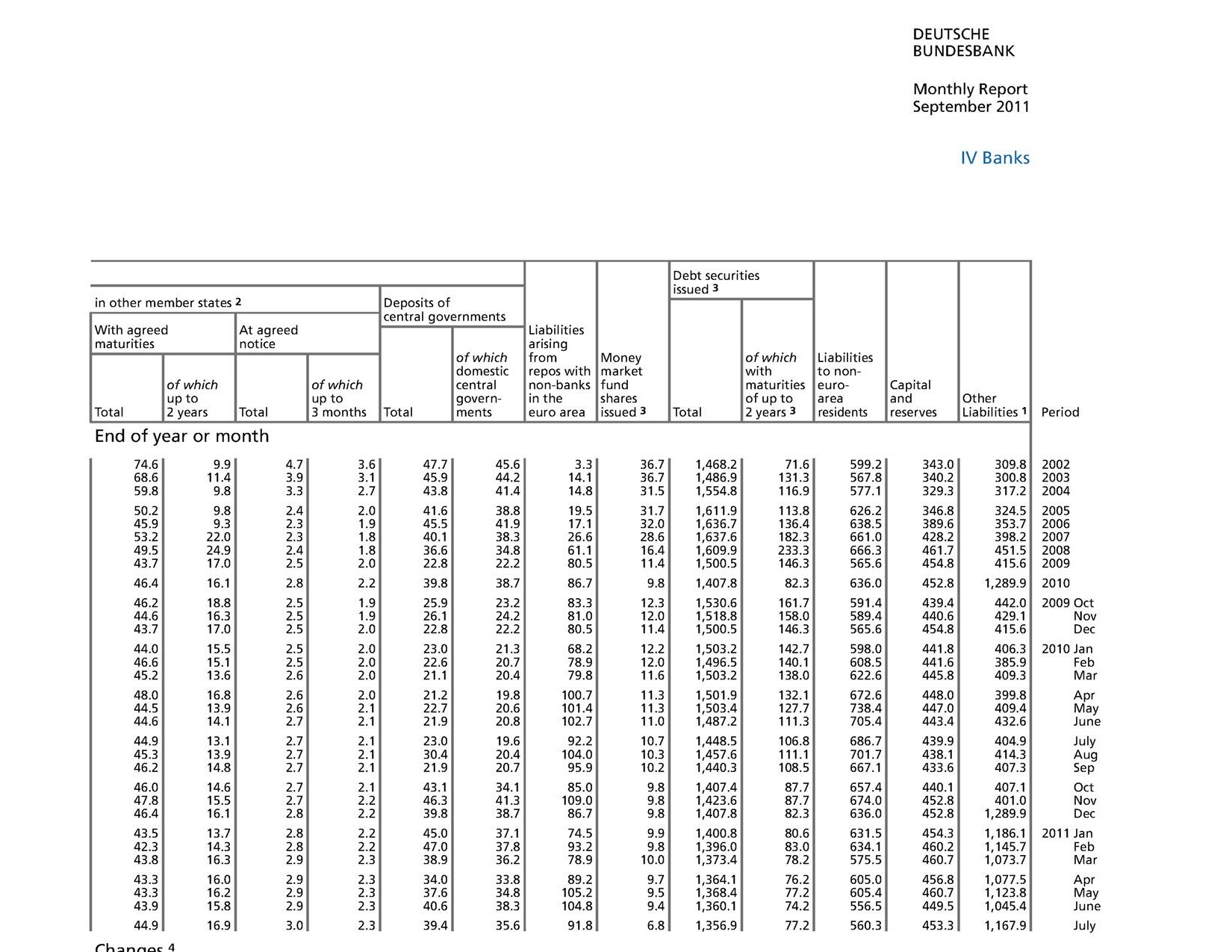
However, it has a large amount of deposits at MFIs – Monetary and Financial Institutions, or banks in short.  Page 116 of the same report shows that the German government deposits at banks was €35.6 billion:

(click to enlarge)

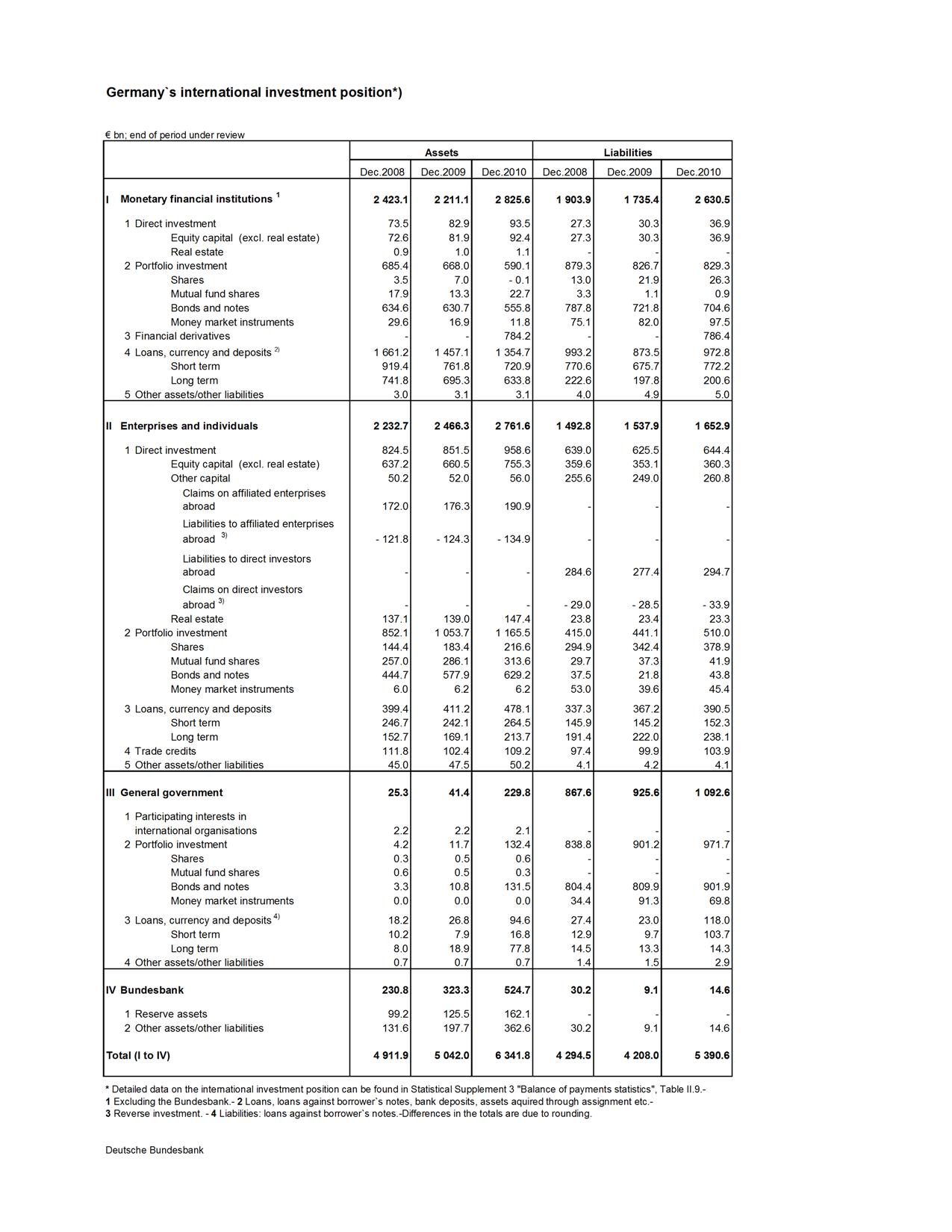
Germany’s International Investment Position shows a large amount of external assets held by the German government.

(click to enlarge)

According to Item III, the Government of Germany (which does not include the Bundesbank) held assets equivalent of €229.8 billion abroad at the end of 2010.

Some of the data is not the latest but to conclude, the German government has sufficient assets to not worry about auction failures and can reject bids easily.

Today’s Auction Fail

Big deal has been made out of today’s auction of 2022 bonds of the Federal Republic of Germany. How it affects the markets or will in the near future is not the point of discussion here. Rather, this post has to do with some misleading description given by Izabella Kaminska of FT Alphaville.

Izabella is writing as if the bonds which were not absorbed by the markets were purchased by the Deutche Bundesbank, which is not allowed by the Treaty governing the Euro Area.

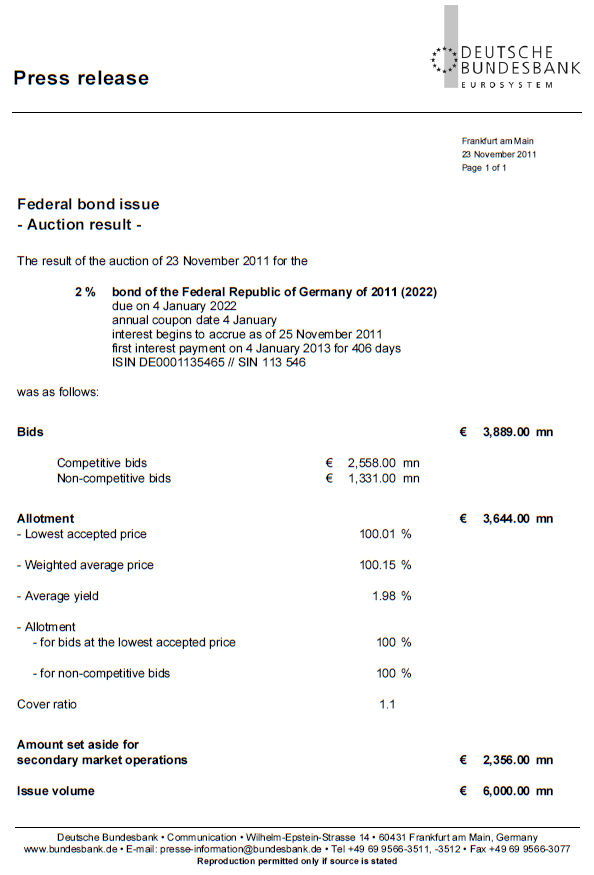
The Bundesbank website gives a description of the auction. Same as the capture below:

So of the €6,000 million of securities on auction, only €3,644 million was alloted. The remaining €2,356 million was “set aside for secondary market operations”

What is that supposed to mean? It simply means the German government is the owner of the €2,356 million of German bonds (i.e., it appears in its Assets as well as Liabilities!) and it will sell them in the secondary markets later at some point.

Some have interpreted it as the Bundesbank having bought €2,356 million of the securities(!), which is not allowed by law. As if nobody is watching!

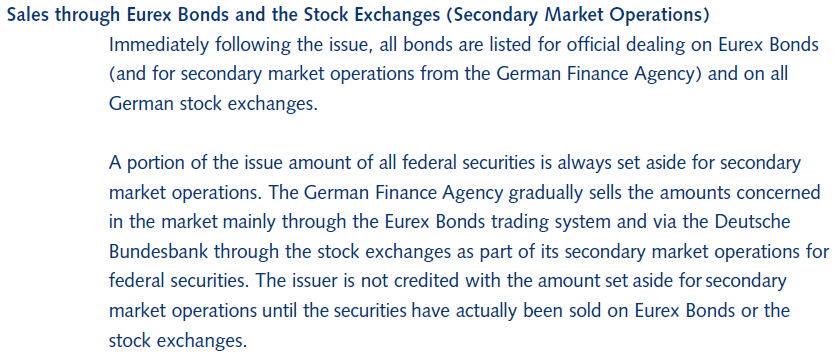
A document from Eurex, page 12 makes it clear.

So nothing unusual there. The issuer is not credited with the amount set aside for secondary market operations until the securities have actually been sold on Eurex Bonds or the stock exchanges.

Izabella writes:

The uncovered technicality comes from the fact that the Bundesbank habitually retains some of the paper from every major bond auction for the purpose of its ‘market operations’. But to understand why this is important one first has to explore how central banks actually set rates.

That is confusing “(open) market operations” of the Bundesbank with the “secondary market operations” of the German Treasury! (The Finance Agency of The Federal Republic of Germany – Bundesrepublik Deutschland – Finanzagentur GmbH)

No Treaty violation, at least till now 😉

Will The Incredible Lacuna Be Rectified?

In 1992, Wynne Godley wrote a terrific London Review of Books article Maastricht And All That pinpointing the exact defect in the Maastricht Treaty. He wrote about an “incredible lacuna”:

… The incredible lacuna in the Maastricht programme is that, while it contains a blueprint for the establishment and modus operandi of an independent central bank, there is no blueprint whatever of the analogue, in Community terms, of a central government …

The New York Times has Wolfgang Schäuble, the German federal minister of finance, for the Saturday Profile this weekend.

According to the article he will push for a treaty change:

MR. SCHÄUBLE said the German government would propose treaty changes at the summit of European leaders in Brussels on Dec. 9 that would move Europe closer to the centralized fiscal government that the currency zone has lacked. The ultimate goal, Mr. Schäuble says, is a political union with a European president directly elected by the people.

and also that

He sees the turmoil as not an obstacle but a necessity. “We can only achieve a political union if we have a crisis,” Mr. Schäuble said.

Schäuble had penned an Opinion piece on the Financial Times, a couple of months ago

where he wrote

Hence my unease when some politicians and economists call on the eurozone to take a sudden leap into fiscal union and joint liability. Not only would such a step fail to durably solve the crisis by addressing only its most superficial symptoms, but it could make it worse in the medium term by removing a key incentive for the weaker members to forge ahead with much-needed reforms. It would also go against the very nature of European integration.

Wolfgang Schäuble, failed to see the crisis coming, but he has a point – it is the other side of the debate to the recent calls to the European Central Bank to act as a lender of the last resort to national euro area governments. Mervyn King made a similar point recently. Schäuble, however wants to manufacture a crisis to force national governments to implement reforms while he gives a blueprint for increasing the powers of the European Parliament. A bit sadist isn’t it?

Seems it is too late! There is a new buzz phrase in financial markets: “redenomination risk”.

Update

Ambrose Evans-Pritchard calls Schäuble the most dangerous man in the world 🙂

German finance minister Wolfgang Schauble – the most dangerous man in the world – is imposing a reactionary policy of synchronized tightening on the whole eurozone through the EU institutions, invoking a doctrine of “expansionary fiscal contractions” that has no record of success without offsetting monetary and exchange stimulus. What is abject is that EU bodies should acquiesce in this primitive dogma.

The Eurosystem: Part 2

In a post last week – The Eurosystem: Part 1, I went into the Euro Area payment system TARGET2 and touched upon domestic payments and implementation of monetary policy in the Euro Area. This post takes off from their to discuss cross-border flows. There are two reasons for looking into this is:

  1. to understand the flow-of-funds in the Euro Area – in particular current balance of payments and balance of payments financing flows;
  2. to understand how the Eurosystem – the ECB and the 17 National Central Banks (NCBs) work together.

Suppose a Firm F (F for France) banking at BNP Paribas wants to send a payment of €1m to a Firm G (G for Germany) banking at Deutsche Bank. How do the funds flow? In Part 1, I discussed how funds flow for domestic payments, but here two nations are involved and hence is likely to be more complicated. The various institutions involved in this transaction are

  1. Firm F
  2. BNP Paribas
  3. Banque de France, France’s NCB
  4. Deutsche Bundesbank, Germany’s NCB
  5. Deutsche Bank
  6. Firm G
  7. European Central Bank (ECB)

To work out how the funds flow and what effects it has on the balance sheets of these institutions, it is again useful to get into the Eurosystem legal framework as we did in Part 1.

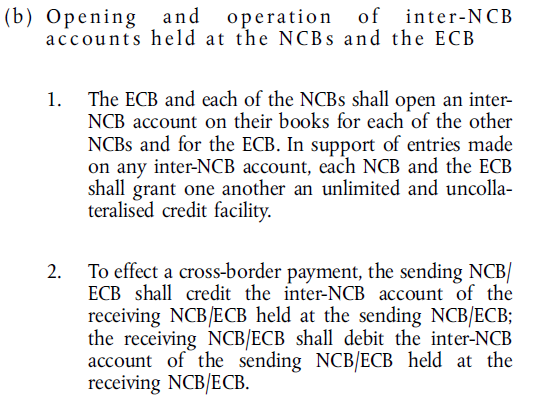
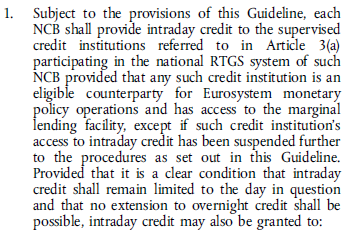
According to the Guideline of European Central Bank of 30 December 2005 on a Trans-European Automated Real-time Gross settlement Express Transfer system (TARGET) (ECB/2005/16) Article 4(b)1&2  (link):

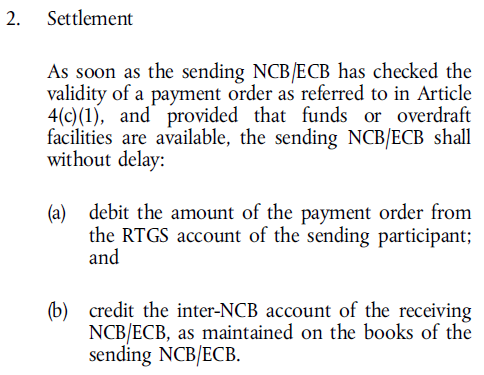
and according to Article 4(c)2:

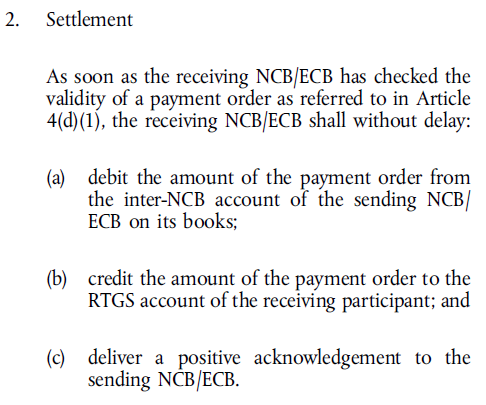
Further, according to Article 4(d)2:

So the NCBs and the ECB have accounts at each other and grant each other unlimited and uncollateralized credit! i.e., they allow all funds to go through. This was shocking when I first discovered this from the same document but later realized it makes sense. There is one more rule that is still missing – how the NCBs settle with each other.

According to the European Central Bank Annual Report 2010, Accounting Policies, Page 219:

INTRA-ESCB BALANCES/INTRA-EUROSYSTEM BALANCES

Intra-ESCB transactions are cross-border transactions that occur between two EU central banks. Intra-ESCB transactions in euro are primarily processed via TARGET2 – the Trans-European Automated Real-time Gross settlement Express Transfer system (see Chapter 2 of the Annual Report) – and give rise to bilateral balances in accounts held between those EU central banks connected to TARGET2. These bilateral balances are then assigned to the ECB on a daily basis, leaving each NCB with a single net bilateral position vis-à-vis the ECB only. This position in the books of the ECB represents the net claim or liability of each NCB against the rest of the ESCB. Intra-Eurosystem balances of euro area NCBs vis-à-vis the ECB arising from TARGET2, as well as other intra-Eurosystem balances denominated in euro (e.g. interim profit distributions to NCBs), are presented on the Balance Sheet of the ECB as a single net asset or liability position and disclosed under “Other claims within the Eurosystem (net)” or “Other liabilities within the Eurosystem (net)”. Intra-ESCB balances of non-euro area NCBs vis-à-vis the ECB, arising from their participation in TARGET2, are disclosed under “Liabilities to non-euro area residents denominated in euro”.

Using these rules and procedures, we can work out the example presented at the beginning of this post.

At the initiation of the payment of  €1m by Firm F, BNP Paribas will debit Firm F’s account €1m, Banque de France will debit BNP Paribas’ account €1m, Deutsche Bundesbank will credit Deutsche Bank’s account €1m and Deutsche Bank will credit Firm G’s account €1m. There remains the settlement between Banque de France and Deutsche Bundesbank and intraday, they settle bilaterally and then settle at the ECB at the end of the day. An important point however is that when NCBs settle with the ECB, they do not need to provide collateral. Also, in principle the overdraft facility provided by the ECB is unlimited.

Some clarifications. How did NCB provide intraday credit to BNP Paribas? The answer is quite simple: Ex Nihilo, at the stroke of  a pen, rather automatically via the system’s computers! The same with Deutsche Bundesbank – it provided Deutsche Bank with settlement balances in the same manner, and so did Deutsche Bank provide €1m of extra deposits to its customer Firm G. And finally at the end of the day, the ECB does the settlement between the NCBs on its books.

However, this is not the end of the story. During the day, there are payments in all directions but let us ignore that. So BNP Paribas finds itself with a positive intraday credit of €1m from Banque de France. Intraday overdrafts were discussed in Part 1 and I repeat the relevant part here. Toward the end of the day, banks may want to instead borrow from the rest of the financial system, instead of relying on central bank credit because the latter is free of interest only intraday and is charged an interest rate equal to that of the marginal lending facility overnightTypically, this poses no problem because some banks may have excess reserves which they may want to lend out because keeping it deposited at the central bank will pay an interest equal to that of the deposit facility which is lower. So typically, banks would retire intraday credit toward the end of the day and borrow funds from the rest of the financial system.

In this case, BNP Paribas would have to borrow abroad because other banks do not have excess reserves in the example. Deutsche Bank will be looking to lend the funds at a higher rate than depositing it at Bundesbank which pays lower interest and we have a situation in which BNP Paribas will borrows funds from Deutsche Bank. The interest rate on this lending/borrowing will likely be the near the ECB main refinancing rate – else, the ECB will intervene to bring the EONIA to the main refinancing rate – its target. It is important to remember that this causes the reversal of the balance sheet changes of the ECB and the NCBs – changes which happened when funds flowed from Firm F to Firm G.

All this is when there is no stress in the markets. During periods of crisis, banks in some affected regions may see deposits flowing out due to worries about credit risk. Banks which are losing funds are unable to borrow funds from abroad and this leaves banks indebted to their home NCBs and the NCBs have a large Other liabilities within the Eurosystem (net). 

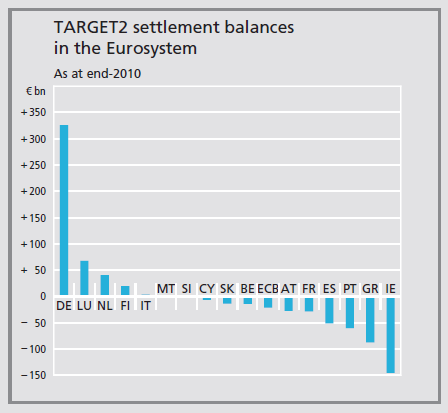
The Bundesbank Monthly Report March 2011 has a special topic The dynamics of the Bundesbank’s TARGET2 balance on Page 34 and has a good discussion. It has two nice charts, one of them is settlement balances of each NCB in the Eurosystem

This was at the end of 2010 and would have worsened in recent times and shows the amount of stress in the banking system.

In Part 3, I hope to discuss the implementation of monetary policy – i.e., the ECB procedures on setting the interest rate and the differences and similarities with the American system.

Hopefully there is a Part 4 which goes into the “sovereign debt” crisis – which really is a balance of payments crisis worsened by the fact that Euro Area national governments do not have a lender of the last resort.

An NIIP Prism

Alastair Marsh at FT Alphaville discusses the Euro Area problems looked through the prism of net international investment position (NIIP), quoting Goldman Sachs economist Lasse Holboell Nielsen:

When considering the causes of the ongoing Euro area debt crisis, it is natural to focus on public debt and deficits as the primary sources of market tensions. However, as the Irish experience demonstrates, private-sector debt can rapidly migrate onto public-sector balance sheets in the event of a financial crisis. It may therefore be more meaningful to look at the aggregate indebtedness of an economy, consolidating the public- and private- sector positions, in assessing a country’s vulnerability to sovereign yield tensions. [Italics not in original]

Nielsen is apparently trying to model government bond yields using NIIP data for some of the EA17 nations.

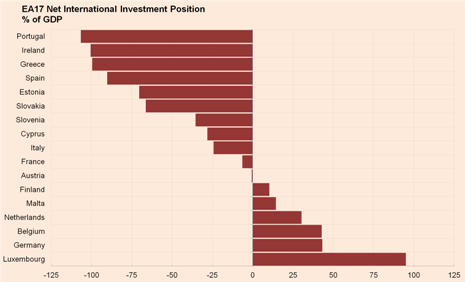
This blog had discussed this earlier in the post Eurozone Indebtedness. I re-did the graph and is below

A nation which is running a current account deficit and is highly indebted (proxied by the NIIP-GDP ratio) has to borrow from the international banking system, money markets and capital markets and refinance the debt and faces the risk of a run on its liabilities if the debt gets out of hand. The chart above gives an insight on why some EA17 nations face more troubles than others.

Mervyn King’s Got A Point

Nils Pratley from The Guardian quotes Mervyn King from the Bank of England’s Inflation report press conference.

This phrase ‘lender of last resort’ has been bandied around by people who, it seems to me, have no idea what lender of last resort actually means, to be perfectly honest. It is very clear from its origin that lender of last resort by a central bank is intended to be lending to individual banking institutions and to institutions that are clearly regarded as solvent. And it is done against good collateral, and at a penalty rate. That’s what lender of last resort means.

That is a million miles away from the ECB buying sovereign debt of national countries, which is used and seen as a mechanism for financing the current-account deficit of those countries, which inevitably, if things go wrong, will create liabilities for the surplus countries. In other words, it would be a mechanism of transfers from the surplus to the deficit countries. That’s why the European Central Bank feels, and with total justification, that it is not the job of a central bank to do something which a government could perfectly well do itself but doesn’t particularly want to admit to doing.

I think it’s very important to recognise that there are circumstances where governments will try and put pressure on central banks to do things that they would like central banks to do in order to avoid their having to own up to the actions that they actually would like someone else to carry out. So I have every sympathy with the European Central Bank in this predicament …

The only circumstance in which looking at the data for the euro area as a whole has merit is in realising that actually the euro area does have the resources, if you were to regard it as a single country, to make appropriate transfers within itself. It doesn’t actually need transfers from the rest of the world. But the whole issue is, do they wish to make transfers within the euro area or not? That is not something that a central bank can decide for itself. It is something that only the governments of the euro area can come to a conclusion on. And that is the big challenge that they face.

Mervyn King has some good insights about global imbalances and I will right something on this sometime soon. I am glad someone came out so openly about the LLR function of the Eurosystem. In my view this comes with tremendous risks. The ECB is carrying out it’s Securities Markets Program by which it intervenes in secondary markets to prevent government bond yields from running away. It doesn’t seem to work, given that there is no explicit ceiling on yields. While it is true that the ECB has the powers to put ceilings on government bond yields, there is nothing preventing governments from taking advantage of this and postpone reforms. Neither is there any institutional means by which fiscal policies are coordinated and the competitiveness gap between Euro Area nations reduced. For the ECB to take such a drastic step, there needs to be some credible commitments from nations to achieve this.

Some proposals were given by Philip Arestis in an excellent article titled European Economic And Monetary Union Policies From A Keynesian Perspective, Ch8, A Modern Guide to Keynesian Macroeconomics and Economic Policies, ed. Eckhard Hein, Engelbert Stockhammer, Edward Elgar Publishing. (Publisher’s book website here)

The Eurosystem: Part 1

The Eurosystem consists of the European Central Bank (ECB) and 17 National Central Banks (NCBs) of the member nations. The purpose of this post (and some that will follow) is to explain how the RTGS payment and settlement system called TARGET2 works in order to understand the flow of funds within the Euro Area. The purpose is also to show that money is endogenous in the Euro Area, that it cannot be otherwise and describe the Euro Area economic dynamics in the money endogeneity framework

First consider payments within a nation, i.e., domestic payments. In the Euro Area, it happens exactly in the way as in any nation. I had a post covering this – Payment Systems And Settlement. An example illustrates this:

Suppose a household A holding deposits in Bank A in Spain wishes to make a payment of €100 to an institution B banking at Bank B. The household A will give an instruction to her Bank A to transfer funds to Bank B. Assuming this goes through, the Spanish central bank Banco de Espana will debit Bank A’s account and credit Bank B’s account. Bank B will credit institution B’s account €100. If Bank A has insufficient funds at Banco de Espana, the latter will provide the former intraday credit free of charge.

So transactions such as the above give rise to payment flows in all directions. To understand how the Eurosystem handles this, it is useful to go into some rules.

The Guideline of European Central Bank of 30 December 2005 on a Trans-European Automated Real-time Gross settlement Express Transfer system (TARGET) (ECB/2005/16) 3(f) 1 says (link)

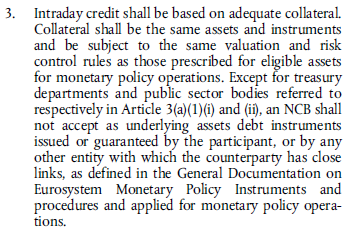
and 3(f)3 says

and finally 3(f)5 says

So within the day banks can go into overdraft at the home central bank by pledging collateral. In practice, banks have more collateral at the central bank to cover for daily fluctuations. Also, in the Euro Area, banks need to satisfy a reserve requirement of 2% which means that the amount of reserves deposited at the NCB should be at least 2% of the deposit liabilities. How do banks get the reserves when they lose reserves? During the day, the intraday credit itself provide the reserves. (Loans make deposits!). However toward the end of the day, banks may want to instead borrow from the rest of the financial system, instead of relying on central bank credit because the latter is free of interest only intraday and is charged an interest rate equal to that of the marginal lending facility overnight. Typically, this poses no problem because some banks may have excess reserves which they may want to lend out because keeping it deposited at the central bank will pay an interest equal to that of the deposit facility which is lower. So typically, banks would retire intraday credit toward the end of the day and borrow funds from the rest of the financial system.

An exception to the above arises during periods of market stress or crisis, when banks prefer to not lend the excess funds due to credit risks and are happy to keep funds deposited at the central bank despite earning lower interest.

As banks create more money by lending (more credit to be precise), the reserve requirement of the whole banking system would increase. How do banks in the Euro Area get more reserves?

It is useful here to distinguish between two types of monetary systems – overdraft and asset-based. In the former, banks as a whole get all the reserves directly by borrowing from the central bank (provided they pledge good collateral) and in the latter, the central bank would create reserves required by the banking system by engaging in permanent open market operations or outright operations, typically purchasing government bonds. The Euro Area monetary system is best described by the former and Anglo-Saxon monetary systems such as one in the United States is best described by latter. Even in the latter, the Federal Reserve does provide direct credit to banks but these are retired quickly. The distinction can be made by looking at the balance sheet of the central bank.

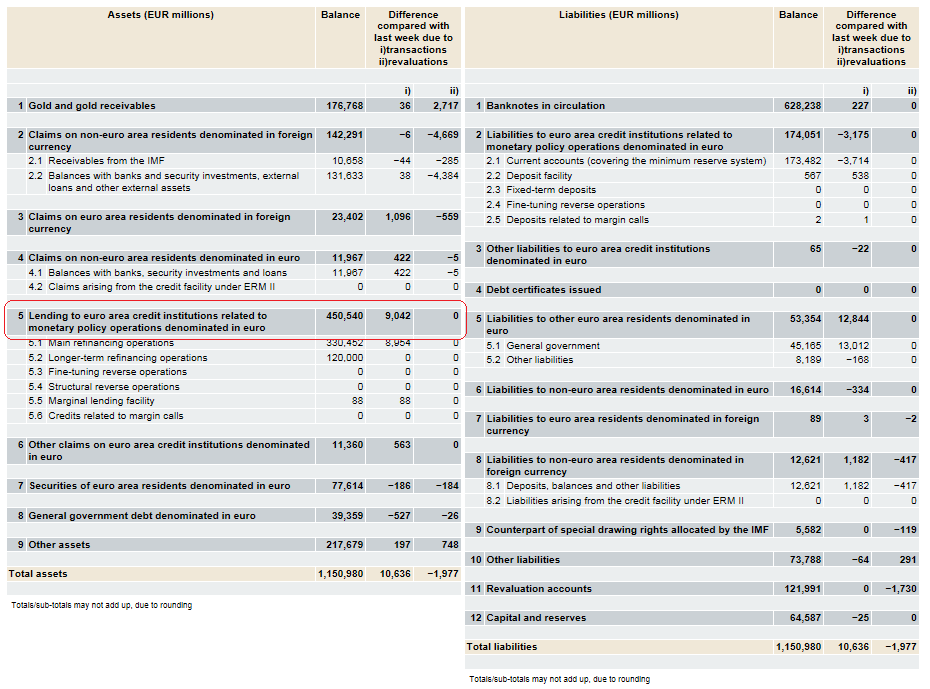
We are yet to see the Eurosystem being described as a whole, but for our purpose of clarifying how an overdraft system looks, it is sufficient to just take a glance at the consolidated balance sheet to verify. The Eurosystem balance sheet near the end of 2006 looked like this (link):

(click to enlarge)

The item rounded in red is €450, 540 million which is a big proportion of the total size of the balance sheet, and one doesn’t see this for the Federal Reserve (in normal circumstances).

Since the Eurosystem is an overdraft type, the funds obtained have to be provided by direct lending by the Eurosystem. This is done mainly via two types of operations – Main Refinancing Operations (MROs), and Long Term Refinancing Operations (LTROs), where the Eurosystem conducts an auction to lend the whole banking system. For the former, the auctions are held weekly and the lending is for one week. LTROs, it is typically conducted every month and the duration of refinancing is three months. As the names suggest, MROs are used mostly.

This will conclude my post. The posts following this will look at cross-border flows of funds and government accounts. They (either one post or two) will attempt to provide the reader an idea of how cross-border dynamics are important for the Euro Area.

Update: Corrected the discussion on frequency and duration of LTROs in the second last para.

Financial Crisis And Flow Of Funds

Marc Lavoie forwarded me the European Central Bank’s Monthly Bulletin, October 2011 which has a section on TARGET2 and the European monetary system. I have had good discussions with him on emails to nail the TARGET2 operations so it is good to see the conclusions being verified in publications. I am waiting to write a long blog post on TARGET2 and trying to collect sources I can quote/link and I came across a section on flow of funds in the same article. It appears on page 99 (page 100 of the pdf) and is titled The Financial Crisis In The Light Of Euro Area Accounts: A Flow-Of-Funds Perspective. 

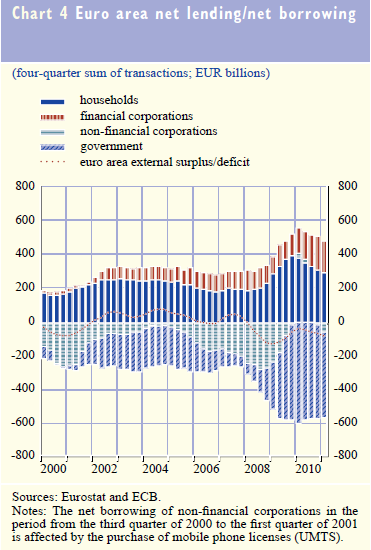
The article has this chart which will be very familiar to readers because it has been in the Levy Institute’s Strategic Prospects since many years.

There are some differences in terminologies. Wynne Godley (and Francis Cripps) started using NAFA (Net Accumulation/Acquisition of Financial Assets) to denote a sector’s surplus in the 1970s and Levy Institute has continued using this. Modern national accountants use Net Lending (by a sector) and split this into Net Acquisition of Financial Assets and Net Incurrence/Acquisition/Increase of/of/in Liabilities and take the difference. Levy’s authors also use Net Lending but as Net Lending to a Sector – e.g., Net Lending to Households.

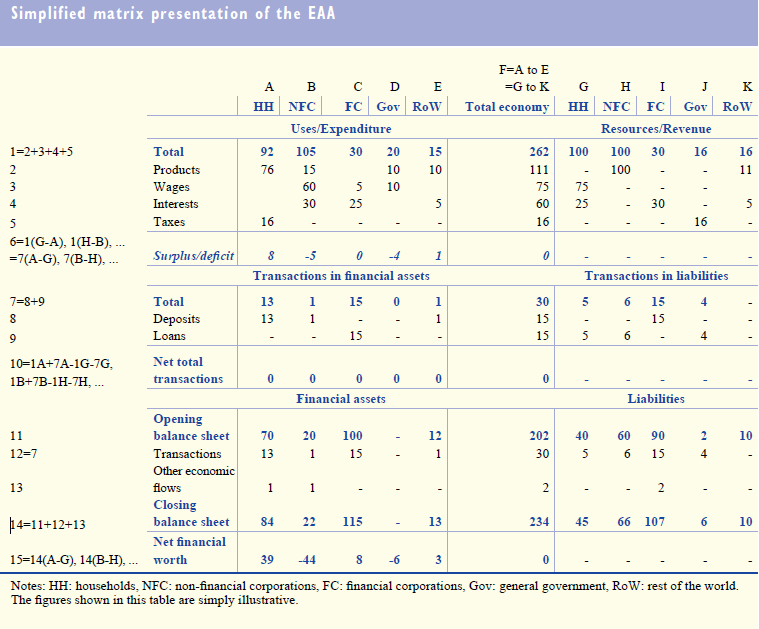
The article also presents this table (termed Transactions Flow Matrix by Wynne Godley – his greatest trick)

(click to enlarge)

and has this description:

The sectoral accounts present the accounts of institutional sectors in a coherent and integrated way, linking – similar to the way in which profit and loss, cash flows and balance sheet statements are linked in business accounting  – uses/expenditure, resources/revenue, financial flows and their accumulation into balance sheets from one period to the next.To this effect, all units in the economy are classified in one of the four institutional sectors (i.e. households, non-financial corporations, financial corporations and general government). Their accounts are presented using identical classifications and accounting rules (those of ESA 95), in a manner such that each transaction/asset reported by one unit will be symmetrically reported by the counterpart unit (at least in principle). Accordingly, the sectoral accounts present the data with three constraints: each sector must be in balance vertically (e.g. the excess of expenditure on revenue must be equal to financing); all sectors must add up horizontally (e.g. all wages paid by sectors must be earned by households); and transactions in assets/liabilities plus holding gains/losses and other changes in the volume of assets/liabilities must be consistent with changes in balance sheets (stock-flow consistency). The sectoral accounts are commonly presented in a matrix form, with sectors in columns and transactions/instruments in rows, with horizontal and vertical totals adding up (see the example in the table).

The first five rows of the table show the expenditure and revenues of each of the sectors (broken down into types of expenditure/revenue). In row 6, the difference between revenue and expenditure (the surplus/deficit) is shown.

The notions of revenue and expenditure are close to, but generally less encompassing than, the more traditional national account concepts of resources and uses. Income can then be defined as revenue (except capital transfers received) minus expenditure other than final consumption and capital expenditure (capital formation and capital transfers paid). For corporations, income corresponds to retained earnings. Savings is the excess of income over final consumption.

Surpluses/deficits are then associated with transactions in financial assets and liabilities in each sector. This is shown in rows 7 to 10. The bottom part of the table shows the stocks of assets and liabilities, which result from the accumulation of transactions and other flows. This table is extremely simplified (e.g. omitting an explicit presentation of the stock of non-financial assets).

The excess of revenue over expenditure is the net lending/net borrowing (i.e. financial surplus/ deficit), a key indicator of the sectoral accounts. Typically, a household’s revenue will exceed its expenditure. Households are thus providers of net lending to the rest of the economy. Non-financial corporations typically do not cover their expenditure by revenue, as they finance at least part of their non-financial investments by funds from other sectors in addition to internal funds. Non-financial corporations are thus typically net borrowers. Governments are also often net borrowers. If the net lending provided by households is not sufficient to cover the net borrowing of the other sectors, the economy as a whole has a net borrowing position vis-à-vis the rest of the world. Deviations from this typical constellation were apparent in several euro area countries before the crisis, in particular, with extremely elevated residential investment that resulted in households becoming net borrowers (as has been the case in the United States).

The adding-up constraints in the accounts require that any (ex ante) increase in the financial balance of one sector is matched by a reduction in the financial balances of other sectors. The accounting framework does not, however, indicate by which mechanism this reduction will be brought about, or which mechanisms are at play. The EAA makes it possible to track changes in net lending in the different sectors of the economy. It also specifies the financial instruments affected and shows how the transactions and valuation changes leave a lasting effect on the balance sheets of the sectors.

The article is worth a read.

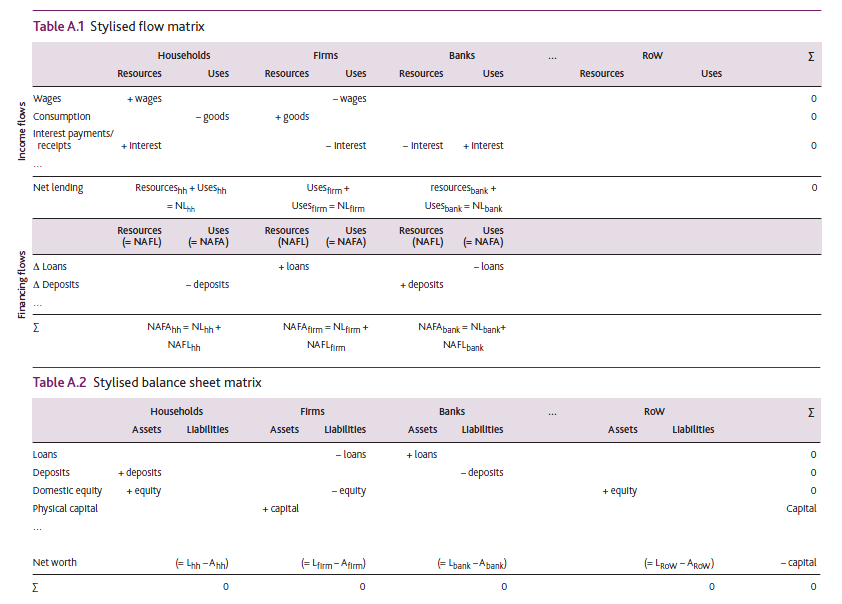
The Bank of England also had a similar article recently but before: Growing Fragilities – Balance Sheets In The Great Moderation by Richard Barwell and Oliver Burrows and quotes the work of G&L (Godley and Lavoie). It also has a similar matrix as the ECB’s article.

(click to enlarge)

Godley and Lavoie build a series of closed accounting frameworks based on the system of National Accounts, which encompass: the standard national income flows, such as wages and consumption; the counterpart financing flows, such as bank loans and deposits; and stocks of physical and financial assets and liabilities. This framework lends itself to representation in a set of matrices. The first matrix captures flow variables (Table A.1). The columns represent the sectors of the economy and the rows represent the markets in which they interact. The matrix has two important properties. Each sector’s resources and uses columns provide their budget constraint — the sums must equal to ensure that all funds they receive are accounted for. And each row must also sum to zero, to ensure that each market clears — that is, the supply of a particular asset must be matched by purchases of that asset, to ensure that no funds go astray.

The table can usefully be split in two, with the top half covering the standard income and expenditure flows and the bottom half covering financing flows. The two halves of the table are linked together by each sector’s ‘net lending balance’, or ‘financial surplus’. The net lending balance can be used to summarise each sector’s income and expenditure flows as the difference between the amount the sector spends on consumption and physical investment and the amount that it receives in income. This difference must be met by financing flows — either borrowing or the sale of financial assets. In national accounts terminology, a sector’s net lending balance (NL) must equal its net acquisition of financial assets (NAFA) less its net acquisition of liabilities (NAFL). Across sectors, the net lending balances have to sum to zero, as all funds borrowed by one sector must ultimately come from another.

While it is useful to split the table for accounting purposes into income and expenditure flows and financing flows, it is important to note that the acquisition of financial assets and liabilities is not necessarily determined purely by imbalances between income and desired expenditure. Sectoral balance sheets can adjust for other reasons. Agents may want to borrow money to purchase assets, simultaneously acquiring financial assets and liabilities. And on occasion agents may want to shrink the size of their balance sheets, selling off financial assets to pay off financial liabilities. Finally, some agents may default on their debt obligations, which will involve a revision in the financial assets and liabilities of both debtor and creditor. At an aggregate level, simultaneous expansion of a sector’s assets and liabilities invariably represents one set of underlying agents taking on assets whilst the other takes on liabilities. The household sector provides an important example. If a young household takes a mortgage to buy a house from an old household, the sector in aggregate simultaneously acquires a liability (the young household’s mortgage) and an asset (the deposit created for the young household to pay to the old household).

All of these activities — leveraging up, deleveraging and default — involve NAFA and NAFL moving in lockstep. The net lending identity still holds: the gap between income and expenditure determines the difference between NAFA and NAFL. But the absolute size of the NAFA and NAFL flows is determined by agents’ actions in financial markets. The second table captures the balance sheet positions of each sector. The balance sheet matrix is updated over time using data on the acquisition of assets and liabilities from the transaction flows matrix, and revaluation effects to asset positions. Proceeding in this manner, balance sheets always balance across sectors, flows of funds are always accounted for over time and the impact of flows of funds on balance sheets is always recorded.

Again, good article!

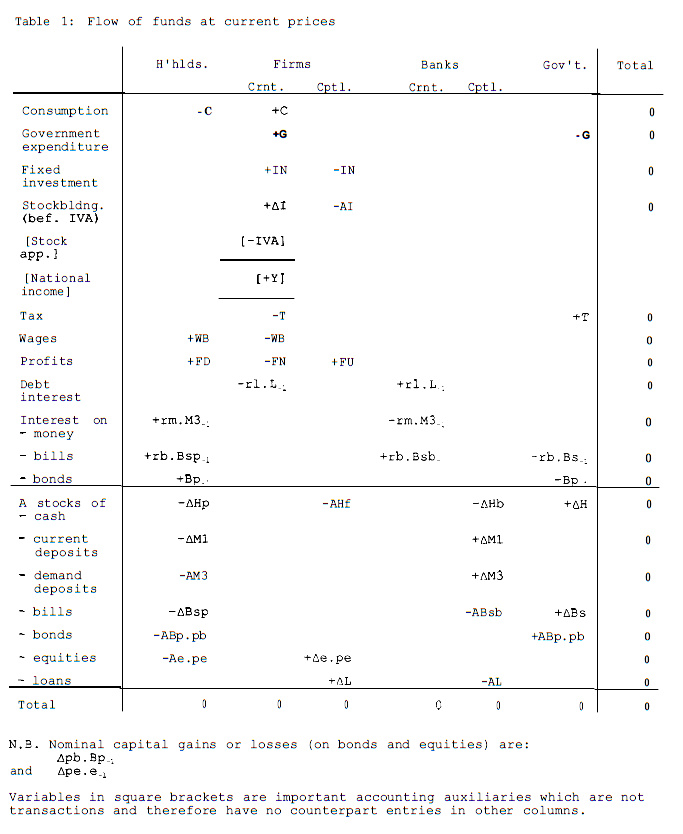
The first time a proper transactions flow matrix appeared was in a 1996 Levy institute paper by Wynne Godley:  Money, Finance And National Income Determination – An Integrated Approach.

(click to enlarge)

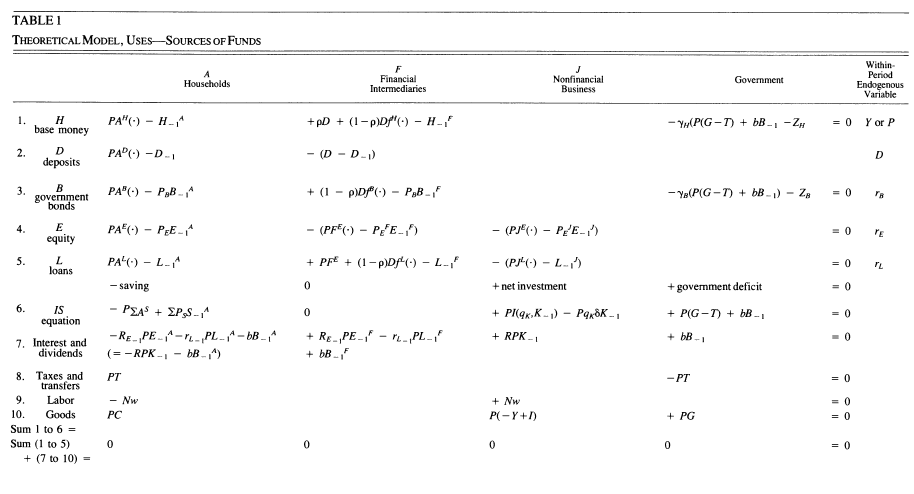
James Tobin et al. had something similar – almost but not quite in A Model Of US Financial And Nonfinancial Economic Behavior :

(click to enlarge)

Hungary Again

I had two previous posts on Hungary here and here. Initially I thought of writing more on this, but today Fitch came out with a rating action and I guess explains most stuff on the deterioration of the economy – so enough of Hungary for now. Find below Fitch’s release. I quoted two comments highlighting CHF mortgages (equivalent of 16% of GDP) while my first post was on deteriorating external finance – both highlighted by Fitch.

Full report below

Fitch Revises Hungary’s Outlook to Negative; Affirms at ‘BBB

Fitch Ratings-London-11 November 2011: Fitch Ratings has revised the Outlooks on the Republic of Hungary’s Long-term foreign and local currency Issuer Default Ratings (IDR) to Negative from Stable and affirmed the ratings at ‘BBB-‘ and ‘BBB’, respectively. The agency has also affirmed Hungary’s Short-term IDR at ‘F3’ and Country Ceiling at ‘A-‘.
“The revision in Hungary’s Outlook to Negative reflects a sharp deterioration in the external growth and financing environment facing Hungary’s small, open and relatively heavily indebted economy,” says Matteo Napolitano, Director in Fitch’s Sovereign Group. “Moreover, various fiscal policy measures and the scheme to allow the repayment of household foreign currency mortgages at below market exchange rates have dented foreign investor confidence, on which medium-term growth prospects depend.”

Hungary is particularly exposed to any deterioration in the economic and financial conditions in the eurozone, owing to its open economy, mainly Western European-owned banking sector, relatively high levels of public and external debt and financing ratios, sizeable stock of portfolio investment (including a 40% non-resident share of domestically issued government debt) and Swiss Franc (CHF) mortgages debt.

Heightened risk aversion has increased refinancing risks on external sovereign maturities. Hungary needs to refinance around EUR4.6bn in 2012, and EUR5bn-EUR5.6bn annually in 2013-14, of foreign exchange denominated debt. Any potential selling of HUF-denominated debt by non-resident investors could add to financing pressures. The government’s EUR1.6bn cash deposit at the central bank provides a moderate buffer against refinancing risks.

Growth prospects have weakened sharply both in Hungary and in its main Western European trading partners in recent months. In October, Fitch revised its forecast for 2012 eurozone GDP growth down to 0.8% from 1.8% previously, and to 1.6% from 1.7% previously for 2011. Against this backdrop, with domestic demand weighed down by fiscal tightening and private-sector de-leveraging, Fitch expects Hungary’s economy to grow by only 0.5% in 2012, down sharply from the agency’s projection of 3.2% in June 2011.

The government appears committed to fiscal consolidation and through the course of 2011, has set out an array of measures in the Szell Kalman plan in March, the Convergence Programme in April and the new measures announced in September. Despite some widening in the structural budget deficit in 2011, it will run a general government surplus in 2011 of around 3.5% of GDP, driven by large one-off factors such as the return of private pension assets to the public sector. Fitch forecasts that government debt will decline to around 76% of GDP at end-2011, from 80% at end-2010.

For 2012, the government intends to reduce the structural budget deficit by over 2 percentage points of GDP to bring the headline deficit to 2.5% of GDP, thus taking Hungary out of the EU’s Excessive Deficit Procedure (EDP). However, the weak growth outlook, the uncertain costing and implementation of some measures and potential reform fatigue make this challenging. Fitch forecasts a 2012 budget deficit of 3.3% of GDP.

Over the course of 2011 the Hungarian forint (HUF) has depreciated by 13%-14% against both the euro and the CHF, thus increasing further heavy public- and private-sector debt repayment burdens. The government’s policies to tackle the large stock of CHF-denominated household debt (equivalent to 16% of GDP in mid-2011) may turn out to be fairly ineffective and have negative consequences. Credit constraints and a lack of sufficient savings will likely prevent the share of CHF loans that are repaid early at a preferential exchange rate from rising above 20%-25% of the total (see ‘Hungary: Risks from Swiss Franc Debt Exposure’, dated 5 October 2011 at www.fitchratings.com).

However, this will still place further pressure on the HUF and on the banking sector’s balance sheet, which is already beset by an exceptional levy, rising non-performing loans and several years of sluggish economic activity. Although the system average Tier 1 capital adequacy ratio (CAR), at 10.9% in September 2011, looks reasonable, a number of banks are already making losses and will require re-capitalisation – which is likely to be forthcoming from foreign parents. Nevertheless, foreign parent banks are likely to continue to cut their exposure to Hungary and the supply of credit is likely to continue to contract, weighing on GDP growth.

Some of Hungary’s fundamental rating strengths such as a rich and diverse economy, and underlying political stability remain in place. Moreover, it is running a large current account surplus, which Fitch forecasts at an annual average of 2.4% in 2011-12, helped by resilient export performance and weak domestic demand. It should also attract around USD2bn in non-debt financing in 2012 from EU transfers and other sources.

Foreign direct investment (FDI) registered a net outflow of EUR1bn in H111. Aside from a handful of large investments in the automotive sector, there are few significant FDI projects in the pipeline. Potential investors appear to be either delaying decisions, or investing elsewhere, as government policies have eroded Hungary’s business climate – a traditional rating strength and key part of the growth model.

When Fitch affirmed Hungary’s rating at ‘BBB-‘ and revised the Outlook to Stable on 6 June 2011, it noted that “negative pressure on the rating could also emerge from the anaemic growth, private sector capital outflows, increased problems in the banking sector or a significant shift in investor sentiment that adversely affected Hungary’s public and external financing capacity”.

Hungary is exposed to an intensification of financial instability and recession in the euro area. A significantly worse than currently anticipated slowdown, evidence of private sector capital outflows or problems in the banking sector, a rise in the risk premium or fiscal financing pressure could lead to a downgrade. A material weakening in the government’s commitment to fiscal consolidation could also lead to a downgrade.

Conversely, the government meeting its budget deficit targets and a return to healthy growth, particularly in the context of significant structural reforms and declining external debt ratios, could lead to positive rating action.

Contact:

Primary Analyst
Matteo Napolitano
Director
+44 20 3530 1189
Fitch Ratings Limited
30 North Colonnade
London, E14 5GN

Secondary Analyst
Ed Parker
Managing Director
+44 20 3530 1176

Committee Chairperson
Shelly Shetty
Senior Director
+1 212-908-0324

Media Relations: Peter Fitzpatrick, London, Tel: +44 20 3530 1103, Email: peter.fitzpatrick@fitchratings.com.

Additional information is available at www.fitchratings.com.

The ratings above were solicited by, or on behalf of, the issuer, and therefore, Fitch has been compensated for the provision of the ratings.

Applicable criteria, ‘Sovereign Rating Methodology’, dated 15 August 2011, are available at www.fitchratings.com.

Applicable Criteria and Related Research:
Sovereign Rating Methodology

ALL FITCH CREDIT RATINGS ARE SUBJECT TO CERTAIN LIMITATIONS AND DISCLAIMERS. PLEASE READ THESE LIMITATIONS AND DISCLAIMERS BY FOLLOWING THIS LINK: HTTP://FITCHRATINGS.COM/UNDERSTANDINGCREDITRATINGS. IN ADDITION, RATING DEFINITIONS AND THE TERMS OF USE OF SUCH RATINGS ARE AVAILABLE ON THE AGENCY’S PUBLIC WEBSITE ‘WWW.FITCHRATINGS.COM’. PUBLISHED RATINGS, CRITERIA AND METHODOLOGIES ARE AVAILABLE FROM THIS SITE AT ALL TIMES. FITCH’S CODE OF CONDUCT, CONFIDENTIALITY, CONFLICTS OF INTEREST, AFFILIATE FIREWALL, COMPLIANCE AND OTHER RELEVANT POLICIES AND PROCEDURES ARE ALSO AVAILABLE FROM THE ‘CODE OF CONDUCT’ SECTION OF THIS SITE.

Copyright © 2011 by Fitch, Inc., Fitch Ratings Ltd. and its subsidiaries.

Holders Of Italy’s Public Debt And Government Securities

Banca d’Italia – Italy’s National Central Bank – released its Financial Stability Report, Nov 2011 recently. With movements in Italian government bond yields making headlines, the following graphs from the report might be useful.

(Click to enlarge)

Lots of foreigners = lots of trouble!