Author Archives: V. Ramanan

The Transactions Flow Matrix

Why is GDP defined as C+I+G+… and how is it related to national income, expenditure etc and that of each sector of an economy such as that of households?

The following table (redrawn by myself) taken from the book Monetary Economics by Wynne Godley and Marc Lavoie gives an idea on how to go about measuring national income, product etc. The sample chapter (Contents, Chapter 1 & Index) from the publisher’s website has an introduction to the authors’ approach of studying Macroeconomics from a stock-flow consistent approach.
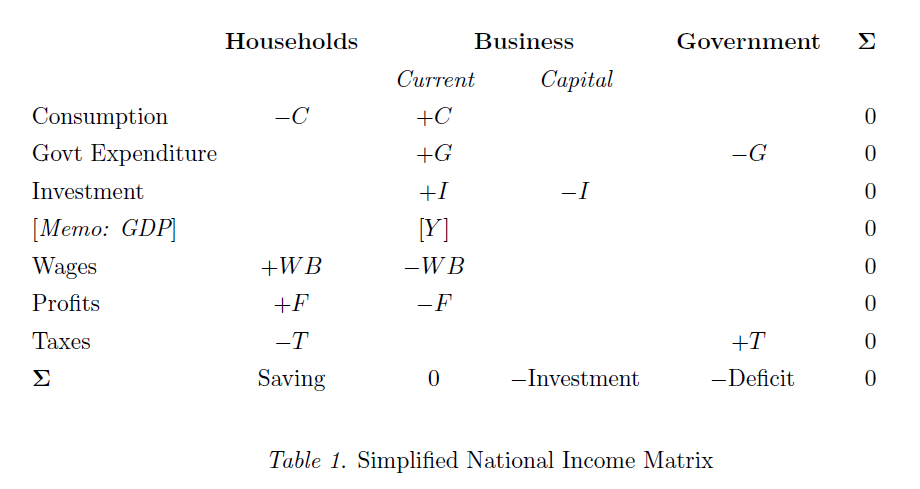
The table describes income and expenditures flows within an economy. Of course, as mentioned this is simplified and complications have to be added one by one. For example, there is no inventories, no external sector and households do not purchase a house etc. However, the above construction shows an easy way of building up and thinking about how funds flow between different ‘sectors’ of an economy. The reader who is new to this way of thinking should pay attention to the signs attached to each entry. For example, households receive wages and it is a source of funds for them and hence the positive sign. When they are consuming, they use funds and hence the first row in the table with the item consumption has a negative sign for households. For businesses, this a source of funds and hence positive. Another item which may be unfamiliar is the capital account of businesses. Firms purchase capital goods for their production and the sale of these goods comes from the same sector and hence one need for this column.

Even at this simplified form, there are a lot which are not known from the above table. What form does saving take? How does the government finance its excess of expenditure over income (i.e., deficit)? How do firms pay for wages and get funds to do the investment etc. To see this, we need a transactions flow matrix which I had discussed previously in my post Financial Crisis And Flow Of Funds from a not-so-pedagogic perspective. It is a foxy trick.

A few things before going into this. First notice that from the matrix,

C + I + G = Y = WB + F

So in our simplified example, gross domestic product is the sum of expenditures on goods and services and at the same time the sum of incomes paid for the production of goods and services.

Second, if you want the actual numbers (for the United States), the place to get this from the Federal Reserve Statistical Release Z.1. In particular, tables F.6 and F.7 and the hyperlink directly takes you to the table.

Back to our question on what form does saving take and how do firms finance their activities etc. Below is the table I made using TeX (and taken from the same book, Chapter 1)
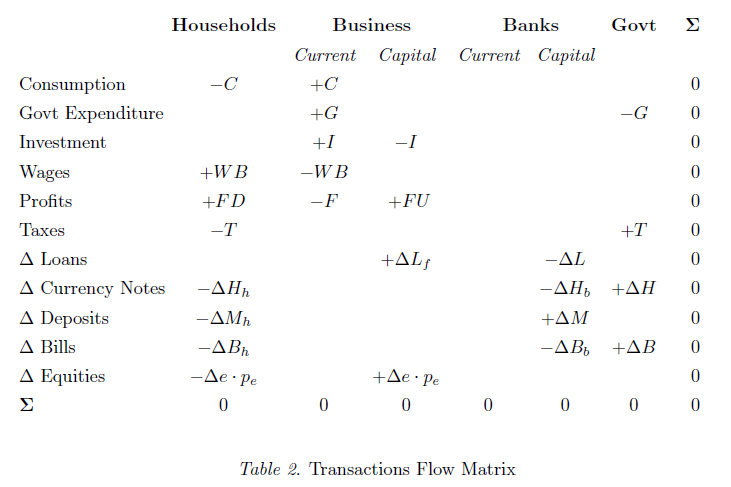
The questions asked also lead us naturally to the introduction of the banking sector and its importance in the process of production, and this sector was missing in Table 1. So we can now clearly see what form saving takes. For households, this is in the form of currency notes, bank deposits, government T-bills and firms’ equities. Apart from various complications added, you may have noticed that profits are assumed to be part distributed and part retained. Firms hence finance investment by retained earnings, loans from banks and by issuance of equities, here. The government finances its deficit (i.e., excess of outlays over receipts) by issuing currency notes and T-bills. We have merged the Central Bank and the Federal Government into one sector “Govt”, for simplicity (which is also the case for Table 1). The behavioural aspects are something different and it should not be assumed that the government can “control” its deficit and that it can choose the proportion of financing in the form of currency notes and bills.

Needless to say, the above transactions flow matrix is a simplified one. For example, you may immediately notice that there is no interest payments on loans and bills yet.

It should be noted here that the entries in the table are flows and hence you may see a lot of Δs. The reader who is relatively new to this should not fail to observe the signs attaching each entry. The negative sign in the entry for deposits for households may be confusing at first, but the self-consistency of the whole construction forces the signs on these entries.

It is worth emphasizing that the fact that all rows and columns sum to zero and this makes the whole construction very appealing. When I was trying to get myself introduced to economics about 3 years back, I browsed around the internet and quickly came across the transactions flow matrix – exactly what I was looking for!

This construction greatly simplifies visualizing flow of funds as compared to the Blue Book way of doing it. The following is the 2008 SNA way of maintaining national accounts and there is some additional effort one needs to visualize this without the usage of a transactions flow matrix!
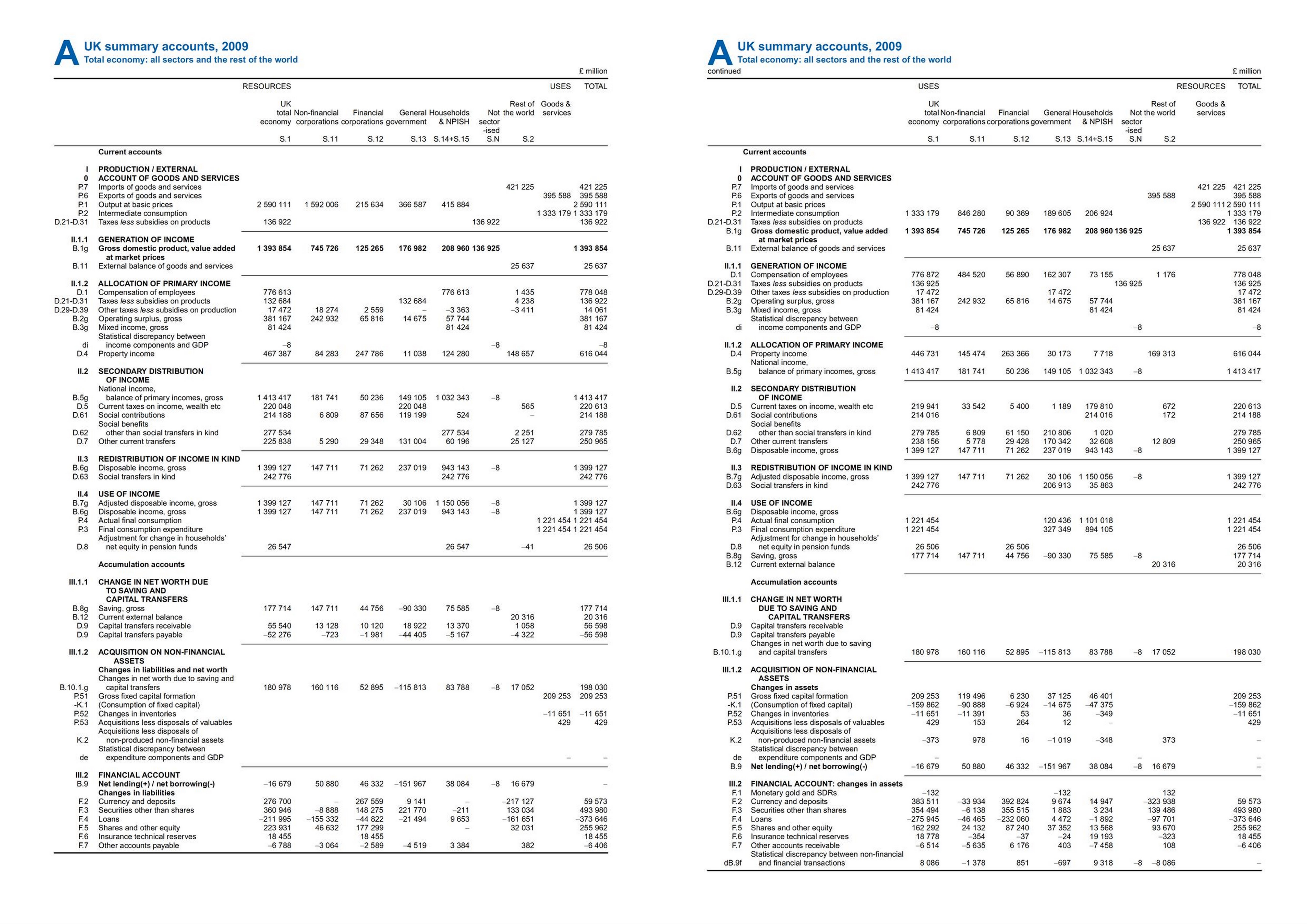
(click to enlarge)
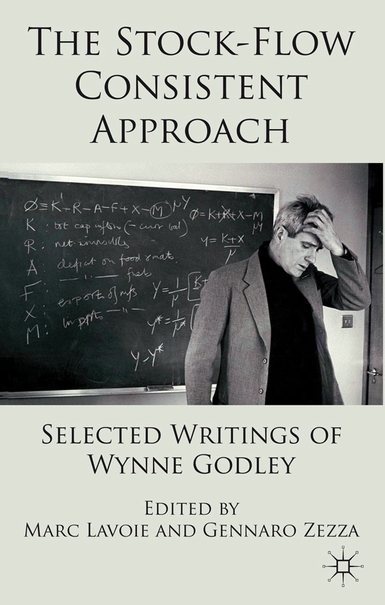

Books In Honour Of Wynne Godley

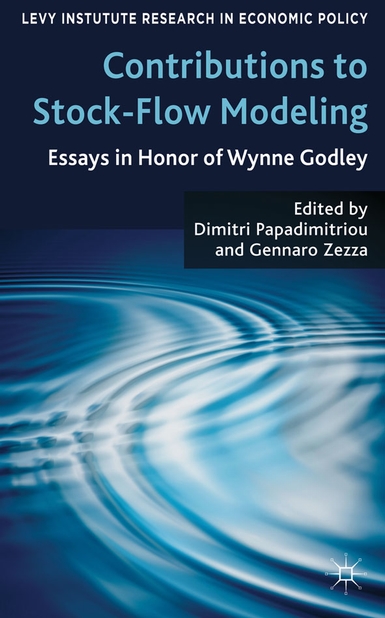
There are two new books in honour of Wynne Godley and they are out now

The first one – edited by Marc Lavoie and Gennaro Zezza – has selected articles and papers by Wynne Godley, and carefully chosen.

It’s available at amazon.co.uk, but not yet on amazon.com

Here’s the book’s website on Palgrave Macmillan. The book also contains the full bibliography of Godley’s papers, books, working papers, memoranda (such as to the UK expenditure committee), magazine/newspaper articles, letters to the editor etc.

Here’s a picture I took of Marc at Levy Institute in May when he was deciding on the cover.

The is second book written in honour of Wynne Godley contains proceeding of the conference held in May at the Levy Institute (the same place the above photograph was taken)

The publisher’s website for the book is here.

Dimitri says:

The death of Wynne Godley silences a forceful and very often critical voice in macroeconomics. Wynne’s own strong view, that although his work was representative of the non-mainstream Keynesian approach to economics and especially economic policy was important nevertheless, has been confirmed time and time again as evidenced in the fortunes of the UK, US and Eurozone economies. His writings, reflecting the sharpness of his mind and intellectual integrity, have had a considerable impact on macroeconomics and have aroused the interest of scholars, economic journalists and policymakers in both mainstream and alternative thought. In a review of Wynne’s last book with Marc Lavoie (2007), Lance Taylor had this to say: ‘Wynne’s important contributions are foxy – brilliant innovations… that feed into the architecture of his models’

I also like Wynne’s stand on the current account imbalance of the United States:

Bibow finds that Godley’s diagnosis of the looming economic and financial difficulties ahead of their occurrence was prescient with regard to US domestic developments – a theme that came up in the chapters by Wray and Galbraith. But Bibow takes issue with Wynne’s assessment of the US external balance being unsustainable. He notes that the US investment position and income flows are more or less in balance and he attributes this phenomenon to the safety of the US Treasury securities and the dollar functioning as the reserve currency.

Dimitri then says

Even if this is so, it cannot continue indefinitely, Wynne would have replied.

The conference page is here

Alfred Eichner And Federal Reserve Operating Procedures

Alfred Eichner was a Post-Keynesian economist known for his text Macrodynamics of Advanced Market Economies published 3 years after his death in 1988. He died at the age of 50 in an accident and at the time he was preparing to include an analysis of open economy macroeconomics in his story of how economies work.

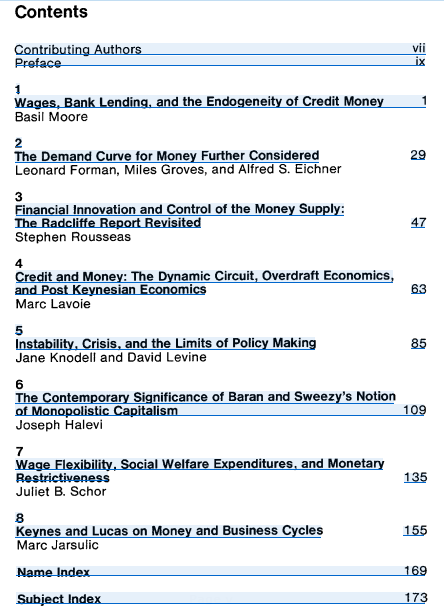
This post is about an article/chapter he wrote (with Leonard Forman and Miles Groves)* in 1984 in a book titled Money And Macro Policy edited by Marc Jarsulic. It is a fantastic book with chapters written by Basil Moore and Marc Lavoie as well on the endogeneity of money. I discussed this previously in my post More On Horizontalism.

Google Books allows a preview of the chapter and embedding it on a webpage and I have done so at the end of this post. If it doesn’t appear properly in your browser, please let me know. Else, like me, you can buy the book 🙂 Of course G-books won’t allow a preview of all pages due to copyright restrictions.

Eichner’s chapter (#2) is titled The Demand Curve For Money Further Considered. 

The authors start off the description with

First, the amount of bank reserves, and thus the monetary base, is not the exogenously determined variable assumed in both orthodox Keynesian and monetarist models but instead depends on the level of nominal income. This is because the central bank, in order to maintain the liquidity of the financial system, is forced to purchase government securities in the open market so as to accommodate, at least in part, the need for additional credit as the pace of economic activity quickens. With the amount of unborrowed bank reserves, and thus the monetary base, to a significant extent endogenously determined, it follows that the money supply is, to no less an extent endogenously determined as well. It is therefore a misspecification to assume that the money stock, or any of its components, is entirely exogenous, subject to the control of the monetary authorities, and then to derive a demand curve for money based on that assumption. In reality, the demand for and supply of “money” are interdependent, with no possibility in practice of being able to distinguish between the two.

Second, it is the demand for credit rather than the demand for money which is the necessary starting point for analyzing the role played by monetary factors in determining the level of real economic activity…

The authors then point out the neutralizing nature of open-market operations of the Fed. Usually this – open market operations – is presented in textbooks and in some old Federal Reserve publications as causing the amount of reserves to rise and allowing banks to increase the supply of reserves. Eichner had earlier worked with data and failed to see open market operations increasing the amount of reserves in practice. He realized that the open market operations neutralize flows:

… Thus, in the face of a fluctuating public demand for currency, flows of gold into and out of the country, variations in the amount of deposits held at the Fed by foreigners and others, changes in the amount of float and fluctuations in the Treasury’s cash holdings, the Fed must engage in open-market operations just to maintain bank reserves at a given level. This is the neutralizing component of a fully accommodating policy, and it is one reason why it is difficult in practice to relate change in bank reserves to open market operations …

What is so nice about the quote above is that Eichner knew exactly what factors affect reserve balances. At the time, “float” may have been more important than it is today. Eichner not only knew that the Treasury’s account at the Fed affects reserve balances but also holdings of other institutions such as foreign central banks – i.e., as a result of “flows of funds into or out of the Federal Reserve System” in his own words. (In the same paragraph from which the quote is taken).

Further the article goes:

An increase in the demand for credit will, to the extent it is satisfied, lead to an increase in bank deposits (especially demand deposits). This is because banks make loans by simply crediting the borrower’s account at the bank with the funds advanced. The increase in deposits will, however, require that banks maintain larger reserves at the Fed. Thus required reserves, ResR, will increase and, unless the Fed acts through the purchase of government securities in the open market to provide banks with the necessary additional reserves, banks will find themselves with insufficient reserves to meet their legal requirements… the Fed is forced to accommodate, at least in part,  whatever demand for credit may manifest itself.

The terminology “accommodating” was later made clear later by Eichner in his book Macrodynamics as operations aimed at pegging the short term interest rate whatever the economic or credit conditions. So when the Fed is not accommodating – in this terminology – it means it is pursuing a policy of raising rates at frequent intervals with an aim to impact credit and aggregate demand.

The Google Books link is embedded below.

click to view on Google Books

Endnote

*Chief Economist and Economic Analyst, respectively at The New York Times at the time of writing.

Happy New Year


Happy New Year 2012 and it is a nice opportunity for me to thank you much for visiting my blog.

(Card courtesy: Hallmark)

Hyman Minsky and Money

Did Hyman Minsky truly understand the endogenous nature of money?

The Levy Institute is one my favourite places in the world, but have been there only once :(. Here’s a picture of the nice garden at the institute I took.

Brings me to the main point of my post. The Institute has made an archive of Minsky’s works and you can reach the page by clicking the link below:

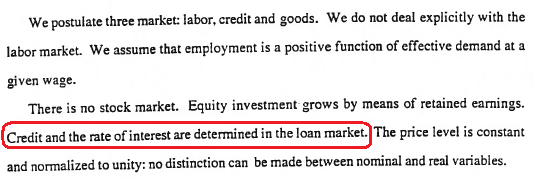
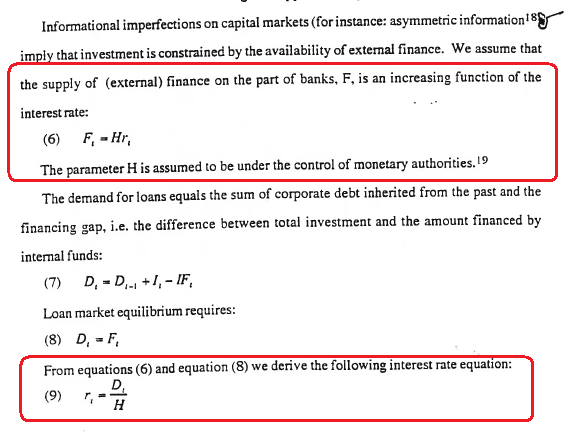
I came across a discussion on whether Minsky was really stuck with the loanable funds model of credit. I found an article he had written titled “Financial Institutions, Economic Policy and the Dynamic Behavior of the Economy” with two co-authors in 1994.

On page 10 (i.e., page 12 of the pdf document) the authors have this to say:

Further on page 12 (page 14 of the pdf):

Decide for yourself on the question posted earlier.

Update 22 January 2012: Withdrew a statement made on Sir Dennis Robertson

Merry Christmas

Merry Christmas to all!

(card courtesy Hallmark)

I have been reading this article/blog post The Curse of Tina by Adam Curtis of the BBC – it’s a long article and there are several videos in the post, making it a long read. What led me into the article was the discussion of policies put forward by Monetarists which led to a damage of the British economy in the 70s and the 80s. The IEA – Institute of Economic Affairs – called Monetarism “scientific” (!) and persuaded the government in adopting its policies. Overall, the article gives a good glimpse of failed policies over so many years. (Nevermind the author’s mistaken belief that there is no alternative)

Of course, the best source for this is Nicky Kaldor’s The Scourge Of Monetarism (Oxford University Press, 1982). Kaldor had a supreme understanding of banking and the endogenous nature of money. In the book, he wrote:

As it is, a highly developed banking system already provides such facilities on an ample scale, since it is prepared to accommodate the public’s changing demand between different types or financial assets by altering the composition of the banks’ assets or liabilities in a reverse direction. If the non-banking public wishes to switch its holding of gilts for interest-bearing bank deposits, the banks are ready to supply such deposits at the minimum of inconvenience, and at the same time to place their surplus funds into the gilts which were previously held by the public. Similarly the banks provide easy facilities to their customers for switching balances on current accounts into interest-bearing deposit accounts, or vice versa. Hence, while the annual increment in the total holding of financial assets of the private sector (considered as a whole) is nothing more than the mirror-image of the borrowing requirement of the public sector (in a closed economy at any rate), neither the Government nor the banks can determine how much of this increment will be held in the form of cash (meaning notes and current deposits) and how much in the near-equivalents to cash (such as interest-bearing demand deposits) or in various forms of public sector debt. Thus neither the Government nor the central bank can control how much or the total financial assets the public prefers to hold in the form of ‘money’ on one particular definition or another.

*I initially thought Adam Curtis as saying that there is no alternative which he was not – he probably just meant that according to politicians there is no alternative. I thank Philip Pilkington in pointing this out).

Today’s Eurosystem LTRO

On 8 Dec, the European Central Bank announced that it will conduct two Longer-Term Refinancing Operations (LTRO) with a maturity of 36 months – one each in December and February. According to the initial press release,

The operations will be conducted as fixed rate tender procedures with full allotment. The rate in these operations will be fixed at the average rate of the main refinancing operations over the life of the respective operation. Interest will be paid when the respective operation matures.

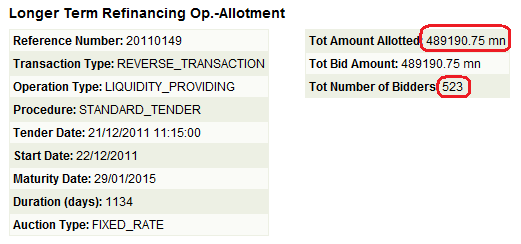
The allotment was made today and banks borrowed around €489bn.

The ECB had also given banks an option to shift previous funding:

Counterparties are permitted to shift all of the outstanding amounts received in the 12-month LTRO allotted in October 2011 into the first 3-year LTRO allotted on 21 December 2011.

And according to today’s press release,

The allotment amount of EUR 489,190.75 million includes EUR 45,721.45 million that were moved from the 12-month LTRO allotted in October 2011. A total of 123 counterparties made use of the possibility to shift, whereas 58 banks decided to keep their borrowing in the 12-month LTRO, which has now a remaining outstanding amount of EUR 11,213.00 million.

Another feature of today’s allotment was that Italian banks issued bonds backed by their sovereign and retained the issuance to place them as collateral with their Banca d’Italia – their home NCB for their bids. According to FT Alphaville,

According to Reuters, 14 Italian banks have listed €38.4bn worth of state-guaranteed bonds ahead of the LTRO.

More information:

RTRS-ITALIAN BANKS TAPPED ECB’S NEW 3-YR LOANS FOR MORE THAN 110 BLN EUROS – ITALIAN BANKING SOURCE

RTRS: 14 Italian banks win clearance for state-backed bond issues worth EUR 57-58bln, figure includes EUR 38.4bln already listed – sources

Another reason the auction received so much attention was due to the huge speculation that banks will borrow from the Eurosystem and use it to purchase the debt of their sovereigns and even other Euro Area governments. To me, this is nothing more than speculation because it fails to understand how banks work – the LTRO was to help banks meet their funding needs. It is true that some banks (and only a few) may have done this “carry trade” but it is highly risky and as Megan Greene of Roubini Global Economics put it,

This sort of carry-trade could be extremely dangerous, because it not only fails to break the banking/sovereign feedback loop, it actually strengthens it.

Gavyn Davies of FT had this to say in his blog (which is a fine explanation).

The French government was very explicit that the liquidity injection could be used by banks to buy sovereign debt with a large positive carry. This will almost certainly prove too optimistic, since the banks need the money to redeem their own bonds, not to buy risky debt from sovereigns. Nevertheless, the ECB is certainly preventing banks from selling sovereign debt that they otherwise would have sold, and it is doing this by expanding its own balance sheet. …

Who Is Germany?

In recent posts on the Eurosystem, I looked at how it operates and in The Eurosystem: Part 2 highlighted how capital flow across borders within the Euro Area has led to a large accumulation of TARGET2 balances by some NCBs such as the Deutsche Bundesbank.

Bloomberg Businessweek had an article Germany’s Hidden Risk recently on this:

If the euro zone breaks into sorry little pieces, Germany could possibly lose its entire €495 billion claim. That’s more than $650 billion. It is 60 percent bigger than Germany’s annual federal budget—and larger than the lending under the European Financial Stability Facility and other aid programs that have received more scrutiny.

Some experts on TARGET2 disagree. So I got into an argument with a blogger (who has a good understanding of TARGET2, btw) according to whom

But let’s take a closer look. Who is this “Germany”? Will the German residents who got their accounts credited as a result of the Target2-facilitated transfers out of Ireland now lose their money? No. There will be no losses to private citizens. Despite all this misleading stuff about “enforced lending”, German citizens will be very grateful that they managed to repatriate their money to German via Target2.

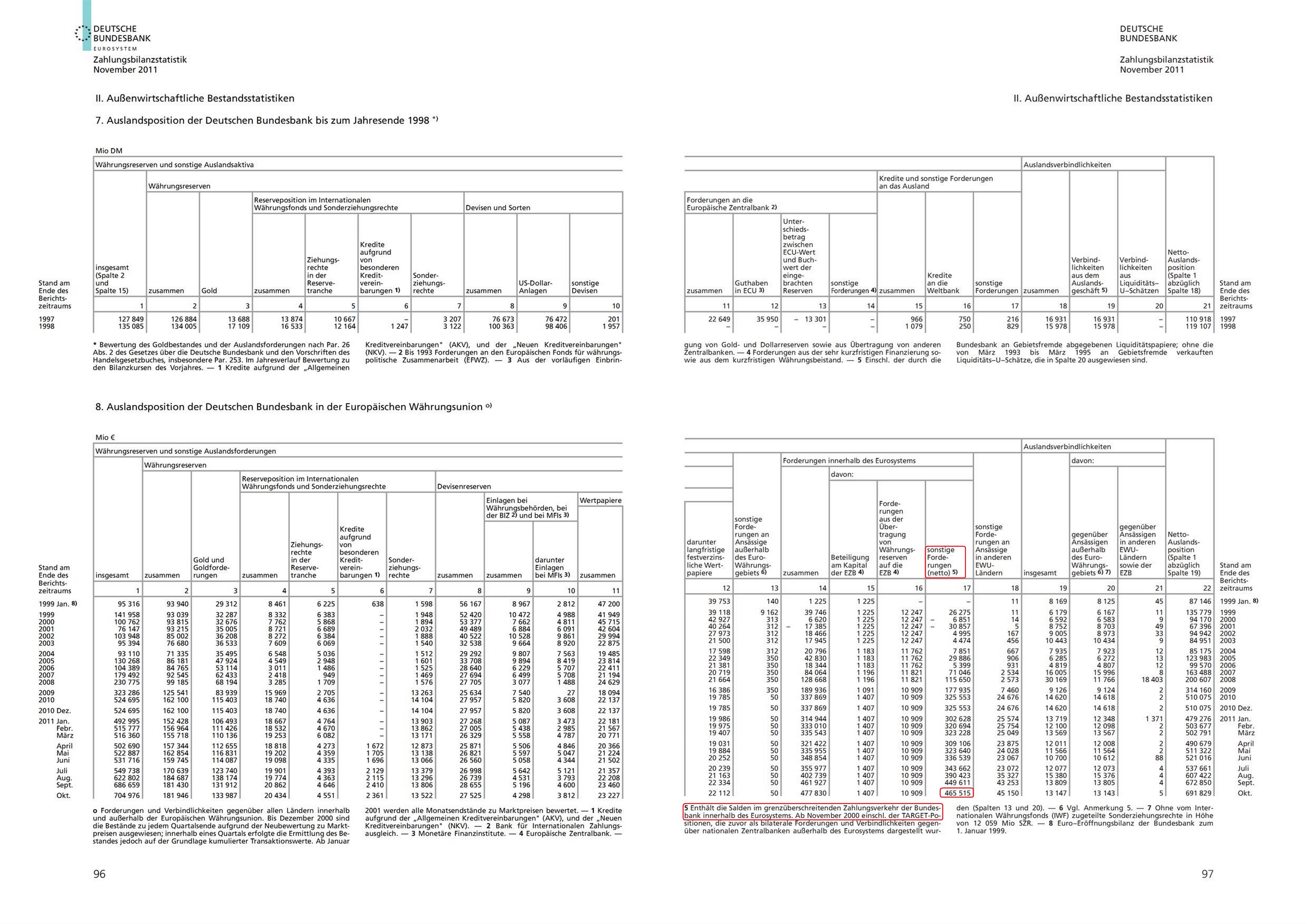
So “Who is Germany”? Hidden in the above quote is that individuals and corporations only make Germany and that if the Euro collapses and hence the European Central Bank goes out of existence, Germany’s Bundesbank’s TARGET2 loss of €465bn (latest data I could get) will be not really a loss for “Germany”. This can be dismissed easily.

According to the IMF’s Balance Of Payments And International Investment Position Manual or BPM6

The IIP is a statistical statement that shows at a point in time the value of: financial assets of residents of an economy that are claims on nonresidents or are gold bullion held as reserve assets; and the liabilities of residents of an economy to nonresidents. The difference between the assets and liabilities is the net position in the IIP and represents either a net claim on or a net liability to the rest of the world.

A nation’s net wealth is the value of its real assets and its net international investment position. This definition has a Mercantalist bias but they have been proven right many times!  A loss of Germany’s TARGET2 balance will represent a loss to Germany as a whole. Let us look at this closely with some real numbers.

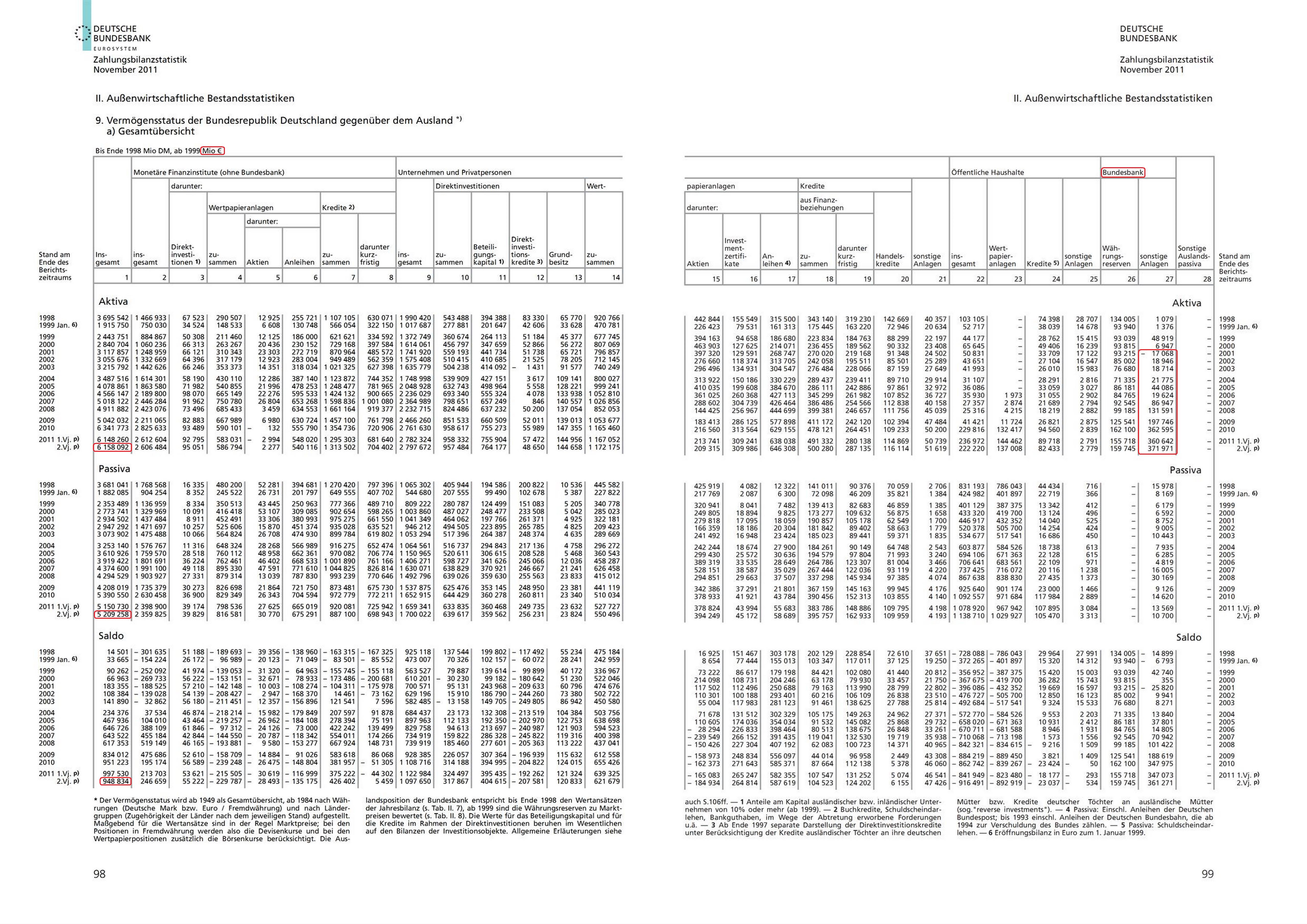
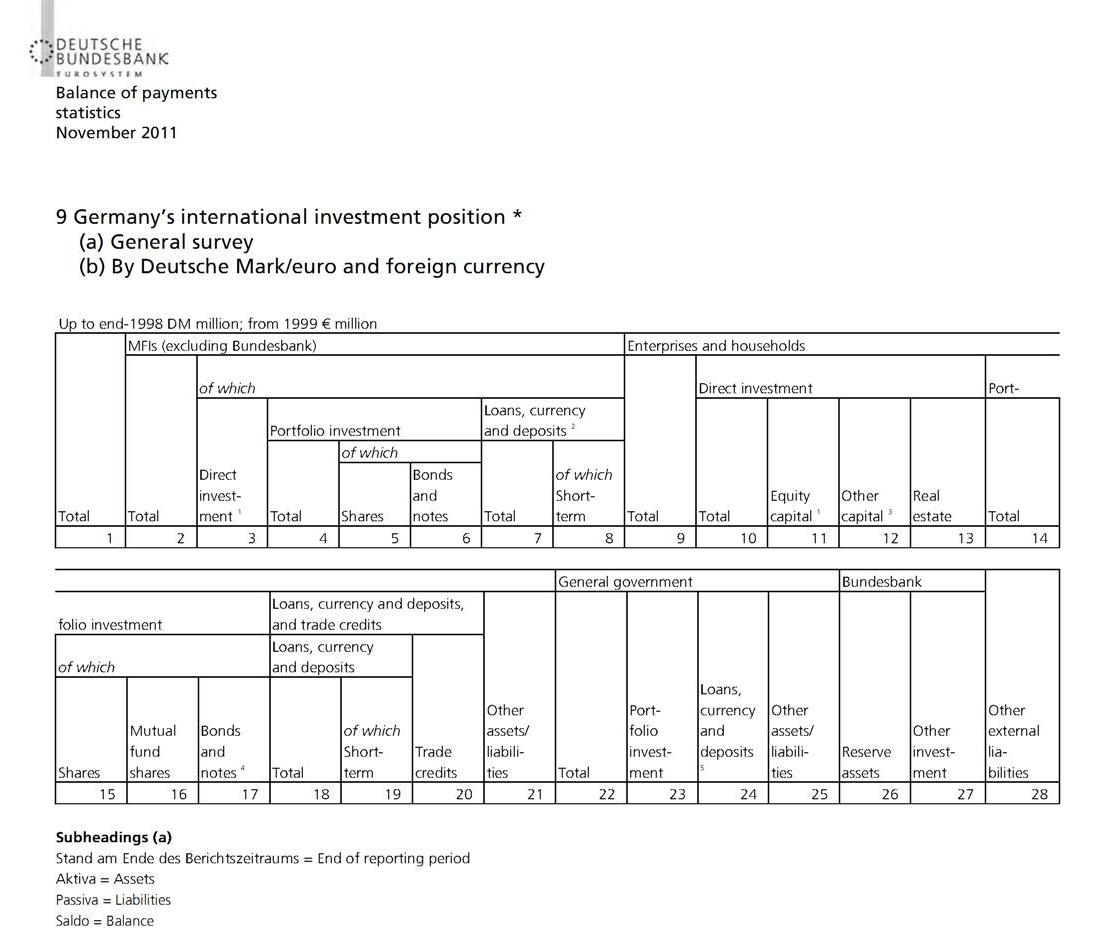
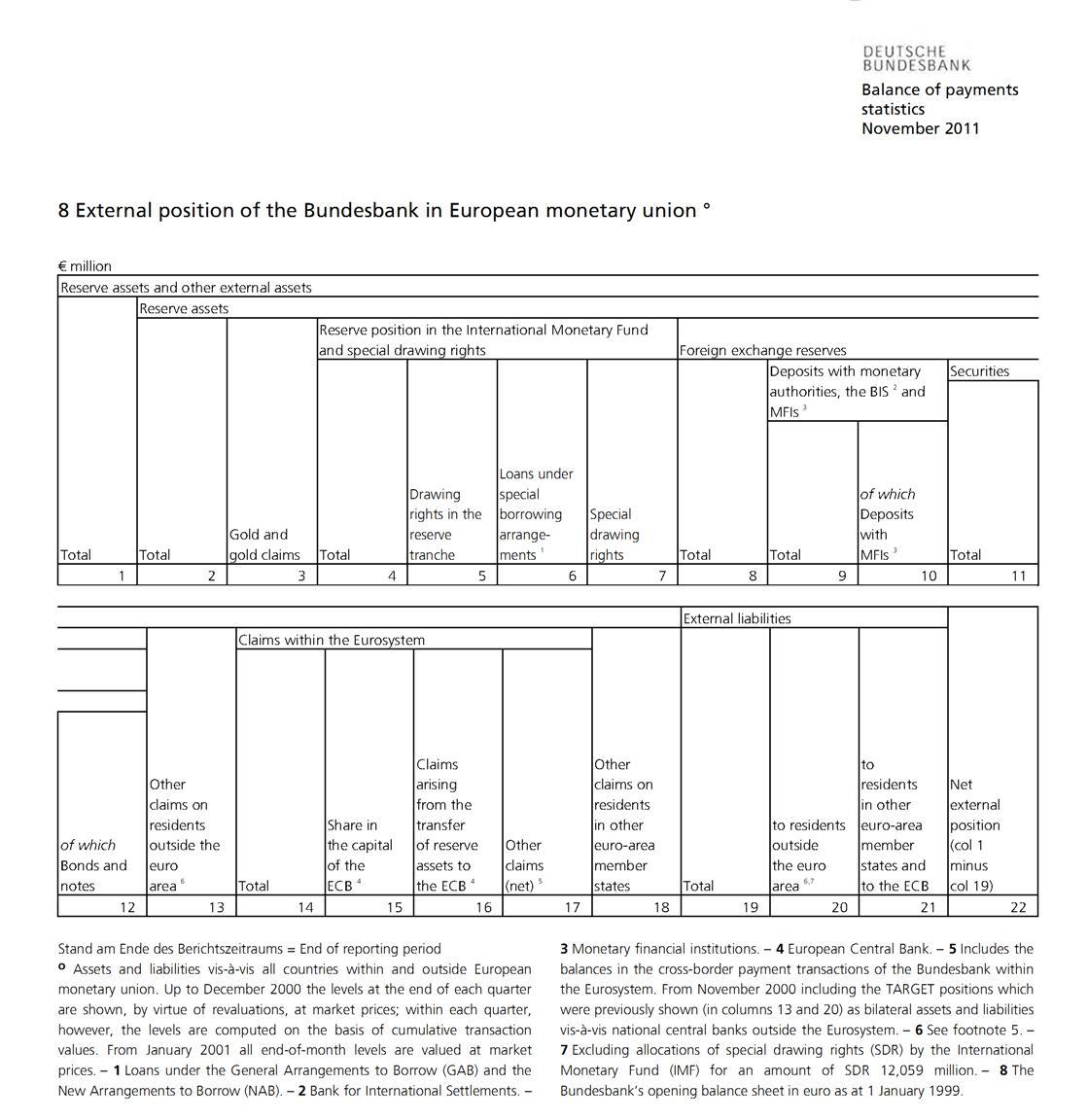
According to the Bundesbank’s Balance of Payments Statistics, November 2011, (with English translation below)

(click to enlarge)
(click to enlarge)

Germany had assets of €6,158bn and liabilities of €5,209bn and thus a net asset position of around €949bn.

The table columns 26 and 27 show how Bundesbank’s foreign assets have increased recently but aren’t fully updated. Another table from the publication gives the updated numbers.

(click to enlarge)

with the English translations:

(click to enlarge)

So the Deutsche Bundesbank had a TARGET2 balance of €465bn at the end of October and is still rising! This is a sizable fraction of the net asset position of €949bn. (for other comparions, Germany’s 2010 GDP was €2,499bn).

The reason I went through this detail was to help the reader appreciate the question “Who is Germany”. Many breakup scenarios may put Germany at the risk of losing out this huge asset. No domestic transaction will bring this back to the original level.

There are even more dreadful scenarios one can think of. A sudden loss of confidence and a dramatic “flight to quality” will lead residents and foreigners selling foreign assets in the Euro Area (in addition to non-Euro denominated assets) and shifting the liquidated deposits via TARGET2 to German banks and if Germany loses its TARGET2 balance, it could become a net debtor to the rest of the world!

An example will illustrate this. Suppose there is a further shift of €1,000bn before a Eurocalypse. This will lead to Germany’s gross assets increasing from €6,158bn to €7,158bn and liabilities from €5,209bn to €6,209bn, leaving the net position unchanged but increasing the Bundesbank’s TARGET2 position from €465bn to €1,465bn. A potential impairment of 100% implies that Germany’s Net International Investment Position is minus €516bn. All this ignoring residents’ revaluation losses of assets held abroad in such scenarios which will make the whole thing even more disastrous!

The above analysis is for non-residents inside the Euro Area making a financial flight to quality into Germany. For residents, a shift of say €1bn does not increase gross asset and liability positions – as far IIP construction is concerned – but increases Bundesbank’s TARGET2 assets by €1bn with the same effect as above.

In either case – residents or non-residents – Germany’s net asset position is under high risk because of the potential loss due to Bundesbank’s TARGET2 balance vanishing in thin air.

Of course, it won’t be an immediate risk to Germany in the sense that it can go back to the Deutsche Mark and redenominate debts in the new currency and do a fiscal expansion to prevent a loss in output. At any rate, Germany’s wealth which it earned in all these years would have reduced – a Mercantalist’s nightmare.

Christine Lagarde’s Warning

FT has an article today on Christine Lagarde’s warning

about a 30s style depression and that

faces the prospect of “economic retraction, rising protectionism, isolation and . . . what happened in the 30s [Depression]”

The video is below. Lagarde’s speech starts at 13:00 and ends at 25:25

click to watch the video on YouTube

Lagarde rightly stresses the “vast interconnectedness” between all economies and that that the crisis can be resolved only by all countries taking action.

Gillian Tett of FT wrote a bio of Christine Lagarde recently. It has more about her shoes than economics.

Macdougall Report

Charles Goodhart and Dirk Schoenmaker just released their article on a game plan for saving the Euro, which is approaching its endgame. According to them,

An EZ Minister of Finance without money is like an emperor without clothes. There are proposals to have tax capacity capable of funding a budget of about 2% of European GDP (Marzinotto et al 2011; Goodhart 2011). This 2% should cover most eventualities, including effective stabilisation policies. Yet there may be exceptional circumstances, for example, relating to banking resolution where more is needed (the deep pockets of government).

Given the severe imbalances in the Euro Area, this looks too low. Really 2%? A recent empirical study done by The Economist for the United States suggests otherwise.

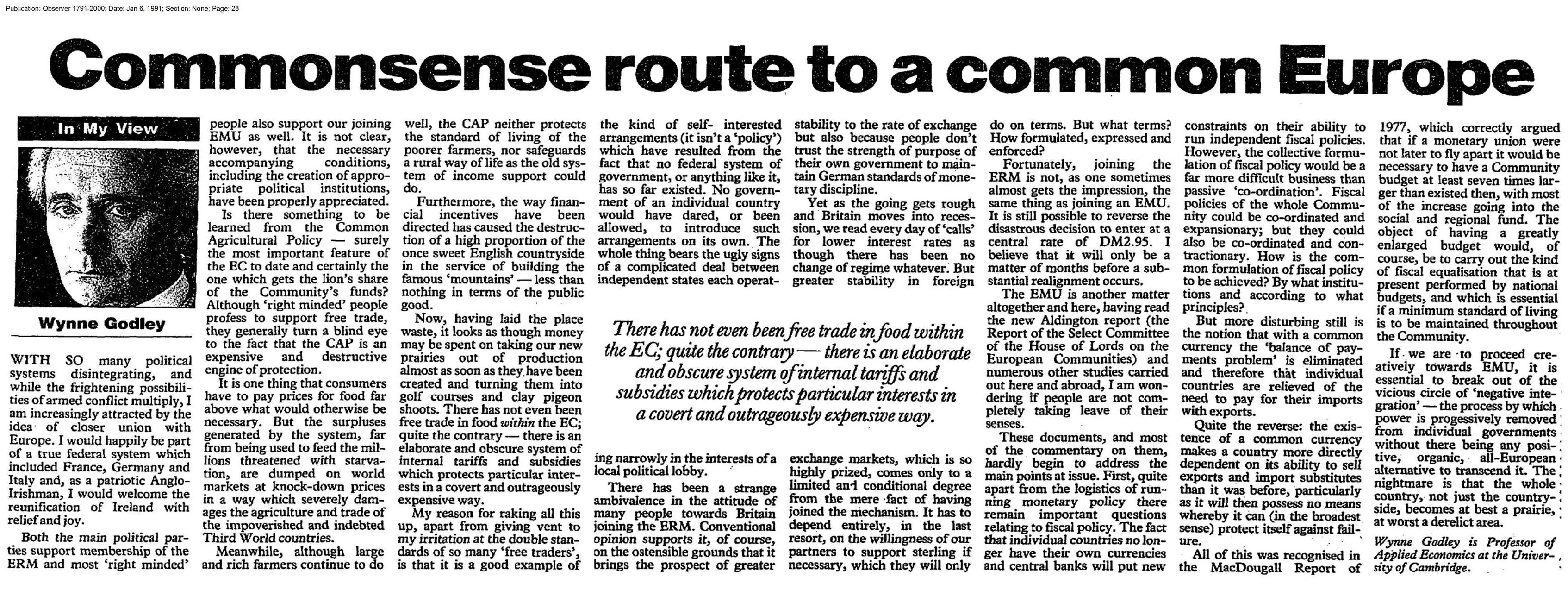
What is wrong with the Euro Area? Wynne Godley said this best in an article (written in 1991) in The Observer titled “Commonsense Route To A Common Europe”. Scan here

But more disturbing still is the notion that with a common currency the ‘balance or payments problem’ is eliminated and therefore that individual countries are relieved of the need to pay for their imports with exports.

Quite the reverse: the existence or a common currency makes a country more directly dependent on its ability to sell exports and import substitutes than it was before, particularly as it will then possess no means whereby it can (in the broadest sense) protect itself against failure.

All of this was recognised in the Macdougall Report of 1977 which correctly argued that if a monetary union were not later to fly apart it would be necessary to have a Community budget at least seven times larger than existed then, with most of the increase going into the social and regional fund. The object of having a greatly enlarged budget would, of course, be to carry out the kind of fiscal equalisation that is at present performed by national budgets, and which is essential if a minimum standard of living is to be maintained throughout the Community.

[emphasis added ;-)]

The Macdougall Report is available from the European Commission website: Part 1 and Part 2. Haven’t read it, so my knowledge is restricted to the above quote, and it adds to my huge list of things to do.

At the time of writing, I believe the situation was much different. The imbalances in the “three sectors” (public, private and external) is now severe in the Euro Area. (Three for each country, so actually 17 x 3)

Sir Donald Macdougall died in 2004 and according to The Guardian‘s obituary:

His career – as an Oxford don, a London “special adviser”, a mover and shaker in Whitehall and Westminster – started before the second world war, and wound down with skilful “letters to the editor” against the euro.

There have been so many proposals on attempts to rescue the Euro Area. Ideas termed “monetary financing” by the European Central Bank carry tremendous risks of exacerbating imbalances within the Euro Area, because nations will keep relying on the Eurosystem’s financing and is a potential political time-bomb. And, there are those simpletons, who argue that nations should just walk away! As if …

To me, it looks as if the European leaders know that the size of the central government and the fiscal transfers would be substantial given Macdougall’s estimations were done when the situation was much different and a redoing may prove this. It is the political unacceptability of this, which will finally lead to Eurocalypse.

Martin Wolf On EU Summit

Excellent analysis of the EU Summit by Martin Wolf on FT using the sectoral balances approach:

Let me make this point by turning last week’s analysis of the balance of payments into one of foreign, private and government financial balances in eurozone members (see charts). To remind readers: these have to add up to zero, by definition. But how they go about adding up is revealing.

As I noted last week, fiscal imbalances were modest before the crisis, but the current account imbalances were huge. Surplus private funds in some countries (notably Germany and the Netherlands) were intermediated by the financial system to fund private deficits in others (notably Greece, Ireland, Portugal and Spain). When crisis hit, these flows ceased. Deficits of private sectors collapsed (most turning into surpluses), while fiscal deficits exploded. Now, says Germany, the latter must be slashed.

By definition, the sum of private and current account deficits must also fall towards zero. The private sectors of erstwhile capital-importing countries have moved towards surpluses, for a good reason: they are trying to reduce their debts, not least because their assets are falling in value. Thus the external deficit needs to fall. That can occur in a good or a bad way. The good way would be via increased output of exports and import substitutes; the bad would be via a deeper recession. The good way requires far higher imports in the core of the eurozone or far greater competitiveness for the eurozone as a whole. But little chance of either of these exists, under plausible expectations for demand and activity. That leaves the bad way: deep recessions, in which the government reduces its deficit by deflating the private sector yet more.

In brief, it is extremely difficult to eliminate fiscal deficits in the structural capital-importing countries, without prolonged recessions or huge improvements in their external competitiveness. But the latter is relative, so the needed improvements in the external performance of weak eurozone countries imply a deterioration in that of eurozone capital-exporters, or radically improved external performance for the eurozone as a whole. The former means that Germany becomes far less German. The latter implies that the eurozone becomes a mega-Germany. Who can believe either outcome is plausible?

This leaves much the most plausible outcome of the orgy of fiscal austerity: long-term structural recessions in vulnerable countries. To put it bluntly, the single currency will come to stand for wage falls, debt deflation and prolonged economic slumps. Can this stand, however big the costs of a break-up?

The eurozone has no credible plan to fix the flaws of the eurozone, apart from greater fiscal austerity: there is to be no fiscal, financial or political union; and there is to be no balanced mechanism for economic adjustment on both sides of the creditor-debtor divide. The decision is, instead, to try still harder with a stability and growth pact whose failures have been both predictable and persistent.

Alternative link with no subscription via Business Spectator