Here are two very nicely written articles by the London Review of Books on the Libor (from 2008) and on the Higgs (from their blog from yesterday).
- What’s In A Number by Donald MacKenzie
- Higgs At Last by David Kaiser
Here are two very nicely written articles by the London Review of Books on the Libor (from 2008) and on the Higgs (from their blog from yesterday).
My previous post “Not In My Lifetime” – The Muddled Road Toward An Integrated Europe had some responses – mostly saying I was too kind to Angela Merkel and Wolfgang Schäuble and that ceding powers to a supranational authority will lead to imposing of draconian rules!
Meanwhile I came across these two articles from France 24: Europe needs ‘reinforced political union’, says Merkel and Merkel rejects debt-pooling proposal ahead of EU talks. According to the first article:
“We need more Europe… a budget union… and we we need a political union first and foremost,” Merkel told German public television. “We must, step by step, cede responsibilities to Europe.”
My answer is while the German leaders have panicked and imposed severe austerity rules on nations due to pressures from the financial markets, their intention of having “More Europe” is certainly a good one. It took me a while to understand that it’s Germany which is open to having a full integration while others do not. There’s a lack of trust here, given what has happened over the past 2-3 years.
There are three ways to approach the crisis as I see it.
The first is to impose trade barriers on each other. This gives fiscal policy more room to expand domestic demand without running into a balance of payments crisis (again) and the European Central Bank can act as the lender of the last resort if it were to understand that the stocks of debts would be sustainable. However imposing barriers is against the philosophy of the “common market”. Hence this is ruled out.
The second is to coordinate a fiscal expansion with the ECB acting as a lender of last resort if needed. But how does this coordination happen and on what terms? This also requires institutions and will require summit after summit – if previous experiences are any guide.
The third is the German plan to have a supranational fiscal authority which is given the power to make expenditures and earn via taxes. In my opinion this is what Germany is looking for and not a small institution which is obsessed with balanced budgets and no fiscal powers. Of course if there is a supranational fiscal authority the nations may have to balance budgets(!) while this institution itself runs a deficit and is involved in substantial transfer of fiscal resources (quite opposite of what Charles Goodhart thinks!).
Economists such as Nouriel Roubini object to the German plan citing surrendering of sovereignty as the reason. It should however be noted that by signing the Maastricht Treaty Euro Area nations have already surrendered their sovereignty. Now, they could either cede more powers to “Europe” or (since there is a lack of trust) decide to break the Euro Area.
There are advantages of breaking up but it will be a terrible thing for Europe. It is also unclear how it can be implemented – given that at some level the Euro Area is integrated. With a lack of trust, this may be the best thing to do but in my opinion, it is the task of the European leaders to work toward gaining each others’ trusts.
The reason Angela Merkel has rejected the “debt pooling” plan of Herman Van Rompuy, José-Manuel Barroso, Jean-Claude Juncker and Mario Draghi (and also pushed by George Soros) is that it really does not solve anything except satiating the instant gratification wants of the financial markets. The Germans haven’t rejected the €-bonds per se.
Merkel’s plan – what’s called transfer union in Germany may meet with substantial opposition by German citizens. The Germans tend to think that they will be paying higher taxes without knowing that at the same time their incomes will be higher because the new union will be substantially less deflationary. A referendum may likely fail and this remains a challenge. The Euro Area needs an Alexander Hamilton as Ronald McKinnon argued recently.
My purpose of writing this post was to point out the in the media – especially the financial media – Germany is shown to be the villain. For example I think Wolfgang Munchau – who generally writes well said this in the Financial Times (The real victor in Brussels was Merkel)
The most important event last week was probably not the agreement at the summit anyway, but the statement by Ms Merkel that there will be no eurozone bonds “for as long as I live”. My belief is that this statement reveals she is not serious about political union, to which she has been paying lip-service over the past few weeks. Her tactics remind me of the “coronation theory” of the 1980s: the Bundesbank used to say that monetary union was acceptable but only after full political union was completed. It was another way of saying never. I always suspected all this talk about long-term solutions might be a ruse. Now, it seems, we know.
If Ms Merkel is right and there are no eurozone bonds in her lifetime, the eurozone will not survive. Without eurozone bonds or a change in ECB policy, Italy’s and Spain’s debt – and eurozone membership – is not sustainable. That was as true on Wednesday as it is today.
This is a slight misrepresentation of Merkel because she said that there will be no €-bonds in the plan presented in the last week’s summit (which didn’t have a common fiscal policy) and hence not without any qualifications.
Both Angela Merkel and the German Finance Minister Wolfgang Schäuble have been quoted in the media as saying that they won’t go ahead with the “€-bills” and plans like that in their lifetime! Of course such quotes are incompletely reported and what they mean is that they won’t have a plan such as that without a common fiscal policy.
In the ongoing Summit, European leaders came up with a few plans which led to financial markets rallying. The Italian FTSE MIB Index was up 6.59% today!! There was one plan which didn’t take off and this was the plan of having a “redemption fund”. The formal proposal is here: TOWARDS A GENUINE ECONOMIC AND MONETARY UNION Report by President of the European Council Herman Van Rompuy
Of course this didn’t go through because the two German leaders wouldn’t have allowed it in their lifetimes! So what does Germany really want?
To understand this we must first understand that – as argued by Wynne Godley in 1992 – to join a monetary union nations should surrender their sovereignty with this sovereignty being taken over by a supranational authority (which was absent in the Maastricht Treaty):
I recite all this to suggest, not that sovereignty should not be given up in the noble cause of European integration, but that if all these functions are renounced by individual governments they simply have to be taken on by some other authority. The incredible lacuna in the Maastricht programme is that, while it contains a blueprint for the establishment and modus operandi of an independent central bank, there is no blueprint whatever of the analogue, in Community terms, of a central government. Yet there would simply have to be a system of institutions which fulfils all those functions at a Community level which are at present exercised by the central governments of individual member countries.
The counterpart of giving up sovereignty should be that the component nations are constituted into a federation to whom their sovereignty is entrusted. And the federal system, or government, as it had better be called, would have to exercise all those functions in relation to its members and to the outside world which I have briefly outlined above.
Merkel and Schäuble want to move ahead with the full creation of a federation – presumably headquartered in Brussels and they have the task of managing the fiscal decisions for the whole of the Euro Area. Since this institution will run deficits, it is natural that it will finance the difference between expenditure and taxation by issuing bills and bonds (which will be the real €-bonds). Hence the two leaders have qualified their statements but this has been quoted everywhere as some kind of comedy of errors!
The two leaders have the double task of convincing the German politicians and German public on the one hand and politicians from the rest of the Euro Area on the other hand. In the middle of this, they see this plan from Herman Van Rompuy, José-Manuel Barroso, Jean-Claude Juncker and Mario Draghi adding to confusions. The plan from the four EU leaders still has no supranational institution which makes financial decisions for the whole Euro Area but only a special purpose entity presumably retired after 25 years.
The important difficulty in the creation of a supranational institution which will manage the finances of the whole Euro Area (and not any “sinking fund”) is that the current setup is an incomplete one where nations’ governments still have a good amount of power in spite of them having surrendered most of their sovereignty.
While convincing the German citizens may be a hard task, Merkel and Schäuble are facing difficulties also in convincing other European leaders. Other nations do not wish to surrender whatever powers they still have but in the process do not understand what an integration means. Their leaders could have chosen to not join the Euro Area – just like what Mrs Thatcher did for the UK. Now that they have joined it and given it is difficult for any one nation to leave, it is in their best interest to go ahead with the full integration which has a supranational fiscal authority but this comes with surrendering more powers!
As Wynne Godley argued further:
If a country or region has no power to devalue, and if it is not the beneficiary of a system of fiscal equalisation, then there is nothing to stop it suffering a process of cumulative and terminal decline leading, in the end, to emigration as the only alternative to poverty or starvation. I sympathise with the position of those (like Margaret Thatcher) who, faced with the loss of sovereignty, wish to get off the EMU train altogether. I also sympathise with those who seek integration under the jurisdiction of some kind of federal constitution with a federal budget very much larger than that of the Community budget. What I find totally baffling is the position of those who are aiming for economic and monetary union without the creation of new political institutions (apart from a new central bank), and who raise their hands in horror at the words ‘federal’ or ‘federalism’. This is the position currently adopted by the Government and by most of those who take part in the public discussion.
As Jim O’ Neill of Goldman Sachs mentions in a recent interview to Bloomberg, the Germans are open to this but unfortunately, the French have objections to this route.
In the above video (edit: no longer available), O’ Neill (jokingly called Governor O’Neill by Tom Keene of Bloomberg because he is said to be the top man for the post of the chief of the Bank of England when Mervyn King’s term ends soon) argues the Europeans are known to leave it till the last moment – when it’s on the brink. Till then they will continue to muddle. Unfortunately for Merkel and Schäuble, solving short term issues makes the financial market conditions ease substantially, the opposite of what they want, because only when other Euro Area nations are in a lot of trouble will they be ready to accept the German solution. Of course this is a sad way to solve the problem but Schäuble has been quoted in the press saying that the EA needs a crisis to make any progress.
Unfortunately the financial markets rally!
How ironic!
The BEA reported yesterday that the U.S. Net International Investment Position at the end of 2011 was minus $4,030.3bn. The large change compared to the end of 2010 (where it was -$2,473.6bn) was due to large revaluations of assets and liabilities in addition to the current account deficit. See the BEA blog on this.
For IIP, Foreign Direct Investments are measured at “current costs”. When evaluated at market prices, the net international investment position at the end of 2011 would have been minus $4,812.4bn. The NIIP also includes official gold holdings and if this is excluded, the net indebtedness is greater than $5T.
The following is the NIIP as a percent of GDP at market prices.
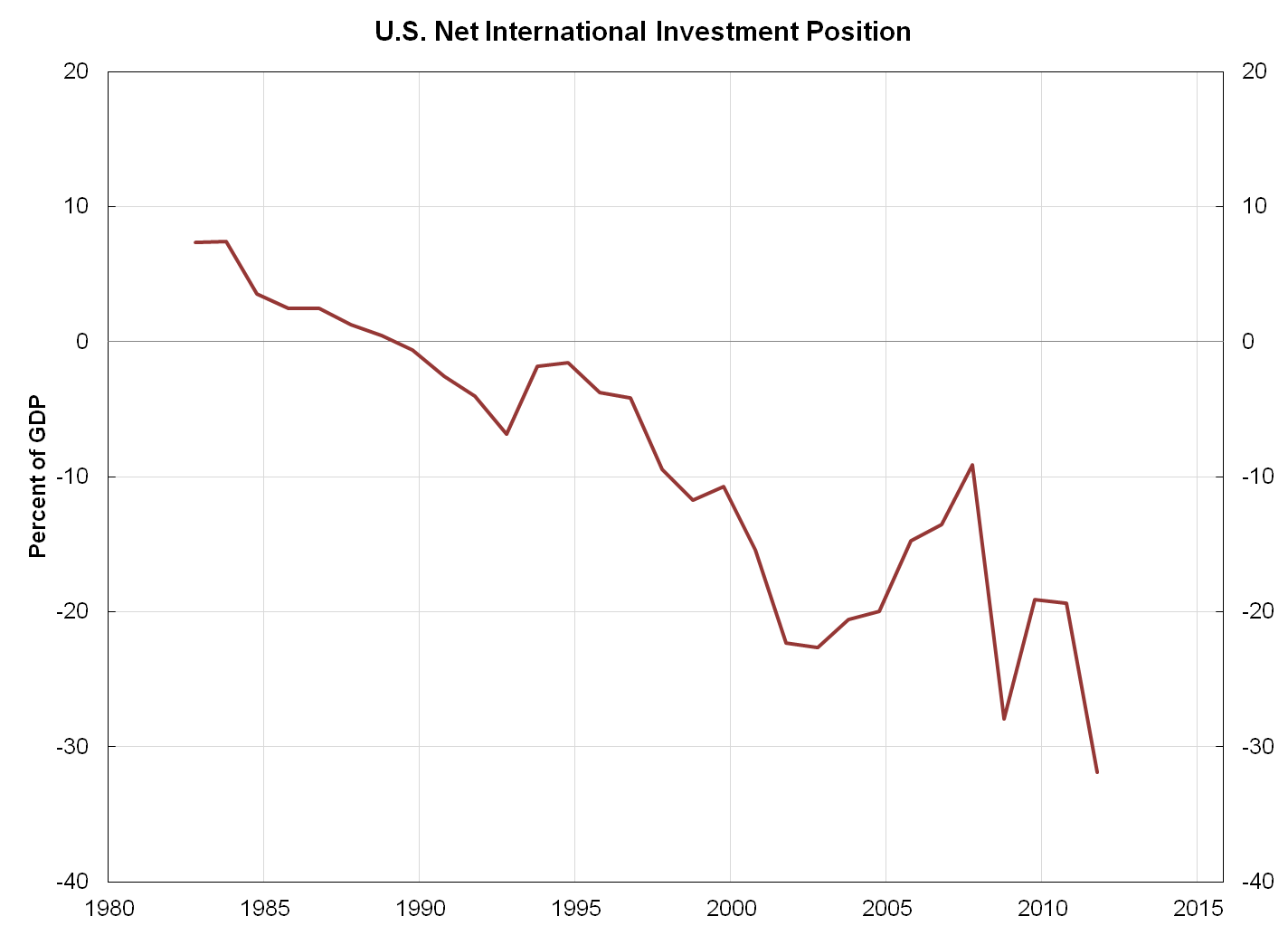
There are several reasons this by itself hasn’t worked against the U.S. The U.S. dollar is the reserve currency of the world* and secondly direct investments make huge returns for the U.S. (It should still be noted that the current account deficits bleed demand in the U.S. at a massive scale). Direct investment abroad at the end of 2011 was about $4.5tn and foreign direct investment by nonresidents in the United States $3.5T.
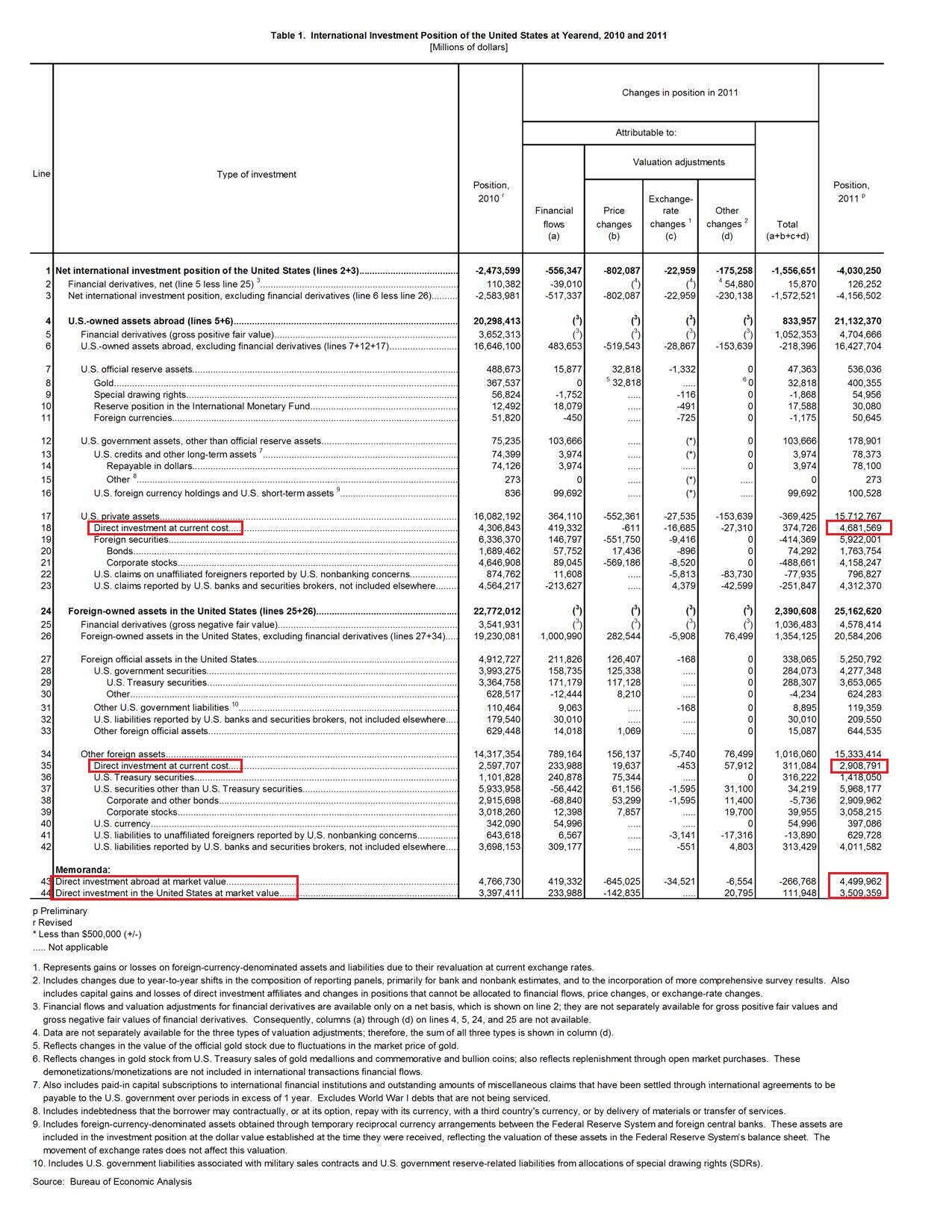
U.S. International Investment Position
(click to enlarge)
The direct investment abroad makes a huge killing for the U.S. as can be seen from the balance of payments. In 2011, direct investment receipts was around $480bn and direct investment payments only $159bn.
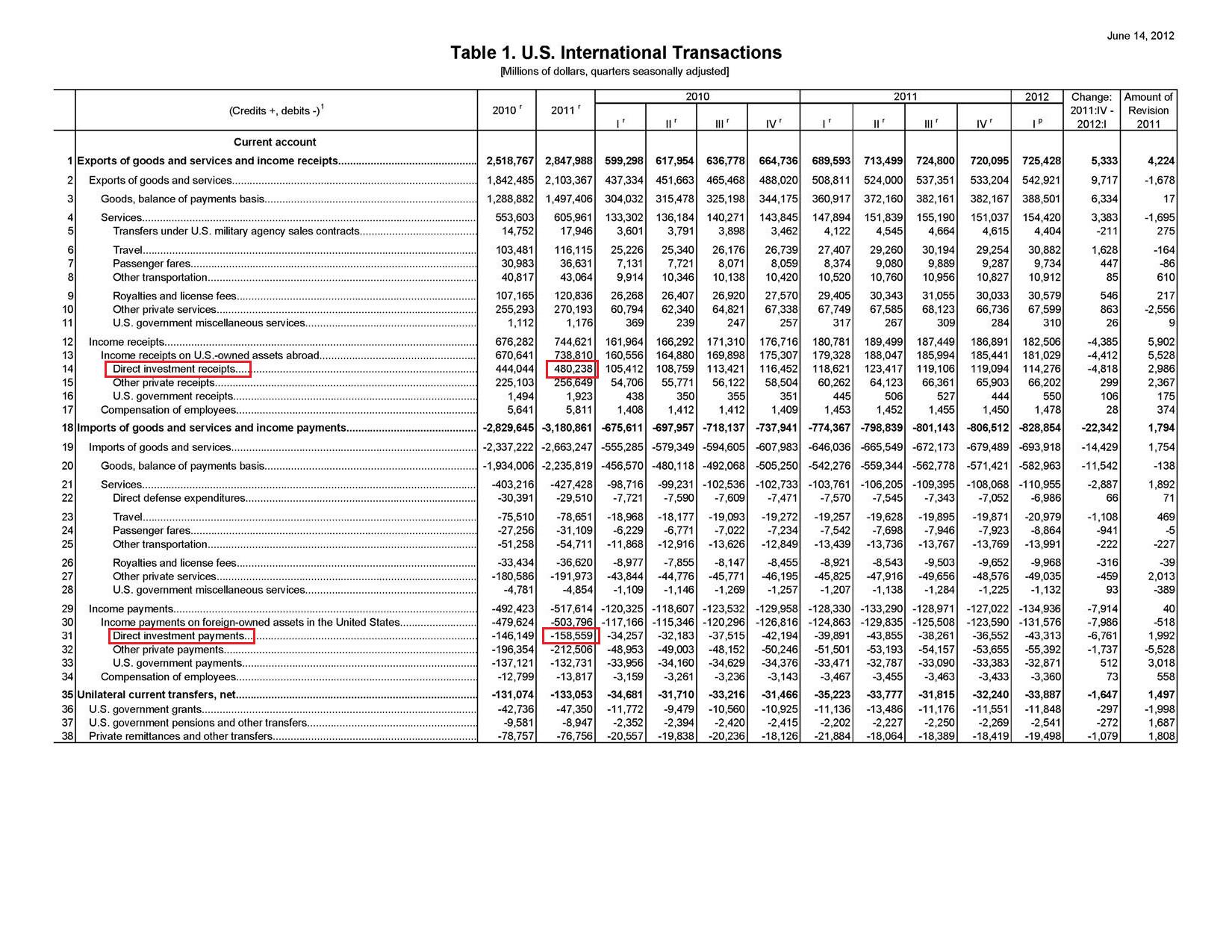
U.S. Current Balance of Payments
(click to enlarge)
*non-direct investment income is already against the United States’ favour though.
Here.
I think Greenspan has to read this article by Dirk Bezemer ‘No One Saw This Coming’ – Or Did They?
Greenspan however confesses that economic models do not have flow of funds in them (just what Bezemer highlighted about mainstream models as opposed to heterodox ones) but claims that the “sophisticated models” of the IMF, the Federal Reserve or JP Morgan explain the real economy well!
This is a note by Eladio Febrero Panos sent to me by Sergio Cesarrato.
by Eladio Febrero Paños
Area de Teoria Economica, Facultad de Economicas, UCLM Pza Universidad no. 1, 02071 Albacete, Spain
Let us assume the following initial situation.
There are two private banks, one in Spain (SPB) and another one in Germany (GPB); we have also two central banks (BdE for Spain and Buba for Germany). For simplicity’s sake, we omit the ECB which connects them through the TARGET2 (T2) system.
Imagine the following balance sheets which (I hope) are self evident:
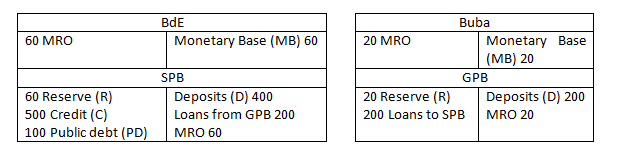
This figure accounts for the import of a commodity made in Germany by a Spanish agent (amounting to 200 monetary units, m.u. onwards). This import generated a deposit which was then “lent” by GPB to SPB. With this loan, T2 claims and liabilities cancelled out.
Also, we are assuming a compulsory reserve system, with a reserve coefficient of 10% on collected deposits. This is an overdraft system (Lavoie[1] has described this very often), so that each central bank lends to private banks in its jurisdiction the reserves that the former requires the latter to hold.
I think that, up to this point there is nothing controversial.
Next, we shall assume that GPB does not wish to roll over its loan to SPB because whatever reason. Consequently, GPB prefers to bring money at home.
How can this be done, if SPB does not have enough reserves? There are two alternatives.
In the first one, SPB would try to sell its public debt (PD). This option has at least two problems.
Firstly, even if SPB sells all its PD it will not obtain proceeds enough to cancel the loan from GPB.
Secondly, the price of PD would plummet and this is a problem for the implementation of monetary policy:
The central bank aims at preventing this situation (here). Because of this, it will provide SPB with liquidity. And here we have the second alternative.
The BdE will lend to SPB, either through the marginal lending facility, providing a loan, or through a MRO / LTRO (for our discussion this does not matter). If it makes a MRO, we shall have:
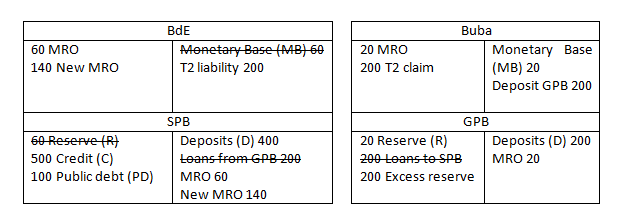
The ECB, through peripheral NCBs (national central banks) is providing liquidity to make it possible for German investors (and also peripheral ones) to carry their money to a safe harbor (in Germany, but also Luxembourg). T2 imbalances are the consequence of this monetary policy.
It should be noted that this is not a specific policy aiming at financing a current account imbalance in the periphery (here). It is not a fiscal policy, as Sinn has claimed so often.
It is an automatic policy, which makes it possible the payment system to run smoothly, something which is mandatory for the ECB.
Contrary to Sinn who argues as if the EMU is a club of countries with a fixed exchange regime, the EMU is a monetary union. In the EMU, countries are for the union like regions or autonomous communities for a nation-state. If you move your savings from a deposit in Banca San Paolo to Unicredit, and the former has no reserves deposited in the Banca d’Italia, the latter would create money and then credit the reserve account of Unicredit so your money would be there now. In its turn Banca d’Italia would acquire a claim on Banca San Paolo. If the latter has a solvency problem, then Banca d’Italia would force it to disappear (after selling its assets). If it has just a liquidity problem, Banca d’Italia probably would let it continue operating and wait until it can pay back its debt.
It should be noted that if Banca d’Italia in the example just above, or the European System of Central Banks (in this discussion on T2) does not provide with liquidity the banking system, it would collapse: there would be a bank run and the whole economic system would have very serious problems.
It is in this sense that T2 imbalances are the consequence and not the cause of the problems within the EMU.
It should be noted also that if, instead of having a central bank in Spain and another one in Germany, but just one for the whole EMU, T2 claims and liabilities would cancel out.
Also, you will find here statistical information about the relation between MRO and T2 for Spain, drawn from the Banco de España website (here and here in epigraph no. 8.1 if you click on ‘Series temporalesdel cuadro 8.1, you will download an excel file with the numerical information included in the pdf file). There you will see that there is a nice correlation between MRO and T2 imbalances during the last year or so (probably the correlation improves if you add LTRO to MRO).
References
There’s an interesting conversation between JKH and Marshall Auerback here on the constitutionality of TARGET2 balances of the NCBs of the Euro Area.
Rather than intervene in the comments, I thought I will let them exchange comments because I am not sure why Marshall Auerback thinks these are unconstitutional and more generally where he is headed in his series of posts. Links from Robert M Wuner who collects all the articles on TARGET.
The mechanics of TARGET2 are explained quite well in this ECB legal document GUIDELINE OF THE EUROPEAN CENTRAL BANK of 30 December 2005 on a Trans-European Automated Real-time Gross settlement Express Transfer system (TARGET)
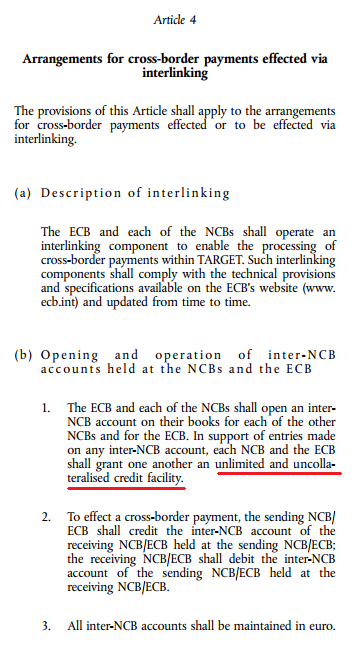
It cannot be otherwise!
I had a comment by Alea (@Alea_) and since I don’t publish comments, I am posting it here. It is the opposite of what I thought.
Your guideline refers to TARGET and has been repealed. There aren’t any unlimited and uncollateralised credit facility between NCBs under TARGET2.
Ramanan here. Thanks Alea for commenting.
This seems right.
The ECB site for ECB/2007/2 has this:
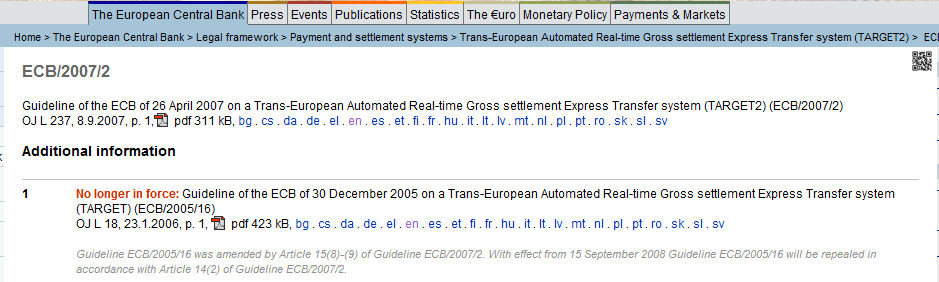
I am still reading ECB/2007/2 and wonder how it changed it and if there is any dope on this – such as setting limits on TARGET2 flows.
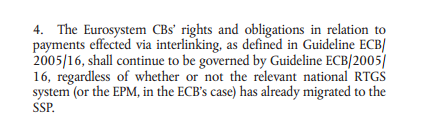
According to Article 15 of Section IV of the ECB/2007/2, interlinking provisions of ECB/2005/16 continue to hold.
Hence it seems NCBs and the ECB indeed have unlimited and uncollateralised credit facility with each other!
Philip Pilkington’s interview of Marc Lavoie on his textbook Monetary Economics is available to read at Naked Capitalism. New Directions in Monetary Economics: An Interview with Marc Lavoie – Part I
Part 2 appears here: New Directions in Monetary Economics: An Interview with Marc Lavoie – Part II
Wynne Godley used to think that Keynesians were being defeated by Monetarists because they (the Keynesians) simply could not answer how money (in general assets and liabilities) is created and hence wrote the book Macroeconomics with Francis Cripps. After that he wanted to make it even more solid.
Marc Lavoie says:
… it is clear that Wynne wished to depart from neoclassical economics, and start from scratch, which is what he did to some extent already when Wynne and his colleague Francis Cripps wrote a highly original book that was published in 1983, Macroeconomics. This book was written because Wynne got convinced that the Keynesians of all strands were losing their battle against Milton Friedman and the monetarists, because Keynesians could only provide very convoluted answers to simple questions such as: “Where does money come from? Where does it go? How do the income flows link up with the money stocks? How is new production financed?”
Our book Monetary Economics also tries to provide appropriate answers to these questions. We agonized for a while between trying to engage in a constructive dialogue with our mainstream colleagues and targeting a non-mainstream audience, or perhaps trying to achieve both goals. In the end, we figured that it would be very difficult to please both audiences, and we chose to focus on a heterodox audience. In any case, I have spent most of my academic career trying to develop alternative views and alternative models of economics – what is now called heterodox economics; this is the literature we know best. So we took our book as a formal contribution to this heterodox literature and more specifically as a contribution to post-Keynesian economics.
 Marc Lavoie at the Levy Institute, May 2011 (Photo Credits: me 😉 )
I came across this 2009 speech by William Dudley on banking where he rightly says:
… A related concern is the question of whether the Federal Reserve will be able to act quickly enough once it determines that it is time to raise rates. This concern reflects the view that the excess reserves sitting on banks’ balance sheets are essentially “dry tinder” that could quickly fuel excessive credit creation and put the Fed behind the curve in tightening monetary policy.
In terms of imagery, this concern seems compelling—the banks sitting on piles of money that could be used to extend credit on a moment’s notice. However, this reasoning ignores a very important point. Based on how monetary policy has been conducted for several decades, banks have always had the ability to expand credit whenever they like. They don’t need a pile of “dry tinder” in the form of excess reserves to do so. That is because the Federal Reserve has committed itself to supply sufficient reserves to keep the fed funds rate at its target. If banks want to expand credit and that drives up the demand for reserves, the Fed automatically meets that demand in its conduct of monetary policy. In terms of the ability to expand credit rapidly, it makes no difference whether the banks have lots of excess reserves or not.
[emphasis: mine]
🙂
Lots of central bankers have nuanced views on this but mostly end up believing the money multiplier approach at some point and it is rare to see this.
Gordon Brown – who is also known for his slightly silly “Golden Rule” of balancing the budget on current expenditures – has called for a coordination of a “concerted global action plan” in a Reuters Opinion article Decisive Euro Action Is Needed At The G20 Summit.
In my opinion the idea is roughly right – at least someone in talking in this direction.
There needs to be institutions to run the world economy on a fresh set of principles on coordination of fiscal policy, regulation of international capital flows and trade in goods and services instead of having blind faith on market forces.
According to The Telegraph (Gordon Brown: France And Italy May Need A Bail-Out):
Mr Brown’s call is unlikely to come to fruition. Sources have played down speculation of a major international plan, with the summit expected instead to put pressure on Germany to agree to new pan-European bonds.
If anyone has a link to the article of Gene Frieda of Moore Capital on Spain (referred in the Reuters article) please send me.