Dani Rodrik has a Project Syndicate article titled No More Growth Miracles and in my view rightly identifies problems of the world economy, although has less to say how to resolve the crisis.
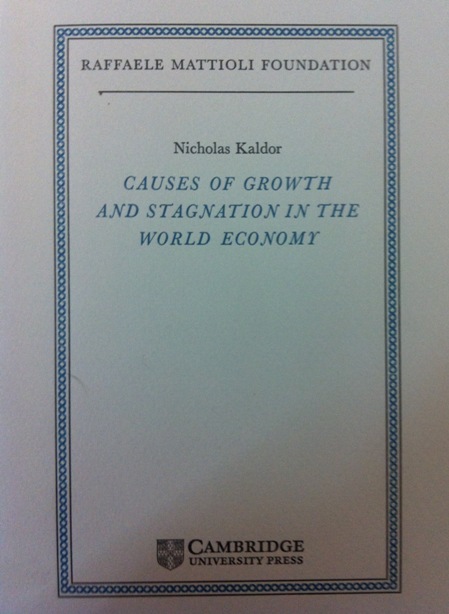
These were most well understood by Nicholas Kaldor (who was touched by genius in Wynne Godley’s words). In the previous post How To Find Nicholas Kaldor’s Works, I recommended his Rafaelle Matiolli Lectures which appeared in a book form titled Causes Of Growth And Stagnation In The World Economy.
The lectures were given in May 1984.
In the fifth and final lecture Kaldor – who understood the shortcomings of Keynesian economics – after having lectured on the causes of growth and stagnation in the world economy, summarizes the situation (page 86):
The fact that OPEC (as a group) is now in deficit on its current balance, and that Britain’s current account surpluses have virtually disappeared while the United States is in a large deficit, makes it a great deal easier for other developed countries to expand their economies than at any time since 1973. But there is still need for coordinated action, at least among the members of the European Community. As the French example has shown, an expansionary budget which is out of line with the fiscal stance of the other main countries of the group, quickly gets a country into serious payments difficulties owing to the resulting imbalance in trade.
But – as is the case now – and even back then policy makers meet and don’t do much ….
The lack of agreement on the fundamental lines of a policy for economic recovery is acutely felt, and the need for it is shown by the increasing frequency of inter-Governmental meetings at various levels: the next world summit meeting in which the heads of the leading western powers all participate is due to take place in London in a few weeks’ time.
If, by some miracle, this summit meeting, unlike all its predecessors, resulted in a constructive programme of recovery, what should its main provisions contain? I should like to end this series of lectures by suggesting the outline of a world-wide agreement on the necessary policies for recovery. The programme could be summed up under four main heads:
In present times, there are very few – in my opinion – who recognizes what needs to be done. Kaldor continues:
1. The first is coordinated fiscal action including a set of consistent balance of payments targets and “full employment” budgets [footnote]. If this does not prove to be politically feasible, it is inevitable that the growth of unemployment will sooner or later force governments to take measures that would make it necessary for them to expand demand without being frustrated by the inevitable balance of payments consequence of expanding their economies relative to their trading partners. This means that there needs to be some form of restriction that would limit the increase in “competitive” imports to some target ratio in relation to exports. Trade liberalisation, which played such an important part in the rapid economic progress during the years of expansion, becomes a serious obstacle to economic recovery in the case of prolonged stagnation due to the inability of countries to achieve a coordinated set of policies. But, given a proper recognition of the problem, that under conditions of unrestricted free trade the actual volume of production and trade may in fact be considerably less than under some system of regulated trade – a system which relates the volume of imports in manufactures from a particular group of countries, such as the members of the EEC, to some mutually agreed ratio to the exports of individual members to the rest of the group – there is no reason why full employment should not be restored through policies of expansion, preferably directed by the expansion of State investment. This coordinated action by all countries, instead of isolated actions by each country, is the first and most important requirement of recovery.
Keynesians and others who have come to understand fiscal policy are however too late. A unilateral fiscal expansion by one country will soon lead to balance of payments problems for it with the result that fiscal policy has to give in and become endogenous sooner or later. (Such is the case with India now, for example). So fiscal expansions need to be coordinated with other countries.
Also there is a footnote suggesting how the endogeneity of the budget deficit is commonly misunderstood:
Footnote: At present all countries have fairly large deficits in the general government budget, but these are largely the consequence of the low level of activity. On a “full employment” basis they would show a highly restrictive picture – they would show surpluses and not deficits. Contrary to appearances, the requirement of stability is for expansionary budgets with lower taxes and higher expenditure, and not further fiscal restriction (as is advocated, for example, by M. de Larosiere of the International Monetary Fund).
Point 2 is about bringing interest rates to as low as possible and this we already have in the present crisis. Point 3 is about stabilization commodity prices and point 4 about the problem of inflation which was more troublesome in the past due to trade unions’ bargaining.
Point 1 is the most important and relevant to the current scenario. Over the years, credit-led growth led to a boom which finally went bust but leaving the world with more “global imbalances”. Economists and politicians wish to resolve the crisis without giving up the doctrine of free trade. At least there is a pressure from the developed world to maintain status quo in spite of resistance from the developing world. As a recent article Protectionism Alert from The Economist recognizes, there is a tendency to move toward more protectionism in practice however which the magazine wishes to alert to the world – so that it is noted and steps taken beforehand to prevent it and free trade is pushed even more.
It should be noted that Kaldor’s plan is more than “coordinated fiscal expansion”. It is also about managing trade instead of relying on market forces. As argued by his “New Cambridge” colleagues, and stated by Kaldor, this will not lead to a decrease in world trade but actually an increase because of higher national output and income!
The first head of the programme is indeed what the world needs at the moment.
One of the listeners of his lectures was Mario Monti! More interestingly, Monti has a question to ask on this plan of Kaldor.
The only truly exogenous factor is whatever exists at a given moment of time, as a heritage of the past.
– Nicholas Kaldor, 1985
That’s my favourite all time quote.
I got myself Kaldor’s lecture series Raffaele Mattioli Lectures in a book titled Causes Of Growth And Stagnation In The World Economy today.
Cover picture taken from my iPhone:
It has Kaldor’s biography by the one and only one Anthony Thirlwall (which is also available separately as a book but reproduced in this book) and a bibliography of Nicholas Kaldor compiled by Ferdinando Targetti.
Another biography is by John E. King, titled Nicholas Kaldor. It also has a lot of articles by Kaldor in the references section and is an excellent book.
Targetti has also written a biography – published in 1992 [which I just ordered on amazon.com!]
Luigi Pasinetti has a small biography of Kaldor in Keynes And The Cambridge Keynesians: A Revolution In Economics To Be Accomplished.
Of course – if you are highly interested in Monetary Economics – you simply shouldn’t miss The Scourge Of Monetarism.
Let us think of a closed economy. Assuming – every year the government runs a budget deficit – a careless analysis would imply the public debt keeps rising relative to gdp.
Without going into derivation – which you can find in other sources – it can be shown that if there is a growth rate of g, the public debt converges to
GD/Y = (PDEF/Y)/(g – r)
where GD is the government debt, Y – the national income, PDEF – the primary government deficit (government expenditure excluding interest payments less tax revenues) and g and r are the nominal growth rates and the interest rate respectively.
Several things. The above assumes – implicitly – that DEF is a constant percent of GDP (Y). Second, it neglects the fact that interest income is also income to bond holders which leads to more consumption. Third, less importantly, it ignores taxes on interest income. The first one is important. There is an implicit assumption of the exogeneity of the budget deficit and the above expression has nothing to say about the private sector’s propensity to save, consume etc.
The above expression has been derived using the assumption that g > r and summing a series. For the opposite case, the series used to derive it diverges. [For example, the equation
1 + x + x2 + x3 + … = 1/(1 – x)
is valid only if x < 1. For x > 1, the left hand side diverges and not negative as the formula implies!]
This has led authors to argue that if the growth rate is higher than the average interest rate paid on government debt, then the public debt doesn’t rise forever.
This intuition is not so right – although there is an element of truth in it but needs to be used extremely carefully.
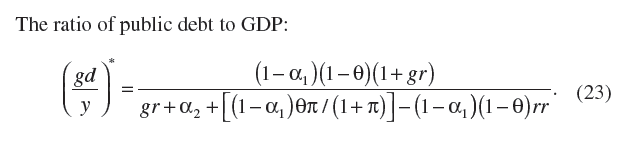
Wynne Godley and Marc Lavoie [1] (but also [2] – which I haven’t managed to get hold of) show what this “stock-flow norm” converges asymptotically in the case of a very simple model of a closed economy – even when the government is not targeting a primary surplus in the budget. The following are from their paper and the lower case is used to denote real variables instead of nominal:
In the above gd is the real government debt, y is the real national income, α1 is the propensity of households to consume out of disposable income, α2 is the propensity to consume out of wealth, gr is the growth rate of output, rr is the real interest rate, π is the rate of inflation and θ is the tax rate.
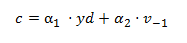
The assumed consumption function is:
where c is real consumption, yd is household real disposable income, and v is real household wealth.
This expression gives some intuition. The growth rate can be quite less than the interest rate and yet the public debt can be bounded. This is because bond interest payments by the government is income for bond holders. More importantly, the denominator contains α2 which significantly brings the (public debt/gdp) ratio down (compared to the case where α2 is zero).
Looking at the model and how the variables change, one can conclude that the government needn’t pursue a policy of targeting a primary surplus, contrary to the intuition neoclassical economists obtain by doing debt sustainability analysis. The budget may reach a primary surplus automatically as a result of higher taxes due to higher activity.
Also, there is no condition “g > r”.
One may wonder what value the parameter α2 has for various economies. According to Lance Taylor – a reviewer of Wynne Godley’s work [3] – the value could be 0.04 or 4% from econometric studies but he does notice the tendency of G&L to choose a higher value in pedagogic examples.
In my opinion it is higher. I think it’s a good challenge to try to show this empirically. This may be true because (abstracting out the effect of the external sector, the public debt ratio is better explained and also that a high α2 implies a quick response to a fiscal expansion – which is true.
One should be highly careful about debt sustainability analysis. For the case of an open economy, while it is true that a debtor nation can be a debtor forever under some assumptions, achieving a faster growth in a world of free trade can lead to stock/flow ratios rising forever instead of converging. Which is to say that nations are balance-of-payments constrained.
References
Wynne Godley and Marc Lavoie, Fiscal Policy In A Stock-Flow Consistent Model, p 79, Journal of Post Keynesian Economics / Fall 2007, Vol. 30, No. 1. Draft version available at http://www.levyinstitute.org/publications/?docid=911
Wynne Godley and Bob Rowthorn, Appendix; The Dynamics Of Public Sector Deficit And Debt, in J. Michie and J. Grieve Smith (eds), Unemployment in Europe (London: Academic Press), pp. 199-206.
Lance Taylor, A Foxy Hedgehog: Wynne Godley And Macroeconomic Modelling, Camb. J. Econ. (2008) 32 (4):639-663.
He has a nice way of giving a short description of pricing in the G&L models:
In my view, the stock-flow and the demand driven (and I should say, the fact that price dynamics is orthogonal to the income flow determination structure) is the essential characteristic of this approach.
—
Also, Simon Wren-Lewis (from Oxford) has a new blog post on the sectoral balances approach – Sector Financial Balances As A Diagnostic Check, where he mentions Martin Wolf’s recent post on Wynne Godley’s approach. He (Wren-Lewis) has been admitting recently that DSGE models are not useful.
In the comments section Simon Wren-Lewis has this to say:
Martin Wolf sent me the following comment, which I am sure others will also find interesting:
“I used sectoral financial balances before the crisis, following Wynne. I argued that what was going on in the US external and household sectors were evidently unsustainable. This allowed me to argue that when the latter’s deficits were eliminated, there would be a recession and a huge fiscal deficit. What I had not expected was that the turnaround in the household sector would trigger a meltdown of the financial system.
“This makes it clear that one has to link the flow sectoral balances to the balance sheets in the economy. In this case, my mistake was not looking closely enough at the balance sheet of the financial sector. Good macroeconomic analysis has to examine the flows and stock meticulously and seek to assess whether the behaviour we see is sustainable. The assumption that private agents cannot make huge mistakes about the sustainability of what they are doing is, in my view, the biggest mistake in macroeconomics.”
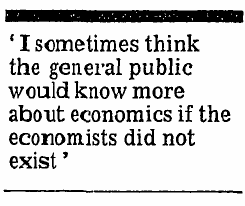
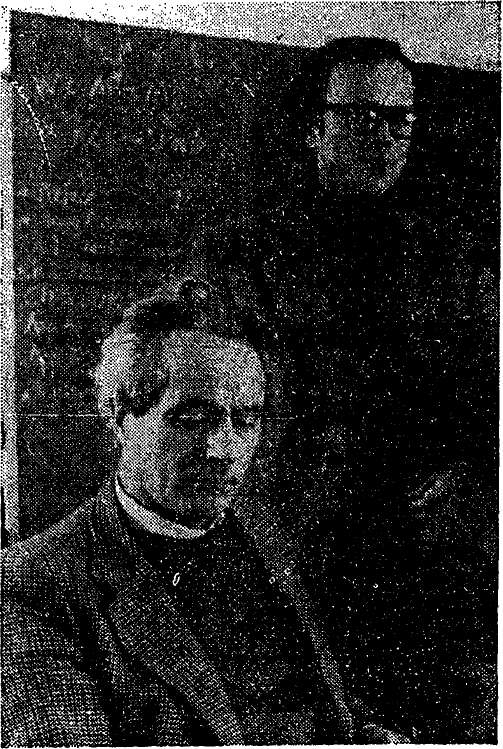
Back to DSGE models. I think they are totally useless. I like this quote by Francis Cripps from an article in The Guardian from 27 Feb 1979: Economists With A Mission:
Martin Wolf who usually writes good articles on macroeconomic developments wrote recently on the sectoral balances approach (which he uses frequently anyway).
… I look at this through the lens of “sectoral financial balances”, an analytical framework learned from the work of the late Wynne Godley. The essential idea is that since income has to equal expenditure for the economy, as a whole, (which is the same things as saying that saving equals investment) so the sums of the difference between income and expenditures of each of the sectors of the economy must also be zero. These differences can also be described as “financial balances”. Thus, if a sector is spending less than its income it must be accumulating (net) claims on other sectors.
The crucial point is that, since sectoral balances must sum to zero, a rise in the deficit of one sector must be matched by an offsetting change in the others. It follows that if the fiscal deficit is increasing, the sum of the surpluses of the other sectors of the economy must be increasing in a precisely offsetting manner.
These are tautologies. But the virtue of this framework is that it forces us to ask what drives what: are, for example, fiscal deficits in the US (or UK) driving the surpluses in other sectors or are the surpluses in the other sectors driving the fiscal deficit? We can obtain answers by examining what behaviour is changing…
and that:
… The idea that the huge fiscal deficits of recent years have been the result of decisions taken by the current administration is nonsense. No fiscal policy changes explain the collapse into massive fiscal deficit between 2007 and 2009, because there was none of any importance. The collapse is explained by the massive shift of the private sector from financial deficit into surplus or, in other words, from boom to bust…
The sectoral balances approach should always be handled with supreme care. There are causalities running in all directions and one needs to ask what brings them to equivalence, what the value of policy instruments are, how is output changing etc.
Although the three balances must always sum to exactly zero, no single balance is more a residual than either of the other two. Each balance has a life of its own, and it is the level of real output that, with minor qualifications, brings about their equivalence. Underlying the main conclusions of our reports is an econometric model in which exports, imports, taxes, and private expenditure are determined as functions of such things as world trade, relative prices, tax rates, and flows of net lending to the private sector. However, neither the knowledge that this is the case nor the perusal of any list of econometric equations will, on its own, impart any intuition as to why output moved as it did over any set period.
It is well known to students of the National Accounts that the surplus of private disposable income over expenditure is equal to the government balance (written as a deficit) plus the current balance of payments (written as a surplus). While these balances are related to one another by a system of accounting identities, each has, to some extent, a life of its own that is reconciled with the other two via the aggregate income flow. The way the balances evolve provides a useful armature around which to organise a narrative account of economic developments, because any one of them is necessarily implied by the other two. Furthermore, the balances may give an early warning that unsustainable processes are taking place, for any high or rising balance implies a change in public, private, or foreign debts, which cannot grow without limit relative to income.
Wynne Godley with his CEPG partner Francis Cripps (from Cambridge Group Sings The Blues, The Guardian, 17 April 1980)
In my previous post, I had the following questions:
Can government expenditure be greater than 100% of gdp?
Can Gross Fixed Capital Formation of an economy as a whole be negative?
The answer to both is yes. Commenters guessed the right answer and provided the example I was looking for (except the fourth below).
Here are examples to illustrate:
Government Expenditure
Open Economy: Imagine a small economy with a gdp of $1bn equivalent (easier to visualize than the United States with a gdp of $15tn having government expenditure greater than 100% of gdp). The government in one accounting period purchases weapons from abroad worth $2bn (maybe by sale of reserve assets or by increasing liabilities: irrelevant).
Closed Economy: Imagine if the government makes large transfers to households who are reducing spending drastically due to increasing uncertainties. They may eventually spend, but that’s eventually. For the accounting period, government expenditure can be large in principle than gdp. Remember, the p in gdp is for product(ion) and the standard formula “GDP = C + I + G” assumes that the government expenditure is for purchase of output and is not making transfers.
Gross Fixed Capital Formation
Open Economy: It’s a small economy with the private sector having few firms selling aircrafts abroad. During one period (such as a quarter), firms sell a lot of aircrafts – produced earlier – to the rest of the world and this makes the gross fixed capital formation negative.
Closed Economy: A bit more implausible than the above there examples but at least mathematically possible and that was what the question was. The example is firms selling huge amount of used cars to households. For households this is consumption and not capital formation. For firms, it is negative capital formation because cars used by firms is used in the production process and is counted as their fixed capital.
Of course, in the examples I ignore consequences (positive or negative) that may happen later.
Recently CNBC asked Paul Krugman to argue against government spending which provoked Krugman to write a blog post Zombies On CNBC.
Krugman is asked – how high can government expenditure go – 100%?
Okay two theoretical questions which are purely theoretical – nothing much to do with the discussion above.
Can government expenditure be greater than 100% of gdp?
Economists use the phrase net investment to describe investment net of consumption of fixed capital (“depreciation”). This can go negative if the consumption of fixed capital is higher than gross investment. This happened in the United States in 2009 – for example because of the deflationary environment. The System of National Accounts uses the phrase “gross fixed capital formation” and in quarterly gdp news release you see this phrase being used than investment. Can this go negative for an economy as a whole?
The fact that I have asked the two questions means the answer is likely yes.
So how?
Comments welcome – although I do not publish them.
Earlier this year Paul Volcker said that “Europe is at an Alexander Hamilton moment”. Barry Eichengreen – who sometimes writes nicely – wrote this today in an article titled Europe’s Divided Visionaries:
… One strategy assumes that Europe desperately needs the policies of this deeper union now. It cannot wait to inject capital into the banks. It must take immediate steps toward debt mutualization. It needs either the ECB or an expanded European Stability Mechanism to purchase distressed governments’ bonds today.
Over time, according to this view, Europe could build the institutions needed to complement these policies. It could create a single bank supervisor, enhance the European Commission’s powers, or create a European Treasury. Likewise, it could strengthen the European Parliament. But building institutions takes time, which is in dangerously short supply, given the risk of bank runs, sovereign-debt crises, and the collapse of the single currency. That is why the new policies must come first.
The other view is that to proceed with the new policies before the new institutions are in place would be reckless. Mutualizing debts before European institutions have a veto over fiscal policies would only encourage more reckless behavior by national governments. Proceeding with capital injections before the single supervisor is in place would only encourage more risk taking…
Bloomberg investigates if there is an Alexander Hamilton in Europe: (edit: video no longer available.)
In this video which has a lot of discussion on the European crisis, Krugman says that the ideal solution for the Euro Area will be federal but doesn’t hope to see it in his lifetime unless advances in medical sciences is made which will make him live longer. (Time: 1:22:36)
click to watch the video on YouTube
He rightly points that a degree of trust required to do so.
This is lacking and someone really needs to build this!
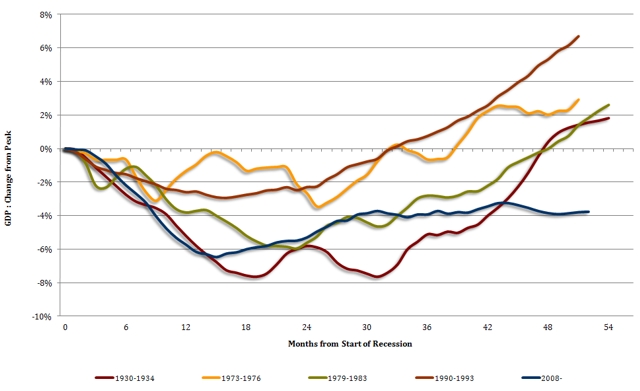
Also, from NIESR (link updated to one from July 2014, as the original link doesn’t work), the pace of the recovery compared in various deflationary episodes in the UK’s history: