Author Archives: V. Ramanan

Noam Chomsky On Neoliberalism

I have been looking at Noam Chomsky’s views on neoliberalism and I found a documentary Neo-Liberalism Ensnares Democracy by Richard Brouillette which I thought I should mention.

Noam Chomsky on Neoliberalism

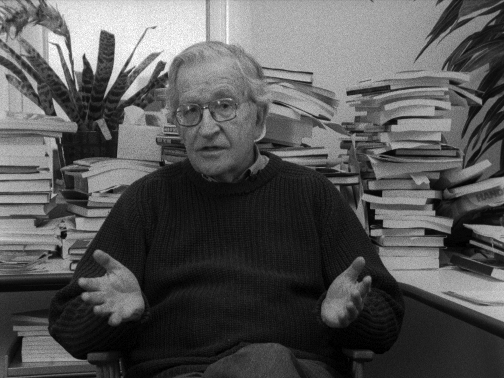
Noam Chomsky in ‘Neo-Liberalism Ensnares Democracy’
Picture from the documentary’s site.

Chomsky argues how neoliberalism is not really “neo” and that it is what created the third world. He goes on to argue how this happens: In his language, free capital flows creates a virtual parliament of investors and lenders who carry out moment by moment referendum on government policies. Governments hence face a dual constituency and that neoliberalism is power-play.

The documentary length is 160 minutes (2h 40m). Chomsky appears at 23:06, 57:20, 1:10:22, 1:46:38, and 2:33:18.

TARGET2 Balances And “QE Recycling”

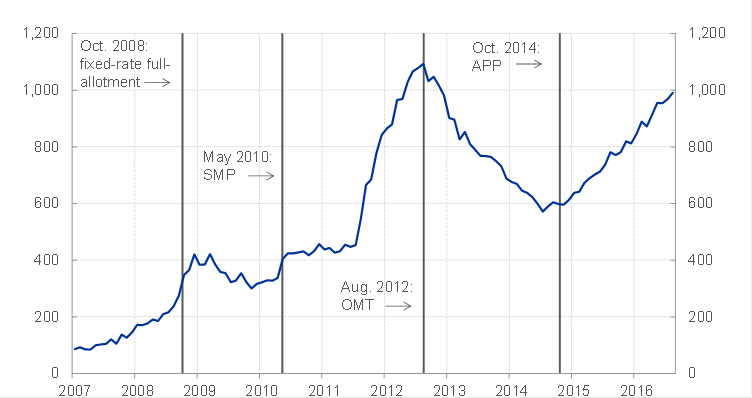
During the crisis which started in 2007 and especially around mid-2011, TARGET2 liabilities of some National Central Banks (NCBs) of the Eurosystem increased drastically (chart below) and led to heated discussion among economists and became a political subject.

Recently, the (im)balance has been increasing again but it seems that it’s mostly because of what some call QE recycling.

Peter Praet, Member of the Executive Board of the ECB explained this in his speech yesterday.

First the chart from his talk:

target2-balance

Sum of all positive TARGET2 balances. Source: ECB.

As Praet shows using T-accounts, what happens if Banco de España purchases securities from a German counterparty, Bundesbank’s TARGET2 assets—claims on the rest of the Eurosystem—will rise and so will Banco de España’s TARGET2 liabilities to the rest of the Eurosystem.

Once the German counterparty sells the securities to Banco de España, it will try to find the nearest substitute which may not be a Spanish security. So this is nothing to be worried about unlike earlier where TARGET2 balances were symptomatic of capital flight from some countries threatening financial meltdown.

Of course one has to be careful. Not all the recent rise may be attributed to the QE effect. But at the same time this analysis should throw some light on the topic.

Physics Envy

Economists have a terrible physics envy.

In 1954, Chen Ning Yang and Robert Mills formulated what is now called “Yang-Mills theory” or “gauge theory” in Physics. It took a while for their work to be used as an empirical theory. The Electroweak Theory was discovered in 1967 and Quantum Chromodynamics around early 70s.

The point of the above is that sometimes theory is ahead of experiments in Physics. Around the 80s, some (and not all) theoretical physicists started working on string theory.

But if you had asked Mr Yang and Mr Mills what the usefulness of their work was in 1954, their answer wouldn’t have looked satisfactory. In the same way, string theory is something which possibly is ahead of its time but just that the connection to experiments seems longer. It is however fashionable to see people writing about string theory and debunking it as pseudoscience without any knowledge of it whatsoever.

Case: Paul Romer’s article The Trouble With Macroeconomics. The abstract says:

In the last three decades, the methods and conclusions of macroeconomics have deteriorated to the point that much of the work in this area no longer qualifies as scientific research. The treatment of identification in macroeconomic models is no more credible than in the first generation large Keynesian models, and is worse because it is far more opaque. On simple questions of fact, such as whether the Fed can influence the real fed funds rate, the answers verge on the absurd. The evolution of macroeconomics mirrors developments in string theory from physics, which suggests that they are examples of a general failure mode of for fields of science that rely on mathematical theory in which facts can end up being subordinated to the theoretical preferences of revered leaders. The larger concern is that macroeconomic pseudoscience is undermining the norms of science throughout economics. If so, all of the policy domains that economics touches could lose the accumulation of useful knowledge that characteristic of true science, the greatest human invention.

Although the new consensus macroconomics is all trash, there are three things wrong with this:

  1. String theory is not pseudoscience. It is a perfectly respectable theory. It comes tantalizingly close to describing the physical world with a few principles. It produces Einstein’s theory of general relativity as a “low-energy approximation” and some solutions of it look very much like the real world, though not exactly. It however has many problems. That it works only in 11 space-time dimensions (!!) isn’t a problem. This is solved by what is known as “compactification”. The real trouble is that it has many solutions and string theorists are stuck at how to proceed. Otherwise its methodology are highly scientific and are being applied in increasing our understanding of quantum field theory which describes fundamental particles and their interactions.
  2. Romer’s equivalence to string theory gives the new consensus macroeconomics some respect. This is totally undeserved.
  3. The new consensus macroeconomics is not the only answer. Keynes made a fundamental breakthrough in macroeconomics in the 1930s and his colleagues and followers have improved upon his work greatly. So there’s a Cambridge revolution. The new consensus however is based on a bastardized version of Keynes: it’s Keynesian only in the name. Otherwise it has everything else Keynes so passionately debunked.

Even outside Cambridge, such as the work of Morris Copeland – his flow of funds approach and the work done by Tobin and subsequently used by Post-Keynesians have contributed to a much better understanding of economic dynamics.

Anyway, economists seem to have a physics envy and should stop comparisons to it. I find it amusing that economists have made a mess of their subject and struggle with basic flow of funds concepts venturing into critiquing string theory.

Paul Krugman Is More Orthodox Than Joseph Stiglitz

… There is also the problem of the relative levels of different types of earned income. Here we have the famous marginal productivity theory. In perfect competition an employer is supposed to take on such a number of men that the money value of the marginal product to him, taking account of the price of his output and the cost of his plant, is equal to the money wage he has to pay. Then the real wage of each type of labor is believed to measure its marginal product to society. The salary of a professor of economics measures his contribution to society and the wage of a garbage collector measures his contribution. Of course, this is a very comforting doctrine for professors of economics, but I fear that once more the argument is circular. There is not any measure of marginal products except the wages themselves. In short, we have not got a theory of distribution.

We have nothing to say on the subject which above all others occupies the minds of the people whom economics is supposed to enlighten.

[italics in original]

– Joan Robinson, The Second Crisis Of Economic Theory, 1972. Link

There’s an article at Evonomics by Joseph Stiglitz, which is an excerpt from a chapter from a book. Stiglitz has denounced the marginal productivity theory. He says:

The trickle-down notion— along with its theoretical justification, marginal productivity theory— needs urgent rethinking. That theory attempts both to explain inequality— why it occurs— and to justify it— why it would be beneficial for the economy as a whole. This essay looks critically at both claims. It argues in favour of alternative explanations of inequality, with particular reference to the theory of rent-seeking and to the influence of institutional and political factors, which have shaped labour markets and patterns of remuneration. And it shows that, far from being either necessary or good for economic growth, excessive inequality tends to lead to weaker economic performance. In light of this, it argues for a range of policies that would increase both equity and economic well-being.

… Neoclassical economists developed the marginal productivity theory, which argued that compensation more broadly reflected different individuals’ contributions to society.

It reminds me of the debate between Paul Krugman and Thomas Palley some time ago. Paul Krugman completely denied all this. In his blog post at his blog for The New York Times, Krugman said in April 2014:

But doesn’t that show that conventional economics is indeed capable of accommodating big concerns about inequality? You fairly often find heterodox economists insisting that to accept the idea that capital and labor are paid their marginal products, even as a working hypothesis to be modified when you address things like executive pay, is to accept that high inequality is morally justified. But that’s obviously not the case: there are plenty of economists who are willing to use marginal-product models (as gadgets, not as fundamental truth) who don’t at all accept the sanctity of the market distribution of income.

So you have two mainstream economists: Paul Krugman defending orthodoxy and Joseph Stiglitz denouncing the marginal productivity theory.

More Liquidity?

The holy grail of macroeconomics is to integrate the real and monetary sides of economics. One needs a good balance between the two: one shouldn’t be too much on one side.

In a recent article, Monetary Policy in a Post-Crisis World: Beyond the Taylor Rule for INET, Perry Mehrling correctly identifies the flow of funds approach and Morris Copeland. He says:

Maybe time to look back at Copeland, reconstructing his money flow approach for the modern world? That’s where I’m placing my bet.

Although, his article seems right in lots of parts, it seems to identity purely monetary factors in identifying solutions to the problems of this world. Mehrling says:

From a money flow perspective, there are logically only three sources of funds for agents who find themselves in deficit on the goods and services account. They can dishoard (spend money balances), borrow, or sell some asset. In the argument sketched above, I have suggested that post-war institutional developments have followed a course emphasizing first dishoarding, then borrowing, and then selling, i.e. monetary liquidity, then funding liquidity, then market liquidity. All three are now in play, but the new one is market liquidity. That’s the one that broke in the global financial crisis, and that’s the one we need to fix in order to get the system working again.

While the first part of the argument is correct, I am not sure how fixing “liquidity” is needed to get the system working again. In my reading of Mehrling, he comes across as someone who stresses too much on the monetary side of things and this is another example of it. What do we need to do to fix liquidity exactly? More central bank asset purchases?

The solution to the problems of the world can come about if there is a coordinated fiscal expansion combined with balance of payments targets, to say the least. I am not sure how liquidity fits into this. After the financial crisis which started in 2007, this may have been the case: what was needed was providing liquidity to the financial system. In the U.S., Euro Area and the rest of the world, central banks have helped to provide liquidity to ease financial conditions. But right now—at least in the advanced world—interest rates are low and just lowering them further won’t help increase production. And the same with “liquidity”.

Hence I am unclear about Merhling’s solutions. It’s monetary hippyness.

Link

https://criticalfinance.org/2016/09/08/consistent-modelling-and-inconsistent-terminology/

Jo Michell has a nice reply to Simon-Wren Lewis’ critique of stock-flow coherent models.

[the title of this post is the link]

Look for links to models around the world which use the SFC methodology.

Mario Draghi On Germany

This mini-post is more intended for my own reference, so that I remember this and don’t forget.

After all these years, Mario Draghi has finally said it. After repeatedly insisting Euro Area governments do “structural reforms”, Draghi has conceded that Germany should do a fiscal expansion.

Post-Keynesians have always maintained that “surplus” countries put a burden on “deficit” countries. Since Germany has a high positive current account balance, and sells its product abroad, it isn’t unfair to ask its government to expand domestic demand via fiscal policy and reduce imbalances.

True Circular And Cumulative Causation

In my opinion, what Kaldor calls the principle of circular and cumulative causation (originally ascribed to Gunnar Myrdal) is as much an important principle in economics as is the Keynesian principle of effective demand. The former is built on top of the latter and so we could just have one most important Keynesian principle.

In an article Foundations And Implications Of Free Trade Theory, written in 📚 Unemployment In Western Countries – Proceedings Of A Conference Held By The International Economics Association At Bischenberg, France, Kaldor says:

Owing to increasing returns in processing activities (in manufactures) success breeds further success and failure begets more failure. Another Swedish economist, Gunnar Myrdal called this’the principle of circular and cumulative causation’.

It is as a result of this that free trade in the field of manfactured goods led to the concentration of manufacturing production in certain areas – to a ‘polarization process’ which inhibits the growth of such activities in some areas and concentrates them on others.

In a recent paper titled The debate Over ‘Thirlwall’s Law’: Balance-Of-Payments Constrained Growth Reconsidered, Robert Blecker says:

Another key empirical question is the direction of causality between export growth and capital accumulation: does the former cause the latter (as assumed implicitly in Thirlwall’s Law), or does the latter cause the former (as in some of the newer small-country models)? Perhaps this is a case of truly ‘circular and cumulative causation’, in which investment is required to promote exports and success in exporting in turn induces further investment.

I have always thought—ever since I have read Kaldor—that this is the case. When Kaldor says success creates more success, what he is really saying is that a rise in a success of a nation makes it more competitive and increases its exports and so on.

In Kaldorian models, however, elasticity of imports/exports is taken to be constant. Rise in production leads to a rise in productivity and hence price competitiveness. But there is no way in which there is a causation to non-price competitiveness (propensity to import, or income elasticities).

A more general modeling plus empirical work should actually study the impact on non-price competitiveness. Personally, my guess is that only this will explain the vast divergence in nations’ fortunes, empirically speaking. Without it, won’t be sufficient. Interestingly, I believe the dynamics could be complex and rich and even lead to convergence in some cases, although will remain just a theoretical curiosity.
DSGE, SFC And Behaviour

This is a continuation of my post Simon Wren-Lewis On Wynne Godley’s Models. I was comparing stock-flow coherent models to DSGE models implicitly (didn’t mention the ‘DSGE’).

One of the things I spoke of was behaviour: firms deciding how much to produce. In stock-flow consistent models, it is decided by trends in sales. So if entrepreneurs see a fall in their inventory-to-sales ratio, they’ll produce more typically. This can be made more accurate. See Wynne Godley and Marc Lavoie’s text Monetary Economics for more details.

Here I want to concentrate on models such as DSGE or any other model used by institutions such as the UK Treasury for the case of production. In these models, there is a production function describing how much firms will produce. This is incorrect to begin with. It says nothing about behaviour. If households start borrowing a lot, in DSGE models, producers are still producing the same because production is governed by the production function. In stock-flow consistent models, simple modeling assumptions about how much firms produce are far superior. So in this case, in SFC, more borrowing leads to more sales and a change in sales trends, inventory/sales ratio and hence affecting how much will be produced.

The DSGE production function is thus inconsistent with the Keynesian principle of effective demand. DSGE is not even Keynesian. It’s thus ridiculous how economists defending DSGE models and its ancestors accuse SFC modelers of not paying attention to behaviour.