Yearly Archives: 2026

FT Talks Of The Bancor

Recently Financial Times had an article A Keynesian Solution to Global Imbalances (‼) by Daire Macfedden.

Martin Wolf at FT also discussed global imbalances in Why Global Imbalances Matter with the intro text:

They lie at the intersection of almost everything that matters in geoeconomics and geopolitics.

This is welcome, but you need to keep in mind that Bancor is not a complete solution.

In stock-flow consistent models, you can see that the most important things governing the world economy are fiscal policy and international trade. Hence, you get expressions such as

G+X θ+μ

as a first approximation of GDP, where the variables are, respectively: government expenditure, exports, the tax rate, and the propensity to import.

John Maynard Keynes:

  • was right about global imbalances (even if the terminology is more recent),
  • underestimated the importance of trade,
  • and therefore proposed Bancor—not exactly a complete solution.

The main problem is that we live in an economic order with free trade, and deficit countries are constrained from expanding demand because they face balance-of-payments problems, while surplus countries are constrained by an ideology that discourages demand expansion.

Even deficit countries can expand demand until they hit a binding constraint. But the problem is that politicians and the corporations that fund them are often dogmatically opposed to fiscal expansion. So there is a bias toward tight fiscal policy in both surplus and deficit countries.

So, in his plan for Bretton Woods, Keynes proposed Bancor, along with penalties on creditor nations, and also required them to take measures such as:

(a) Measures for the expansion of domestic credit and domestic demand.
(b) The appreciation of its local currency in terms of bancor, or, alternatively, the encouragement of an increase in money rates of earnings.
(c) The reduction of tariffs and other discouragements against imports.
(d) International development loans.

[The Collected Writings of John Maynard Keynes, Volume XXV: Shaping the Post-War World: The Clearing Union, Chapter 1, The Origins of the Clearing Union, 1940–1942]

Now, the Bancor rules work when Bancor balances move outside a certain range. However, Bancor balances are neither the current account balance nor a stock measure such as the net international investment position.

In fact, Bancor balances can be positive even while a country is running large current account deficits and accumulating a large negative net international investment position.

So while the discussion is moving in the right direction, it is important to realise that pundits may downplay the problem in the same way Keynes did, leaving us with a solution that is far less effective than directly targeting measures such as current account balances and the net international investment position.
On Adam Tooze Talking Down Global Imbalances

In his newsletter, Chartbook, in a recent post Chartbook 442: Global imbalances – A new cocktail in old bottles: World Economy April 2026:, Adam Tooze discusses global imbalances but seems dismissive of the problem.

For some, the continuing accumulation of US sovereign liabilities is a worry. It is true that the US Treasury borrows at rates that are higher than for some rich-country sovereigns. But if that is your concern, why start with the balance of payments? If you want to reduce America’s fiscal overhang, issue less debt. In the current moment it is not just American trade policy that is shocking. Never in American history has the country run such a large budget deficit at a time of relatively full employment.

Now that is quite dismissive, especially since the United States is not at full employment. Worse, he comes close to getting it but does not in fact get it: the budget deficit and public debt are large as percent of gdp because of the current account deficits. Having a policy of fiscal contraction would lead to a fall in gdp. Tooze seems to be minimising the causality from the current account balance to budget deficit. Public debt is not itself a problem but reflects the huge negative net international investment position of the United States. Large deficits because the balance of payments situation reduces the expenditure multiplier to bring sufficient taxes in.

From a larger perspective, Tooze offers no solution to all this. Why would he? The purpose of his article is to play down the problem.

Years later, Adam Tooze is going to be writing a mea culpa on how he was wrong on this problem.

The irony is that Adam Tooze is highly influenced by Wynne Godley, who worried about imbalances, and proposed to change the economic order to move toward a system of balanced trade combined with expansionary fiscal policies. In his 2018 book Crashed, Tooze says:

Wynne Godley was a mentor and teacher of a very different kind. Spontaneously warm and generous in spirit, he took me under his cape in my first year at King’s and introduced me, and a group of my contemporaries, to what, at the time, was a highly idiosyncratic brand of economics. In so doing he provided a model of intellectual warmth and vitality. And he confirmed doubts that had been gestating in me about the IS-LM model that was my first great love in economics. Wynne introduced me to the importance of looking “beyond the flows” and insisting on stock-flow consistency in macro models. I don’t think this book, written almost thirty years later, would have been the same without his early influence.


The IMF On Global Imbalances In 2026

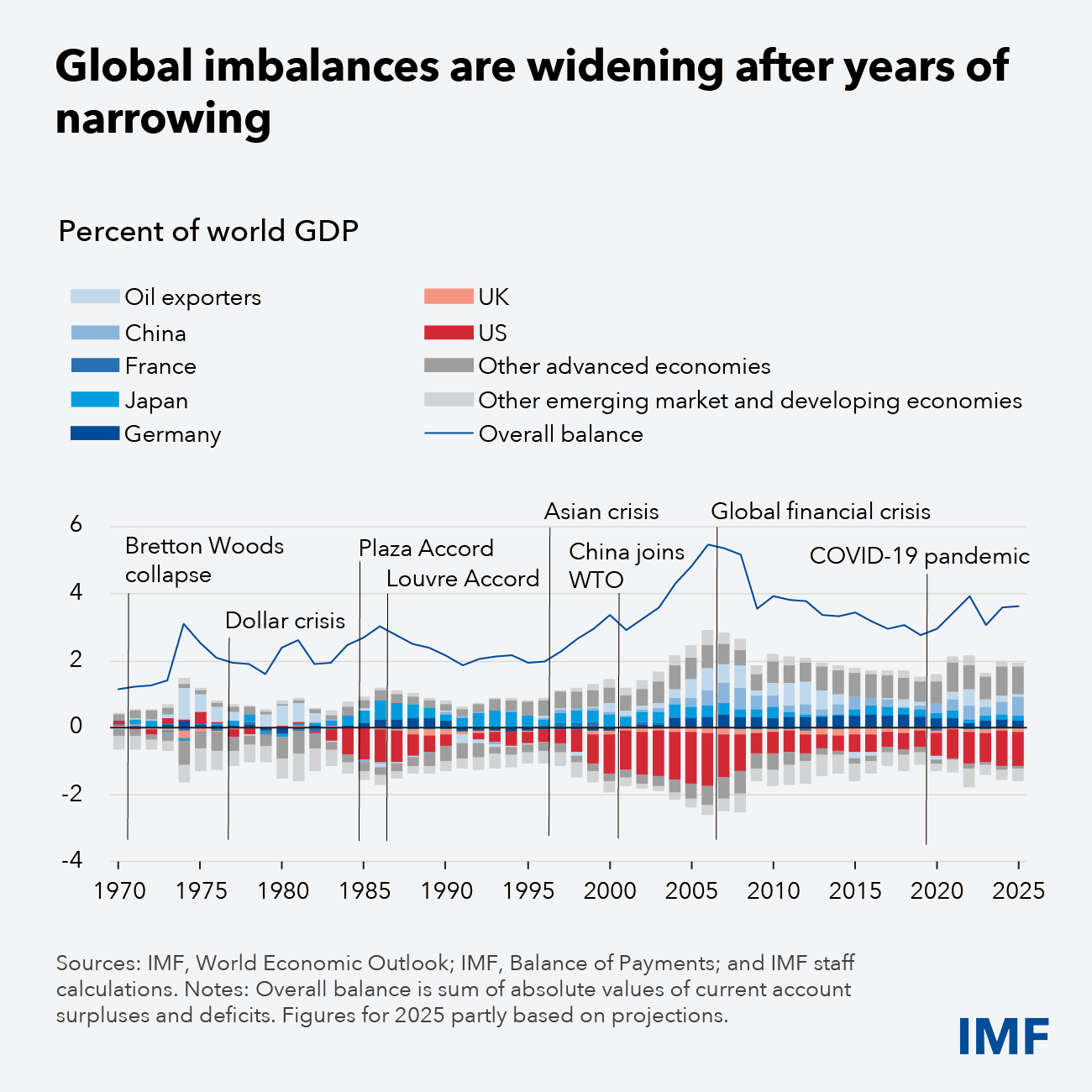
A few days ago, the IMF wrote about global imbalances, with this chart:

Global imbalances in 2026

Source: IMF

The IMF’s analysis uses the identity:

SI = DEF + CAB

where S is private sector saving, I is capital formation (investment), DEF is the government deficit, and CAB is the current account balance.

You can move the government deficit term to the left-hand side, with S and I now denoting the saving and capital formation of the whole country:

S (national) − I (national) = CAB

And just reasoning from the accounting identity, it concludes that, to improve the current account balance, saving has to be raised—and that this should be done via fiscal tightening.

Ugh.

Although it is fascinating that the IMF is at least acknowledging that there is a problem!

However, the IMF’s solution is ridiculous:

This synchronized adjustment would lead to the best outcome for the global economy. The economic drag from US fiscal tightening would be offset by stronger demand from China and Europe. But even if such coordination proves difficult, the best course of action for each country is clear: start addressing domestic imbalances now, regardless of what others do.

The IMF understands that fiscal tightening would slow down the US economy, so it is calling for coordination with China and Europe, which would require them to pursue fiscal expansion. But it is still proposing fiscal tightening even if others do not cooperate, on the assumption that this would pressure them.

There is no guarantee that this would work—it could instead lead to a worldwide recession.

Instead, we should abandon these dogmas and work toward a plan like Keynes’ proposal (without any Bancor), where countries with current account deficits can use import controls and industrial policy, while surplus countries relax import controls and provide assistance to deficit countries. In extreme cases where they fail to rebalance, they should pay penalties to the rest of the world.

Under such a change in the international order, fiscal tightening is not required per se.